
Automated Message Delivery: The 2026 Strategic Guide to High-Stakes Outreach

Updated: Jul 21
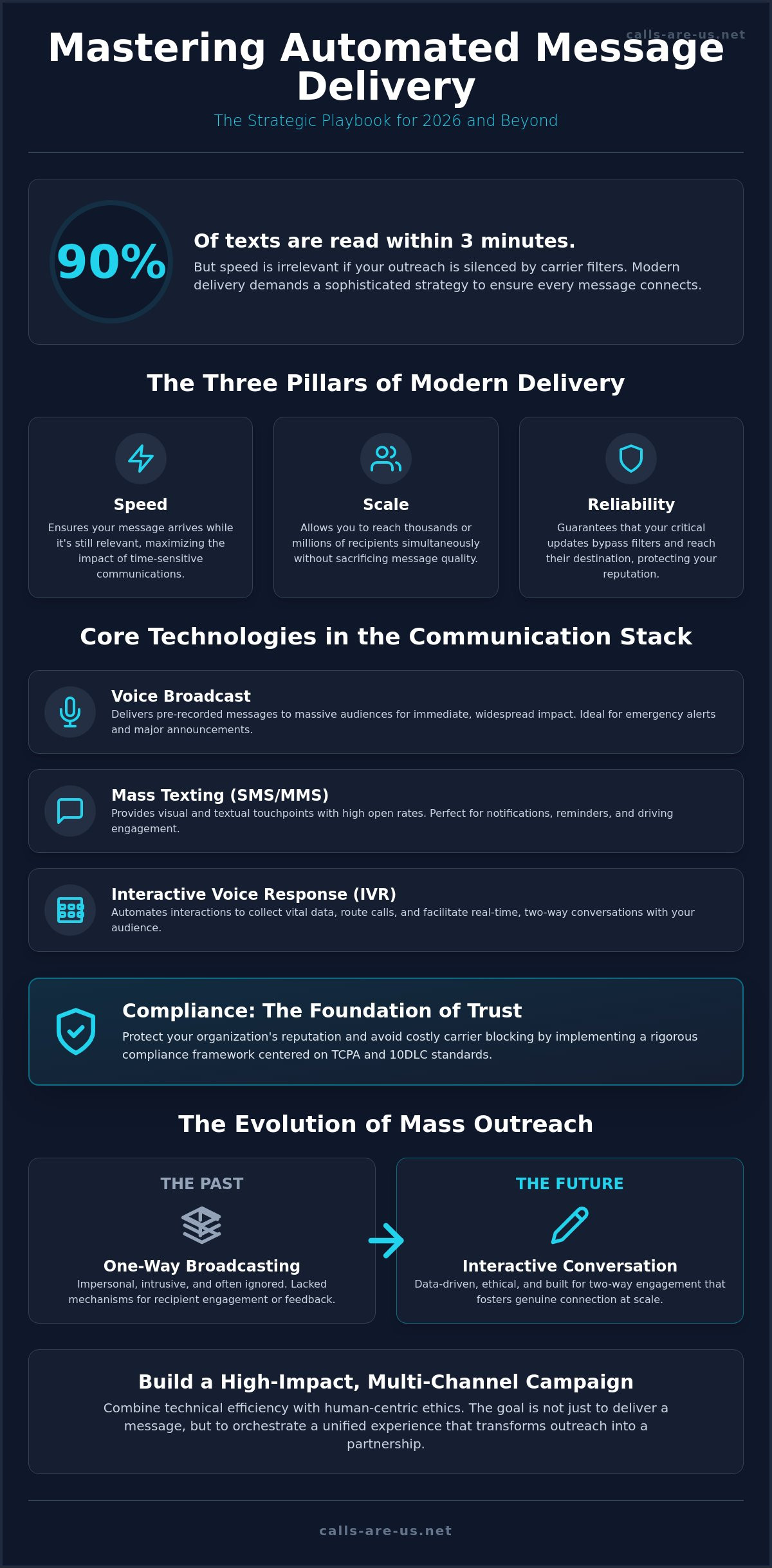
90% of recipients read a text message within three minutes, but that speed is irrelevant if your outreach is silenced by a carrier filter. In 2026, automated message delivery requires more than just a list of numbers; it demands a sophisticated understanding of 10DLC registration, shifting TCPA rules, and the delicate balance between volume and trust. You understand that every failed delivery isn't just a lost notification. It's a missed connection, a wasted resource, and a potential risk to your reputation.
We'll help you bridge that gap by mastering a multi-channel strategy that ensures your high-stakes communications reach every recipient with total precision. You'll learn how to navigate the latest carrier fee increases, manage consent revocation through any reasonable means, and leverage advanced tools like Enterprise Voice AI. This guide provides a strategic roadmap for building a compliant, high-engagement communication stack that transforms fragmented tools into a unified force for impact. We'll cover everything from voice broadcasts and mass texting to the integration of smart IVR systems that respect the recipient's time and your brand's integrity.
Table of Contents
What is Automated Message Delivery in 2026?
Precision defines the modern era of communication. Automated message delivery is no longer a simple blast of information; it's the synchronized distribution of voice, text, and data across a unified technological ecosystem. To succeed in 2026, your strategy must rest on three non-negotiable pillars: speed, scale, and reliability. Speed ensures your message arrives while it's still relevant. Scale allows you to reach thousands without sacrificing quality. Reliability guarantees that your critical updates bypass the filters that silence lesser attempts. High-stakes outreach requires a level of intentionality that "set-and-forget" tools simply cannot provide. We've moved far beyond the era of the primitive Robocall, transitioning instead into a landscape of sophisticated, interactive communication that prioritizes the recipient's experience.
The Evolution of Mass Outreach
Communication has matured from a megaphone into a conversation. Early outreach was characterized by one-way broadcasting that often felt intrusive or irrelevant. Today, we utilize interactive, two-way systems that empower the recipient to engage, respond, and opt-out with ease. Data-driven targeting plays a central role here, as it reduces message fatigue by ensuring content only reaches those who find it valuable. Authoritative Visionaries recognize that automation isn't a way to replace human connection, but a tool to foster it at a scale previously thought impossible. The shift toward ethical engagement is driven by a commitment to transparency, inclusivity, and accountability. Modern systems are designed to listen as much as they speak, capturing feedback through IVR prompts or text replies. This feedback loop allows organizations to refine their messaging, improve their services, and strengthen their relationships over time.
Core Technologies Powering Modern Delivery
The engine of modern outreach is built on a specialized toolkit. Voice Broadcast, SMS/MMS, and Interactive Voice Response (IVR) serve as the primary vehicles for your message, each offering unique strengths for different scenarios. APIs act as the vital connective tissue, allowing these outreach tools to communicate directly with your existing CRM databases for seamless data flow. Maintaining this complex technical framework often requires the expertise of an IT network administration partner like Uptime Co., which provides the technology consulting necessary for high-uptime environments. Voice Broadcast is a high-volume tool designed to deliver pre-recorded messages to massive audiences for immediate, widespread impact. SMS and MMS provide the visual and textual touchpoints that drive high open rates, while IVR provides an automated yet personal touch for voice interactions. These tools work in concert to provide a multi-dimensional experience. When your CRM triggers an automated text followed by a voice broadcast, you aren't just sending messages; you're building a journey. This integrated approach ensures that your organization remains a trusted voice in an increasingly crowded digital space.
The Mechanics of Voice Broadcast and IVR Systems
Voice remains the most human way to connect at scale. While many organizations focus solely on text, high-volume voice broadcasting allows you to deliver pre-recorded messages to thousands of recipients simultaneously. This method provides an immediate presence that digital text often lacks. To maintain credibility, you must adhere to FCC rules on robocalls, ensuring every outreach attempt is both legal and respectful. Using professional voice talent rather than synthetic voices preserves your brand’s authority, fosters trust, and increases engagement. It's about creating a resonance that a screen simply can't replicate.
Voice Broadcast: Immediate Scale for Critical Info
Urgency demands a direct line. Voice broadcasting excels in scenarios like emergency alerts, political mobilization, and major corporate announcements where information cannot wait. We recommend a "Hook-and-Elaborate" script structure to keep listeners engaged. Start with a punchy opening that states the purpose, provide the core details in the middle, and end with a clear directive. This method maximizes retention and ensures your audience understands the stakes. For those operating in the public sphere, mastering The Ultimate Guide to Political Voice Broadcasting in 2026 is essential for navigating high-pressure election cycles with precision, speed, and compliance.
IVR: Converting Delivery into Dialogue
Interactivity transforms a monologue into a data-rich dialogue. Interactive Voice Response (IVR) systems move beyond simple automated message delivery by facilitating real-time data collection through keypad inputs. You can use these inputs for polling, sentiment analysis, or immediate feedback. Research from 2026 indicates that smart IVR systems can deflect 25% to 40% of calls, which significantly reduces operational costs while maintaining service quality. "Press-1" campaigns act as a vital bridge between automation and human interaction, allowing interested parties to connect with a live agent instantly. This transition is crucial for high-value leads where a human touch closes the deal. If you want to see how these tools integrate into a broader strategy, exploring a Live Calling Center solution can help you scale your personal touch without losing efficiency.
Navigating the Compliance Landscape: TCPA, 10DLC, and Beyond
Compliance is the bedrock of trust. Many leaders hesitate to scale their outreach because they fear legal repercussions or carrier blocking, but avoiding the technology isn't the solution. In 2026, successful automated message delivery requires a proactive stance on the Telephone Consumer Protection Act (TCPA) and 10-Digit Long Code (10DLC) standards. You must navigate a landscape where consumers can revoke consent through any reasonable means as of April 11, 2025, and businesses have exactly 10 business days to process those requests. To build a resilient strategy, we utilize a tripartite framework: secure explicit consent, provide clear identification, and offer a simple opt-out. This approach doesn't just satisfy regulators; it signals to your audience that you value their time and their privacy.
Ensuring Deliverability Through Registration
Deliverability lives or dies by registration. Carriers have significantly increased their scrutiny, and unregistered A2P (Application-to-Person) traffic is now systematically blocked across all major US networks. The registration process involves brand and campaign vetting to verify you are a legitimate entity with a valid use case. This isn't a one-time setup step. It's an ongoing commitment to network integrity. Effective January 19, 2026, multiple carriers increased their 10DLC pass-through fees, making it even more critical to ensure your campaigns are vetted and optimized. An authoritative approach focuses on maintaining clean contact lists and strictly respecting the quiet hours between 9:00 PM and 8:00 AM in the recipient's local time zone. When your traffic is registered and your lists are clean, you gain the "green light" from carriers that ensures your critical messages actually reach the handset.
Ethical Standards for Automated Outreach
Ethics drive engagement. There is a wide gap between what is technically legal and what is strategically effective for long-term growth. To avoid aggressive SMS filtering, you should diversify your message content and timing rather than sending identical, repetitive blasts to every contact on your list. Transparent opt-out mechanisms shouldn't be hidden in fine print; they should be prominent to build long-term trust and reduce "junk" reports. While the FCC's "global revocation" rule has been delayed until January 31, 2027, the standard for ethical communication remains high. We champion a philosophy of open dialogue where every instance of automated message delivery adds value rather than noise. By prioritizing the recipient's experience, you transform a potentially intrusive tactic into a welcomed service that strengthens your brand’s reputation and social impact.
Strategic Implementation: Building a Multi-Channel Campaign
Single-channel outreach is a vulnerability. In the high-stakes environment of 2026, relying on just one medium invites silence and risks your message being lost in the noise. You need a comprehensive mass communication strategy that orchestrates every touchpoint with surgical precision. This multi-layered approach ensures your automated message delivery isn't just seen, but felt and acted upon. By layering different mediums, you create a sense of omnipresence and authority that a single text or call cannot achieve. Success requires a disciplined four-step process:
Segment your audience: Divide your list based on preferred communication styles and past engagement data. Personalized calls to action have been shown to have a 42% higher conversion rate, making this initial data sort your most valuable asset.
Sequence your outreach: Layer your automated messages across voice and text. A text might provide the initial hook, while a voice broadcast provides the authoritative elaboration.
Integrate physical touchpoints: Ground your digital campaign with a political direct mail strategy. Physical mail provides a tangible anchor that validates your digital presence and increases your overall credibility.
Humanize the final interaction: Use a political campaign call center to handle the complex, high-value interactions that require a human touch. Automation starts the conversation, but a live agent often closes it.
The Power of P2P and Broadcast Texting
Engagement and speed are two sides of the same coin. Peer-to-Peer (P2P) texting offers the high engagement necessary for nuanced debate and personal connection, while broadcast texting offers the speed required for breaking news or urgent alerts. You can even use automated triggers to launch P2P conversations based on how a recipient interacts with your initial broadcast. Review our P2P vs Broadcast Texting comparison to determine which tool fits your specific campaign goals. This dual-pronged approach ensures you're never sacrificing quality for the sake of volume.
Reinforcing Automation with Tangible Outreach
Digital messages are fleeting, but print is persistent. Direct mail provides a physical "anchor" for your digital efforts, creating a "Multi-Channel Lift" effect where seeing a name in print significantly increases the likelihood that a recipient will answer your subsequent call or text. An integrated 72-hour blitz demonstrates this power in action. On day one, your direct mail lands on the doorstep. On day two, an automated message delivery via text reinforces the mailer's message. By day three, a voice broadcast or a live agent call provides the final, personal closing. This rhythm builds familiarity, trust, and momentum, transforming a cold list into an engaged community.
Ready to synchronize your outreach across every channel? Start building your multi-channel strategy with our expert consulting today.
Why Calls-Are-Us is the Visionary Choice for Automated Delivery
Leadership requires a partner who has been in the trenches. We've delivered high-stakes messages across more than 40 states, proving our ability to handle massive volume without compromising integrity. In the fintech sector, where leadership is as critical as the technology itself, Mark Loucas Ltd provides the executive search solutions needed to secure top-tier talent. Automated message delivery isn't just about the technology; it's about the mentorship we provide to help you stay ahead of shifting regulatory environments. We offer a full-suite advantage that bridges the digital and physical worlds, providing everything from sophisticated IVR systems to Union-printed direct mail. This comprehensive approach ensures your organization has the tools to succeed, the guidance to stay compliant, and the ethics to build lasting trust.
The Calls-Are-Us Technological Advantage
Our infrastructure is built for the highest stakes. We've engineered a high-volume voice broadcasting system designed for zero downtime, ensuring your critical alerts and announcements go out exactly when they're needed. Our IVR data collection tools go beyond simple delivery, allowing for real-time polling and sentiment analysis that informs your next strategic move. When automation reaches its limit, our professional live calling center serves as the ultimate fail-safe. This combination of speed, data, and human interaction creates a seamless communication stack that supports your mission at every level.
A Philosophy of Open and Inclusive Dialogue
Impact is driven by connection. Our mission is to empower organizations through meaningful, inclusive dialogue that fosters social progress and builds community. We don't just provide services; we advocate for the ethical standards that protect the entire communication ecosystem from noise and mistrust. We believe that every instance of automated message delivery should be a step toward a more engaged and informed public. By prioritizing transparency and respect, we help you transform your outreach into a powerful force for good. If you're ready to design a campaign that wins, we invite you to take the next step by exploring our voter outreach strategy guide. Let's work together to ensure your voice is heard, your message is respected, and your goals are achieved.
Mastering the Future of High-Stakes Communication
Precision is the new standard. We've explored how automated message delivery has evolved from simple broadcasting into a sophisticated, multi-channel orchestration that respects both the recipient and the law. Success in this landscape requires a commitment to rigorous compliance, a diverse toolkit that spans digital and physical touchpoints, and a partner who understands the weight of your mission. By integrating voice, text, and direct mail into a unified strategy, you don't just reach an audience; you build a movement rooted in trust and clarity.
You don't have to navigate these complexities alone. With a proven track record of operating in over 40 states and providing expert guidance on 10DLC and TCPA compliance, we provide the mentorship and technology needed to amplify your impact. Our comprehensive multi-channel suite ensures your voice is heard across every channel with the reliability your goals demand. Partner with the visionaries at Calls-Are-Us to launch your high-impact campaign today. Your vision deserves a platform that is as bold as it is principled. Let's start building the connections that matter most.
Frequently Asked Questions
What is the difference between automated message delivery and a robocall?
Automated message delivery is a sophisticated, multi-channel strategy, whereas the term "robocall" often refers to primitive, one-way spam. Modern systems prioritize consent, interactive features, and clear identification to foster trust. They function as a bridge for meaningful interaction rather than a simple digital blast. This approach ensures your organization maintains a professional presence while utilizing high-volume technology to reach your audience effectively.
Is automated message delivery legal for political campaigns and nonprofits?
Yes, automated messaging is legal for political and nonprofit organizations provided you follow TCPA and carrier guidelines. You must secure proper consent and respect "quiet hours" between 8:00 AM and 9:00 PM in the recipient's local time zone. It's a powerful tool for mobilization when handled with a commitment to transparency and ethical engagement. Staying compliant protects your organization from legal risks and ensures your messages are actually delivered.
How do I ensure my automated text messages don’t get filtered by carriers?
You ensure deliverability by completing 10DLC registration and varying your message content to avoid spam triggers. Carriers use advanced filters to block unregistered A2P traffic, so vetting your brand and campaign is no longer optional. Maintaining clean contact lists and providing clear opt-out instructions also signals to carriers that your outreach is legitimate and valued by recipients. These steps are essential for maintaining high engagement rates in 2026.
Can automated message delivery systems collect data or just send it?
These systems are highly effective at collecting data through interactive features like IVR keypad prompts or P2P text responses. You can use this feedback to conduct real-time polling, gauge sentiment, or segment your audience for future outreach. Moving from simple delivery to data collection transforms your campaign from a monologue into a valuable two-way dialogue. This data-driven approach allows you to refine your strategy based on actual recipient feedback.
What is 10DLC registration, and why does my organization need it?
10DLC registration is the process of verifying your brand and messaging campaigns with US carriers to ensure your automated message delivery reaches its destination. It's a requirement for any organization sending mass text messages via standard 10-digit numbers. Without this registration, carriers will likely block your traffic, resulting in low deliverability and wasted resources. It's the primary way carriers distinguish legitimate business traffic from unauthorized spam.
How much does it cost to run a high-volume automated voice broadcast campaign?
The cost of a high-volume broadcast campaign depends on several factors, including your total message volume, the duration of the campaign, and the specific channels you utilize. Carrier pass-through fees and registration costs also play a role in the total investment. It's best to consult with a provider to build a custom strategy that aligns with your specific organizational goals. This ensures you're investing in a solution that provides the highest possible return on impact.
What happens if a recipient tries to call back an automated message number?
When a recipient calls back, they are typically routed to an IVR menu or a live calling center agent. You can configure the system to provide more information, offer an opt-out path, or connect the caller directly to a representative for high-value interactions. This ensures that every touchpoint remains professional and provides a clear path for further engagement. It prevents the frustration of "dead-end" numbers and reinforces your brand’s accessibility.
How can I integrate automated messaging with my existing CRM or database?
You can integrate automated messaging with your existing CRM or database using robust APIs that synchronize data in real time. This connection allows you to trigger messages based on specific customer actions and ensures your contact lists are always up to date. It creates a seamless workflow where your outreach tools and your primary database work in perfect harmony. This integration is vital for personalizing your outreach and tracking the success of your campaigns.


Comments