
Political Advertising Disclosure Rules: Who Must Disclose and How

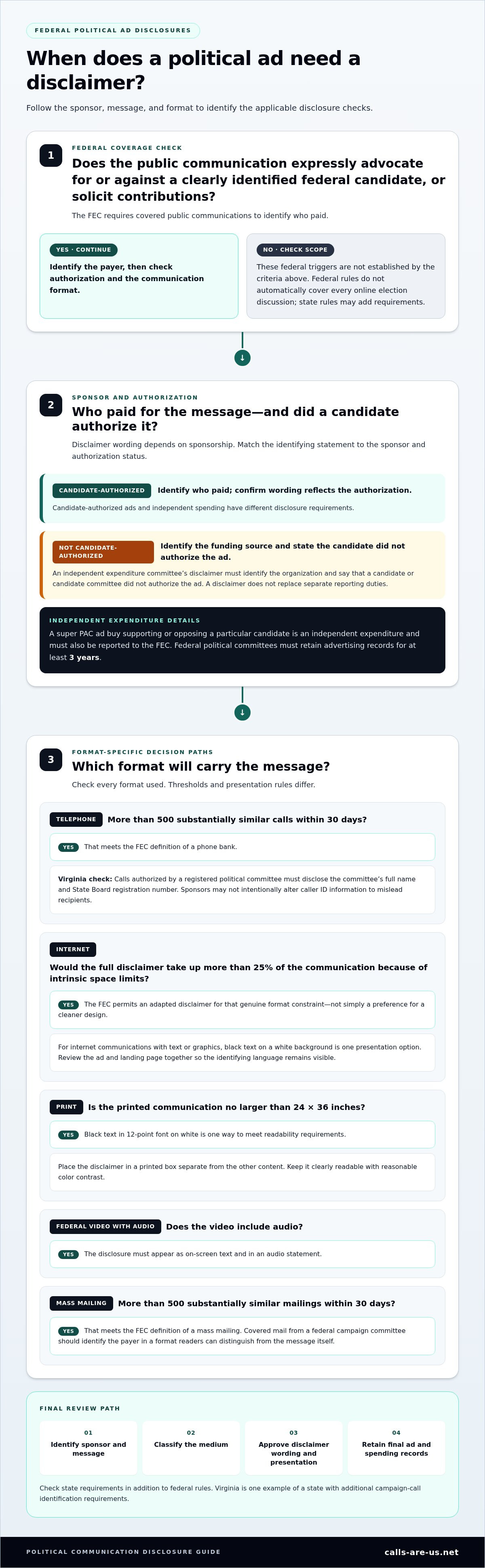
For covered federal public communications that expressly advocate for or against a clearly identified candidate or solicit contributions, the Federal Election Commission (FEC) requires a disclaimer naming who paid. These political advertising disclosure rules depend on the sponsor, message, and format, so one disclaimer does not fit every campaign or group ad.
The Honest Ads Act is part of the debate over online political ad transparency, but it isn’t a substitute for understanding the rules that apply to an ad now. The bill was most recently introduced in the Senate in May 2019. Whether you’re planning campaign outreach or reviewing an ad, the key is knowing who must disclose, what the disclaimer needs to say, and how the medium affects its presentation.
This guide explains federal disclaimer requirements, how candidate-authorized ads differ from independent spending, and how state rules may add requirements. It also outlines possible penalties for violations, so you can make informed decisions and communicate transparently with voters.
Table of Contents
Disclaimer requirements for campaign committees and other groups
Disclosure duties depend on who sponsors a message, what it says, and how it reaches voters. Federal requirements also cover certain campaign calls, emails, and internet ads, while state rules may require additional identification details.
For a concise overview of federal disclaimer requirements across communication formats, watch this FEC video:
Telephone Campaign Call Identification
A campaign-call disclosure identifies the sponsor behind a covered telephone communication. Under the Federal Election Commission’s definition, a phone bank is more than 500 substantially similar calls within 30 days. Virginia campaign telephone calls authorized by a registered political committee must disclose the committee’s full name and State Board registration number. Sponsors in Virginia also may not intentionally alter caller identification information to mislead recipients about who is calling.
Virginia defines an automatic dialing-announcing device by reference to § 59.1-518.1. For compliance, counsel can map each planned call type to its sponsor, authorization status, and required spoken or displayed identification before distribution. Keep the approved script with the campaign’s communication records.
Disclaimer Wording and Prominence
A disclaimer is a clear statement identifying who paid for, or authorized, a political communication. Federal rules require identifying information on covered public communications, and the wording depends on sponsorship. For an internet public communication, the Federal Election Commission permits an adapted disclaimer if space constraints intrinsic to the product or medium mean the full disclaimer would occupy more than 25 percent of the communication.
Prominence matters: the identifying statement should be noticeable and legible in its format. For internet communications with text or graphics, black text on a white background is one presentation option. Review the final creative, landing page, and sponsor language together, then keep the approved version and distribution details.
Disclosures for Group-Funded Ads
A group-funded ad is a political message paid for by an organization or independent group rather than a candidate’s committee. An independent expenditure committee’s disclaimer must identify the organization and state that a candidate or candidate committee did not authorize the ad. Political messages not authorized by a candidate should make clear that the candidate did not approve them and identify their funding source.
Corporations and unions may fund independent political expenditures, but a disclaimer does not replace separate reporting duties. A super PAC’s ad buy supporting or opposing a particular candidate is an independent expenditure and must also be reported to the FEC. Federal political committees must retain advertising records for at least three years.
Campaign finance counsel can establish a workflow: identify the sponsor and message, classify the medium, approve disclaimer language, and retain the final ad and spending records. The 2016 Russian social media campaign illustrates why sponsor identification matters: Kremlin agents’ paid Facebook posts reached 126 million Facebook users, while Russian operatives posted more than 131,000 messages on Twitter and more than 1,000 videos on YouTube. These examples show how paid promotion and sharing can complicate the path from sponsor to audience.
Federal Election Commission disclaimer requirements
Federal disclosure requirements arise under the Federal Election Campaign Act and amendments, including the Bipartisan Campaign Reform Act. The FEC requires covered public communications to identify who paid when they expressly advocate for or against a clearly identified federal candidate or solicit contributions.
Online Political Ad Disclosures
An online political ad disclosure identifies the payer of a covered internet public communication. The Federal Election Commission allows an adapted disclaimer when intrinsic space limits mean the full disclaimer would occupy more than 25 percent of the communication. This applies to a genuine format constraint, not simply a preference for a cleaner design.
For an internet communication containing text or graphics, black text on a white background is one presentation option. Review both the ad and its landing page, then confirm the identifying language remains visible in the actual placement. Federal requirements apply to covered communications, not automatically to every online discussion of an election.
Paid-for-by Lines Across Ad Formats
A paid-for-by line names the person or organization that paid for a covered political communication. Federal campaign ads must clearly disclose who paid, and the precise presentation depends on whether the ad appears in print, online, or on broadcast media.
For federal video ads that include audio, the disclosure must appear as on-screen text and in an audio statement. A printed communication no larger than 24 inches by 36 inches can use black text in 12-point font on white as one way to meet readability requirements. Its disclaimer must sit in a printed box, separate from the other content, and remain clearly readable with reasonable color contrast. Radio and internet placements still need an appropriate, identifiable disclaimer when covered.
Print and Mass-Mailing Notices
A mass mailing is more than 500 substantially similar mailings within 30 days, according to the Federal Election Commission. When a federal campaign committee sends covered mail, the notice should identify the payer and appear in a format readers can distinguish from the message itself.
For print, a separate box, legible type, and reasonable contrast can help make the disclaimer clear. Build review into production: classify the item, check whether the mailing meets the FEC definition, verify the sponsor wording, and inspect a final proof. Keep the approved creative with the campaign’s spending and distribution records.
Additional Federal Notices
An additional federal notice is a disclosure required because of a communication’s format or circumstances. The FEC does not require a disclaimer when displaying one is impracticable, such as on wearing apparel, water towers, or skywriting.
That exception is format-specific; it does not remove other reporting duties that may apply to a federal expenditure. Before release, identify the sponsor, determine whether the message advocates for a clearly identified federal candidate or solicits contributions, and match the notice to the medium. Campaigns coordinating phone outreach can explore political communication support as part of their broader outreach planning.
Candidate-authorized and candidate-financed ad disclaimers
Authorization and payment are separate facts, and the disclaimer should make each clear. A candidate’s approval does not always mean the candidate financed the message.
Sponsor Identification and Authority Lines
An authority line identifies who paid for a message and whether a candidate authorized it. Make sure the ad and landing page clearly identify who paid for the message and whether the candidate authorized it. When a candidate authorizes but does not finance an ad, disclosure should make clear who paid and that the candidate approved it.
A federal candidate committee’s authorized ad disclaimer can include: “I’m [Candidate Name] and I approve this message.” Candidates must also provide the name of their authorized committee’s treasurer in political ad disclosure information. Treat these as separate checks: name the payer, establish authorization, and include the treasurer’s name where required.
Meta placement adds a separate operational review, not a replacement for the authority line. Treat the platform’s advertiser-identification process and the legal disclaimer as separate items: confirm the ad identifies its payer and accurately states candidate authorization. Keep the final ad, landing page, and approval record together so the committee can trace the message to its sponsor.
State and Local Disclosure Differences
State and local disclosure rules are jurisdiction-specific requirements that apply alongside federal obligations. They can vary by medium, sponsor, and whether a candidate authorized the ad. For example, Virginia requires covered print ads supporting or opposing clearly identified candidates to state whether a candidate authorized them.
Virginia also requires a print ad identifying an opposed candidate to name the candidate intended to benefit when the sponsor coordinated with or had authorization from that candidate. Maryland directs its State Board to adopt regulations applying authority-line rules to electronic media. These examples show why campaigns should classify each ad by jurisdiction and format before approving the creative.
Use a practical review sequence for each placement: identify the candidate, payer, authorizing party, and medium, then compare the wording with applicable federal and state requirements. A contribution or expenditure may involve different sponsors, so do not assume the candidate’s name alone identifies the organization that paid. Record who approved the final version and retain the corresponding creative and landing page.
These political advertising disclosure rules do not establish one universal authority line for every state or locality. If a campaign sends the same message across jurisdictions, review each placement separately, especially when print and electronic versions use different disclosures. The responsible committee can coordinate this review with campaign finance counsel before release.
Broadcast and short-ad disclosure rules
A broadcast disclosure identifies the payer or sponsor of a political message carried on television or radio. Federal requirements depend on the ad’s content and authorization, while state rules may prescribe additional wording, timing, or visual presentation.
For a television ad not authorized by a candidate’s committee, a candidate voiceover must accompany an image of the candidate occupying at least 80 percent of the vertical screen height, according to the Federal Election Commission. For a television ad authorized by a candidate’s committee, the disclaimer must use a full-screen view of the candidate speaking or a candidate voiceover with the candidate occupying at least 80 percent of the vertical screen height.
These presentation rules make both the spoken message and visible image part of the disclosure. Review the final cut, not just the script: confirm that the voiceover, candidate image, payer identification, and authorization language appear together as required. An independent ad must not imply candidate authorization when none exists.
State examples add precise requirements. In Virginia, a political committee’s television advertisement must bear or include a “Paid for by” statement naming the committee. Virginia television-ad visual disclosure legends must be 20 scan lines in size. For a Virginia political committee’s radio ad, the disclosure must be spoken by its chief executive officer or treasurer and last at least two seconds.
Television and radio stations must keep information about the political advertising they sell and make their political files available to the public. The Federal Communications Commission oversees political advertising and enforcement of broadcast disclosure rules. A committee can use a practical review sequence: identify the payer, confirm candidate authorization, match the disclaimer to the medium, and retain the final ad with its records.
Short advertisements raise a different issue: some jurisdictions allow exceptions when a disclosure cannot reasonably fit the format. Delaware permits regulations to create exemptions when compliance is not reasonably practicable because an ad is small or short. It also requires ads with the same medium and duration to follow the same requirements, including internet ads shorter than 200 characters.
That consistency rule matters when a campaign prepares multiple versions of one message. Compare each ad’s medium and duration before applying a short-format exception; don’t treat a brief version as exempt simply because its wording is concise. Nebraska separately limits the hours for reportable prerecorded or recorded candidate- or ballot-question-related telecommunications messages to 8 a.m. through 9 p.m. at the recipient’s location.
For a campaign using voice broadcast, classify the communication before release and review both its spoken content and sponsor identification. A political committee’s radio script, a candidate’s television endorsement, and an independent short internet ad can trigger different presentation rules, even when they share the same underlying message.
Civil penalties for disclosure violations
A civil penalty is a financial sanction for violating a campaign disclosure requirement. The amount and legal consequences depend on the state, the type of advertisement, and the specific violation, so a federal ad and a Virginia print ad may be subject to different rules.
Its television and radio advertisement requirements also carry civil penalties of up to $25,000. For multiple broadcasts of one particular campaign ad, the total civil penalties cannot exceed $25,000. A willful violation of campaign-ad disclosure requirements in Articles 2, 3, or 4 is a Class 1 misdemeanor.
Arizona uses a different calculation for certain violations. A person who violates its campaign-literature identification law may face a civil penalty of up to three times the cost of producing and distributing the material. A corporation, limited liability company, or labor organization that fails to meet specified independent-expenditure disclosure obligations may face a civil penalty of up to three times the expenditure. The relevant measure therefore depends on the violation and, in Arizona, on production and distribution costs or the expenditure.
These examples show why campaigns should identify the governing rule before purchasing or publishing an ad. A missing “paid for by” line, unclear sponsor, or omitted notice can raise different issues under different laws. A platform placement, landing page, television spot, and printed mailer may each need separate review. Do not assume one approved creative automatically covers every format or jurisdiction.
Use a practical compliance workflow before the ad goes live:
Identify the sponsor, the communication format, and the state or federal election involved.
Compare the final ad with its required disclaimer, including wording, placement, and visibility.
Review the landing page and each platform version alongside the original creative.
Preserve the approved ad and records showing the purchase and distribution.
Keep evidence tied to each version. Federal political committees must retain advertising records for at least three years. This requirement supports a clear review trail, while state penalties still depend on the applicable law and conduct. If you find an error, document the affected ad, its sponsor, and where it appeared, then address it through the appropriate compliance process.
Build a more organized outreach plan by planning campaign communications across the channels your audience uses.
Calls-Are-Us: Voice Broadcast
Calls-Are-Us supports campaign outreach with Voice Broadcast for delivering recorded messages to an audience. Peer-to-Peer Texting and Mass Texting provide text-based channels, while the Live Calling Center enables live phone conversations. These tools help campaigns choose an outreach format that fits the message and audience.
Connect compliance steps to the outreach workflow: approve the script, confirm required sponsor disclosures, and retain the final version before distribution. The communication channel does not replace the campaign’s responsibility to meet applicable disclosure requirements.
To discuss campaign communications, contact Calls-Are-Us.
Make Disclosure Part of Every Campaign Message
Trust is built before an ad reaches its audience. Treat disclosure as part of the communication, not a final edit: align the approved message, sponsor identification, and delivery channel from the start. This helps campaigns maintain clear accountability throughout their outreach.
The practical next step is to map each planned message to its audience and channel, then build the required review into the campaign workflow. Whether you are preparing a recorded call or text message, account for the applicable political advertising disclosure rules before distribution.
Calls-Are-Us offers Voice Broadcast, Peer-to-peer texting, and Mass Texting to support campaign outreach across voice and text channels. If you’re planning communications and want to discuss how these options fit your outreach needs, contact Calls-Are-Us.
Thoughtful communication can make transparency part of how voters experience your campaign, from the first message onward.
Frequently Asked Questions
What is the Honest Ads Act?
The Honest Ads Act is proposed federal legislation focused on transparency for online political advertising. It was most recently introduced in the Senate in May 2019, and a House companion bill was sponsored by Representative Derek Kilmer with 35 co-sponsors. The proposal is distinct from existing Federal Election Commission disclaimer requirements, so campaigns should assess current obligations rather than treating the bill as an operative rule.
Which political ads require disclosure of who paid for or authorized them?
Covered federal public communications that expressly advocate for or against a clearly identified federal candidate, or solicit contributions, require a disclaimer identifying the payer. This can include campaign committee ads and qualifying communications funded independently by outside groups. For example, an ad urging voters to defeat a named federal candidate differs from general issue discussion. Assess the message, sponsor, and format to determine which disclosure duties apply.
Do online political ads need disclaimers under federal law, and what are the FEC rules?
Some online political ads do need federal disclaimers, depending on their content and whether they qualify as public communications. The Federal Election Commission permits an adapted disclaimer when an internet ad’s intrinsic space limits would make the full notice occupy more than 25 percent of the communication. A campaign preparing multiple ad sizes should review each version and its destination page, rather than assuming one layout works everywhere.
What penalties apply for failing to include required political ad disclosures?
Penalties vary by jurisdiction and violation. In Arizona, a person who violates the campaign-literature identification law may face a civil penalty of up to three times the material’s production and distribution cost. A corporation, limited liability company, or labor organization that fails to meet specified independent-expenditure disclosure obligations may face a penalty of up to three times the expenditure. The applicable rule depends on the sponsor and conduct involved.
What disclosure rules apply to social media platforms and digital political ads?
Federal disclaimer duties may apply to covered internet public communications, while a platform’s advertiser policies are a separate layer. Major digital advertising platforms have tightened political ad policies since 2016, but platform processes don’t replace legal disclosure duties. Before publishing, distinguish paid political advertising from ordinary posts, identify the payer, and review both the ad and its linked landing page for consistent sponsor information.
What are the deadlines and reporting requirements for political ad spending and sponsors?
Covered federal ads must identify who paid. A super PAC’s ad buy supporting or opposing a candidate is an independent expenditure that must be reported to the FEC, and federal political committees must retain advertising records for at least three years. The material provides no specific spending-report filing deadline.



Comments