
Voter Data Privacy Best Practices: A Campaign Checklist for 2026

What if protecting voter information starts with separating what’s public from what should stay private? Campaign teams need useful data to plan outreach, but records can quickly spread across staff, spreadsheets, and communication channels. Strong voter data privacy best practices help reduce that risk. A secret ballot protects how someone votes; it doesn’t automatically make every voter record confidential, and access rules can vary by state and data source.
Clear safeguards can help your team communicate responsibly without losing sight of its outreach goals. This checklist covers what to collect, who needs access, how to manage records across channels, and how to assess communication tools without treating a platform feature as a privacy guarantee. It also distinguishes ballot secrecy from voter-record privacy and explains why state-specific rules require careful review. The aim is a repeatable approach that respects the people behind every record.
Table of Contents
What Voter Data Privacy Means for Campaigns, and What It Does Not
Voter data privacy means protecting personal voter information from unnecessary collection, exposure, and misuse. Start by identifying what each record contains, where it came from, and why the team needs it. A name or phone number used for outreach may seem routine, but combining contact details with recorded responses can reveal more about a person’s interactions with a campaign.
Privacy is not the same as ballot secrecy. The secret ballot protects an individual’s choice of candidate or measure; it does not automatically make every registration record or campaign contact record confidential. Voter data privacy best practices treat these as separate questions and account for the rules that apply to each state and data source.
For a broader overview of the types and uses of a voter database, see this reference. To explore general principles for protecting participant information, watch:
Secret ballots and voter records are different privacy questions
Ballot secrecy concerns how someone votes. Registration records are maintained through election systems, while campaigns may create separate contact lists, outreach histories, or response notes. These datasets have different sources and purposes. The U.S. Election Assistance Commission provides context on registration information and election administration; EPIC discusses voter privacy and ballot secrecy from a privacy-policy perspective. Neither is a universal guide to every state’s rules.
Access and confidentiality vary by jurisdiction and record type. Some registration information may be available for specified uses under state rules, while other details may receive different treatment. Don’t assume a field is public, private, or restricted everywhere. Identify the state and source, then consult official election guidance and qualified counsel when interpreting requirements.
Which voter information deserves careful handling?
Review the information your team actually holds, such as names, mailing addresses, phone numbers, email addresses, and recorded outreach responses. Check how those details appear in exported lists, shared spreadsheets, call notes, and message histories. Information collected by election systems varies across states, and a campaign’s own records may include additional details. Avoid labeling every field legally sensitive without jurisdiction-specific support.
Accuracy and privacy are related, but distinct responsibilities: accurate records help teams communicate appropriately, while privacy practices govern how information is collected, accessed, shared, and retained. A wrong phone number can misdirect outreach; a correctly recorded response can still be exposed or used beyond its intended purpose. For each field, ask whether it serves a clear campaign purpose, who needs access, and how the team will handle corrections or requests concerning the record. This gives campaigns a practical starting point without confusing public availability with permission to use information carelessly.
Map the Voter Data Lifecycle Before Your Team Uses It
Good data management starts before the first upload. A lifecycle map shows where voter information comes from, why it enters your workflow, who handles it, and when it should be reviewed or removed. It can also expose gaps, such as a spreadsheet with no clear owner or a survey field nobody can explain.
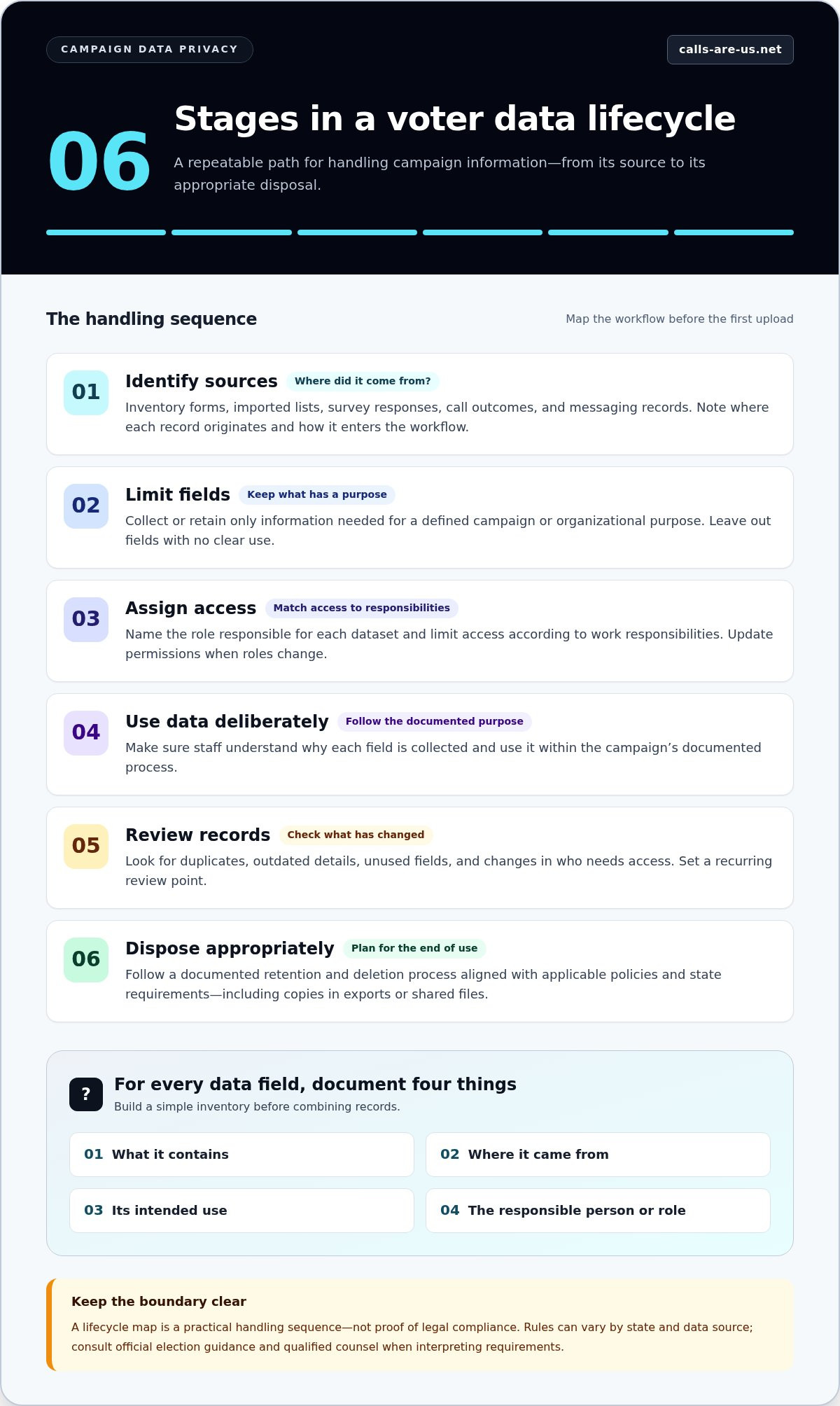
Treat the data lifecycle as a practical sequence for responsible handling, not as proof of legal compliance. Use this repeatable path:
Identify sources. Inventory forms, imported lists, survey responses, call outcomes, and messaging records. Note where each record originates and how it enters your team’s workflow.
Limit fields. Keep only the information needed for a defined campaign or organizational purpose. If a field has no clear use, leave it out.
Assign access. Name the role responsible for each dataset and limit access according to work responsibilities.
Use data deliberately. Make sure staff understand the purpose of each field and use it only within the campaign’s documented process.
Review records. Check for duplicates, outdated details, unused fields, and changes in who needs access.
Dispose appropriately. Follow a documented retention and deletion process that aligns with applicable policies and state requirements.
Set collection and purpose rules at the start
Build a simple inventory before combining data. For every field, record what it contains, its source, its intended use, and the person or role responsible for it. For example, a phone number might support a planned outreach call, while a response note may help staff avoid repeating a question. Don’t collect extra personal details just because a form or spreadsheet has room.
This is central to voter data privacy best practices: decide why you need information before requesting or importing it. A purpose written in plain language helps staff distinguish useful campaign records from information that is merely convenient to keep.
Control access, review records, and plan retention
Access should follow responsibilities, not habit. A staff member who prepares mailing lists may not need access to every response record. When roles change, update permissions and remove access that’s no longer necessary. Set a recurring review point to identify duplicates, outdated contact details, and fields the team no longer uses.
Retention needs an owner and a clear procedure. Document what happens to records when their purpose ends, including copies in exports or shared files. Since voter-record requirements can differ by state and source, compare your process with official state election guidance and applicable organizational policies. Seek qualified legal advice for legal interpretations.
A short record inventory can keep the process usable. Campaigns coordinating calls, texts, and other outreach can also consider how communication workflows fit their documented data policies. Calls-Are-Us campaign outreach workflows can support that operational planning, while the campaign defines its own access, purpose, review, and retention practices.
Compare Privacy Considerations Across Voter Outreach Channels
Each channel can create a different trail of campaign information. A voice call may leave a list and an outcome note; a text conversation may include replies; a mailed piece depends on an address and an audience file. The channel alone doesn’t determine whether those records are private. Your team’s collection choices, access practices, and retention decisions matter across all of them.
Use this comparison to map the records your campaign handles. It’s a planning aid, not a description of what every platform automatically records.
Assess the data created by each communication channel
Look beyond the initial contact list. For voice outreach, map call outcomes and any response details staff choose to record. For texting, consider message content, replies, and link-click tracking where used. For direct mail, document where addresses and audience files came from, and decide how returned mail is handled. Apply the same questions to email: what recipient details and response records does the campaign keep, and who can access them?
Campaigns weighing one-to-one and broadcast approaches can also review this P2P vs broadcast texting comparison from Calls-Are-Us as they map each workflow against their data policies.
Evaluate platforms without treating features as guarantees
Assess each workflow against your team’s documented policies: who owns the data, which roles need access, and how records will be reviewed and retained. A stated security feature addresses a specific part of a system; it doesn’t replace campaign decisions about collection, permissions, sharing, and deletion.
Calls-Are-Us states that it encrypts account information, and its Mass Texting is described as 10DLC compliant. Keep those facts within their stated scope. They are not a guarantee of voter-data privacy or legal compliance. Strong voter data privacy best practices pair tool features with clear ownership and consistent team procedures.
Use This Voter Data Privacy Checklist to Strengthen Daily Practices
Make privacy operational. A checklist gives staff a shared routine for handling campaign records, whether they’re preparing an outreach list, reviewing replies, or updating a file. Use the items below as a working process, then tailor them to your organization’s policies and the rules that apply to each state and data source.
Purpose: Record why each field is collected and how the campaign plans to use it.
Minimum fields: Remove information that isn’t needed for the documented purpose.
Access: Limit records to people who need them for assigned work, and revisit access when roles change.
Training: Explain approved sources, storage locations, permitted uses, and how to report concerns.
Sharing: Restrict exports and sharing; document who receives information and for what work.
Review: Check records for outdated details, duplicates, unnecessary fields, and unresolved corrections.
Retention: Set a process for keeping or disposing of records according to applicable policies and state requirements.
Escalation: Identify who staff should notify about suspected loss, exposure, or misdirected information.
Include a clear correction process: route a reported error to a responsible owner, verify the change against an appropriate source, update relevant records, and note the correction according to internal procedures. If someone raises a confidentiality request, record it and route it for review under applicable state rules and your organizational process. Don’t assume one response or timeline applies everywhere.
Prepare staff and vendors to handle data consistently
Consistency depends on clear instructions. Tell staff which sources and storage locations are approved, what uses are permitted, and how to avoid creating untracked copies. Share only the records needed for assigned work. Document vendor responsibilities and data-handling expectations in your own process, including who oversees the relationship and how information is handled when the work ends.
For channel planning, the mass communication strategy guide can help teams consider outreach workflows alongside these internal safeguards.
Review and respond when something goes wrong
Make reporting straightforward. Staff should know whom to alert if a file is sent to the wrong recipient, a device or account may have exposed information, or records appear to be missing. Preserve relevant records and follow the organization’s incident-response and legal-review procedures. Avoid making unsupported assumptions about notification duties or legal requirements.
Revisit the checklist when the campaign changes its outreach approach, adds a tool, adjusts staff responsibilities, or receives updated state guidance. Confirm state-specific obligations through official election sources and consult qualified counsel for legal interpretations. These voter data privacy best practices turn good intentions into repeatable habits. Plan campaign outreach with Calls-Are-Us as part of a workflow shaped by your team’s data policies.
Choose Outreach Tools That Fit a Trust-Centered Privacy Workflow
A communication tool should fit the campaign’s purpose and data-handling policies. Before choosing a channel, define who owns the records, which staff need access, and how the team will review and retain information. This keeps tool selection connected to the campaign’s actual workflow instead of treating a feature as a substitute for responsible practices.
Match the communication workflow to the campaign’s needs
Start with the kind of interaction the campaign needs. Voice Broadcast can deliver a recorded message, with Press-1 routing for recipients who want to respond. Mass Texting supports broad text outreach and keyword-triggered auto-responses. Peer-to-Peer texting supports real-time conversations, while a live calling center supports direct conversations with agents. IVR offers an interactive voice channel. Choose based on the intended contact and the records your team needs to manage.
For operational context, the political campaign call center guide can help teams consider how call-center workflows fit into voter contact planning. Whichever channel you use, document what information staff will handle, who is responsible for it, and how the workflow follows your internal policies.
Calls-Are-Us’ desktop-based Call Center software combines voice, text, and email workflows. This unified setup can support teams planning across those channels, but it doesn’t decide which voter records staff should access or how long those records should be kept. Put those decisions in the campaign’s documented process.
Keep platform safeguards in their proper scope
Evaluate a platform in context: Does its workflow suit the campaign’s needs? Are data ownership and staff responsibilities clear? Can your team apply its own access and retention policies consistently? These questions distinguish a useful operational capability from a broader privacy program. Software can support outreach, but it doesn’t replace campaign safeguards, state-specific review, or qualified legal guidance.
Calls-Are-Us states that it encrypts account information. That statement applies to account information and shouldn’t be extended into a claim that every voter record is encrypted or that campaign data practices are legally compliant. Calls-Are-Us Mass Texting is described as 10DLC compliant. That is a Mass Texting feature, not a general privacy certification or assurance about how a campaign collects, accesses, shares, or retains voter information.
Strong voter data privacy best practices depend on pairing tools with clear ownership, controlled access, and procedures your team can follow. A thoughtful workflow makes outreach more manageable while keeping privacy decisions with the campaign and its documented policies. Explore Calls-Are-Us communication solutions as one part of a trust-centered outreach workflow.
Make Trust Part of Every Campaign Decision
Privacy practices grow stronger when they’re part of routine planning, not a document that sits untouched. Assign someone to own the process, then revisit it as staff, outreach plans, and tools change. That commitment helps make voter data privacy best practices a durable part of how your campaign communicates with people.
Clear processes and purposeful communication can work together. Calls-are-Us offers communication solutions for campaigns coordinating voter contact across channels. Explore Calls-are-Us communication solutions to plan outreach around your team’s data policies and respect voter trust.
Your team can build trust one careful decision at a time.
Frequently Asked Questions
What is voter data privacy?
Voter data privacy is the responsible handling of personal information connected with voter registration or campaign outreach. It’s distinct from ballot secrecy, which protects the privacy of an individual’s vote. Teams can reduce exposure by asking whether a field is needed before adding it, restricting who can view it, and setting a review or deletion point. Applicable rules depend on state and data source, so don’t assume one national standard applies.
Is voter registration information public in the United States?
Not all voter registration information is publicly available, and access rules differ across states. What may be accessible can depend on the record, its intended purpose, and applicable law. Some states offer confidentiality options for eligible voters, including for safety reasons. Avoid treating an entire registration record as public or assuming every voter has the same protections. Consult the relevant state election authority for current rules.
Can political campaigns use voter data for outreach?
Whether a campaign can use particular voter data depends on its source, outreach purpose, and applicable state and federal requirements. Access to a public record doesn’t automatically settle whether other information collected by the campaign can be used in the same way. Keep a record of where each list came from and what use the team intended. Limit fields to what that purpose needs, and seek qualified legal guidance for jurisdiction-specific questions.
How should a campaign protect voter information?
Build safeguards into everyday work: track where records come from, remove fields the team doesn’t need, and restrict access to appropriate roles. Train staff on approved storage and sharing practices, and set procedures for review and eventual deletion. Give everyone a clear way to report a lost file or information sent to the wrong recipient. These steps support responsible operations, but they aren’t a substitute for legal advice or a complete security program.
Does ballot secrecy protect voter registration records?
No. Ballot secrecy protects how a person votes; voter registration records and campaign contact information are separate categories with their own access and confidentiality considerations. Keep voting choices separate from identifiable outreach records. This can help prevent accidental disclosure and reduce the chance that staff interpret contact history as information about a person’s ballot.
Does 10DLC compliance mean voter data is private?
No. 10DLC compliance relates to mass-texting requirements; it isn’t, by itself, a guarantee that voter data is private or secure. Calls-are-Us describes its Mass Texting as 10DLC compliant and separately states that account information is encrypted. These are specific product facts, not a complete privacy program. Campaigns still need their own policies for deciding what voter information to collect, who can access it, and how to manage records.
How often should voter databases be reviewed?
Review voter databases on an ongoing schedule rather than relying on a one-time cleanup. Set a recurring review point that fits your workflow, then reassess sooner if staff responsibilities, data sources, outreach processes, or relevant guidance change. Check for duplicate entries, outdated fields, information the campaign no longer needs, and access that no longer matches someone’s role. This is a practical review rhythm, not a legally required interval for every jurisdiction.



Comments