
SMS Deliverability Best Practices: 2026 Practical Guide

A “delivered” status doesn’t always answer the question that matters: did your message reach the right person? Delivery reports can be difficult to interpret, while outdated numbers, carrier filtering, and unclear audience practices can undermine a well-planned campaign. The most effective SMS deliverability best practices look beyond a single report and strengthen the full path from recipient readiness to delivery signals.
Delivery describes the reported status of an individual message. Deliverability is your ability to reach recipients consistently over time. Improving it takes more than adjusting message volume. You need a repeatable way to review consent, maintain accurate contact lists, tailor content, and assess campaign results without losing sight of recipient trust.
This guide explains how to diagnose common delivery problems, build a practical improvement process, and assess whether your outreach tools support relevant, compliant messaging. We’ll also cover how A2P 10DLC fits into business texting. Calls-Are-Us Mass Texting includes link-click tracking and keyword-triggered auto-responses, giving teams additional engagement signals to consider alongside delivery reports. Use the guidance ahead to make each campaign more deliberate, measurable, and useful to recipients.
Key Takeaways
Separate message submission and delivery status from deliverability, which focuses on reaching intended devices.
Apply SMS deliverability best practices by reviewing sender setup, contact quality, message relevance, and destination conditions.
Use delivery reports, failures, clicks, and opt-outs as distinct signals to guide your investigation, not as standalone proof of campaign success.
Build a repeatable campaign process that checks the audience, validates the list, prepares and tests content, then reviews results.
Calls-are-Us Mass Texting offers link-click tracking, keyword-triggered auto-responses, and 10DLC compliance to support outreach planning.
Table of Contents
What SMS deliverability means, and why sending is not the same as delivery
A message can leave your sending platform without reaching the person it was meant for. That distinction matters: a send confirmation, a delivery status, and a recipient response describe different stages of communication. Understanding those stages helps campaign teams interpret reports and investigate problems without jumping to conclusions.
Delivery status describes the reported outcome of an individual message; deliverability describes a sender’s broader ability to reach intended recipients’ devices; engagement describes what recipients do, such as clicking a link or replying. These measures inform one another, but they aren’t interchangeable. The Short Message Service (SMS) carries messages across many kinds of communication, yet each campaign still depends on accurate recipient details and the route between sender and device.
How SMS delivery and deliverability differ
Delivery is a message-level event. Depending on the status information available, a platform may show that a message was submitted, accepted for routing, or reported as delivered. Deliverability takes the wider view: can your outreach consistently reach the intended devices across a campaign or over time? The status of one message is a useful clue, not a complete verdict on your process.
Even a “delivered” report doesn’t establish that a recipient noticed or read the text. A phone may receive a message while its owner is busy, notifications are muted, or the message goes unseen. Click activity and replies indicate whether someone interacted with the message or its call to action. They measure engagement, not whether delivery occurred in the first place.
What can prevent a text from reaching its recipient?
Start with the contact record. A mistyped number, disconnected line, or number that no longer belongs to the intended person can send a campaign off course. These are list-quality problems, and a sending platform can’t make inaccurate contact details current simply by processing them.
Other factors sit outside the contact list. Carriers may filter messages, and a recipient’s device or network conditions may affect whether a text reaches the phone at that moment. A temporarily unavailable device, for example, can complicate the path between routing and receipt. Status details vary, so treat a failure as a prompt to investigate rather than assume there is one universal cause.
For practical SMS deliverability best practices, interpret each signal in context. A submitted message confirms that sending began; a delivery report offers information about its reported progress; a click or reply indicates engagement. None alone proves that every intended recipient received, read, or acted on the message. No sender or platform can promise inbox placement in every case. Clear definitions help you identify which part of the communication path needs attention, without mistaking activity in one stage for campaign-wide success.
How sender setup, contact quality, and message content shape SMS deliverability
Reliable outreach starts before a message is sent. Sender setup, recipient data, message content, and destination conditions all shape how a text moves through the delivery path. A well-written campaign can still struggle if sender details or contact records are poor. Clean data, in turn, won’t make an irrelevant message welcome.
Sender setup: Accurate business and campaign information helps recipients understand who is sending and why.
Recipient data: Current, valid numbers help messages reach the people they’re intended for.
Message content: Clear, relevant wording makes the purpose recognizable and useful.
Destination conditions: Carrier handling, network availability, and device status can affect the final route.
No single factor controls every delivery outcome; dependable SMS outreach comes from aligning sender identity, recipient permission, accurate data, relevant content, and destination conditions. Treat these as connected parts of the process, not isolated checklist items.
Prepare a trustworthy, usable contact list
Begin with permission: send people messages that match what they agreed to receive. Before each campaign, review records for invalid numbers, stale contacts, and prior opt-outs. Then segment the audience by relationship or interest. Members who signed up for event updates, for example, may need different information from customers receiving service notices. Targeting messages to the right group helps avoid sending irrelevant content that can erode trust.
Make each SMS clear, recognizable, and useful
Introduce the organization and purpose early, especially if recipients may not immediately recognize the sender. Keep the wording concise and specific, and make sure the information or offer fits the audience’s expectations. Before scheduling, test every link, confirm the call to action works, and check that response instructions are easy to understand. A recipient should be able to tell who is contacting them and what the message asks them to do.
Sender setup also matters for business texting. A2P 10DLC is a system for organizations sending application-to-person messages from standard 10-digit numbers. Its registration process connects a business identity with the purpose of its messaging campaigns. Treat setup as part of deliverability planning, not an administrative task to leave until the last minute. For registration and compliance detail, use the dedicated 10DLC compliance guide.
Apply these SMS deliverability best practices as a connected routine: maintain trustworthy contacts, match messages to audience expectations, and keep sender information aligned with the campaign. For teams planning high-volume outreach, Calls-are-Us Mass Texting includes link-click tracking and keyword-triggered auto-responses, adding useful engagement signals to campaign review.
How to diagnose SMS delivery problems using campaign signals
Campaign reports are most useful when you read each signal for what it can actually tell you. A delivery status can help you investigate message routing, while clicks and replies show recipient interaction. Opt-outs raise a different question: whether the message, audience, or sending pattern met recipient expectations. Don’t treat one metric as a complete explanation.
Which SMS metrics help identify a delivery issue?
Review sent and delivered counts alongside any failure or bounce details your platform provides. Check how the platform defines each status before drawing conclusions, since “sent” may indicate submission rather than receipt. Clicks and keyword-triggered replies are engagement indicators, not proof of delivery to every intended recipient. Opt-outs show a recipient response; a change can prompt a closer look at audience fit and message relevance.
These signals answer different questions. A click can’t establish that every recipient received the text, and a delivered status can’t establish that anyone read it. Avoid applying a universal threshold to a single campaign. Use the available data to identify a pattern and decide what to examine next.
What should you check when results change?
Compare like with like: campaigns with similar audiences, purposes, and formats. Then identify what changed. Did the list include a different mix of contacts? Were consent records, opt-outs, or number quality handled differently? Did sender configuration or 10DLC status change? Review edits to the message, links, timing, or call to action, and consider whether recipients would expect the communication.
Where practical, change one relevant factor at a time, then review subsequent campaign signals. This makes it easier to connect a change with a result instead of guessing based on several simultaneous edits. Keep a simple record of audience, content, configuration, and outcomes. These SMS deliverability best practices support a repeatable investigation without mistaking correlation for cause. If you use external benchmarks, name a relevant source and explain how its measurement compares with your own.
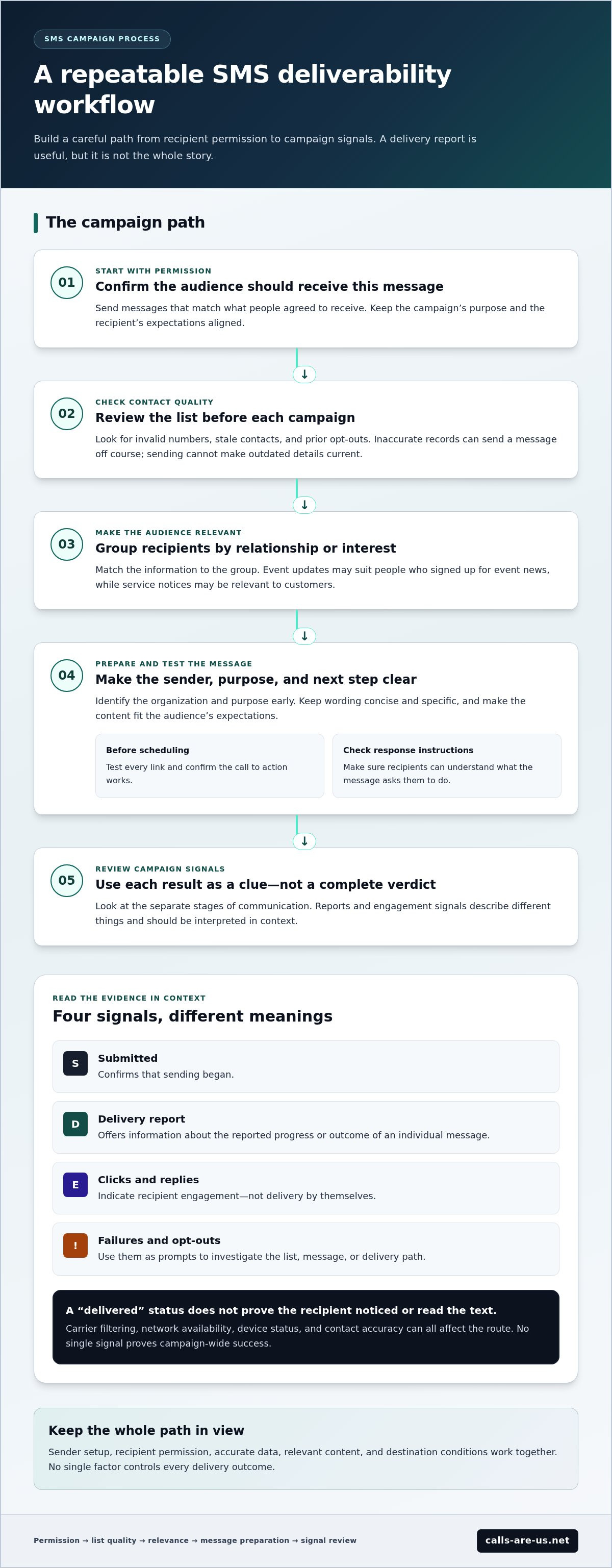
A repeatable SMS deliverability workflow for every campaign
Consistency makes troubleshooting easier. A standard workflow helps your team catch preventable issues before sending, then use campaign results to make informed adjustments. Keep the steps simple enough to repeat, but detailed enough to record what changed and why.
Before sending: validate audience, content, and configuration
Build the campaign around its purpose and recipients. Before launch, verify that the audience is appropriate, contact records are usable, and the message matches recipient expectations. Review sender details, links, timing, and setup while there’s still time to correct errors.
Define the audience. Identify who needs the message and what they should know or do. Segment recipients by their relationship, interest, or reason for receiving the update.
Validate the list. Review number accuracy, stale records, permission status, and prior opt-outs. Remove contacts who shouldn’t receive the campaign.
Prepare the content. State the organization and message purpose clearly. Keep the text focused, and make sure any call to action and response instructions are easy to understand.
Test the campaign. Check links, spelling, sender identity, and how the message appears on a device. Review the sending configuration and 10DLC status before proceeding.
After sending: review outcomes and refine the next campaign
Sending isn’t the end of the process. Review results against the audience and purpose you defined, separating delivery and failure information from engagement. Clicks, replies, and opt-outs each offer a different perspective. Document the campaign’s audience, content, timing, configuration, and observations so the next review has a useful comparison.
Send with recipient expectations in mind. Choose timing and frequency that fit the campaign purpose and the audience’s likely expectations. Avoid sending simply because a list is available; each message should have a clear reason to reach its recipients.
Review and refine. Compare available delivery and failure signals with the intended audience. Then review clicks, replies, and opt-outs separately. Record what changed and adjust campaign inputs thoughtfully, rather than changing several things without tracking them.
Teams coordinating SMS with voice, email, or other outreach can use a mass communication strategy guide to plan how channels work together. A shared plan helps keep messages consistent while giving each channel a clear purpose.
Make this workflow part of your SMS deliverability best practices, not a one-time cleanup. For high-volume campaigns, explore Calls-are-Us Mass Texting, which includes link-click tracking and keyword-triggered auto-responses to help teams review recipient engagement.
How Calls-are-Us Mass Texting supports deliverability-focused outreach
Good tools support a sound process; they don’t replace it. Start with an appropriate audience, relevant content, and a clear plan for reviewing results. Then consider whether the platform’s functions fit how your organization communicates and what you need to learn from each campaign.
Match Mass Texting capabilities to campaign needs
Calls-are-Us Mass Texting includes link-click tracking, giving teams an engagement signal when a recipient clicks a campaign link. That information can help evaluate whether a call to action resonated, but it doesn’t prove that every recipient received or read the message. Keyword-triggered auto-responses can respond to defined recipient keywords, supporting a planned next step in an exchange.
Calls-are-Us Mass Texting is compliant with 10DLC. For teams planning business texting, this supports sender setup, but it doesn’t replace careful audience selection, clear messaging, or campaign review. Treat delivery signals and engagement data as separate inputs when assessing how a campaign performed.
Security matters alongside communication planning. Calls-are-Us protects account information with data encryption. Keep this distinct from deliverability: encryption relates to protecting account information, while delivery outcomes depend on multiple parts of the messaging path.
Coordinate SMS with broader organizational outreach
SMS can be one part of a wider communication plan. An organization sharing a time-sensitive update, for example, may coordinate text with voice and email so each channel serves a clear purpose and recipients aren’t sent conflicting messages. The right mix depends on the audience, the urgency, and the kind of response the organization needs.
Choose the texting approach that matches the interaction. A one-to-one conversation and a message intended for a broad audience, for example, call for different planning decisions. This P2P and broadcast texting comparison can help clarify which approach better fits a campaign’s purpose. Coordinating channels also means aligning the message, timing, and audience across each touchpoint.
Use the same principles throughout: respect recipient expectations, keep content relevant, and review delivery and engagement signals on their own terms. These SMS deliverability best practices give outreach teams a practical foundation, while features such as link-click tracking and keyword-triggered responses support measurement and planned interaction.
If Mass Texting fits your organization’s outreach needs, explore Calls-are-Us Mass Texting as part of your campaign planning.
Turn your next campaign into a learning opportunity
Reliable outreach is built through thoughtful decisions and steady learning. For your next campaign, choose one clear objective, then decide what recipient response would help you understand whether the message was useful. Keep that learning in view as you plan future outreach. Consistent SMS deliverability best practices can help your team build a process that respects recipients and improves with experience.
Calls-are-Us Mass Texting includes link-click tracking and keyword-triggered auto-responses, and is compliant with 10DLC. Account information is protected with data encryption. These capabilities support campaign engagement and account security, while audience choices and message strategy remain central to the work.
Take the next step by exploring Calls-are-Us Mass Texting for your outreach plans. Explore Calls-are-Us Mass Texting and keep building campaigns that make each message count. A clearer process starts with one deliberate send, and each thoughtful review can help your team move forward with greater confidence.
Frequently Asked Questions
What is SMS deliverability?
SMS deliverability is how consistently messages reach the intended recipients’ mobile devices. It’s different from a platform confirming that a message was submitted, and it doesn’t tell you whether someone read or acted on the text. A delivery report may show a message reached a device, while a separate link click or reply indicates recipient interaction. Keep these stages distinct when evaluating campaign results.
How can I improve SMS deliverability?
Improve your process by sending relevant messages to people who expect them, keeping contact records current, and reviewing sender setup before each campaign. Segment recipients so each message fits their relationship with your organization. Check the text and any links before sending, then compare results with similar campaigns. These SMS deliverability best practices help you spot changes and make deliberate improvements without assuming one adjustment will solve every issue.
Why are my SMS messages not being delivered?
Messages may fail to reach recipients because a number is invalid or outdated, carrier filtering affects the route, or the recipient’s device or network is unavailable. Start by examining the failure details your messaging platform provides, then look for shared patterns. If failures cluster around recently added records, for instance, review how those numbers were collected and entered before changing message content or campaign configuration.
Does 10DLC compliance guarantee SMS delivery?
No. 10DLC compliance supports an appropriate setup for business messaging, but it can’t guarantee that every text reaches a recipient’s device. Contact accuracy, carrier handling, and destination conditions can still affect outcomes. Treat registration status as one part of campaign readiness, not a substitute for reviewing audience records and message results. If a campaign encounters failures, investigate the available status information rather than assuming compliance rules out setup issues.
Can links in text messages affect deliverability?
Links can influence how recipients perceive a message, and link or message characteristics may be relevant when investigating carrier filtering. Make sure the destination works, matches the text’s stated purpose, and belongs in the context of the message. A broken link can undermine recipient trust even if the text arrives. Track clicks separately from delivery: click activity shows interaction with the link, not how many recipients received the SMS.
How do I measure SMS deliverability?
Use campaign reports to compare the number of messages reported as delivered with the number submitted or sent, and state clearly which denominator you use. Review failure details alongside that comparison, since a single rate won’t explain why messages missed their destinations. Track clicks, replies, and opt-outs separately as engagement or recipient-response signals. Compare campaigns with similar audiences and purposes, and avoid treating a delivery report as proof that recipients read the message.



Comments