
Automated Voter Outreach: The 2026 Guide to Scalable Campaigning

Updated: Jun 26
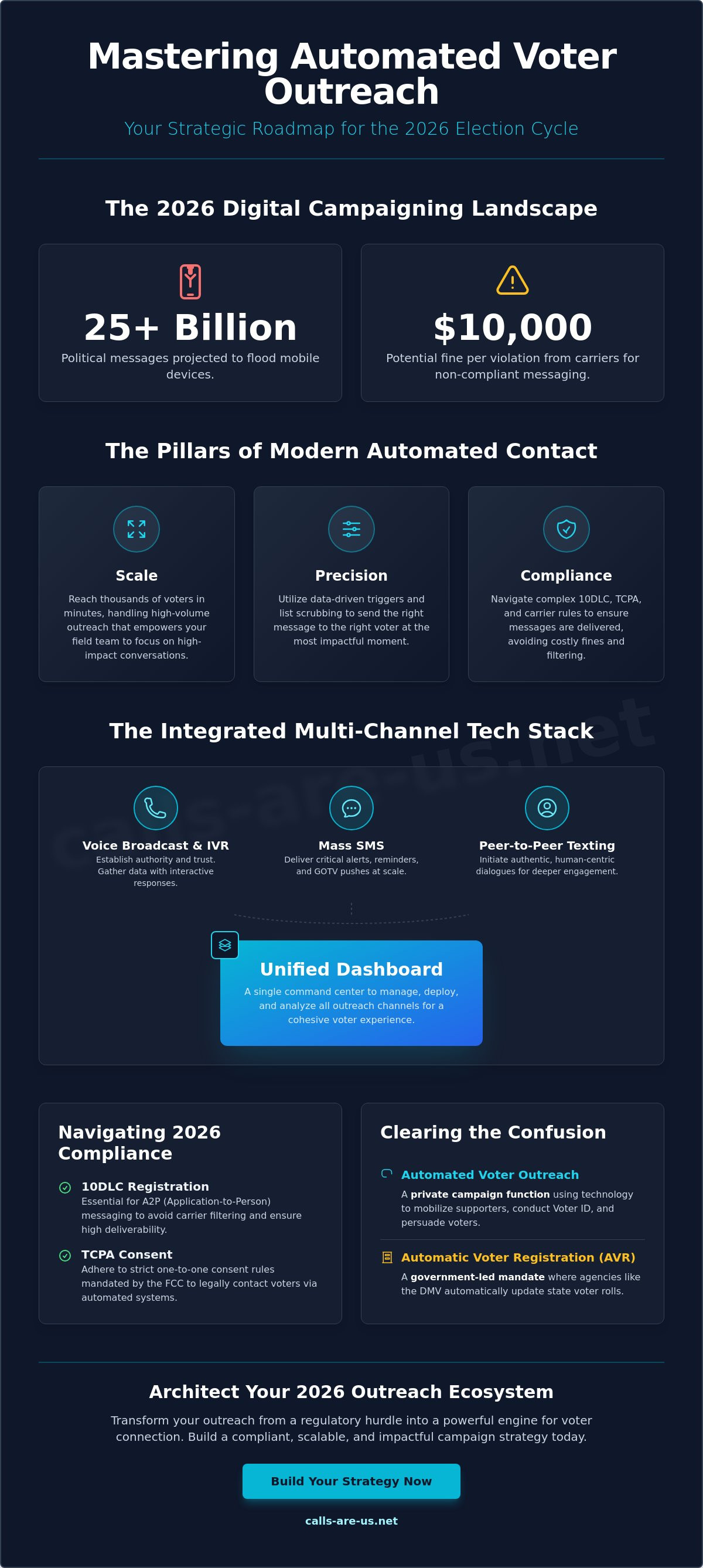
With over 25 billion political messages projected to flood mobile devices this cycle, the margin for error in digital campaigning has vanished. You understand that reaching voters on their phones is essential, but the escalating costs of manual contact and the threat of $10,000 carrier fines create a high-stakes environment. Relying on outdated tactics is no longer an option. Success in 2026 requires a strategy for automated voter outreach that is as disciplined as it is scalable. It's about finding the balance between high-volume delivery and the human-centric trust required to win an election.
You've likely felt the frustration of high carrier filtering rates or the confusion surrounding the FCC’s new one-to-one consent rules. We're here to bridge that gap. This guide provides a clear roadmap to deploying multi-channel campaigns that prioritize deliverability, transparency, and impact. You'll learn how to navigate 10DLC registration, master TCPA-compliant messaging, and integrate Voice Broadcast and Peer-to-Peer texting into a single, cohesive strategy. We will transform your outreach from a regulatory hurdle into a powerful engine for voter connection.
Table of Contents
What is Automated Voter Outreach in 2026?
Modern campaigning demands more than passion; it requires infrastructure. Automated voter outreach is the deployment of scalable technology to deliver campaign messages through voice, text, and direct mail. This isn't the simple bulk-sending of the past. Today, it represents a sophisticated transition from one-way broadcasting to interactive, trigger-based communication loops that respond to voter behavior in real time. You aren't just sending a message; you're initiating a dialogue at scale.
To succeed, you must build your efforts on a foundational mass communication strategy that aligns your technology with your message. Understanding the technical evolution of robocalls and automated dialing helps campaigns maintain high levels of engagement without sacrificing the human element of political discourse. By integrating these tools, you ensure your voice is heard above the noise of a crowded election cycle.
To better understand how these systems function in a modern campaign environment, watch this helpful video:
Outreach vs. Registration: Clearing the Confusion
Many people mistakenly search for automated voter outreach and find information on government-led Automatic Voter Registration (AVR) policies. It’s a common point of friction. While AVR is a state-level mandate handled by agencies like the DMV to update voter rolls, automated outreach is a private campaign function. We use these tools to facilitate direct contact, mobilize supporters, and conduct Voter ID. This technology doesn't replace your field team; it empowers them by handling the high-volume heavy lifting, allowing your volunteers to focus on the deepest, most meaningful door-knocking conversations.
The Three Pillars of Modern Automated Contact
Efficiency in 2026 rests on three distinct capabilities. First is Scale. You can reach thousands of voters in the time it takes a volunteer to dial a single number. Second is Precision. Modern systems use data-driven triggers to send the right message at the exact moment a voter is most likely to engage. Third is Compliance. You must navigate a complex legal framework to ensure your messages aren't just sent, but actually delivered to the recipient's handset.
By mastering these pillars, your campaign moves from a reactive posture to a proactive, visionary approach. You aren't just sending messages; you're architecting an ecosystem of trust and connection that drives voters to the polls.
The Multi-Channel Tech Stack: Voice, Text, and Beyond
Winning campaigns don't happen by accident. They're built on a robust, integrated campaign communication tools stack that ensures no voter is left behind. In 2026, the secret isn't just sending messages; it's the synergy between Voice Broadcast, Mass SMS, and Peer-to-Peer (P2P) messaging. When these channels work together, they create a surround-sound effect that reinforces your campaign's narrative across every digital and telephonic touchpoint.
A unified dashboard serves as the command center for this entire operation. It allows your team to manage multi-channel delivery without the friction of switching between disparate platforms. This visibility is crucial for effective automated voter outreach, as it provides real-time data on which messages are resonating and which segments need a more personalized approach. Transitioning from fragmented tools to a centralized ecosystem allows you to focus on the mission while the technology handles the heavy lifting of distribution and tracking, a shift that mirrors how IntellifyAi helps organizations automate complex document processing to drive enterprise-wide transformation.
Voice Broadcast and IVR: Establishing an Authoritative Sound
Voice remains the most human way to project authority and trust. A professional voice recording carries a psychological weight that text often lacks, making it essential for persuasion and high-stakes announcements. This is why political voice broadcasting remains a pillar of national strategy. By incorporating Interactive Voice Response (IVR), you turn a simple call into a two-way data collection tool. Voters can press a key to confirm their support, request a mail-in ballot, or opt-in to future updates. This interactivity qualifies sentiment at scale, turning passive listeners into active participants in your movement.
SMS and P2P: The Frontline of Instant Engagement
Texting is where the battle for attention is won or lost. While automated broadcast SMS provides massive reach for urgent alerts, P2P messaging offers the high-engagement feel of a genuine conversation. Your automated voter outreach should utilize short, punchy messages that drive immediate action. Whether you're integrating digital donation links for rapid-response fundraising or sending polling place reminders, the goal is clarity and speed. Because mobile carriers have strict filters, following the FCC Robocall and Robotext Rules is non-negotiable for maintaining high deliverability. To ensure your campaign has the reliable reach it needs, consider partnering with Calls-Are-Us to architect your delivery ecosystem.
Navigating 2026 Compliance: 10DLC, TCPA, and Carrier Trust
Compliance is the bedrock of electoral integrity. In the high-stakes environment of 2026, navigating the regulatory landscape is no longer just about avoiding fines; it's about protecting your campaign's ability to speak. The Federal Communications Commission (FCC) has significantly tightened the reigns, and staying legally safe requires a proactive, technical approach to every message sent. When you prioritize transparency and adherence to standards, you don't just stay out of court; you build a foundation of trust with carriers and voters alike.
As of February 2025, all major U.S. mobile carriers block unregistered A2P 10DLC messaging traffic entirely. For political entities, this means 10-Digit Long Code (10DLC) registration is a mandatory prerequisite for any automated voter outreach. You must register your brand and vet specific campaigns to ensure your traffic is recognized as legitimate. Failure to do so doesn't just result in higher surcharges per message; it results in total silence as your traffic is dropped before it ever reaches a handset.
Voice deliverability faces similar scrutiny through SHAKEN/STIR protocols. These standards verify that the caller ID displayed on a voter's phone is authentic, preventing the "cloned" or "artificial" voices that the FCC ruled illegal in 2025. To maintain "Carrier Trust," your campaign should follow this essential checklist:
Register early: Complete your 10DLC brand and campaign vetting well before your first broadcast.
Verify Identity: Ensure all voice traffic is signed with the highest level of SHAKEN/STIR attestation to prevent "Spam Risk" labels.
Respect the Clock: Adhere to "quiet hours" by never calling or texting before 8 a.m. or after 9 p.m. in the recipient's local time zone.
Clean Your Lists: Regularly scrub your databases to distinguish between landlines and wireless numbers.
The Essentials of TCPA for Political Campaigns
The Telephone Consumer Protection Act (TCPA) remains the primary governor of digital contact. It's vital to understand that while autodialed calls to landlines are generally permitted, calls and texts to wireless numbers require prior express consent. A critical shift occurred in January 2026, when the FCC closed the "lead generator loophole." Consent must now be "one-to-one," meaning you can't rely on shared or third-party lists. Your campaign must obtain direct permission from each voter for your specific brand. Automating your opt-out management is equally essential; you must process "STOP" requests promptly to avoid statutory damages that range from $500 to $1,500 per violation. You can review the full FCC rules on political robocalls to ensure your strategy remains beyond reproach.
Deliverability: How to Avoid SMS Filtering
Content variation is your best defense against automated carrier filters. Carriers use sophisticated algorithms to flag repetitive, high-volume messages as spam. By rotating your copy and using dynamic fields, you signal to the network that your outreach is legitimate and human-centric. Monitoring your delivery rates in real-time allows you to identify bottlenecks before they derail a critical GOTV push. Remember, T-Mobile can issue fines of up to $10,000 per violation for non-compliant messaging. Adherence to delivery standards isn't a technical chore; it's the only way to ensure your message actually lands.
Strategic Use Cases for Automated Voter Outreach
Strategy is the catalyst that turns raw technology into electoral victory. You must align every message with a sophisticated voter outreach strategy to cut through the noise of a cycle projected to exceed 25 billion political messages. Automated voter outreach isn't just for the final sprint; it's a multi-stage process that begins with Voter ID and list scrubbing. By identifying your supporters early and cleaning your databases of inactive numbers, you ensure your later, high-cost efforts are targeted with surgical precision. This proactive approach transforms your data from a static list into a living map of your path to victory.
Speed defines the modern political landscape. When an opposition narrative breaks, you can deploy rapid-response messaging across your entire list in minutes. This "surround sound" approach hits voters via voice, text, and direct mail simultaneously, creating a consistent and unavoidable presence. By saturating multiple channels, you reinforce your campaign's core message and ensure that your side of the story is the one that sticks. It's about being everywhere at once, with a message that resonates because it was delivered at the exact moment it was needed most.
GOTV: Driving High-Impact Turnout
Get Out The Vote (GOTV) is the ultimate test of your infrastructure. A successful sequence starts days before the election with early voting reminders and culminates in election morning voice broadcasts. These automated reminders drive polling site visits by providing localized information directly to the voter's handset. Coordination is key; matching text alerts with specific deadlines ensures your national-scale impact is felt at the local precinct level. You aren't just reminding people to vote; you're removing the friction between their intent and the ballot box.
Advocacy and Fundraising: Turning Contact into Action
Turning contact into action requires immediate engagement. You can leverage Interactive Voice Response (IVR) to conduct instant polling, identifying high-propensity donors who are ready to contribute to your cause. Once a gift is made, automating thank-you messages and follow-up texts builds the long-term supporter trust necessary for a sustained movement. By using direct mail to reinforce these digital touchpoints, you create a physical reminder of your campaign's mission. To build an outreach system that turns passive supporters into active donors, partner with Calls-Are-Us today.
Calls-Are-Us: Architecting Your 2026 Outreach Ecosystem
Infrastructure is the silent engine of electoral success. At Calls-Are-Us, we don't just provide digital tools; we architect the resilient ecosystems that allow your message to resonate across the nation. Our national infrastructure is built to handle millions of deliveries without latency, ensuring your campaign stays ahead of the curve. By integrating Voice Broadcast, Peer-to-Peer texting, and a sophisticated political direct mail strategy, we provide a surround-sound presence that turns passive voters into active supporters. This is the future of automated voter outreach, where technology and strategy meet to drive real-world impact.
We invite you to move beyond the era of transactional robocalls. True engagement requires a partner that understands the nuance of voter behavior and the strict requirements of carrier networks. Our platform is designed for transformation, facilitating meaningful interactions that build trust over time. We provide the scale you need, the precision you demand, and the compliance you require to win. It's about putting the "us" back in outreach, creating a human-centric experience that survives the noise of a crowded election cycle.
Proven Expertise in 40+ States
Experience is our greatest asset. Our history supporting national and local elections across 40 states provides the high-stakes authority your campaign needs. We specialize in the complexities of 10DLC and A2P compliance, ensuring your messages aren't just sent, but delivered. Our technology stack is built to scale with you, moving seamlessly from the early identification phases of a primary to the high-volume demands of a general election. You don't have to navigate these technical hurdles alone; we provide the seasoned guidance to keep your communication lines open and effective.
Start Your 2026 Campaign with a Visionary Partner
We don't just provide a service; we champion a philosophy of open and inclusive dialogue. Our consultative approach means we act as a powerful ally, helping you architect a strategy that aligns with your campaign's unique goals. We focus on the potential for impact, the importance of connection, and the necessity of integrity in every broadcast. When you partner with us, you gain more than a vendor; you gain a principled guide for the modern communication landscape. Take the first step toward a more effective ground game. Consult with Calls-Are-Us to build your 2026 voter contact plan and ensure your automated voter outreach is built to win.
The Future of Your Campaign Starts with Connection
Victory in 2026 demands a shift from simple broadcasting to strategic engagement. You now have the roadmap to integrate voice, text, and mail into a unified force that respects voter privacy while maximizing impact. By prioritizing deliverability and strict compliance, you protect your campaign’s voice and build the trust necessary to win. It's about more than just numbers; it's about ensuring your message lands in the hands of the people who need to hear it most.
You don't have to navigate this high-stakes landscape alone. Calls-Are-Us has operated in over 40 states for national and local elections, providing a seamless ecosystem of Voice, SMS, and Direct Mail. Our team handles the heavy lifting of 10DLC and TCPA compliance management, allowing you to focus on the message that matters. We're ready to help you deploy a sophisticated strategy for automated voter outreach that scales with your ambition and integrity.
Architect Your National Voter Outreach with Calls-Are-Us
Your vision for a more inclusive and engaged electorate is within reach. Let's build the connections that drive change and lead your campaign to a decisive victory.
Frequently Asked Questions
Is automated voter outreach legal for political campaigns in 2026?
Automated voter outreach is legal provided your campaign adheres to TCPA regulations and the FCC's January 2026 one-to-one consent rules. You must obtain direct, express written consent for automated calls and texts to wireless numbers. Consent cannot be shared or sold between different organizations. Adhering to these standards protects your campaign from statutory damages that can reach $1,500 per message or call.
What is the difference between automated voice broadcasting and robocalls?
Voice broadcasting is the professional technology used to deliver messages, while "robocall" is the regulatory term for any call made using an autodialer or prerecorded voice. It's a distinction of intent and technology. In 2025, the FCC officially classified AI-generated or cloned voices as "artificial" under the TCPA. This means using deepfake technology for outreach without express consent is now illegal across all mobile platforms.
How does 10DLC registration affect my campaign’s ability to send text messages?
10DLC registration is now a mandatory requirement for any campaign that wants to ensure its texts actually reach voters. Since February 2025, major U.S. carriers have blocked unregistered A2P messaging traffic entirely. By registering your brand and vetting your campaigns, you establish "Carrier Trust." This status allows you to send high volumes of messages with significantly lower filtering rates and higher deliverability.
Can I use automated message delivery for Get Out The Vote (GOTV) efforts?
Automated message delivery is a cornerstone of modern GOTV efforts because it allows you to reach an entire district in minutes. You can deploy election morning reminders or coordinate text alerts with early voting deadlines to drive immediate turnout. This technology doesn't replace your field team; it empowers them by handling the high-volume reminders while they focus on deep, persuasive doorstep conversations.
What are the best practices for avoiding SMS filters in political messaging?
Content variation and 10DLC registration are your most effective defenses against aggressive carrier filters. You should rotate your message copy frequently and use dynamic fields to ensure each text appears unique to carrier algorithms. Monitoring your delivery rates in real-time helps you identify and fix bottlenecks. Remember, T-Mobile can issue fines of up to $10,000 per violation for non-compliant messaging that triggers filters.
How do I integrate automated voice calls with my existing voter database?
Most modern platforms allow you to integrate automated voice calls through secure CSV uploads or direct API connections with your existing voter database. This integration enables you to conduct Voter ID and list scrubbing early in the cycle. By cleaning your data before the final push, you ensure your resources are focused on high-propensity voters who are actually reachable on their mobile devices.
Does automated voter outreach work for national non-profit advocacy?
National non-profit advocacy groups use these tools to mobilize supporters and identify high-propensity donors for specific causes. You can leverage IVR to conduct instant polling or automate thank-you messages to build long-term trust with your base. This technology scales effortlessly, making it just as effective for massive national awareness campaigns as it is for local municipal elections. To see how these principles apply to commercial growth, you can explore AI lead Gen to discover how specialized digital representatives capture and convert high-intent search leads.
How can I track the ROI of my automated outreach campaign?
You can track the ROI of your automated voter outreach by monitoring delivery rates, opt-out percentages, and direct conversion metrics like donation links clicked. Analyzing these data points allows you to refine your messaging strategy and allocate your budget more effectively. High deliverability and low opt-out rates are the primary indicators that your outreach ecosystem is healthy and resonating with your audience.



Comments