_edited.png)
Bilingual Voter Outreach: The 2026 Guide to Inclusive Campaign Strategy

With over 36 million Latino voters eligible to cast ballots in 2026, the era of treating diverse communities as an afterthought is officially over. Yet, as 25 billion political messages flood mobile devices this cycle, simply translating a script is no longer enough to be heard. You already recognize that bilingual voter outreach is the cornerstone of a winning national strategy. Still, the fear of sounding culturally disconnected or the anxiety of managing complex 10DLC regulations often stalls momentum before the first text is even sent.
It is exhausting to watch potential supporters disengage because your messaging feels like a cold, literal translation rather than a genuine conversation. This guide provides the master blueprint you need to bridge that gap with confidence. You will learn to integrate sophisticated technology with deep cultural nuances to build trust, ensure regulatory compliance, and scale your operations effectively. We provide a clear roadmap for multilingual engagement that leverages live call centers, IVR, and P2P texting to drive record turnout across every demographic.
Table of Contents
Defining Bilingual Voter Outreach in the 2026 Political Landscape
Bilingual voter outreach is the strategic engine of modern electoral victories. It is the practice of engaging voters in their preferred language to ensure every citizen has equitable access to the democratic process. In the 2026 cycle, this isn't just about following the law; it's about winning the margin. National campaigns are prioritizing multilingual blocks because these voters often hold the decisive power in tight races across battleground states. When you speak to a voter in their primary language, you aren't just delivering a message. You're building a bridge of respect, recognition, and trust.
The shift from reactive compliance to proactive engagement defines the current political era. Successful organizers don't just wait for a legal mandate to print a second ballot. They build relationships, foster trust, and create dialogue long before Election Day arrives. This approach transforms communication from a transactional exchange into a powerful partnership between the campaign and the community. To understand the operational demands and community impact of these initiatives, watch this look at the search for bilingual support:
The Legal Foundation: Section 203 and Beyond
The Voting Rights Act, specifically Section 203, provides the essential framework for language access. It identifies "covered jurisdictions" where campaigns must provide bilingual materials to remain compliant. As of July 2026, census data shows a 26% increase in covered jurisdictions since 2016, now encompassing over 24 million voters. Federal law mandates language assistance when more than 5% of voting-age citizens in a jurisdiction belong to a single language minority group and have limited English proficiency. Understanding these boundaries allows your campaign to deploy technology that meets specific local needs while avoiding regulatory pitfalls.
Beyond Translation: The Role of Transcreation
Transcreation is the bridge between being understood and being felt. Word-for-word translation often fails because it ignores the idioms, values, and emotional triggers that drive voter behavior. Organizations like the League of Women Voters have long championed accessible information, proving that native-level fluency is vital for authentic connection. When a script reflects the actual cultural context of a voter, it validates their experience and significantly increases the likelihood of turnout. Effective bilingual voter outreach requires three things: precision, empathy, and scale. It's about knowing who to call, how to speak to them, and having the tools to reach everyone. We don't just translate words; we translate vision.
Building a Multi-Channel Framework for Multilingual Engagement
Reach voters where they live, work, and communicate. A successful voter outreach strategy doesn't rely on a single point of contact; it creates a "surround sound" effect by integrating voice, text, and mail into a unified narrative. This multi-channel approach ensures that your message isn't just heard once but reinforced across different mediums. Consistency across these channels builds the brand recognition and trust essential for meaningful engagement in diverse communities. By using data to analyze which channels resonate with specific linguistic groups, you can allocate resources where they'll have the highest impact.
According to the National Conference of State Legislatures, jurisdictions with high numbers of Limited English Proficiency Voters require nuanced, multi-layered communication to ensure full participation. This demographic landscape demands a shift from generic messaging to targeted, channel-specific content. If you want to maximize your reach, Calls-Are-Us offers the integrated platform needed to manage these diverse touchpoints from a single, compliant dashboard.
Voice Broadcast and IVR for Mass Education
Speed is critical during the final weeks of a campaign. Use Voice Broadcast to deliver rapid, multilingual updates about polling place changes, early voting deadlines, or emergency alerts. Interactive Voice Response (IVR) systems act as a 24/7 digital concierge, allowing you to conduct efficient multilingual polling and data collection without manual intervention. To maintain professional authority, always record prompts with native-speaking talent. This avoids the "uncanny valley" of AI-generated voices that can alienate listeners and damage rapport. For those interested in the advanced AI that powers such voice and semantic algorithms, Ubestream Inc. offers a look at the future of linguistic technology.
P2P and Mass Texting: The Mobile Connection
Mobile devices are the most personal channel available for bilingual voter outreach. Understanding the strategic nuances of P2P vs broadcast texting is vital for effective engagement. Peer-to-peer messaging allows your team to answer complex questions in real-time, providing the cultural context that automated systems might miss. You must also account for text expansion; Spanish translations can be 30% longer than English, requiring concise scripts that fit within SMS character limits while maintaining the integrity of your message.
Reinforcing with Political Direct Mail
Tangibility matters in a world saturated by digital noise. A well-designed political direct mail strategy uses dual-language layouts to ensure the message is accessible to every member of the household. These physical assets serve as a permanent reference for voters. Integrate QR codes that lead directly to in-language landing pages or video resources to bridge the gap between the mailbox and the smartphone. This creates a seamless, supportive experience for voters navigating the complexities of the 2026 election cycle.
Bilingual Live Agents vs. Automated Outreach Systems
Efficiency and empathy aren't mutually exclusive. Choosing between live interaction and automation depends on your specific objective, whether it's broad awareness or deep persuasion. For a comprehensive bilingual voter outreach program, the most effective campaigns use a hybrid model. This approach balances the high-volume capabilities of technology with the irreplaceable rapport of a human voice. By integrating these methods into a unified political campaign call center workflow, you can optimize your budget while maximizing your impact on the ground.
Analyze your cost-per-contact through the lens of voter intent. Automated systems offer a low-cost solution for mass education and simple reminders, whereas live agents represent a higher investment geared toward conversion. Hearing a familiar language spoken with native-level fluency from a real person triggers a psychological sense of belonging and importance. This "human touch" is often the deciding factor that moves a hesitant voter to the polls. When you blend these methods, you create a seamless journey that respects the voter's time and cultural identity.
The Power of Live Bilingual Agents
Complex issues require a human conversation. While a text can inform, a live agent can persuade, clarify, and connect. Managing a bilingual operation involves more than just hiring translators; it requires training agents on campaign-specific terminology and local political context. Dialectical nuances are equally critical. A voter in Miami may respond differently to a Caribbean Spanish accent than a voter in Los Angeles would to a Mexican Spanish dialect. Professional agents navigate these subtleties to build authentic rapport that a machine simply cannot replicate.
Scaling with Automated Voice and Text
Speed is the primary advantage of automation. You can use political voice broadcasting for rapid-fire "Get Out The Vote" (GOTV) efforts and event reminders in multiple languages simultaneously. Mass texting provides a similar advantage for rapid response messaging, allowing you to counter disinformation or share breaking news instantly. Use these automated tools at the "top of the funnel" to identify supporter sentiment. Once your IVR or mass text identifies a highly interested voter, you can then trigger a live follow-up call to seal the commitment. This strategic hand-off ensures your most expensive resources, your live agents, are only talking to the most promising leads.
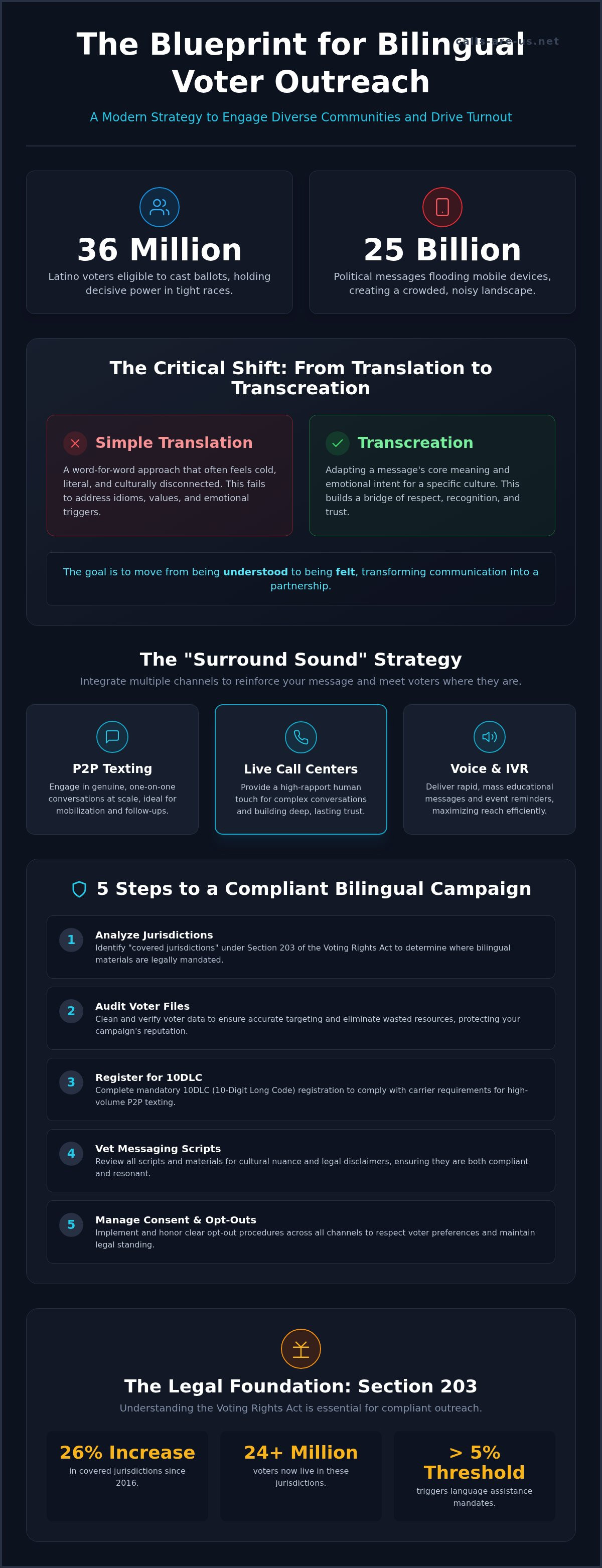
5 Steps to Executing a Compliant Bilingual Campaign
Compliance is the invisible architecture of a successful campaign. Without a rigorous mass communication strategy, even the most resonant message can be silenced by regulatory filters or legal challenges. In the 2026 cycle, precision is your greatest asset. High-stakes bilingual voter outreach requires a methodical approach that balances technological scale with legal integrity. By following a structured roadmap, you can protect your campaign’s reputation while expanding your influence in diverse communities.
Step 1: Audit your voter file. Begin by identifying language preferences and ethnic coding within your data to ensure your resources are targeted accurately.
Step 2: Develop and vet scripts. Work with native speakers to transcreate your message, ensuring it maintains its emotional core across different dialects.
Step 3: Register for 10DLC and TCPA. Secure your brand’s delivery by completing mandatory registration for political messaging and strictly adhering to opt-in requirements.
Step 4: Launch a multi-channel pilot. Test your message across voice, text, and mail to determine which medium yields the highest response for each specific language group.
Step 5: Analyze and scale. Use real-time data to identify the most effective channels and double down on the strategies that drive the highest voter engagement.
Navigating 10DLC and TCPA for Multilingual Messaging
Trust is built on transparency. Your opt-in processes must be crystal clear in the target language to ensure voters understand exactly what they are signing up for. In 2026, 10DLC registration for political entities is more stringent than ever, requiring detailed campaign descriptions to avoid heavy filtering. Never rely on "implied consent" in diverse communities; it's a legal risk that can lead to costly litigation and brand damage. To ensure your campaign meets every regulatory hurdle without sacrificing speed, partner with Calls-Are-Us for compliant high-volume outreach.
Scripting for Success: Tone and Clarity
Authenticity can't be automated. A persuasion script should sound like a neighbor having a conversation, not a clinical recitation of policy points. Avoid idioms or slang that don't translate well across different regions; Mexican Spanish and Puerto Rican Spanish often use different terms for the same concept. "The Ask" is the most critical part of your script. It must be culturally appropriate and direct, giving the voter a clear path to action that feels empowering rather than demanding. When you respect the linguistic nuances of your audience, you don't just win a vote; you build a lasting relationship.
Scaling Inclusive Outreach with Calls-Are-Us
Scaling requires more than just high-volume capacity. It demands a partner that understands the delicate balance between technological speed and cultural sensitivity. Calls-Are-Us provides the robust infrastructure necessary for national-scale contact while ensuring every interaction remains authentic, respectful, and impactful. We specialize in transforming complex bilingual voter outreach into a streamlined, high-performance operation that resonates across every demographic block. Our integrated reporting allows you to track the ROI of your bilingual efforts across all channels, giving you the transparency needed to make data-driven decisions in real-time. By bridging the gap between sophisticated technology and human-centric connection, we empower your campaign to lead with confidence.
Our Technology Stack for Diverse Engagement
Precision meets power in our technology suite. We provide high-volume voice broadcast and IVR systems that feature full multilingual support, allowing for rapid-fire education, efficient polling, and seamless data collection. Our P2P and mass texting platforms are architected specifically for political compliance, ensuring your message reaches the mobile device without regulatory friction or delivery delays. Finally, our direct mail management services complement your digital and telephonic outreach, creating a surround sound effect that reinforces your campaign’s presence in the physical and digital worlds simultaneously.
Why Experience Matters in Bilingual Contact
Experience is the foundation of trust. We have operated in over 40 states, supporting national and local elections with a proven track record of high-volume voice and text compliance. Our team provides expert guidance on the shifting complexities of 10DLC registration and TCPA standards, shielding your campaign from technical setbacks, legal risks, and delivery failures. We don't just provide a service; we champion a philosophy of inclusive dialogue and social progress. Our live call center features professional agents who are trained to build rapport, handle nuanced dialects, and deliver your message with native-level fluency. By choosing Calls-Are-Us, you are partnering with an authoritative visionary committed to fostering meaningful interactions that drive turnout and build a more inclusive democracy.
Inclusive outreach is more than a tactical necessity. It is a commitment to the democratic ideal. We provide the expertise, the technology, and the passion required to turn that commitment into a winning reality. Let us help you build a campaign that doesn't just reach people, but truly connects with them in the language they trust most. Together, we can ensure every voice is heard and every vote is counted in 2026.
Leading the Future of Inclusive Engagement
The 2026 electoral landscape rewards campaigns that prioritize authentic, multi-channel dialogue over simple translation. You've seen how integrating the human rapport of a professional live call center with the efficiency of mass texting and voice broadcast ensures your message resonates across every linguistic boundary. This strategy isn't just about regulatory compliance; it's about building lasting trust within the communities that define the decisive margins in modern races. When you treat language access as an opportunity for connection rather than a legal hurdle, you transform your entire outreach paradigm.
Effective bilingual voter outreach requires a partner that understands the high stakes of national-scale communication. We have operated in over 40 states, providing the expertise and integrated multi-channel reporting you need to measure impact and drive turnout. Scale your bilingual outreach with the experts at Calls-Are-Us to bridge the gap between sophisticated technology and human-centric tradition. Your vision deserves a platform that speaks everyone's language and honors every voter's voice. Let's build a more inclusive democracy together.
Frequently Asked Questions
What is the legal requirement for bilingual voter outreach under Section 203?
Section 203 of the Voting Rights Act mandates that specific jurisdictions provide bilingual voting materials and assistance. This requirement is triggered when more than 5% of voting-age citizens in a jurisdiction belong to a single language minority group and have limited English proficiency. As of July 2026, the number of covered jurisdictions has increased by 26% since 2016, making compliance a critical operational priority for national campaigns.
How do I know which languages to prioritize for my campaign?
Start by auditing your voter file for ethnic coding and language preference data provided by county election officials. You should also analyze U.S. Census Bureau determinations, which identify areas where significant populations speak languages other than English at home. In many high-impact congressional districts, over 83% of immigrant voters use a primary language other than English, necessitating a robust bilingual voter outreach strategy to ensure full engagement.
Is peer-to-peer texting better than voice broadcast for bilingual voters?
Neither is inherently better; they serve different strategic functions. Peer-to-peer texting is the gold standard for high-stakes persuasion and real-time rapport because it allows for nuanced, two-way conversations. Conversely, voice broadcast is the most efficient tool for rapid-response messaging, such as sharing polling place updates or "Get Out The Vote" reminders to tens of thousands of voters simultaneously.
How can I ensure my translated scripts are culturally sensitive?
Always prioritize transcreation over literal, word-for-word translation. This involves using native-level speakers who understand the idioms, values, and emotional triggers of specific dialects, such as the differences between Mexican and Caribbean Spanish. Vetting your scripts with local community partners ensures your message sounds natural and respectful rather than clinical or out of touch.
What are the TCPA rules for bilingual political calls?
The Telephone Consumer Protection Act (TCPA) requires prior express consent for any autodialed calls or texts sent to mobile devices, regardless of the language used. Campaigns must also navigate 10DLC registration requirements to maintain high deliverability rates. It's vital that your opt-in disclosures are clearly written in the voter's primary language to ensure consent is informed and legally defensible.
How much does a bilingual live call center service cost for a campaign?
Pricing for specialized outreach services depends on the scale of your campaign and the specific linguistic expertise required for your target demographics. While general consulting fees vary based on the level of the race, bilingual services are typically quoted based on the volume of professional hours or the total number of attempted contacts. It's standard practice to request a tailored proposal that accounts for your specific voter file size and engagement goals.
Can I use IVR to conduct multilingual voter polling?
Yes, Interactive Voice Response (IVR) is a highly effective tool for gathering structured data across diverse linguistic groups. Voters can select their preferred language at the beginning of the call, allowing them to answer polling questions comfortably and accurately. This technology provides the real-time insights you need to adjust your bilingual voter outreach tactics as the political landscape shifts.
Does direct mail still work for non-English speaking voter blocks?
Direct mail remains a vital, tangible component of an inclusive campaign. Physical mailers with dual-language layouts ensure that every member of a household can access your platform, regardless of their English proficiency. When you integrate these mailers with QR codes that link to in-language videos or landing pages, you create a seamless, multi-channel experience that reinforces trust and brand recognition.



Comments