_edited.png)
Cost-Effective Voter Outreach: Maximizing ROI in 2026 Campaigns

With political ad spending projected to hit a staggering $11.6 billion for the 2026 midterms, can your campaign afford to keep shouting into the digital void? You've likely felt the pressure of rising media costs and the heavy weight of voter ad fatigue. It's a constant challenge to maintain a presence when traditional channels demand more of your budget while delivering fewer results. Achieving cost effective voter outreach requires more than just cutting corners; it requires a strategic shift in how you engage, filter, and convert your audience.
You deserve a strategy that works. We understand that your mission is to build genuine connections without exhausting your resources. This article will show you how to balance high-impact communication with budget-conscious tactics to reach more voters for less. We'll examine the power of multi-channel synergy, the necessity of regulatory compliance, and the specific methods for using automated tools to prioritize your most valuable human interactions. By the end, you'll have a clear roadmap to maximize your ROI, ensure high deliverability, and navigate the complex legal landscape with confidence.
Table of Contents
Defining Cost-Effective Voter Outreach in the 2026 Landscape
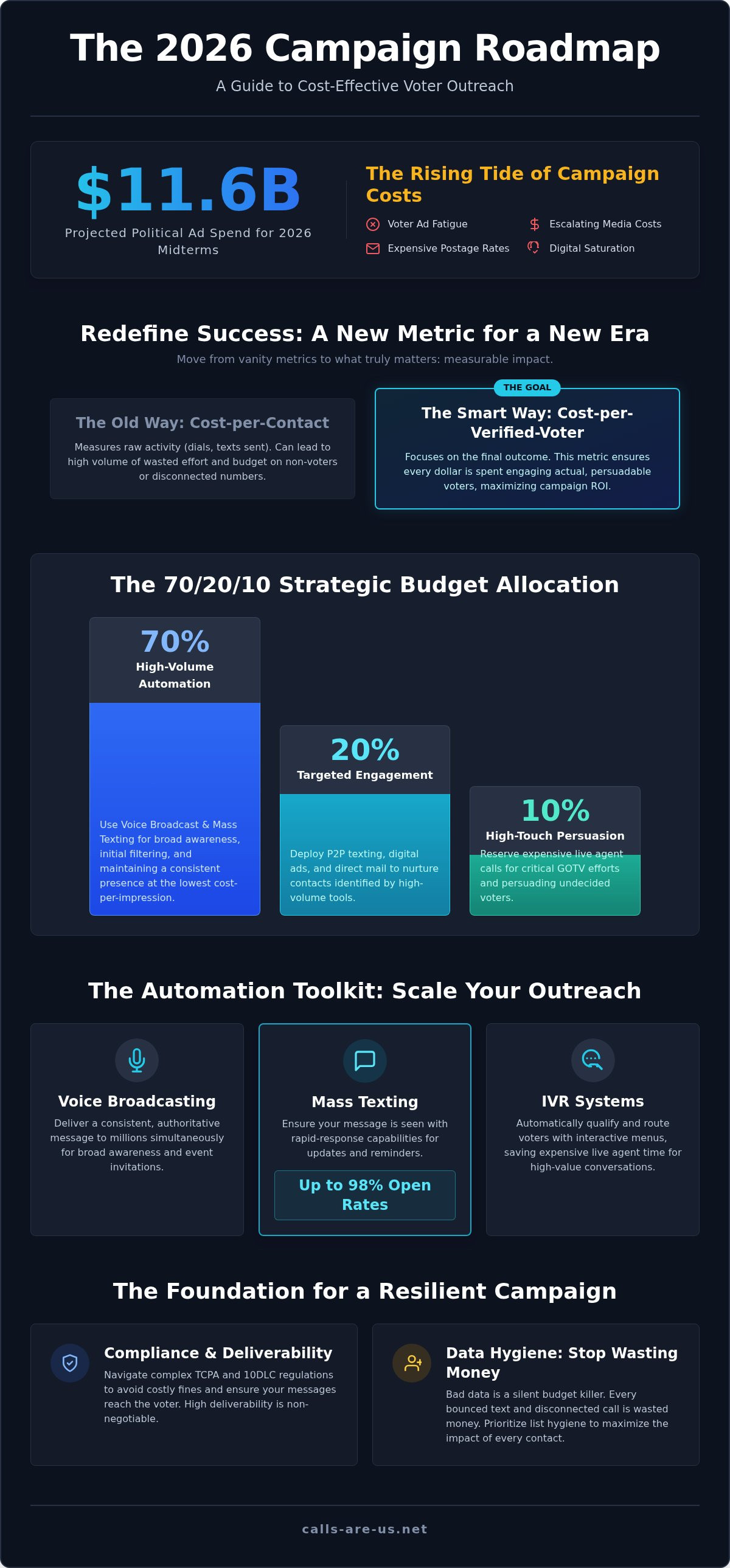
Spending doesn't guarantee victory. In the high-stakes environment of 2026, where political ad spending is projected to exceed $11 billion, the loudest voice isn't always the most efficient. True cost effective voter outreach isn't measured by the number of dials made or the volume of mailers sent. Instead, savvy campaigns focus on the final cost-per-verified-voter. This shift in perspective allows teams to distinguish between vanity metrics and actual movement at the ballot box. You need to target, engage, and mobilize with surgical precision to ensure every dollar provides a measurable return.
Voters are exhausted. Digital saturation has reached a breaking point, and traditional mail is becoming increasingly expensive with rising postage rates. With EDDM retail postage sitting at $0.260 per piece and standard stamps at $0.82, campaigns can't afford a "spray and pray" approach. Modern strategy requires a transition from single-channel blasts to sophisticated, multi-touch voter journeys. High-volume automation serves as the bedrock here; it filters out the noise so your high-touch resources can focus on the most persuadable targets during critical Get out the vote (GOTV) efforts. This integrated methodology transforms a simple contact list into a dynamic engine for civic participation.
The Hidden Costs of Inefficient Data
Bad data is a silent budget killer. Every bounced text and disconnected call represents a fraction of your budget disappearing without impact. List hygiene isn't just a technical chore; it's a financial necessity that maintains a low cost-per-contact. While "cheap" lists might look attractive on a spreadsheet, they often result in higher overall spend due to wasted attempts and potential regulatory fines. We prioritize precision to ensure every message reaches a live, registered voter, protecting both your budget and your reputation.
Scalability: The Key to National Impact
Physical canvassing is powerful but notoriously difficult to scale. While door-to-door efforts have high conversion rates, the overhead of managing thousands of volunteers across multiple states is often prohibitive for national-level strategies. Technology bridges this gap. It allows a lean team to execute national communication through Voice Broadcast, Mass Texting, and IVR systems that operate at a fraction of the cost of manual labor. Cost-effective outreach is the delicate balance of achieving maximum reach while maintaining the emotional resonance required to drive action.
High-Volume Tools for Maximum Reach and Minimum Spend
Reach is the engine of momentum. To move a national audience, you need tools that combine massive scale with minimal overhead. Achieving cost effective voter outreach relies on high-volume automation to handle the heavy lifting of awareness and initial engagement. By deploying technology that processes thousands of interactions per minute, campaigns can preserve their most valuable asset: time. You don't need to choose between broad coverage and budget discipline when you use the right infrastructure.
Efficiency defines the winner. Voice Broadcasting remains the most streamlined way to deliver a consistent, authoritative message to millions of voters simultaneously. When combined with Mass Texting, which typically sees open rates as high as 98%, your campaign ensures its message isn't just sent, but actually seen. For more nuanced engagement, Peer-to-Peer (P2P) messaging balances human interaction with high-speed software facilitation. Finally, Interactive Voice Response (IVR) systems allow you to qualify voters through automated menus before committing expensive live agents to the conversation. This tiered approach ensures your resources are always focused where they can do the most good.
Voice Broadcast vs. Live Calling: When to Use Each
Strategy dictates the tool. You should use political voice broadcasting for broad awareness, event invitations, and simple polling reminders. It's the ideal choice for high-volume, low-complexity tasks where consistency is paramount. Conversely, reserve your live agents for high-stakes persuasion and complex voter identification efforts that require a personal touch. Automated messaging also plays a critical role in rapid-response situations, allowing you to counter opposition narratives in real-time across your entire database. If you're looking to optimize your spend, consider how an integrated outreach solution can streamline these workflows.
SMS Strategies for High Engagement
Texting is immediate and personal. Broadcast texting offers unparalleled cost-efficiency for urgent "Get Out The Vote" (GOTV) alerts, ensuring your supporters have the information they need exactly when they need it. While broadcast is built for speed, P2P texting remains the gold standard for building deep supporter relationships through two-way dialogue. By integrating links and rich media, you can drive voters directly to your digital assets, donation pages, or polling locators. This multi-faceted approach turns a simple text into a powerful tool for mobilization and conversion.
Strategic Budget Allocation: Where Every Dollar Counts
Money doesn't win elections; smart allocation does. In the high-stakes environment of 2026, the key to cost effective voter outreach lies in the 70/20/10 rule. You should dedicate 70% of your budget to proven, high-volume automation like Voice Broadcast and Mass Texting to establish a solid foundation of awareness. Allocate 20% to high-touch live calls for deep persuasion, and reserve the final 10% for testing new messaging or emerging channels. This structure ensures you're scaling what works while remaining agile enough to adapt to shifting voter sentiments.
Front-load your spending. By investing in early voter identification (ID) calls, you filter your universe long before the expensive final push. It's much cheaper to identify a supporter in July than it is to chase an unknown voter in November. This proactive approach creates powerful multi-channel synergy, allowing you to use automated polling to pivot your strategy without the high price tag of traditional research firms. When you identify supporters early, you stop wasting money on voters who will never move to your side.
Calculating Your True Cost-Per-Voter
Move beyond simple CPM metrics. You need to focus on the cost of a "meaningful interaction" rather than just raw impressions. Using IVR systems to filter out uninterested parties significantly lowers the operational burden on your live calling center. By measuring the ROI of your voter outreach strategy against actual turnout data, you gain a clear picture of which channels drive results and which ones simply drain your coffers. Precision is the ultimate cost-saving measure.
The Role of Direct Mail in a Digital World
Digital isn't the only answer. A well-executed political direct mail strategy reinforces your digital presence by landing a physical reminder directly in the voter's home. Targeting high-value, undecided voters with physical mail helps break through digital fatigue and creates a tangible connection that an email simply can't replicate. Modern mailers utilize QR codes to bridge the gap between physical and digital budgets. This allows you to track conversions in real-time, providing the data necessary to justify every cent spent on printing and postage.
Compliance and Deliverability: Avoiding Costly Penalties
Compliance isn't just a legal hurdle; it's a financial safeguard. In the high-stakes environment of 2026, a single regulatory misstep can trigger fines that dwarf your entire advertising budget. Achieving cost effective voter outreach means nothing if your messages never reach the voter or, worse, result in costly litigation. You must view compliance as the foundation of your deliverability strategy, ensuring that every dollar spent on outreach actually results in a successful contact. Protecting your campaign's treasury requires a proactive stance on the evolving rules of digital engagement.
The landscape has shifted dramatically. As of February 2026, major mobile carriers block 100% of unregistered political A2P (Application-to-Person) text messages. If you haven't registered your campaign with The Campaign Registry (TCR), your outreach is effectively invisible. This A2P environment demands a sophisticated approach to carrier trust scores, where your reputation as a sender determines whether your content lands in a voter's hand or a spam folder. Professional management of your opt-in lists and 10DLC registration is the only way to guarantee your voice is heard without wasting spend on blocked traffic.
TCPA Safeguards for Voice and Text
The Telephone Consumer Protection Act (TCPA) remains a formidable force. Political campaigns don't have a "get out of jail free" card; you must have prior express consent for autodialed texts and prerecorded calls to mobile devices. Additionally, as of early 2026, robocalls to residential landlines are strictly limited to three calls per 30-day period. To ensure your cost effective voter outreach remains secure, follow this non-negotiable compliance checklist:
Confirm 10DLC registration is active and verified before sending your first text segment.
Audit your database to ensure every mobile number has documented prior express consent for automated contact.
Establish a rigid workflow to honor "Stop" or "Unsubscribe" requests within 10 business days to maintain carrier trust.
Maximizing SMS Deliverability
Deliverability is a moving target. Carrier-specific rules now analyze messaging patterns, link quality, and engagement rates to filter out perceived noise. If your campaign uses identical scripts for every voter or includes unverified short-links, your carrier trust score will plummet. Professional platform management is consistently cheaper than the alternative: being blacklisted across major networks. By varying your content and using clean, branded links, you maintain the high deliverability rates essential for a successful campaign. Ensure your campaign stays compliant and reaches every voter by leveraging our secure, national-scale outreach platforms.
The Calls-Are-Us Advantage: Integrated Outreach Solutions
Strategy is only as good as its execution. At Calls-Are-Us, we provide the technical infrastructure and seasoned expertise required to turn your campaign's vision into a winning reality. Since our founding circa 2010, we've operated in over 40 states, delivering the national scale necessary for high-stakes influence. We don't just offer tools; we offer a partnership designed for cost effective voter outreach that respects your budget while maximizing your impact. Our efficiency-first approach ensures your message is delivered with precision, compliance, and speed across every available channel.
Execution requires a unified front. Our comprehensive toolset brings Voice Broadcast, SMS, Live Calling Center agents, and Direct Mail under one roof to eliminate the friction of multi-vendor management. We understand that in 2026, the margin for error is non-existent. Our team acts as an authoritative visionary for your campaign, guiding you through the complexities of modern regulations while facilitating meaningful interactions that drive voters to the polls. You gain the power of an integrated system that transforms raw data into a cohesive engine for civic mobilization.
Unifying Your Communication Stack
Fragmentation kills momentum. When your data is siloed between different providers, you lose the synergy that drives conversion and wastes valuable campaign resources. By adopting a comprehensive mass communication strategy under one roof, you ensure a seamless flow between IVR, SMS, and live agent services. Imagine an IVR system that qualifies a voter and instantly triggers a follow-up text or routes the call to a live agent for high-stakes persuasion. This integrated data flow reduces administrative overhead, eliminates redundant touches, and provides a unified view of your voter universe.
Getting Started with a Scalable Plan
Every race is unique. Whether you're managing a local municipal contest or a national midterm effort, we customize our outreach packages to fit your specific scale and goals. Our onboarding process is built for the fast-paced reality of 2026, moving you from initial strategy to active execution in record time. We handle the technical complexities of 10DLC and TCPA compliance so you can focus on your message and your voters. Ready to optimize your budget? Consult with the experts at Calls-Are-Us today.
Empowering Your Campaign with Strategic Precision
Victory in 2026 demands a departure from outdated, expensive tactics. You've seen how precision data, high-volume automation, and strategic budget allocation create a foundation for success. By prioritizing a multi-channel approach and rigorous compliance, you protect your campaign's resources while ensuring your message reaches the right voters at the right time. This transition from broad noise to targeted resonance is the only way to achieve true cost effective voter outreach in an increasingly crowded digital landscape.
Partnering with an expert ensures your vision becomes a reality. We provide the national high-volume delivery capability and full-service multi-channel integration you need to dominate your race. Our team offers expert 10DLC and TCPA compliance guidance to navigate the legal complexities of modern communication with total confidence. It's time to stop guessing and start winning. Maximize your voter outreach ROI with Calls-Are-Us today and build the meaningful connections your campaign deserves. Your path to the finish line starts with a partner you can trust.
Frequently Asked Questions
What is the most cost-effective way to reach voters in 2026?
The most cost effective voter outreach strategy utilizes high-volume automation to identify, filter, and mobilize supporters. By combining Voice Broadcast with Mass Texting, you can screen your voter universe at a fraction of the cost of traditional door-knocking. This layered approach ensures that your expensive live agents only spend time talking to the most persuadable targets during the final weeks of the campaign.
How much does a typical political voice broadcast campaign cost?
Pricing for voice broadcasting depends primarily on call volume and message duration, though it remains one of the most budget-friendly mass communication tools available. Campaigns often realize significant savings by using this method for simple reminders, event invitations, and broad awareness. It requires minimal administrative overhead, allowing you to maintain a consistent presence across your entire district without exhausting your financial resources.
Is text messaging more effective than phone calls for voter turnout?
Texting and calling serve different but complementary roles; texting offers immediate visibility while calls provide deeper personal engagement. Text messages often see open rates as high as 98%, making them ideal for urgent alerts or polling reminders. However, phone calls are still essential for complex voter identification and high-stakes persuasion. A balanced strategy uses SMS for speed and phone banking for building rapport with undecided voters.
What are the TCPA regulations for political campaigns in 2026?
TCPA regulations require campaigns to have prior express consent for all automated calls and texts sent to mobile devices. Additionally, as of early 2026, political robocalls to residential landlines are limited to just three calls per 30-day period. Maintaining accurate opt-in records, documenting consent, and honoring stop requests within 10 business days are critical steps to protect your campaign from heavy financial penalties and legal exposure.
How does 10DLC registration affect my campaign's SMS budget?
10DLC registration is a mandatory upfront investment that prevents the much higher cost of blocked messages and wasted spend. Major carriers now block 100% of unregistered political A2P traffic, meaning an unregistered campaign is essentially throwing its SMS budget away. While registration involves small administrative fees, the return is found in higher deliverability rates and the security of knowing your messages actually reach the voter's hand.
Can I use automated calls for voter persuasion or just GOTV?
Automated calls excel at high-volume tasks like GOTV reminders and event invitations, but persuasion is often better handled through live interactions. You can use Voice Broadcast to deliver a consistent, authoritative message to millions, but the nuance of a two-way conversation is usually required to move an undecided voter. Many campaigns use IVR to identify interested voters first, creating a cost effective voter outreach workflow that saves live calls for high-value targets.
What is the difference between mass texting and peer-to-peer (P2P) texting?
Mass texting is an automated one-to-many broadcast designed for speed, while P2P texting involves individuals sending messages to facilitate a conversation. Mass texting is perfect for urgent "Get Out The Vote" alerts and broad announcements. P2P texting is often considered the gold standard for building relationships because it allows for two-way dialogue and satisfies different regulatory requirements for manual intervention. Both tools are necessary for a comprehensive digital strategy.
How do I ensure my political mailers are delivered cost-effectively?
Cost-effective mailing requires a shift from broad ZIP code saturation to targeted lists based on verified voter history. Utilizing EDDM Retail Postage can lower your costs to $0.260 per piece, provided your message is suited for specific geographic routes. You can also bridge the gap between physical mail and digital engagement by including QR codes. This allows you to track ROI in real-time and ensures your printing budget is spent on voters most likely to engage.



Comments