
Direct Mail Response Rates: 2026 Benchmarks and Strategic Insights

Updated: Jun 21
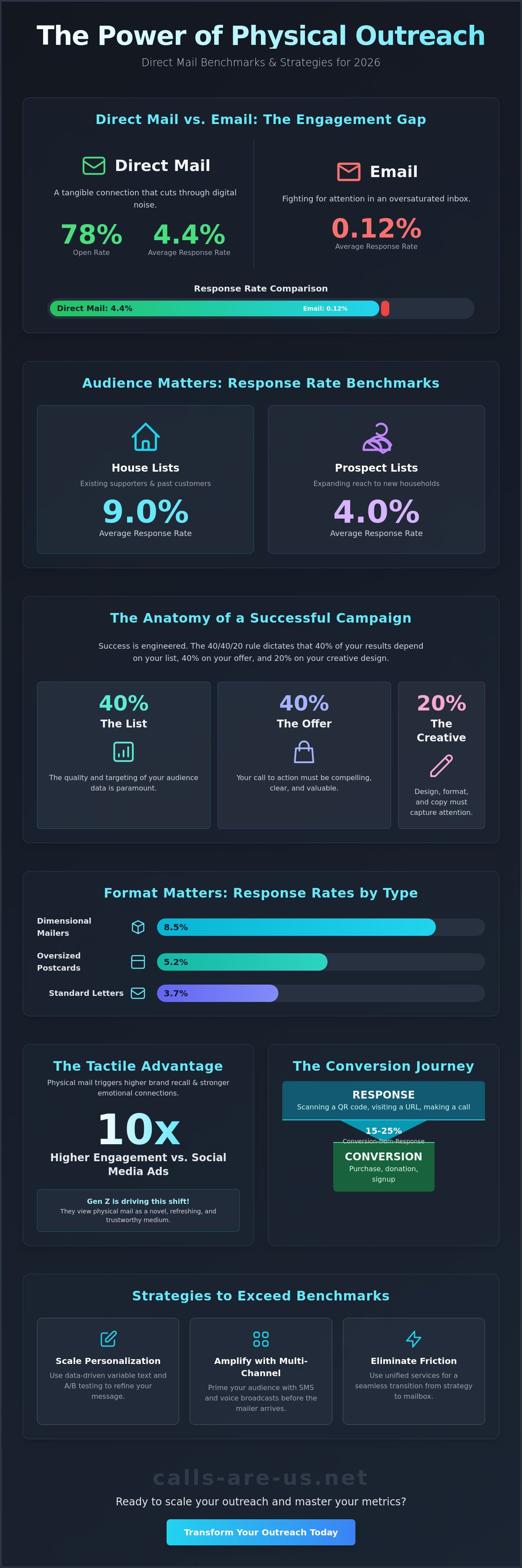
While digital inboxes overflow with ignored notifications, 78% of direct mail is opened by recipients who value the tangible. This physical connection drives average direct mail response rates of 4.4%, a figure that dwarfs the 0.12% often seen in saturated email channels. Digital noise is deafening. You've likely watched your digital ad costs climb while engagement in crowded inboxes continues to plummet. It's a struggle to prove ROI when your message feels fleeting and easily ignored.
You can master the metrics of physical outreach with our comprehensive guide to benchmarks and optimization strategies for 2026. We'll provide the data you need to satisfy stakeholders, share actionable tactics to increase engagement, and offer a framework for multi-channel success. This guide explores how house lists reach response rates up to 9.0%, why oversized postcards outperform standard letters, and how tracking mechanisms like QR codes bridge the gap between physical and digital worlds. You'll gain a sophisticated understanding of how to transform cold prospects into loyal connections through high-impact, physical touchpoints.
Key Takeaways
Benchmarking success requires precision. Learn how to distinguish between house and prospect list performance to accurately forecast your direct mail response rates.
Master the 40/40/20 rule of campaign performance. Prioritize high-quality data and compelling offers to ensure your physical outreach achieves maximum impact.
Amplify engagement through multi-channel synchronicity. Discover how to use SMS and voice broadcasts to prime your audience before their mailer even arrives.
Scale personalization beyond the basics. Deploy data-driven variable text and A/B testing frameworks to move your metrics from industry average to exceptional.
Eliminate operational friction with unified fulfillment. Transition seamlessly from strategy to the mailbox by leveraging integrated voice, text, and direct mail services.
Table of Contents
Defining Direct Mail Response Rates: 2026 Industry Benchmarks
Precision is the foundation of high-stakes outreach. A direct mail response rate measures the exact percentage of recipients who take a tracked action, such as scanning a code, making a call, or visiting a specific URL. In a landscape crowded by digital noise, these metrics provide the clarity needed to evaluate influence and impact. Direct mail response rates remain a primary indicator of how well your message resonates with a physical audience. They represent a conscious choice by the recipient to engage with your brand in their own home.
To understand the current environment, you must distinguish between your audience segments. House lists, which include your existing supporters and past customers, currently see benchmarks between 8% and 10%. Cold prospect lists, used for expanding your reach to new households, typically hover between 3% and 5%. While digital platforms often struggle with bot traffic and fleeting impressions, Advertising mail provides a verifiable, physical bridge to your audience. This physical presence ensures your message is handled, considered, and acted upon.
To better understand this concept, watch this helpful video:
Calculating your Return on Investment (ROI) requires looking beyond the initial cost per piece. Direct Mail ROI is defined by the total value of high-intent conversions, like a major donation or a secured vote, weighed against the total campaign expenditure. For those operating in high-value sectors like real estate, you might visit County Properties to see how specialized local guidance is used to drive these significant results. A single high-value conversion from a mailer often outweighs hundreds of low-cost, low-impact digital clicks that fail to move the needle. It's about the quality of the connection rather than the quantity of the impressions.
Response Rate vs. Conversion Rate
Engagement is the first gate. A response occurs when a recipient scans a QR code, visits a Personalized URL (PURL), or dials a unique toll-free number. However, a conversion is the final desired action, such as completing a purchase or signing a petition. In 2026, national organizations often see conversion-from-response ratios of 15% to 25%. Modern tracking tools allow us to see exactly where a recipient pauses in that journey, providing the data needed to refine the path from the mailbox to the final goal.
The 2026 Digital-to-Physical Gap
Physical mail engagement remains nearly 10x higher than social media advertising. This "Tactile Advantage" is rooted in how our brains process physical objects; touchpoints trigger higher brand recall and stronger emotional connections than pixels on a screen. Surprisingly, Gen Z is driving a significant portion of this shift. This generation, raised in a digital-first world, views physical mail as a novel and trustworthy medium. They're responding to well-designed mailers at increasing rates, seeing them as a refreshing break from the saturated digital environment.
Variables That Dictate Your Campaign Performance
Success in physical outreach is never accidental. It's the result of a disciplined approach known as the 40/40/20 rule. This framework establishes that 40% of your results depend on the quality of your list, 40% on the strength of your offer, and 20% on the creative design. When you align these three pillars, your direct mail response rates move from baseline averages to exceptional benchmarks. You aren't just sending mail; you're engineering a connection.
Format choice serves as your first impression. Data from Direct Mail ROI & Response Rate Statistics shows that oversized postcards (6x11 or larger) typically achieve a 5.2% response rate. In contrast, standard letters in envelopes hover around 3.7%. While postcards offer immediate visual impact, dimensional mailers like boxes or tubes can skyrocket engagement to 8.5%. Choosing the right format requires balancing your budget with the depth of the message you need to convey.
Friction is the enemy of action. In 2026, your call to action (CTA) must be effortless to follow. Whether you use a scannable QR code, a personalized URL, or a dedicated phone number, the path from the mailbox to the response must be seamless. Timing also plays a critical role. Orchestrating your "drop dates" to coincide with specific events or seasonal shifts ensures your message arrives when your audience is most receptive. For those looking to streamline these complex variables, integrated direct mail solutions provide the technical infrastructure needed for precision execution.
List Hygiene and Targeting Precision
Data integrity is your most valuable asset. Utilizing National Change of Address (NCOA) updates is mandatory to protect your response rates from the erosion of outdated records. Move beyond broad demographics by employing predictive modeling to identify "likely responders" who share traits with your best supporters. For real estate professionals, this involves targeting high-intent segments like FSBOs or expired listings; you can find out more about accessing this specialized data. Effective list segmentation allows you to tailor your message to specific sub-groups, often doubling your engagement without adding a single piece to your total mail volume.
Creative and Format Impact
Visual hierarchy dictates focus. Your mailer must guide the recipient's eye to the primary offer and the response mechanism in under three seconds. Use personalized-look fonts to create a "handwritten" effect, which continues to drive higher open rates by adding a human touch to the interaction. While postcards win for immediate impact, traditional envelopes remain the gold standard for confidential messaging or complex storytelling that requires a more formal presentation.
The Multi-Channel Multiplier: Integrating Mail with Voice and Text
Isolation is the enemy of influence. While physical mail offers a tangible connection that digital channels cannot replicate, it is most effective when it serves as the cornerstone of a broader communication ecosystem. It doesn't exist in a vacuum. Instead, it provides the physical foundation for a political direct mail strategy that leverages vocal and digital touchpoints to reinforce a single, powerful message. By surrounding your audience with consistent messaging, you create a "surround sound" effect that drives higher recall and action.
Data consistently proves the value of this integrated approach. According to 2026 Direct Mail Response Rate Benchmarks, campaigns that combine mail with digital reinforcement see significantly higher engagement levels. Industry research suggests that multi-channel campaigns can achieve up to a 28% lift in response rates compared to standalone mailers. This synergy ensures your direct mail response rates don't just hit benchmarks but consistently exceed them through strategic repetition across channels.
SMS and Direct Mail Synergy
Mobile engagement primes the mailbox for success. Sending a "Look for it in your mail" text message can increase open rates by alerting the recipient to an incoming physical touchpoint before they even reach their front door. You can also use peer-to-peer (P2P) texting to handle immediate questions generated by a mail piece, providing a real-time bridge between physical and digital worlds. This coordination creates a unified brand experience where every interaction feels intentional, timely, and deeply personal.
Voice and IVR Integration
Automated outreach drives physical action with remarkable efficiency. Using voice broadcasts to remind recipients of a mailer’s call to action creates a sense of urgency that physical paper alone may lack. Interactive Voice Response (IVR) systems then serve as a high-response intake method for mail-driven inquiries, allowing recipients to respond via phone at their convenience. For technical implementation details on these systems, refer to our guide on political voice broadcasting. This integrated approach transforms a simple mailer into a comprehensive advocacy engine.
Optimization Tactics to Exceed National Averages
Data-driven refinement is the bridge between baseline performance and market leadership. While industry benchmarks provide a necessary starting point, achieving superior direct mail response rates requires a relentless focus on testing, personalization, and offer strength. Refinement is mandatory. You cannot rely on luck when the stakes of your outreach are this high. Our framework focuses on three critical levers: the precision of the data, the relevance of the message, and the clarity of the call to action.
Offer strength remains the primary engine of your campaign. You might have the most sophisticated creative in the world, but if the incentive doesn't resonate with the recipient's immediate needs, they won't act. A compelling offer should feel exclusive, urgent, and valuable. Every response must be captured with absolute accuracy. Utilizing QR codes and PURLs ensures that every scan or click is instantly attributed to the specific mailer in your CRM, allowing for real-time campaign adjustments and precise ROI calculations.
When you are ready to implement these high-performance strategies, partner with Calls-Are-Us to deploy data-driven direct mail campaigns that deliver measurable results.
A/B Testing Frameworks
Statistical significance is the goal of every test. We recommend testing one variable at a time to isolate exactly what drives the lift in engagement. This methodical approach allows you to identify the winning combination of headlines, colors, and CTA placements. Consider using these testing priorities:
Headlines: Test emotional appeals against benefit-driven statements.
Visuals: Compare the impact of photography versus clean, graphic illustrations.
CTA Placement: Determine if a front-side QR code outperforms a back-side placement.
Small test drops allow you to validate your hypothesis before committing to a full national distribution, protecting your budget and ensuring maximum impact.
Advanced Personalization
Variable Data Printing (VDP) has transformed physical outreach in 2026. This technology allows you to move beyond generic greetings and instead map local issues or specific donor history directly onto your national mailers. This level of relevance makes the recipient feel seen and understood, and you can learn more about how Linemark executes these complex personalization strategies. By integrating personalized imagery that reflects the recipient's specific community or previous interactions, you significantly increase the emotional resonance and trust required for conversion. This transition from "mass mail" to "personal correspondence" is what drives exceptional engagement in a crowded marketplace.
Scaling Your Outreach with Calls-Are-Us
Execution is the final differentiator between a theoretical benchmark and a successful outcome. While understanding direct mail response rates is essential for planning, the ability to scale that outreach without losing precision is what defines market leaders in 2026. High-stakes communication demands a partner who manages the entire lifecycle of a campaign, from the first data upload to the final delivery in the recipient's mailbox. We provide the logistical backbone that allows your organization to move from strategy to implementation with absolute confidence.
Complexity often introduces friction that erodes your ROI. By utilizing a unified provider for direct mail, voice broadcasts, and text messaging, you eliminate the silos that typically hinder national advocacy efforts. This integrated approach ensures that your messaging remains consistent, your data stays secure, and your timing is perfectly synchronized across every channel. Leaders trust us to navigate the regulatory and operational complexities of large-scale outreach, allowing them to focus on the impact of their message rather than the mechanics of its delivery.
Integrated Fulfillment Services
Seamless distribution begins with data integrity. Our mass communication strategy aligns your digital and physical channels into a single, high-performance workflow. We streamline the transition between your supporter lists and our physical distribution centers through a methodical three-step process. First, we perform rigorous data validation to ensure every record is accurate. Second, we utilize union-standard printing to maintain the highest quality of creative output. Third, we manage the sorting and postage logistics to guarantee timely arrival. This rigorous attention to detail protects your direct mail response rates by ensuring your mailers reach the right hands at the right moment.
Partnering for Impact
Scalability is the engine of national influence. We offer more than just fulfillment; we provide a scalable infrastructure that grows alongside your organization's evolving needs. Our expertise in political campaign call centers allows us to support your physical mailers with live calling and IVR systems that capture and convert interest in real time. Whether you are launching a local initiative or a national advocacy campaign, we provide the technical sophistication and human-centric core required for success. Contact us today to design a response-driven campaign that transforms your vision into measurable, large-scale impact.
Mastering the Future of Physical Outreach
Elevating your outreach requires a transition from traditional mailing to a sophisticated, data-driven ecosystem. You've seen how the 40/40/20 rule and advanced personalization transform standard metrics into exceptional results. Integrating physical touchpoints with voice and text creates a unified experience that digital-only channels simply cannot match. This multi-channel approach is the most effective way to ensure your direct mail response rates consistently outperform industry averages and drive meaningful connections.
Precision execution is the final piece of the puzzle. We've operated in over 40 states, bringing a wealth of expertise in high-volume national outreach to every partnership. Our integrated fulfillment platform combines voice, text, and mail to streamline your workflow, maximize impact, and maintain data integrity. Design your high-response direct mail campaign with Calls-Are-Us today to secure your place as a leader in the 2026 communication landscape. Your message deserves a partner that values precision and results as much as you do. We look forward to helping you make a lasting impression.
Frequently Asked Questions
What is a good direct mail response rate for a prospect list?
A good response rate for a cold prospect list typically ranges between 2% and 4.9%. If you utilize highly targeted data or niche lists, these numbers can climb to between 3% and 7%. These benchmarks represent the standard for successful outreach to individuals who have no prior relationship with your organization.
How do direct mail response rates compare to email marketing in 2026?
Direct mail response rates are significantly higher, averaging 4.4% compared to email's 0.12%. The physical nature of mail ensures a 78% open rate, which is nearly four times higher than the 20% average for digital inboxes. This tangibility creates a lasting impression that fleeting notifications cannot replicate in a saturated digital environment.
Can I track direct mail responses in real-time?
Real-time tracking is standard in 2026 through the use of QR codes, personalized URLs, and dedicated phone numbers. When a recipient scans a code or visits a PURL, the action is instantly recorded in your CRM. This allows your team to trigger immediate follow-up via peer-to-peer texting or voice broadcast to capitalize on the engagement.
What mailer format gets the highest response rate?
Dimensional mailers, such as boxes or tubes, achieve the highest engagement at approximately 8.5%. For high-volume campaigns, oversized postcards (6x11 or larger) outperform standard letters with a 5.2% average. These formats demand attention through their unique size, physical presence, and immediate visual impact.
How does multi-channel marketing affect direct mail ROI?
Integrating mail with digital channels provides a 28% lift in overall performance. By using SMS to prime the mailbox and voice broadcasts to follow up after the drop, you create multiple touchpoints that reinforce your message. This "surround sound" strategy significantly improves the return on your investment by keeping your organization top-of-mind.
Does the timing of a mail drop impact the response rate?
Timing is a critical variable for national engagement and deliverability. Dropping mail to coincide with specific events, pay cycles, or seasonal shifts ensures your message arrives when recipients are most receptive. Precision scheduling prevents your mailer from being lost in holiday surges or heavy election-cycle clutter.
How do I calculate the response rate for my direct mail campaign?
Calculate your rate by dividing the number of tracked responses by the total number of pieces mailed, then multiply by 100. For example, receiving 440 responses from 10,000 mailers equals a 4.4% rate. This simple formula provides the baseline data needed to evaluate campaign success and present findings to stakeholders.
Are direct mail response rates declining with the rise of digital media?
Response rates are actually increasing as digital fatigue sets in across all demographics. Physical mail stands out in 2026 precisely because it is tangible, personal, and trustworthy. Gen Z recipients are showing higher engagement levels than previous years, viewing physical mail as a refreshing and high-impact alternative to digital noise.


Comments