
Direct Mail Response Rates: 2026 Benchmarks and Strategic Insights

Updated: Jul 28
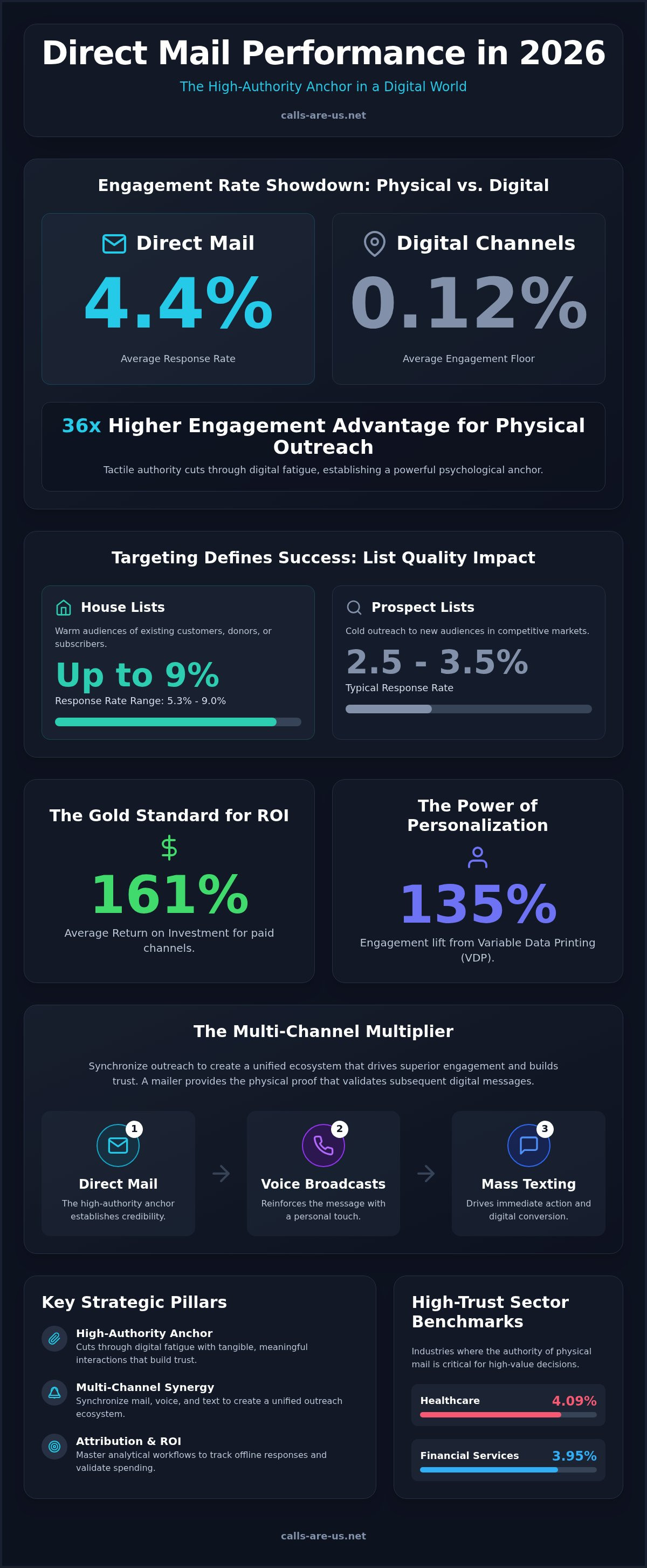
While digital channels struggle with a 0.12 percent engagement floor, direct mail response rates have surged to an average of 4.4 percent in 2026. This isn't just a nostalgic comeback. It's a strategic shift toward high-authority, tangible communication that demands attention in an era of digital exhaustion. You're likely feeling the strain of rising postage costs and the pressure to prove ROI in a fragmented market. It's difficult to invest in physical mail without a clear path to attribution or a guarantee of impact.
We're here to bridge that gap by showing you exactly how to navigate the 2026 benchmarks while using multi-channel integration to turn every mailer into a high-performance asset. You'll discover how house lists are achieving response rates as high as 9 percent and why the 161 percent average ROI of direct mail remains the gold standard for paid channels. This article provides a comprehensive breakdown of industry-specific data, the impact of AI-powered personalization, and the tactical steps to combine mail with voice and text messaging for a unified outreach engine that drives superior engagement.
Table of Contents
Direct Mail Response Rate Benchmarks in 2026
Physicality creates permanency. In a landscape where digital notifications vanish with a single swipe, the weight of a mailer in a recipient's hand establishes an immediate psychological anchor. Current data confirms that direct mail response rates have maintained a robust 4.4 percent average in 2026, a figure that dwarfs the 0.12 percent engagement floor seen in email marketing. This performance gap highlights a 36-fold advantage for physical outreach, proving that tactile authority is a primary driver of modern engagement. In fact, 95 percent of recipients interact with their physical mail daily, providing a level of visibility that digital platforms simply cannot replicate.
This resurgence isn't accidental. It's the result of a quality over quantity shift. For a deeper understanding of these mechanics, this Direct Mail Overview provides foundational context on how physical mailers have evolved from simple circulars into precision-targeted tools. Today, the most effective campaigns treat mail as the high-stakes anchor of a multi-channel ecosystem. It demands attention, builds trust, and drives action. It establishes the credibility required to support subsequent voice broadcasts or text messages, ensuring your message isn't just seen, but respected and remembered.
Prospect vs. House Lists: Setting Realistic Expectations
Data-driven targeting dictates your ceiling. While the broad average is impressive, the distinction between warm and cold audiences is stark. House lists, comprised of existing donors or previous customers, are currently yielding response rates between 5.3 percent and 9 percent. These individuals have already established a connection with your brand, making them far more receptive to physical touchpoints. Conversely, prospect lists for cold outreach typically hover between 2.5 percent and 3.5 percent in high-competition markets. Success here relies heavily on list hygiene; removing dead mail addresses and refining segments ensures your budget is spent on active, high-intent recipients rather than empty mailboxes.
2026 Conversion Metrics: Moving Beyond the Initial Response
Engagement is the gateway, but conversion is the goal. A response signifies interest, yet a conversion represents a completed action, whether that is a donation, a vote, or a purchase. In high-saturation sectors like healthcare and financial services, conversion rates are holding steady because physical mail fosters the trust necessary for high-value decisions. Healthcare campaigns are seeing engagement levels around 4.09 percent, while financial services follow closely at 3.95 percent. These industries rely on the authoritative nature of mail to communicate complex information. By providing a tangible reference point, you eliminate the scam perception often associated with unsolicited digital links, paving a clear path toward a final commitment.
Variables That Move the Needle: List Quality and Format
Precision defines performance. While list quality remains the primary engine for success, the physical format acts as the transmission, determining how effectively your message reaches the recipient's conscious mind. Data-driven targeting is the single most important factor in determining direct mail response rates; without a clean, segmented, and up-to-date list, even the most beautiful design will fail to convert. Recent industry benchmarks show that personalization through Variable Data Printing (VDP) can generate a 135 percent lift in engagement compared to generic mailers.
Strategic timing is equally critical. The modern "Rule of Seven" suggests that recipients need multiple touchpoints across different channels before they take action. In a multi-channel context, a well-timed mailer should arrive just as a digital campaign reaches its peak, providing the physical proof that validates your electronic messaging. This layered approach ensures that your message is not just seen, but felt and remembered.
The Power of Personalization in High-Stakes Outreach
Generic messaging is no longer sufficient. Moving beyond "Dear Resident" to data-specific messaging allows you to address the unique concerns of specific voter or customer segments directly. Personalized QR codes are now the standard for bridging the gap between physical mail and digital action, allowing for seamless attribution and immediate tracking. Variable Data Printing is a digital printing method that allows specific elements such as text, graphics, and images to be changed from one printed piece to the next using information from a database. This level of customization ensures that direct mail response rates remain high by making every recipient feel like the sole focus of the outreach.
Mailer Format Impact: Postcards, Letters, and Dimensional Mail
Format choice should always align with your campaign's specific objectives. Postcards offer a high-visibility, low-friction option for rapid awareness; they are often the first thing a recipient sees in their stack. To maximize this impact, We Mail America provides full-service production for postcards and custom mailers that stand out in the mailbox. For more complex policy discussions or high-value financial offers, personalized letters in envelopes establish a level of authority and trust that a postcard cannot match.
Research into modern consumer behavior, such as the analysis found in Why Catalogs Are Making a Comeback, highlights how physical formats provide a sensory experience that digital ads lack. Dimensional mail, often referred to as "lumpy" mail, achieves nearly 100 percent open rates in competitive markets because it triggers immediate human curiosity. To ensure your physical mailers are reinforced by immediate vocal touchpoints, you might consider how integrated outreach can synchronize your delivery with a follow-up call.
The Multi-Channel Multiplier: Integrating Voice and Text
Isolation is the enemy of engagement. While physical mailers carry an inherent weight and authority, they lack the immediate urgency of digital communication. Integrating these channels creates a "Surround Sound" effect that significantly elevates direct mail response rates by ensuring your message is heard, seen, and felt across multiple touchpoints. Research into Direct Mail Response Rate Benchmarks suggests that campaigns combining mail with digital follow-ups can see response rates jump as high as 27 percent. By coordinating your delivery with political voice broadcasting, you transform a passive piece of paper into an active, anticipated document.
Speed is often cited as the primary drawback of physical mail. Voice and text solve this by providing the real-time velocity that mail lacks. You can use SMS to "prime" the mailbox, sending a brief notification a day before the mailer arrives to increase anticipation. This strategy removes the friction of cold outreach. It builds a bridge between the digital world where your audience lives and the physical world where your authority is established. It's about creating a unified narrative that follows the recipient from their mobile screen to their front door.
Coordinating with Voice Broadcast and IVR
Anticipation drives action. A simple "look for this in your mail" voice broadcast can dramatically increase open rates by giving the recipient a reason to scan their daily delivery for your specific branding. Once the piece is in hand, Interactive Voice Response (IVR) systems allow for immediate, automated data collection when recipients call the number on your mailer. For more complex inquiries, a professional political campaign call center provides the human touch needed to handle high-volume leads generated by the mailer. This tripartite approach, broadcast, mail, and live support, ensures no opportunity for connection is lost.
Strengthening Mail with Mass and P2P Texting
Follow-up is the final piece of the ROI puzzle. Sending a text message 24 hours after a mailer hits the doorstep serves as a gentle nudge that reinforces the physical message. When choosing your method, consider the strategic differences of P2P vs broadcast texting to determine which fits your campaign's scale. P2P texting allows for a two-way dialogue that can answer specific questions raised by the mailer, while mass texting provides the broad reach necessary for urgent reminders. This synchronization ensures your outreach isn't just a series of random pings; it's a cohesive, authoritative campaign that commands respect and drives results.
Political and Advocacy Benchmarks: A High-Stakes Analysis
Elections are won at the doorstep. While commercial sectors aim for market share, political campaigns use direct mail to secure fundamental commitments in high-pressure environments. In 2026, direct mail response rates for political advocacy and nonprofit sectors are outperforming general retail averages, often reaching between 5 percent and 9 percent for established house lists. This surge is driven by a need for unfilterable communication; physical mail bypasses the algorithmic shadow-banning and digital noise that frequently suppress advocacy messaging on social platforms. It provides a managed, tracked, and optimized channel for reaching voters without interference.
Physical mailers provide a tangible record of a candidate's platform or an organization's mission. They offer a sense of permanence that digital ads lack, fostering the long-term donor loyalty essential for multi-year advocacy. By delivering a message directly into the hands of a voter, you establish an authoritative presence that digital platforms cannot censor or ignore. This physical connection is a powerful tool for securing high direct mail response rates, as it requires a level of engagement that a scrolling feed simply cannot match.
Voter Contact Response Trends in National Elections
Access determines influence. Mail remains the most reliable method for reaching rural voters and low-bandwidth blocks where digital connectivity is inconsistent. Measuring success in this context requires a shift in perspective; you aren't just looking for clicks, but for polling shifts and direct contributions. A sophisticated voter outreach strategy uses high-impact mail to anchor these broader metrics, ensuring your message permeates every corner of the district. It serves as the authoritative foundation for your campaign's narrative, providing voters with a physical document they can reference, discuss, and trust.
Fundraising vs. GOTV: Distinct Metrics for Success
Distinct goals require distinct metrics. Fundraising mailers are judged by immediate ROI, often tracked through return envelopes or dedicated online portals, with house lists delivering an average ROI of 161 percent. Conversely, Get Out The Vote (GOTV) mailers focus on turnout benchmarks, using social pressure tactics to remind voters of their civic duty and upcoming deadlines. A high-performance political direct mail strategy balances these objectives by alternating between persuasive storytelling and urgent, data-backed reminders. If you are ready to scale your impact across national borders, Calls-Are-Us provides the integrated infrastructure needed for high-stakes voter contact.
Maximizing Your ROI: From Data to Delivery
Attribution serves as the definitive heartbeat of a successful modern campaign. In 2026, simply distributing mail is insufficient; you must possess the technical capability to identify exactly which creative, list segment, or drop date triggered the recipient's action. This granular insight is what separates industry-leading direct mail response rates from generic, wasted budgets. By adopting an authoritative visionary approach to data, you can use advanced analytics to refine your segments, ensuring that every subsequent drop is more efficient than the last. True leadership in communication requires a commitment to transparency and a refusal to accept vague, anecdotal results.
Tracking and Attribution: Bridging the Offline-Online Gap
Bridging the gap between the mailbox and the server requires a structured technical approach. Implementing unique tracking phone numbers for every specific mail drop allows you to isolate the source of every incoming call with absolute certainty. Similarly, QR codes and Personalized URLs (PURLs) provide a direct line of sight into digital engagement triggered by physical mail, allowing you to track the recipient's journey from paper to screen. Integrated IVR systems facilitate immediate data capture from respondents, providing real-time feedback on mailer performance that allows for rapid campaign adjustments. These tools effectively reduce friction, making it effortless for the recipient to respond via their preferred channel without hesitation.
Scalable Delivery with Calls-Are-Us
Scaling your impact demands a sophisticated operational framework. Transitioning from a local pilot to national mass communication strategies requires a partner that understands the intricate logistics of high-volume delivery. Calls-Are-Us manages the complex requirements of national outreach while maintaining a unified narrative across the 40 states we serve. Our integrated platform offers an intuitive, unified dashboard where you can monitor mail, voice, and text metrics in a single view. This centralized oversight ensures your campaign remains consistent, professional, and results-driven across every zip code. By streamlining your delivery and data collection, you protect your brand's integrity and maximize your direct mail response rates through operational excellence and ethical, high-stakes communication.
Mastering the Future of Tangible Outreach
Direct mail has proven its resilience by offering a tactile authority that digital channels simply cannot match. By focusing on high-quality house lists and precision-targeted formats, your campaign can achieve direct mail response rates that significantly outperform the digital average. Success in 2026 relies on this physical anchor, but it's the strategic integration of voice and text touchpoints that truly scales your impact across diverse voting blocks and rural districts.
You now have the benchmarks and strategic insights to transform your outreach into a high-performance engine. With expertise in over 40 states and an integrated multi-channel platform, we provide the authoritative leadership needed for complex political and advocacy environments. Optimize your voter outreach with Calls-Are-Us integrated direct mail and voice services to ensure your message commands the attention it deserves. Your vision for meaningful connection is within reach, and the right tools will help you achieve it.
Frequently Asked Questions
What is a good response rate for direct mail in 2026?
A good response rate typically averages around 4.4 percent for prospect lists, while house lists often see engagement between 5 percent and 9 percent. These figures represent a high-authority benchmark for physical outreach in a digital-first market. Achieving these numbers requires clean list hygiene and a strategic choice of format, such as oversized postcards or dimensional mailers that demand immediate attention.
How does direct mail response compare to email marketing?
Physical mailers consistently outperform email marketing by a factor of 36 to 1. While the average email response rate hovers around 0.12 percent, direct mail response rates remain robust at 4.4 percent. This massive performance gap exists because physical mail demands attention in a way that easily ignored digital notifications cannot match, providing a tangible anchor for your message that recipients often keep for days.
Does personalization really increase direct mail response rates?
Yes, personalization through Variable Data Printing can increase response rates by as much as 135 percent. By moving beyond generic greetings to data-specific messaging, you create a sense of direct partnership with the recipient. This human-centric approach transforms a standard mailer into a personalized interaction, significantly lifting the likelihood of a completed action, a donation, or a vote in high-stakes environments.
What industry has the highest direct mail response rate?
The nonprofit and fundraising sectors currently report the highest engagement, with response rates frequently ranging from 5 percent to 9 percent. High-stakes industries like healthcare and financial services follow closely, maintaining rates around 4 percent. These sectors rely on the inherent trust and authority of physical mail to communicate complex, sensitive information that requires a high level of recipient confidence and a physical record.
Can I track the response rate of a physical mail campaign?
You can track physical campaigns with high precision using unique tracking phone numbers, QR codes, and Personalized URLs (PURLs). These tools bridge the offline-online gap, allowing you to attribute every response to a specific mail drop. Integrated IVR systems also provide real-time feedback by capturing automated data from respondents who call the number provided on your mailer, ensuring your attribution remains flawless and actionable.
Is direct mail effective for younger generations like Gen Z?
Direct mail is surprisingly effective for Gen Z because it cuts through the overwhelming noise of their digital-first lives. Younger generations often view physical mail as more personal and trustworthy than digital ads, which they frequently filter out. This tactile authority creates a memorable experience that establishes a meaningful connection with an audience that is otherwise difficult to reach through traditional digital channels alone.
How often should I send direct mail to see a response?
Consistency is vital; the "Rule of Seven" suggests that recipients often need multiple touchpoints across various channels before taking action. Rather than relying on a single drop, you should integrate mail into a broader multi-channel strategy. Coordinating a mailer with a follow-up voice broadcast or text message creates the necessary frequency to move a recipient from initial awareness to a final, verified response.
What is the difference between response rate and conversion rate in mail?
A response rate measures the percentage of recipients who take any initial action, such as scanning a QR code or making a phone call. In contrast, the conversion rate tracks those who complete the ultimate goal, such as casting a vote or submitting a donation. Understanding this distinction allows you to refine your direct mail response rates by identifying where recipients might be dropping off in your engagement funnel.


Comments