_edited.png)
How to Avoid SMS Filtering: The 2026 Guide to Reliable Message Delivery

Updated: Jun 18
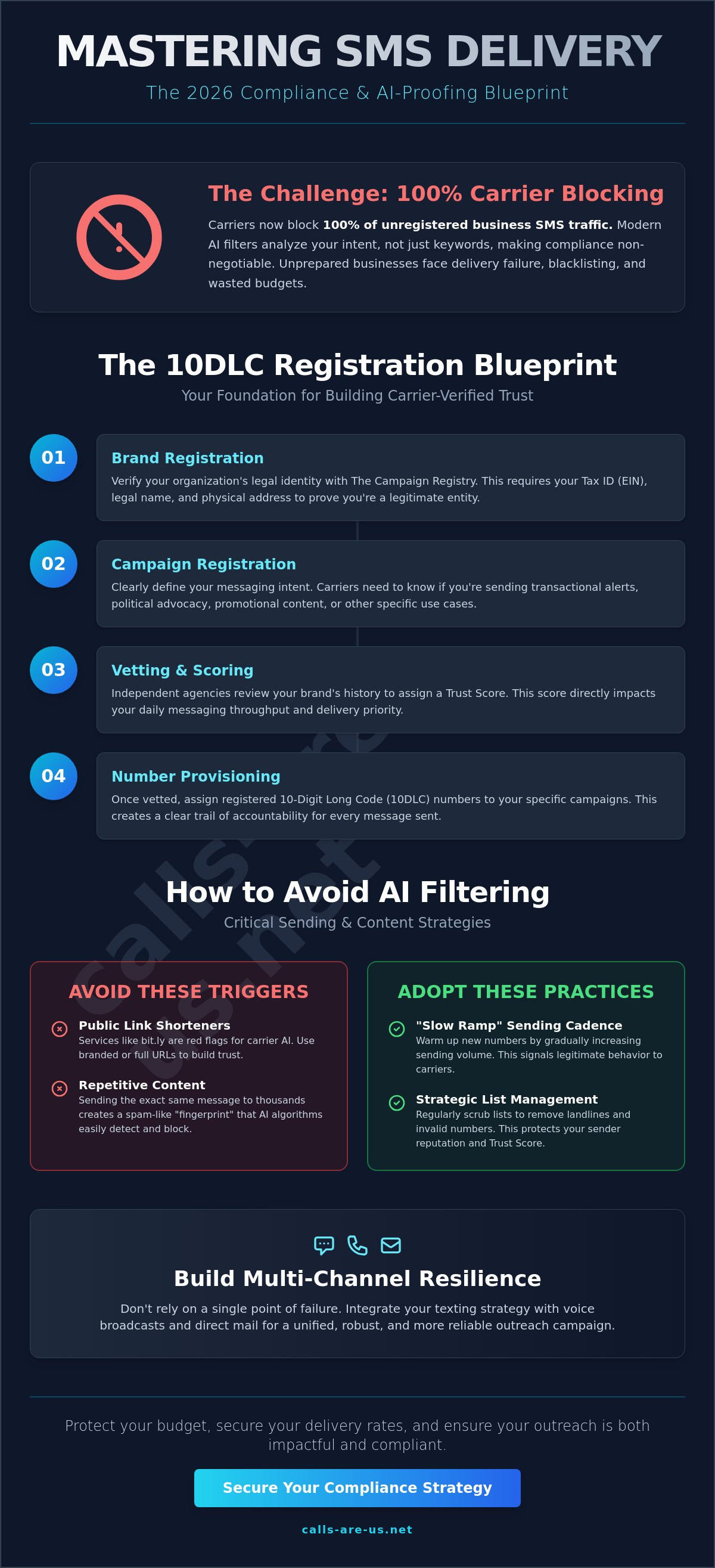
Carriers are now blocking 100% of unregistered business traffic. This aggressive shift in the mobile environment has turned the most effective communication channel into a minefield for the unprepared. If you're struggling with high bounce rates or the fear of carrier blacklisting, you need a strategy that prioritizes structural compliance over simple tactics. Learning how to avoid SMS filtering is no longer about finding loopholes; it's about building a foundation of trust that carriers recognize and reward.
You understand that your message matters. It's frustrating when technical barriers stand between you and the people you serve. We've designed this guide to help you master the nuances of 10DLC registration, navigate the new 2026 TCPA one-to-one consent rules, and optimize your content for real-time AI filters. You'll gain a clear roadmap to achieve 100% compliance, protect your budget from wasted sends, and ensure your outreach remains both impactful and ethical. We will examine the specific technical workflows, regulatory updates, and strategic content shifts required to secure your delivery rates in 2026.
Key Takeaways
Secure your brand identity through the 10DLC blueprint to move from throttled traffic to a foundation of carrier-verified trust.
Discover how to avoid SMS filtering by eliminating public link shorteners and repetitive content fingerprints that trigger modern AI interception algorithms.
Maintain high delivery rates by adopting a "slow ramp" sending cadence and scrubbing lists to remove landlines that damage your sender reputation.
Build a more reliable outreach strategy by integrating texting with voice broadcasts and direct mail for a unified, multi-channel approach.
Table of Contents
Understanding Carrier Filtering: Why Modern SMS Delivery Fails
Carrier filtering is an automated defense mechanism. It functions as a high-speed gatekeeper that analyzes, categorizes, and intercepts high-volume traffic to protect mobile users. In the early years of mobile marketing, filters relied on basic keyword blocks to stop unwanted messages. Modern systems now use advanced AI to perform deep behavior analysis on every send. Understanding Understanding Messaging Spam is essential because carriers now look for patterns of intent rather than just specific words. Learning how to avoid SMS filtering in this environment requires you to align your strategy with these intelligent algorithms.
Delivery failures happen at two distinct levels. Network-level filtering occurs when a carrier's infrastructure blocks your message before it reaches the recipient's device. Handset-level blocking happens when a user identifies your message as unwanted and manually blocks your number. If you ignore these signals, you risk more than just a low conversion rate. You face significant financial penalties, permanent carrier blacklisting, and the total erosion of your brand's digital trust.
To see how users interact with unknown senders on their devices, watch this helpful video:
The Rise of A2P 10DLC and Its Impact
A2P 10DLC stands for Application-to-Person 10-Digit Long Code. It's the mandatory standard for all business messaging in the United States. As of February 1, 2025, carriers have moved to a total block of all unregistered A2P traffic. This means that if you haven't registered your brand and your specific campaign, your messages won't get through. Many teams mistakenly believe they've been "shadow banned" by a specific carrier, but this delivery failure is almost always a direct result of incomplete or rejected registration.
How Carrier AI Evaluates Your Intent
Carrier algorithms are designed to measure your reliability through three critical metrics: delivery success, opt-out frequency, and the use of "STOP" keywords. These factors combine to create a Trust Score. This score determines your daily throughput and your priority in the delivery queue. Developing a successful mass communication strategy requires you to treat this score as a vital business asset. Mastering how to avoid SMS filtering involves maintaining a high Trust Score through transparent opt-in practices and relevant content. When your AI-evaluated intent appears suspicious, carriers protect their customers by throttling your speed or severing your connection entirely.
The 10DLC Registration Blueprint: Building a Compliant Foundation
Trust is the currency of the 2026 messaging ecosystem. You can't rely on luck or legacy tactics to get your messages through. A structural alignment with the 10DLC (10-Digit Long Code) framework is the only way to secure a permanent path to the inbox. Adhering to FCC guidelines on unwanted texts protects your brand from legal scrutiny, establishes your reputation as a responsible sender, and secures your connection to your audience. This registration blueprint is the most effective way to understand how to avoid SMS filtering while building long-term digital authority.
Step 1: Brand Registration. You must verify your organization's legal identity with The Campaign Registry. This involves providing your Tax ID (EIN), legal name, and physical address to prove you're a legitimate entity.
Step 2: Campaign Registration. This step defines your intent. Carriers need to know if you're sending transactional alerts, political advocacy, or promotional content.
Step 3: Vetting and Scoring. Independent vetting agencies review your brand's history and industry standing. They assign a numerical score that directly impacts your daily messaging capacity.
Step 4: Number Provisioning. Once vetted, you assign registered 10-digit numbers to your specific campaigns. This creates a clear trail of accountability for every message sent.
Step 5: Ongoing Monitoring. Compliance is not a one-time event. You must audit your opt-out rates, track your delivery metrics, and refine your content to maintain the high trust scores required for reliable delivery.
Brand vs. Campaign Registration Nuances
A single organization often needs multiple campaign registrations to handle different communication styles. For instance, you might use one campaign for critical account alerts and another for general marketing. This separation is strategic. It ensures that if a marketing campaign sees a temporary dip in engagement, your high-priority alerts remain unaffected. Political organizations must submit FEC documentation, whereas 501(c)(3) nonprofits must provide IRS verification. Incomplete registration, mismatched documentation, or failed vetting are the leading causes of registration failure and subsequent filtering. If you're managing complex outreach, our peer-to-peer texting platform simplifies these registration requirements to keep your conversations flowing.
Throughput and Tiers: What You Need to Know
Your Vetting Score is the primary factor determining your daily messaging volume limits. Carriers like AT&T and T-Mobile use this score to place you into specific "trust tiers." Lower tiers face strict throughput caps, while high-trust organizations enjoy much higher limits. Maintaining a "High Trust" status requires a commitment to ethical messaging. You should keep your opt-out rates below industry thresholds, maintain a consistent sending cadence, and ensure your opt-in methods are transparent. By following these methodical steps, you transform your messaging from suspicious traffic into a verified, high-priority communication stream.
Content Optimization: Crafting Messages That Bypass AI Triggers
Your content is your fingerprint. Carriers use AI to analyze every message for repetitive templates that signal low-value automation. If your campaign sends 10,000 identical messages, the system flags it as a fingerprint of spam. Mastering how to avoid SMS filtering requires a shift from static templates to dynamic, high-value communication. By varying your syntax, utilizing dynamic fields, and respecting carrier logic, you ensure your message is treated as a priority interaction rather than a digital nuisance.
Public link shorteners are the most common Link Trap in modern messaging. Services like bit.ly or tinyurl.com are instant triggers for carrier filters because they are frequently exploited by bad actors to hide malicious destinations. Instead, you must use branded, dedicated domains that reflect your organization's identity. This establishes transparency, improves click-through rates, and validates your intent to both the carrier and the recipient. When your domain matches your registered brand, you remove the anonymity that triggers defensive filtering.
Personalize at scale. Use dynamic fields for names, locations, or specific interests to ensure every outgoing message is unique.
Refine your syntax. Avoid the trap of ALL CAPS, excessive punctuation, or a sea of emojis that mimic the visual style of phishing attempts.
Optimize your links. Never place a naked URL at the very beginning or the very end of your message; surround it with context to prove its relevance.
The Golden Rule of Links and CTAs
Transparency drives deliverability. Your call-to-action should be a natural extension of a helpful conversation, not a high-pressure demand. When you use a branded domain, you signal to the carrier that you take responsibility for the destination. Position your link in the middle of the message body to ensure the AI reads the surrounding text as supporting context. This approach encourages genuine engagement and significantly reduces the frequency of STOP replies that can damage your Trust Score.
Avoiding SHAFT and Sensitive Keywords
Certain topics are non-negotiable. The industry acronym SHAFT (Sex, Hate, Alcohol, Firearms, and Tobacco) represents content categories that trigger immediate, non-reversible blocks. Beyond these, you must be wary of soft triggers like free, win, urgent, or debt relief, which AI often associates with predatory behavior. If your outreach involves sensitive topics where keywords might be flagged, political voice broadcasting offers a resilient alternative. It allows you to deliver complex, high-stakes messages through a medium that isn't subject to the same text-based keyword algorithms; this ensures your voice is heard without the risk of digital interception.
Strategic List Management and Sending Cadence
Data integrity is the silent engine of deliverability. You can't reach your audience if your contact list is cluttered with landlines, deactivated numbers, or unverified leads. Carriers monitor your "error rate" closely; a high percentage of failed sends to non-mobile numbers signals a lack of list hygiene. This is a primary reason why learning how to avoid SMS filtering begins with rigorous list scrubbing. By removing invalid entries before you hit send, you protect your sender reputation, maximize your budget, and ensure your messages reach active devices.
The "Slow Ramp" strategy is equally vital for national organizations. Sudden bursts of high-volume traffic often trigger automated "burst" filters that assume your account has been compromised by a bot. Instead of sending your entire campaign at once, you should gradually increase your volume over several days. This methodical approach allows carrier algorithms to recognize your traffic pattern as legitimate and safe. It builds a history of successful deliveries that reinforces your Trust Score across all major mobile networks.
Consent is the Ultimate Deliverability Hack
Consent is both a legal mandate and a technical necessity. Under the 2026 TCPA regulations, you must obtain express written consent on a one-to-one basis. This means a lead generated for one business cannot be shared with others. Your first message sets the tone for the entire relationship. It must clearly identify your brand, state the purpose of the message, and provide a simple opt-out instruction. Managing the opt-out process is your most powerful deliverability tool. Under the 2025 FCC rules, you must process these requests within 10 business days and accept them through any reasonable method, including keyword replies or website forms. Instant processing of "STOP" requests doesn't just keep you compliant; it signals to carriers that you're a responsible sender who respects user preferences.
Volume Control and Timing
Timing is a critical component of professional outreach. Sending messages outside of the standard 8 AM to 9 PM local time window is a red flag that can lead to immediate filtering. This practice, known as dayparting, ensures you respect the recipient's "quiet hours" and comply with industry standards. In the context of peer-to-peer (P2P) messaging, maintaining a "human pace" is essential. Messages should be sent at a speed that mimics real interaction rather than automated mass broadcasting. If you need to scale your reach while maintaining this high level of integrity, our mass texting solutions provide the tools to manage your cadence with precision.
Multi-Channel Resilience: The Calls-Are-Us Advantage
Single-channel dependence is a strategic vulnerability. National organizations cannot afford to have their entire outreach efforts silenced by a single carrier update or a sudden algorithmic shift. While mastering how to avoid SMS filtering is a critical tactical requirement, true resilience requires a diversified approach to communication. We empower you to move beyond the limitations of the inbox by creating a multi-layered strategy that ensures your connection to your audience remains unbreakable.
Meaningful outreach is about more than just hitting a delivery target; it's about fostering genuine connection. By integrating peer-to-peer texting with voice broadcast and direct mail, you create a cohesive narrative that reaches people where they are. This visionary approach transforms your communication from a series of transactional sends into a powerful, multi-channel dialogue that carries the weight of authority and the warmth of partnership.
Managed Compliance: Taking the Burden Off Your Team
Complexity shouldn't be your barrier to entry. Our white-glove approach to A2P 10DLC registration removes the technical and administrative weight from your internal team. We manage the entire lifecycle of your messaging infrastructure through three specific actions:
Brand and Campaign Registration. We navigate the intricate requirements of The Campaign Registry to ensure your legal identity is verified and your use cases are approved.
Rigorous Deliverability Audits. Every campaign undergoes a pre-launch review to identify potential content triggers and optimize your link structures.
Active Traffic Monitoring. Our systems track your delivery metrics in real-time to detect filtering spikes and adjust your strategy before your reputation is impacted.
This managed service ensures that your focus remains on the impact of your message rather than the mechanics of how to avoid SMS filtering. We handle the technical friction so you can focus on the results.
Integrating Voice and Mail for 100% Reach
Redundancy is the hallmark of a professional campaign. If a time-sensitive text message is delayed by a carrier filter, your strategy must automatically pivot to a secondary channel. A missed text can be followed by a personalized Voice Broadcast or an Interactive Voice Response (IVR) call to ensure the information is delivered. For high-stakes voter persuasion or critical organizational updates, direct mail remains the ultimate unfilterable fallback. This physical touchpoint provides a level of permanence and trust that digital channels alone cannot match. You don't have to choose between speed and reliability. Partner with Calls-Are-Us to ensure your message is heard, not filtered, and build a communication framework that stands the test of time.
Securing Your Future in Modern Messaging
Modern communication demands structural integrity. You've seen how carrier AI and mandatory 10DLC requirements have transformed the landscape from a tactical playground into a regulated trust framework. Understanding how to avoid SMS filtering requires you to embrace full registration, craft high-value content, and maintain impeccable list hygiene. These aren't just technical hurdles. They are the markers of a professional organization committed to ethical dialogue and meaningful connections.
You deserve a partner that handles the technical friction while you focus on the impact. We empower your team through managed 10DLC registration, 99% delivery rates on vetted traffic, and a robust national multi-channel infrastructure. This comprehensive support ensures your outreach remains resilient across mass texting, voice broadcasts, and direct mail. By aligning your strategy with carrier expectations, you transform potential blocks into permanent pathways for engagement.
Scale your outreach without the filtering headache-get started with Calls-Are-Us today. Your mission matters too much to be lost in a digital filter. Take the lead, protect your reputation, and connect with your audience with absolute confidence.
Frequently Asked Questions
What exactly is SMS carrier filtering?
SMS carrier filtering is an automated defense mechanism used by mobile network operators to intercept and block suspicious or non-compliant traffic. It functions as a digital gatekeeper, protecting subscribers from spam, phishing attempts, and unwanted commercial content. These systems analyze message volume, content patterns, and sender reputation in real-time to decide whether a message reaches the recipient's handset or is discarded by the network.
How do I know if my campaign messages are being filtered?
Monitoring your delivery logs is the most effective way to detect filtering. If you notice a high volume of messages marked as "undelivered" or see specific carrier error codes, such as the industry-standard code 30007, your traffic is likely being intercepted. A sudden, unexplained drop in engagement rates often indicates that carriers have flagged your sending number or content fingerprint as a risk to their users.
Why is my 10DLC registration taking so long?
Registration timelines are often extended by manual vetting processes and documentation errors. If there's any discrepancy between your legal Tax ID and your registered brand name, The Campaign Registry will trigger a manual review that can take several weeks to resolve. Carriers have also increased their scrutiny of campaign use cases, requiring more detailed descriptions and verified opt-in links before granting final approval for your traffic.
Can I use public link shorteners like Bitly for my campaign texts?
You should avoid public link shorteners because they are a primary trigger for carrier AI. These shared domains are frequently exploited by bad actors, leading carriers to treat them as high-risk indicators of spam. Using branded, dedicated domains is the professional standard for how to avoid SMS filtering. This approach establishes transparency, validates your brand identity, and ensures that your call-to-action remains visible to your audience.
Does peer-to-peer (P2P) texting bypass carrier filters?
P2P texting does not bypass modern filters; carriers now classify nearly all business-related outreach as A2P traffic. While the human-driven pace of P2P can help with certain behavioral triggers, you're still required to register your brand and campaigns under the 10DLC framework. Failure to register P2P traffic will result in 100% blocking by major U.S. carriers, regardless of the sending method or the size of your organization.
What are the most common keywords that trigger SMS spam filters?
Prohibited categories known as SHAFT, which include sex, hate, alcohol, firearms, and tobacco, trigger immediate and total blocks. Beyond these, carriers flag "soft" triggers such as "free," "win," "urgent," and "debt relief" because they mimic the language of predatory scams. AI filters analyze the context of these words, so a message that feels overly transactional or high-pressure is far more likely to be intercepted before delivery.
How can I improve my 10DLC trust score?
Improving your trust score requires a commitment to consistent behavior and high-quality data. You can boost your standing by maintaining low opt-out rates, scrubbing your lists for landlines, and providing clear, transparent opt-in methods during registration. Carriers reward senders who demonstrate a history of successful, engagement-heavy interactions, eventually granting them higher throughput tiers and more reliable access to the mobile network.
What should I do if my number is flagged as 'Scam Likely'?
Register your sending numbers with the Free Caller Registry to verify your organization's identity with all major U.S. carriers. This centralized database allows you to declare your legitimate intent and request that "Scam Likely" or "Spam" labels be removed. If the flag persists, you should pause your campaign to audit your content and consider shifting your outreach to more resilient channels like voice broadcast or direct mail.



Comments