
How to Contact Thousands of Voters Quickly: A 2026 Guide to Scalable Outreach

Updated: Jun 18
In an election cycle where 56% of young voters report they are extremely likely to cast a ballot, your outreach strategy cannot afford to be slow. You have likely felt the frustration of watching calls go unanswered and seeing critical texts get caught in the 10DLC filtering web while the clock ticks down to Election Day. It often feels like the harder you push to scale, the more the technology and regulatory landscape push back. This guide explores exactly how to contact thousands of voters quickly by synchronizing high-speed tools like voice broadcast, mass texting, and live calling into a single, compliant engine.
We understand that winning requires more than just volume; it requires precision, speed, and trust. You will learn to master the latest 10DLC registration requirements, navigate new FCC regulations on AI-generated voices, and implement a multi-channel approach that bypasses filters. We are moving past the era of disconnected tools toward a future of integrated, scalable influence. By the end of this guide, you will have a clear roadmap to deliver rapid messages, achieve high open rates, and simplify your compliance management so you can focus on what matters most: winning the hearts and minds of your constituents.
Key Takeaways
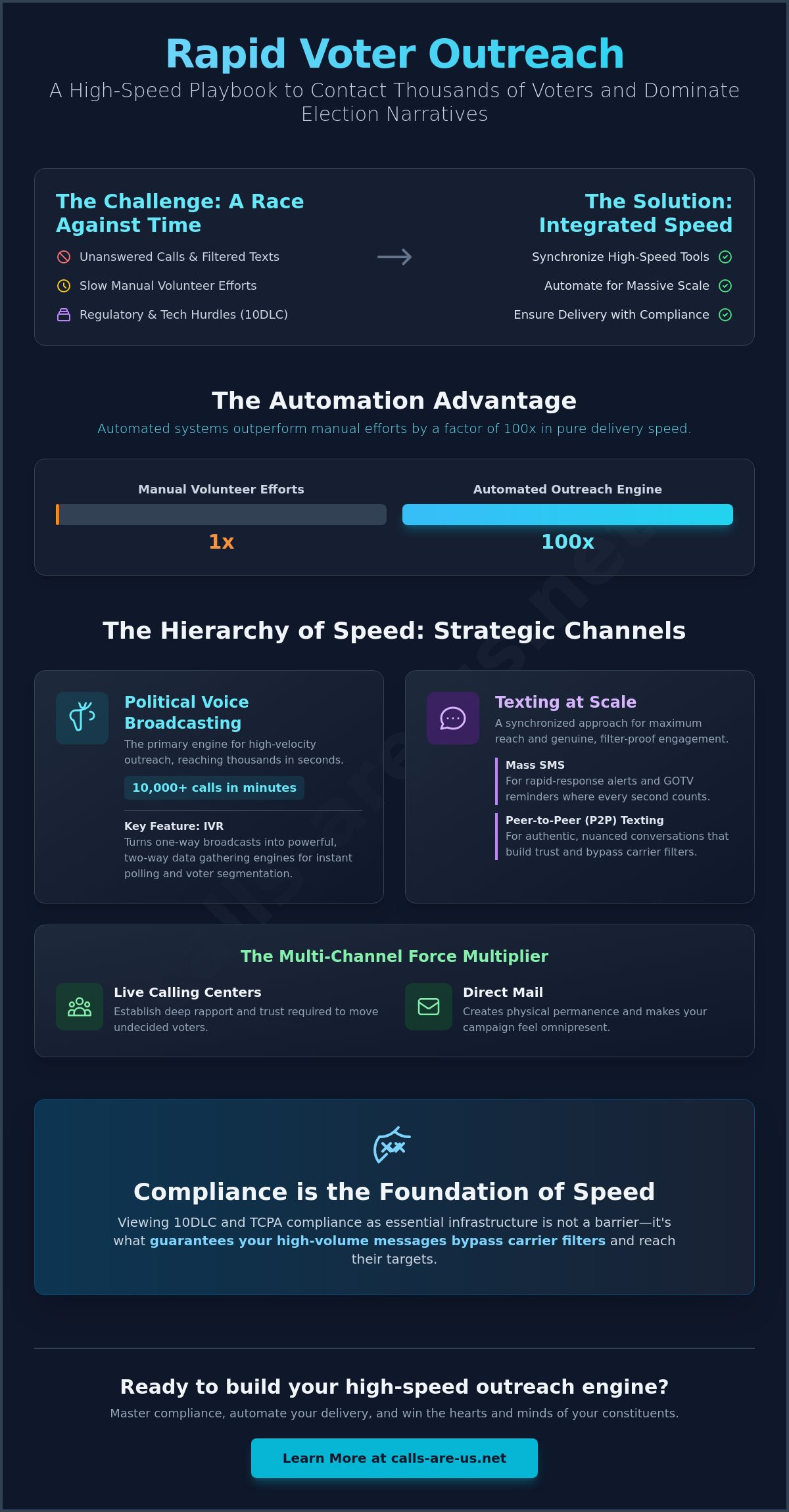
Automate your delivery to outpace manual volunteer efforts by a factor of 100x, securing your ability to dominate late-breaking election narratives.
Learn how to contact thousands of voters quickly by synchronizing mass SMS for reach and peer-to-peer texting for authentic, filter-proof interactions.
Deploy Interactive Voice Response (IVR) and voice broadcasting to turn one-way broadcasts into powerful, two-way data gathering engines.
Integrate live calling centers and direct mail to establish the deep rapport and trust required to move undecided voters toward the ballot box.
View 10DLC and TCPA compliance as essential infrastructure that guarantees your high-volume messages bypass carrier filters and reach their targets.
Table of Contents
The Hierarchy of Speed: Strategic Channels for Rapid Voter Contact
Speed is the lifeblood of a winning campaign. In the high-stakes environment of 2026, time serves as your most valuable currency. When an opponent drops a last-minute attack or a news cycle shifts, your ability to respond determines your survival. Mastering how to contact thousands of voters quickly allows you to seize the narrative before it's set in stone. While manual volunteer efforts are vital for local flavor, automated systems outperform them by a factor of 100x in pure delivery speed. This isn't just about noise; it's about strategic momentum and the power to influence public opinion in real-time.
To better understand how rapid-scale physical outreach can trigger immediate digital and phone responses, watch this helpful video:
Effective outreach requires a tiered hierarchy that balances velocity with depth. You need a mix of broadcast tools for immediate awareness, peer-to-peer (P2P) texting for genuine engagement, and direct mail for physical permanence. Modern Political campaign techniques prioritize this multi-layered approach to ensure your message isn't just sent, but actually received and remembered. The goal is to establish a meaningful connection delivered at the scale of thousands of interactions per hour. By synchronizing these channels, you create a force multiplier that makes your campaign feel omnipresent and authoritative.
Broadcast vs. Relational: When to Automate
Automated broadcast tools are your best allies when volume is the primary objective. Use voice broadcast and mass texting for rapid-response alerts or Get Out The Vote (GOTV) reminders where every second counts. Conversely, deploy relational tactics for deep persuasion and long-term base building. You must identify the inflection points in your campaign calendar, such as the final 72 hours before polls close, where speed must override depth to maximize turnout. Automation handles the breadth, while your team handles the nuance.
Mapping Your Voter Outreach Strategy
Success depends on integrating your voter file with high-speed delivery engines for real-time data syncing. This ensures your voter outreach strategy remains agile and accounts for the specific technological limitations of each channel. You should prioritize channels based on the voter's entry state. Rapid response requires the instant hit of a text or call, while planned mobilization might lean on the steady rhythm of direct mail and live calling. This structured approach prevents wasted effort and ensures your resources are deployed where they have the most impact.
Political Voice Broadcasting: Reaching Thousands in Seconds
Speed defines the modern campaign. Voice broadcasting serves as the primary engine for high-velocity outreach, allowing you to bypass the logistical bottlenecks of traditional phone banks. It enables the simultaneous delivery of a pre-recorded message to your entire voter universe, ensuring no one is left out of the conversation. When you are looking for how to contact thousands of voters quickly, this technology provides the scale required to execute 10,000 calls in minutes rather than days. Mastering how to contact thousands of voters quickly using these tools gives you the tactical advantage needed to respond to shifting political winds instantly. It transforms a monumental task into a streamlined process that respects your campaign's limited time and resources.
Leveraging IVR for Instant Polling
Modern Interactive Voice Response (IVR) systems have turned simple broadcasts into dynamic, two-way data collection tools. These systems allow you to gather voter sentiment, identify core supporters, and segment your audience in real-time. You can automate immediate follow-up actions based on specific keypad inputs, such as sending a text message with polling place details when a voter presses a specific number. For the highest efficiency, you should integrate these IVR results directly into your political campaign call center. This integration allows live agents to prioritize follow-ups with the most engaged voters, ensuring your human resources are focused where they matter most.
Best Practices for High-Impact Audio
The quality of your audio determines whether a voter listens or hangs up. A sophisticated message should feel like a personal update from a trusted source, avoiding the stiff tone of a generic advertisement. Research from voter mobilization experiments indicates that messages featuring the candidate or a known local leader carry more authority and drive higher engagement. Voice broadcasting is a tool for high-volume, low-friction awareness that builds a foundation for your broader strategy. To maintain high completion rates, keep your scripts under 30 seconds. This brevity respects the voter's time while delivering your core message with punchy, memorable clarity.
Effective communication is about being heard at the right moment. Implementing a robust voice broadcast solution ensures your campaign remains agile and responsive as Election Day approaches.
Texting at Scale: Mass SMS vs. Peer-to-Peer (P2P)
Attention is the ultimate prize in any campaign. In 2026, where digital noise is deafening, a text message remains the most direct path to a voter's pocket. Mass texting provides the highest open rates of any digital channel, typically exceeding 90%. However, the strategy behind how to contact thousands of voters quickly involves choosing the right mechanism for your specific objective. Speed is maximized when you align your tool with your intent, whether you're pushing out a rapid notification or engaging in interactive persuasion. By selecting the correct pathway, you ensure your message isn't just delivered, but actually read and acted upon.
Mass Texting for Urgent Alerts
Mass texting is designed for pure velocity. It's the ideal choice for "Breaking News" alerts, last-minute event reminders, and emergency GOTV pushes. While this method requires strictly opted-in lists, it delivers messages to thousands of handsets within seconds. To make the most of this speed, you should implement a clear, punchy call-to-action in every message. This drives immediate digital action, such as clicking a link to donate or checking a polling location. Staying compliant is vital; campaigns must strictly adhere to TCPA and political campaigns guidelines to ensure their messages aren't flagged as spam by carriers.
P2P Texting for Personalized Engagement
Peer-to-Peer (P2P) texting offers a human-to-human interaction that bypasses many automated filters. This method allows for nuanced conversations and the handling of specific voter objections that a broadcast message simply can't address. It scales through volunteer "bursts," where a single agent can send thousands of texts per hour using a specialized interface. This personal touch is crucial for your mass communication strategy, especially when targeting younger, mobile-first demographics who value authenticity. By leveraging P2P, you combine the speed of digital delivery with the persuasive power of a real person.
Choosing between these two isn't about which is better, but which is faster for the task at hand. Mass texting provides the reach, while P2P provides the resonance. Understanding how to contact thousands of voters quickly requires mastering both. You can alert your base to a rally in seconds with a broadcast, then use P2P to answer their questions about the event. This dual-track approach ensures your campaign is both loud and listened to, creating a comprehensive blanket of communication that covers every voter need.
The Multi-Channel Force Multiplier: Live Calls and Direct Mail
True speed is measured by the time it takes for a voter to move from awareness to action. While automated tools provide the initial surge of contact, live calling and direct mail offer the depth needed to finalize a voter's decision. When campaigns ask how to contact thousands of voters quickly, they often overlook the persuasive power of human interaction and physical touchpoints. This multi-channel approach creates a "surround-sound" effect. It ensures your message is heard, felt, and remembered across every available medium. By synchronizing these channels, you create a campaign that feels ubiquitous without becoming intrusive.
Live Calling for High-Stakes Identification
Live calling centers provide the highest level of trust and rapport for undecided voters. Professional agents can navigate complex objections and subtle nuances that a pre-recorded message might miss. You should balance automated dialing speed with human empathy to convert "doubtful" voters into active supporters. This human element is essential for high-stakes voter identification and deep persuasion. To optimize your reach, you must deploy agents during peak engagement windows. This strategy maximizes live answer rates and ensures your team spends more time talking to voters and less time leaving voicemails.
Direct Mail as a Strategic Support
Direct mail acts as the tangible anchor in a sea of digital pings. While a text can be deleted in a second, a well-designed mailer often sits on a kitchen counter for days, providing a longer shelf life than any digital channel. Implementing a sophisticated political direct mail strategy allows you to prime voters for an upcoming call or text. This physical presence builds credibility and reinforces your digital outreach. When a voter sees your mailer and then receives a personalized text, the message resonance increases significantly. Coordinating these mail drops with your digital schedule ensures a seamless experience for the voter.
Speed is about momentum, and momentum is built through consistent, high-quality touchpoints. You can expand your reach and deepen your impact by integrating these high-touch channels into your broader strategy. If you are ready to scale your outreach and build lasting voter trust, explore our live calling center solutions to start making more meaningful connections today.
Compliance as a Speed Factor: Navigating TCPA and 10DLC
Compliance is not a hurdle; it is the essential infrastructure that prevents carriers from blocking your messages. In the high-stakes environment of 2026, the speed of your outreach is directly tied to your reputation as a sender. Understanding how to contact thousands of voters quickly requires more than just a powerful dialer; it requires a clean standing with mobile carriers and regulatory bodies. Proactive compliance management allows for higher throughput, better deliverability rates, and the peace of mind that your campaign won't be silenced at a critical moment. It protects your brand, preserves your budget, and proves your integrity to the electorate.
The 10DLC Registration Process
10DLC (10-Digit Long Code) registration is now mandatory for any campaign utilizing high-volume texting. By registering your brand and specific campaigns, you unlock higher messaging volumes and significantly lower the risk of aggressive carrier filtering. 10DLC is the industry standard for "trust but verify" in mass texting. To maintain this trust, you must ensure your messaging content matches your registered "use case" exactly. Failing to align your content with your registration can lead to immediate carrier penalties or the total suspension of your traffic. A successful registration provides three primary benefits:
Increased Throughput: Higher message-per-second limits for registered campaigns.
Improved Deliverability: Reduced likelihood of being flagged by automated carrier filters.
Cost Efficiency: Lower surcharges compared to unregistered or non-compliant traffic.
TCPA and Opt-In Integrity
The Telephone Consumer Protection Act (TCPA) guidelines are your campaign's shield against legal liability and massive fines, which can range from $500 to $1,500 per violation. As of April 11, 2025, new regulations require businesses and campaigns to honor consent revocation requests made through any reasonable means, not just specific keywords. These requests must be processed within 10 business days to remain compliant. Maintaining rigorous opt-in and opt-out records is vital for long-term list health and voter trust. When you prioritize these standards, you are optimizing the very pathway that allows you to how to contact thousands of voters quickly without being diverted to a spam folder.
Effective campaigns use automated "STOP" processing to respect voter preferences instantly, ensuring that your communication remains a welcome interaction rather than an intrusion. This commitment to ethical communication builds a foundation of trust that carries through to Election Day. Before you launch your next high-volume campaign, contact Calls-Are-Us to audit your outreach compliance and ensure your strategy is built for maximum speed and zero interference.
Seize the Narrative: Scaling Your Impact for 2026
Winning an election requires more than just a single tool; it demands a synchronized engine of communication. We have explored how the hierarchy of speed relies on balancing automated reach with human-centric persuasion. By mastering how to contact thousands of voters quickly through voice, text, and mail, you ensure your message remains both urgent and credible. Compliance serves as your competitive edge, clearing the path for high-volume delivery while your competitors get caught in carrier filters. It's about building a foundation of trust that transforms a simple notification into a mobilized movement.
Success in high-pressure environments comes down to choosing the right partner. With over 15 years of political outreach experience and national coverage across 40+ states, we provide the expertise needed to navigate these complexities. Our fully integrated multi-channel platform streamlines your workflow, maximizes your engagement, and secures your delivery. Launch your mass outreach campaign with Calls-Are-Us and transform your voter contact strategy into a decisive advantage. The future of civic engagement is open, inclusive, and faster than ever. You have the vision; now it's time to reach the voters who will make it a reality.
Frequently Asked Questions
What is the fastest way to contact 10,000 voters?
Voice broadcasting and mass texting are the fastest methods, capable of reaching 10,000 voters in minutes. These automated systems bypass the slow pace of manual dialing or door knocking. By using a fully integrated platform, you can trigger a simultaneous release of audio or text alerts. This approach ensures your message lands instantly, respects your timeline, and empowers your ground game.
How much does it cost to send a mass text to voters?
Mass texting costs depend on message volume, multimedia requirements, and carrier-specific surcharges. SMS segments are generally more cost-effective than MMS, but MMS allows for higher engagement through images. You should also account for the mandatory brand and campaign registration fees required by carriers in 2026. Pricing is typically structured to reward high-volume campaigns that maintain high deliverability standards and clean opt-in lists.
Is political voice broadcasting legal under TCPA?
Political voice broadcasting is legal provided you comply with TCPA regulations regarding consent and disclosure. For mobile phones, prior express consent is required for prerecorded messages. Calls to residential landlines are generally permitted but are limited to three calls within a 30-day period. It's essential to include a clear disclaimer identifying the caller, providing contact information, and offering a way for voters to opt out.
Can I send mass texts to voters without their permission?
You cannot send automated mass texts to voters without prior express consent under current TCPA rules. Carriers also require 10DLC registration, which mandates that your lists consist of opted-in users. Sending unsolicited texts leads to high filtering rates and potential legal penalties. However, you can use peer-to-peer texting to reach voters if a human agent initiates each message, as this falls under different regulatory standards.
How long does it take to set up a 10DLC campaign?
Setting up a 10DLC campaign generally takes three to ten business days for brand and campaign vetting. This timeline depends on the accuracy of your registration data and current carrier volume. You must provide your EIN, brand details, and specific message samples for review. Planning your registration at least two weeks before a major push ensures your traffic is authorized, verified, and ready for delivery.
What is the difference between a robocall and voice broadcasting?
Robocall is a general legal term used by the FCC to describe any call made with an autodialer or prerecorded voice. Voice broadcasting is a professional outreach service used by campaigns to deliver high-quality audio updates or GOTV reminders. While all voice broadcasts are technically robocalls, professional broadcasting focuses on high-impact messaging and compliance. This distinction is vital when determining how to contact thousands of voters quickly while maintaining a positive reputation.
How can I prevent my campaign calls from being marked as spam?
Prevent spam tagging by using verified caller IDs and maintaining high answer rates through targeted list segmentation. Carriers track how often voters report calls as junk, so delivering relevant content is your best defense. You should also rotate your outbound numbers and ensure your brand is correctly registered through STIR/SHAKEN protocols. This proactive management is a core part of how to contact thousands of voters quickly without losing reach.
Can I use direct mail for rapid-response political messaging?
Direct mail can support rapid response if you have a pre-integrated workflow that allows for quick printing and regional drops. While it's slower than a text, it provides a physical anchor that reinforces your urgent digital messages. Coordinate your mailers to land just as your voice broadcasts or texts go out. This creates a surround-sound presence that makes your campaign's response feel immediate, authoritative, and pervasive.


Comments