
How to Implement an IVR System for Small Business: The 2026 Strategy Guide

Updated: Jun 20
What if your most efficient team member cost less than fifty cents per interaction and never missed a single detail? For many entrepreneurs, the phone is a source of constant tension, a persistent interruption that pulls you away from high-impact work or results in missed revenue when calls go unanswered. Implementing a professional IVR system for small business isn't about building a wall to keep people out; it's about creating a strategic bridge that prioritizes caller intent. This technology empowers you to scale your presence, protect your team's focus, and ensure every inquiry finds a home.
You likely worry that automation will make your brand feel cold or frustrate the very people you want to serve. We agree that a poorly designed menu is a liability, yet we know that the right strategy transforms your communication into a seamless, sophisticated experience. This guide will show you how to deploy a system that balances high-tech efficiency with a human-centric core. We'll explore intuitive menu design, examine the latest 2026 regulatory standards, and outline the steps to launch a professional voice interface that actually builds trust.
Key Takeaways
Efficiency meets empathy. A well-designed IVR acts as a strategic bridge that handles routine inquiries while protecting your team's focus for high-value connections.
Streamline the caller journey. Identify your top four inquiry types and draft scripts that place the action before the digit to reduce cognitive load.
Integrate for impact. Implementing a robust IVR system for small business enables seamless data collection and CRM synchronization, turning every interaction into a measurable asset.
Eliminate menu entropy. Maintain a lean architecture that allows callers to reach a live agent or specific resolution in two clicks or less.
Scale with confidence. Leverage cloud-based infrastructure to bridge the gap between lean operations and the professional communication capabilities of national organizations.
Table of Contents
What is an IVR System for Small Business?
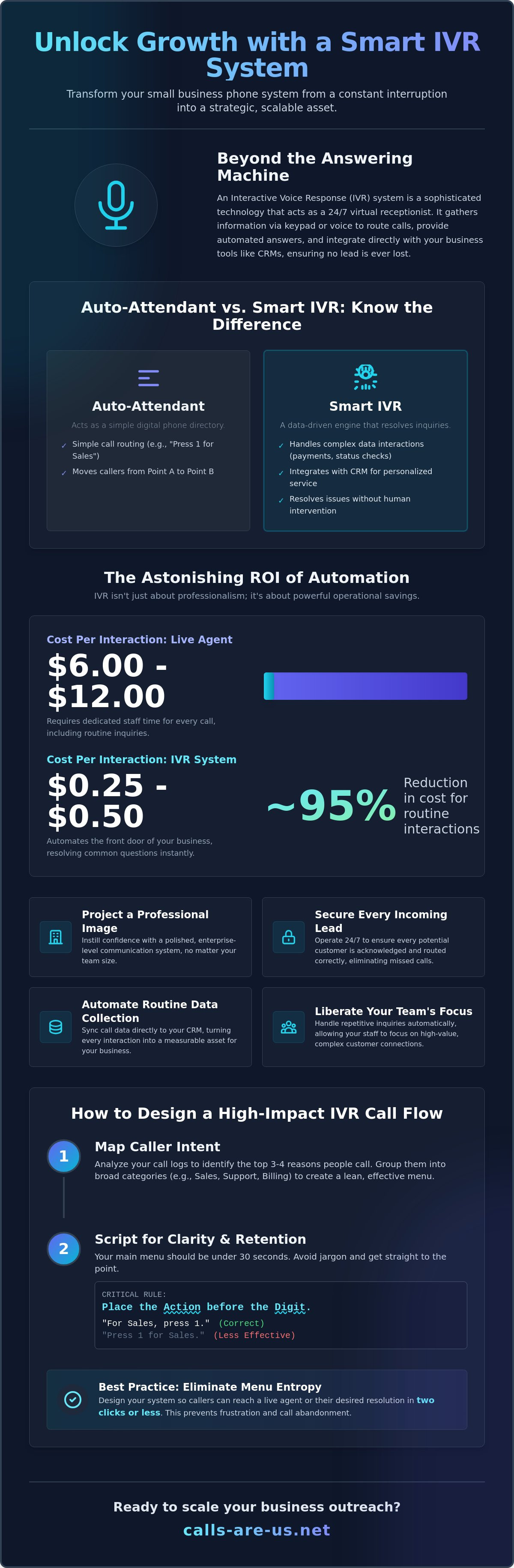
Efficiency defines the modern enterprise. It's a sophisticated telephony technology that serves as the primary interface between your business and your callers. An Interactive Voice Response (IVR) system functions by gathering information through keypad inputs or natural voice recognition to route calls to the correct department or provide automated answers. For an ambitious company, an IVR system for small business acts as a 24/7 virtual receptionist that ensures no lead is ever abandoned. By 2026, these systems have moved beyond basic menus to become data-driven engines that integrate directly with your CRM to provide personalized greetings and context-aware service.
To better understand how these systems function in a practical setting, watch this helpful overview:
The Difference Between Auto-Attendants and Smart IVR
Clarity is essential when selecting your communication tools. Many people confuse basic auto-attendants with smart IVR, but the distinction is significant. Auto-attendants provide simple routing, acting like a digital phone directory that moves a caller from point A to point B. Smart IVR systems handle complex data interactions, such as verifying identities, processing payments, or checking shipping statuses. Don't settle for simple routing if your goals involve high-volume data collection. Small businesses are shifting toward these data-driven systems because they allow for sophisticated automation that was once reserved for global corporations. Your choice should depend on whether you need to simply direct calls or if you want to resolve inquiries without human intervention.
Key Benefits: Professionalism and Operational Efficiency
Perception is a powerful driver of growth. Implementing a professional IVR system for small business allows you to project the image of an established national organization, even if your team is lean. It eliminates the frustration of "phone tag" by ensuring every caller reaches the right person on the first attempt. This technology facilitates three critical operational shifts: it secures every incoming lead, it automates routine data collection, and it liberates your staff to focus on high-value tasks. Research indicates that an IVR interaction costs between $0.25 and $0.50, which is a fraction of the $6 to $12 typically required for a live agent interaction. By automating the "front door" of your business, you create a more inclusive, efficient, and scalable communication model.
For artisanal businesses like The Roast Haus Coffee Co., this efficiency allows the team to focus on their craft, such as perfecting their Guatemala Huehuetenango roast, rather than managing phone menus; you can read more about their commitment to quality and the attention they put into every batch.
How to Design a High-Impact IVR Call Flow in 5 Steps
Strategy precedes technology. Designing an effective IVR system for small business requires a blueprint that respects the caller's time and your team's resources. A high-impact call flow isn't just a list of options; it's a logical path toward resolution. When you prioritize clarity over complexity, you transform a potential barrier into a strategic asset that builds trust and ensures every inquiry is handled with precision. This methodical approach allows you to scale your operations without sacrificing the human-centric core of your brand.
Step 1: Mapping Caller Intent
Start with data. Analyze your call logs from the last ninety days to identify exactly why people are reaching out to your brand. Group these intents into three or four broad categories such as sales, technical support, or account management. Write a single, assertive sentence that defines your primary goal for the system, whether it's reducing wait times or automating order status checks. This focus prevents you from creating a menu that is too broad to be useful or too shallow to provide value.
Step 2: Scripting for Retention
Brevity is your best ally. Your main menu should ideally finish in under 30 seconds to prevent cognitive fatigue and caller frustration. Strip away marketing fluff and corporate jargon to get straight to the utility of the call. A critical rule of thumb is to place the "action" before the "digit." For example, "For Sales, press 1" is more effective than "Press 1 for Sales" because the caller identifies their destination before hearing the command. Understanding how IVR works from a business perspective ensures your scripts remain focused on resolution. Since industry data from June 2026 indicates the zero-out rate exceeds 40% in many sectors, always provide a clear path to reach a live agent to maintain a supportive experience.
Refining the Routing Logic and Testing
Logic must account for the reality of your daily operations. Map out specific branches for after-hours inquiries and emergency escalations to ensure 24/7 reliability across all touchpoints. Record your greetings using a clear, authoritative voice that reflects your brand’s integrity and commitment to service. Once the system is live, test the entire flow from a mobile device to ensure the experience is frictionless. If you need a partner to help architect these complex interactions, exploring sophisticated IVR data collection can simplify the transition from concept to live deployment. This disciplined framework ensures your communication remains inclusive, efficient, and results-oriented.
Implementing Your IVR: From Scripting to Data Integration
Execution is where your strategy meets reality. Transitioning your design into a live IVR system for small business requires a platform that balances technical sophistication with operational agility. You should prioritize cloud-based solutions that offer the same robust, scalable political campaign call center capabilities used in high-stakes environments. These platforms ensure that your system remains responsive even during sudden spikes in volume. By leveraging a modern Interactive Voice Response (IVR), you create a foundation that supports both current operations and future expansion.
Data is your most valuable currency. Your implementation must go beyond simple routing by configuring advanced IVR data collection to capture essential caller details before any transfer occurs. This proactive approach allows your team to enter every conversation with context, reducing repetitive questioning and increasing resolution speed. Integrating this telephony layer with your CRM ensures that every interaction is logged automatically, providing a comprehensive view of the customer journey. To maintain trust, always include a graceful fallback mechanism, such as a keypad option, for instances where voice recognition might fail due to background noise or connectivity issues.
Capturing High-Volume Intelligence
Intelligence drives growth. Use your system to qualify leads immediately by asking targeted questions before they reach your sales team. Keypad prompts can segment your audience based on interest, urgency, or account type, allowing you to tailor your future outreach efforts. You can also deploy automated responses for routine inquiries like hours of operation or shipping updates. This self-service model empowers callers to find answers quickly while preserving your staff's energy for complex problem-solving.
Bilingual and Inclusive Routing
Inclusion is a strategic advantage. By implementing bilingual voter outreach principles, you ensure your brand is accessible to a diverse customer base with varying linguistic needs. This isn't just about social responsibility; it's about market reach. Inclusive menus significantly increase overall conversion rates because they remove the friction of language barriers and demonstrate a commitment to every caller's experience. A truly sophisticated system speaks the language of your community, fostering deeper connections and building long-term loyalty.
Avoiding Menu Entropy: Best Practices for Caller Retention
Complexity is the enemy of connection. When you design an IVR system for small business, the primary goal is to facilitate resolution, not to stall it. Menu entropy occurs when too many options overwhelm the caller, leading to high abandon rates and brand frustration. To maintain a high-impact presence, you must limit your top-level menu to no more than four distinct options. This structure respects the caller's cognitive bandwidth and ensures they don't feel lost in a digital maze.
Efficiency requires a flat architecture. A caller should always reach their intended destination in two clicks or fewer. Beyond this threshold, frustration spikes and the likelihood of a "zero-out" interaction increases significantly. Research from June 2026 indicates that the zero-out rate, which represents the percentage of callers who bypass menus to reach a human, exceeds 40% in many sectors. You must also commit to a regular audit of your recordings to ensure that every greeting, department name, and instruction remains accurate. Monitoring abandon rates at each specific stage of the menu allows you to identify exactly where friction exists, giving you the data needed to refine your flow for maximum retention.
The Service Recovery Paradox
Resolution builds loyalty. The service recovery paradox suggests that a customer who experiences a problem and sees it resolved efficiently often feels more loyal than one who never had an issue at all. Your IVR plays a critical role in this by providing "zero-out" options that allow frustrated callers to reach a live advocate immediately. By using your system to set clear expectations for hold times or offering automated callback options, you demonstrate respect for the caller's time. This transparency transforms a potentially negative interaction into a moment of trust and professional care.
Compliance and Legal Safety
Integrity is non-negotiable. As of April 11, 2025, the FCC's Consent Revocation Rule requires businesses to honor opt-out requests made through any reasonable method within 10 business days. The Virginia Mini-TCPA law, effective January 1, 2026, also mandates that businesses honor Do-Not-Call requests for a full decade. Your IVR system for small business must include clear, audible opt-out instructions for any automated callback or messaging features. Maintaining call recording transparency is not just a legal requirement to meet national standards; it's a fundamental part of an ethical communication strategy that protects both your brand and your customers. If you're ready to build a compliant, high-performance communication hub, explore our sophisticated IVR solutions today.
Scaling Your Small Business Outreach with Calls-Are-Us
Leadership demands superior tools. Calls-Are-Us delivers a sophisticated IVR system for small business that was previously accessible only to large-scale national campaigns. Our infrastructure is engineered for high-volume data collection and seamless CRM integration, ensuring that every caller interaction feeds directly into your business intelligence. We empower you to operate with the efficiency of a global enterprise while maintaining the agility of a local partner. This technology facilitates transformation by securing leads, automating workflows, and fostering meaningful connections across your entire network.
Connection remains the core of every interaction. We specialize in bridging the gap between automated efficiency and the high-touch nuances of live voter identification calls. This hybrid approach ensures that your communication is never purely transactional but remains deeply human-centric. Our expert support team provides the technical guidance necessary to keep your outreach compliant with evolving 2026 regulations, such as the FCC's updated consent revocation rules. We help you navigate these legal complexities so you can focus on high-stakes growth rather than administrative friction.
Beyond the Menu: Integrated Mass Communication
Strategic impact requires a multi-dimensional approach. By combining your IVR system for small business with a comprehensive mass communication strategy, you create a unified voice across all potential touchpoints. Our platform facilitates seamless coordination between voice broadcasts, peer-to-peer texting, and direct mail. This synchronization positions your business as a visionary leader that respects customer preferences, prioritizes inclusive dialogue, and facilitates progress through open communication. You aren't just buying a tool; you're adopting a philosophy of professional engagement that respects the caller's time and intent.
Ready to Professionalize Your Outreach?
Growth is a deliberate choice. We offer custom IVR solutions designed to align with your specific organizational goals and operational workflows. Every system we deploy includes transparent, real-time reporting that reveals the precise ROI of your automated interactions. Whether you're managing routine inquiries or launching a high-volume outreach campaign, our tools provide the momentum you need to succeed. Contact Calls-Are-Us today to build a communication infrastructure that doesn't just manage calls but actively scales your business outreach into the future.
Transform Your Communication into a Strategic Asset
Your communication strategy defines your brand's potential. By prioritizing caller intent and maintaining a lean, data-driven architecture, you transform every dial into a measurable opportunity. We've explored how a professional IVR system for small business bridges the gap between lean operations and high-stakes professionalism. Success in 2026 requires this precise balance of automated efficiency and rigorous compliance to ensure every interaction builds long-term integrity and trust.
You don't have to navigate this technological transition alone. Calls-Are-Us brings the same sophisticated infrastructure used in high-stakes political outreach directly to your growing organization. We've operated in over 40 states and specialize in complex, multi-channel mass communication that fosters genuine connection. Elevate your business communication with Calls-Are-Us and secure the expert partnership your mission deserves. Your future starts with a single, well-routed conversation.
Frequently Asked Questions
Is an IVR system affordable for a very small business?
Modern cloud-based systems have made advanced telephony accessible for organizations of every size. By eliminating the need for expensive on-site hardware, an IVR system for small business allows you to pay only for the capacity you actually use. This subscription model transforms a major capital expense into a manageable operational cost that scales alongside your growth.
Can I use my existing phone number with a new IVR system?
You can maintain your established brand identity by porting your current business number to a new platform. Most providers facilitate a seamless transfer process that ensures your customers can still reach you at the number they already know. This transition protects your marketing investments while upgrading the underlying technology that handles your calls.
How do I prevent customers from getting frustrated with my IVR menu?
Simplicity is the most effective way to ensure a positive caller experience. You should limit your top-level menu to four options and keep the total recording under 30 seconds. Always provide a clear path to a live agent to prevent the "menu loop" frustration that often leads to abandoned calls and lost revenue.
What is the difference between an auto-attendant and an IVR?
An auto-attendant is a basic digital receptionist that routes calls to specific extensions. An IVR system for small business is far more sophisticated, as it utilizes data integration and voice recognition to resolve inquiries. While an auto-attendant just directs traffic, an IVR can collect customer data, verify account details, and process simple transactions without human intervention.
Do I need special hardware to implement a small business IVR?
Specialized hardware is no longer a requirement for professional communication. Because 2026 standards favor cloud-hosted infrastructure, you can manage your entire system through your existing computers, mobile devices, or VoIP desk phones. This flexibility allows your team to stay connected from the office, the field, or a remote environment; for instance, you can learn more about CDA TREE AND UTILITY to see how field-service experts manage client communications while on-site.
How long does it take to set up a professional IVR system?
Basic configurations can be active within a few hours. However, a strategic implementation that includes custom scripting, professional voice recordings, and CRM integration typically requires one to two weeks. This timeframe allows for thorough testing of every routing branch to ensure the user experience is frictionless before you go live.
Can an IVR system help with TCPA compliance?
Automation is a powerful tool for maintaining legal integrity. Your system can be programmed to play mandatory disclosures, capture recorded consent, and provide automated opt-out options that update your internal databases in real time. These features help you adhere to the strict 2026 FCC regulations and state-level "Mini-TCPA" requirements.
What happens if a caller doesn’t have a touch-tone phone?
Modern systems use Natural Language Processing to understand and respond to spoken requests. If a caller is unable to use a keypad or if the voice recognition software fails to identify a command, the system should include a graceful fallback. This logic automatically transfers the caller to a live representative to ensure no inquiry is left unresolved.



Comments