
How to Increase Voter Turnout: A Multi-Channel Tactical Guide for 2026

Updated: Jul 23
In an election cycle where total ad spending is projected to reach up to $13.8 billion, the loudest voice in the room isn't always the one that wins. You've likely felt the mounting pressure of rising operational costs, especially with postage rates for Forever stamps hitting $0.82 and postcards climbing to $0.61 this July. Understanding how to increase voter turnout in 2026 requires more than just broad awareness; it demands a strategic bridge between a supporter's passive intent and their concrete plan to cast a ballot. You deserve a strategy that respects your budget while deepening your connection with the community.
We understand that the fear of voter fatigue and the high cost of traditional outreach can feel like an exhausting uphill battle. This guide provides the proven communication strategies and psychological nudges required to mobilize your base and maximize turnout at the polls. We will break down a multi-channel tactical roadmap that leverages live calling, peer-to-peer texting, and high-impact direct mail to ensure your message doesn't just reach voters, but moves them to action. By focusing on efficiency, empathy, and evidence-based tactics, you can transform your GOTV efforts into a precision engine for civic participation.
Table of Contents
The Psychology of Mobilization: Why Voters Stay Home
Intent doesn't always equal action. Many supporters truly believe in a candidate's platform but still fail to arrive at the polls on Tuesday. This phenomenon, known as the "Intent-Action Gap," is the primary hurdle for any campaign strategist looking for ways on how to increase voter turnout. While civic duty remains a strong motivator, modern research suggests that social pressure and perceived community expectations are often more effective at driving people to the ballot box. You must move beyond simple awareness to create a sense of social accountability.
Low-propensity voters represent a unique challenge because they lack the deeply ingrained habit of participation found in your core base. These individuals require a higher volume of touchpoints to overcome the inertia of apathy. Understanding the nuances of voter turnout allows you to move beyond simple reminders and start addressing the specific psychological barriers that keep these potential supporters at home. By identifying these friction points, you can transform a passive supporter into an active participant.
To better understand how a clear campaign message drives action, watch this helpful video:
The "Plan-Making" Nudge: Moving from Intent to Action
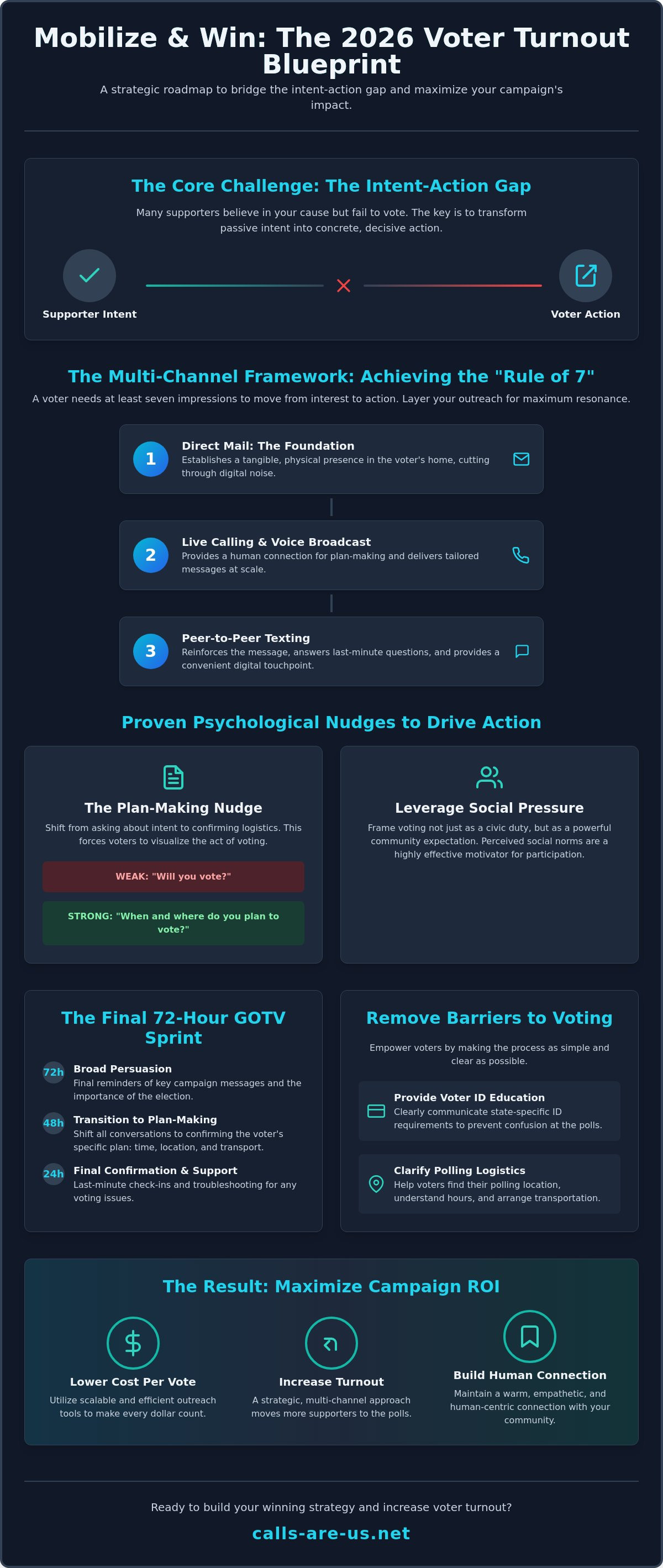
Specificity breeds success. One of the most potent psychological tools in your arsenal is the plan-making nudge. Instead of asking a supporter a binary question like "Will you vote?", your team should focus on the logistics by asking "When and where do you plan to vote?". This shift in phrasing forces the voter to visualize the act of voting, making them significantly more likely to follow through on their commitment.
Live agents in a dedicated calling center can guide voters through these essential details. They can help identify polling locations, discuss transportation options, and confirm the specific time of day the voter will be at the polls. Integrating these questions into your voter persuasion scripts ensures that every interaction serves as a concrete step toward mobilization. This methodical approach reduces the mental load on the voter and creates a clear path to the ballot box.
Combating Voter Apathy with Personalized Outreach
Relevance reduces resistance. To truly understand how to increase voter turnout, you must speak directly to the issues that keep your supporters awake at night. Segmenting your audience by their core concerns, such as the economy, healthcare, or local infrastructure, allows you to craft messages that resonate on a personal level. When a voter feels heard, their apathy begins to dissolve.
The Multi-Channel Outreach Framework for 2026
Visibility is the foundation of mobilization. When you're determining how to increase voter turnout, you have to embrace the "Rule of 7." This principle suggests a supporter needs at least seven impressions before they move from passive interest to concrete action. By integrating evidence-based turnout strategies, you ensure your message cuts through the noise of a high-stakes election cycle. You aren't just sending a message; you're building a persistent presence in the voter's daily life.
Layering is the key to reinforcement. Start with direct mail to establish a physical presence in the home, then follow up with digital touchpoints like text and voice to solidify the narrative. This multi-layered approach prevents your campaign from being forgotten in the daily shuffle of information. While automated tools handle the broad reach, your live calling efforts should be reserved for high-value, undecided, or low-propensity voters who require a more nuanced, human-centric conversation to overcome their specific hurdles.
Peer-to-Peer (P2P) Texting for Real-Time Engagement
Meaningful engagement is built through dialogue. While mass blasts are useful for simple alerts, comparing P2P vs broadcast texting reveals that peer-to-peer interactions offer a significantly higher engagement rate. These two-way conversations allow your team to handle objections immediately. If a voter says, "I don't know where my polling place is," a volunteer can text them a direct link to their local registrar. To maintain high delivery rates, all campaigns must ensure 10DLC compliance by registering their brand and specific use cases with mobile carriers.
Voice Broadcasting and IVR for Scalable Awareness
Speed and scale are the hallmarks of a successful final push. Interactive Voice Response (IVR) allows you to poll voters on their "likelihood to vote" weeks before the election, letting you focus your expensive live calling resources on those who are truly on the fence. Automated voice broadcasts serve as efficient, rapid-response tools for critical deadline reminders in the final week. For all automated political calls, TCPA compliance requires that you strictly adhere to consent regulations and time-of-day restrictions to protect both your campaign and the voters you serve. Coordinating these channels through a unified communication platform ensures that no supporter falls through the cracks during the critical lead-up to Election Day.
Removing Friction: Accessibility and Education Tactics
Friction is the silent killer of democratic participation. When supporters face confusion over new proof-of-citizenship requirements or shifting polling locations, they often choose the path of least resistance: staying home. Understanding how to increase voter turnout in 2026 requires you to act as a navigator through an increasingly complex regulatory environment. There are numerous ways to increase voting, but few are as impactful as providing clear, accessible information. Your campaign must evolve from a solicitor of support into a trusted resource for civic education.
Barriers to the ballot box are often informational rather than ideological. Voters need to know exactly what ID is required, where their specific polling station is located, and what hours it remains open. By proactively addressing these concerns, you reduce the anxiety that often prevents first-time or low-propensity voters from showing up. You build trust, foster inclusivity, and empower your base to navigate the logistics of Election Day with total confidence.
Providing Logistics via Mass Texting
Logistics should never be a mystery. Mass texting provides the immediate, high-visibility channel required to deliver location data and deadline alerts directly to a voter's pocket. You can send automated links to "Find My Polling Place" tools, notify supporters of early voting windows, and blast "Last Chance" registration alerts as deadlines approach. For example, in New York, the mail-in registration deadline for the 2026 general election is October 24. These timely nudges clarify requirements, simplify the process, and facilitate action without requiring the voter to do their own research.
Direct Mail as a Tangible Education Tool
Tangible tools build lasting trust. A robust political direct mail strategy remains essential, particularly for older demographics who value physical reference materials they can hold and save. Even with the July 2026 postage rate increases bringing Forever stamps to $0.82 and postcards to $0.61, the ROI of a well-designed "How to Vote" guide is significant. These postcards can summarize complex ballot measures, list necessary ID requirements under new state laws, and include QR codes that trigger a personalized text reminder. This approach creates a seamless bridge between physical and digital channels, ensuring your education efforts are both accessible and actionable.
The GOTV Sprint: A 72-Hour Execution Plan
The final 72 hours are where elections are won or lost. In this critical window, your strategy on how to increase voter turnout must shift from broad persuasion to relentless execution. You've already established the "why"; now you must facilitate the "when" and "how." This sprint requires a synchronized effort across every communication channel to ensure no supporter is left behind. You aren't just sending reminders; you're managing a logistical operation that moves people from their homes to the ballot box.
T-Minus 72 Hours marks the pivot from ideological debate to logistical reality. You're no longer trying to change minds; you're confirming the physical presence of your supporters at the polls. This is the moment to verify registration status and ensure every voter has a clear understanding of the 2026 ID requirements. T-Minus 48 Hours is the peak of the "Plan-Making" phase. Research indicates that voters who visualize their trip to the polling station are significantly more likely to follow through. Your outreach should focus on the "who, what, and where" of their voting day.
T-Minus 24 Hours and Election Day itself are about high-urgency mass alerts. This is the "Final Push" where you leverage every automated tool to keep the election top-of-mind. Real-time tracking of voter participation allows your team to redirect resources toward areas with lower-than-expected turnout, ensuring your mobilization is both agile and impactful. By staying responsive to the data as it comes in, you can pivot your focus to the precincts where every extra vote counts the most.
Deploying the Political Campaign Call Center
Operational agility defines a successful sprint. Scaling your political campaign call center is not just about volume; it's about the quality of the interaction. Live agents are your front-line problem solvers, capable of navigating complex voter ID questions or providing immediate directions to polling locations. By focusing your "chase" efforts on voters who have requested absentee ballots but haven't returned them, you maximize your ROI by targeting individuals with the highest intent who may have faced logistical delays.
The Final Push: Automated Alerts and Social Pressure
Social pressure is a remarkably effective motivator. When you execute your how to run a GOTV campaign checklist, incorporate voice broadcasts that emphasize high community turnout. Reminding a supporter that their peers and neighbors are already at the polls creates a powerful psychological nudge toward participation. As the day progresses, high-urgency text blasts like "Polls close in 120 minutes" provide the final spark for those who have been procrastinating. To implement a high-stakes outreach strategy that respects both 10DLC and TCPA compliance, explore our professional campaign solutions.
Maximizing ROI: Cost-Effective Turnout Strategies
Efficiency is the hallmark of a sophisticated campaign. With 2026 midterm ad spending projected to reach between $10.8 billion and $13.8 billion, every dollar in your budget must work toward a measurable result. Strategizing how to increase voter turnout isn't just about the volume of messages sent; it's about the precision of your resource allocation. You must identify which voters require a high-touch human interaction and which can be effectively mobilized through scalable, automated systems. This balance protects your donor capital while expanding your reach.
Understanding the "Cost Per Vote" is a fundamental requirement for modern campaign managers. Traditional door-to-door canvassing is valuable but carries a high price in terms of management and labor hours. By utilizing cost effective voter outreach tools, you can automate the initial layers of contact. This approach allows you to reserve your most expensive assets, like live call center agents and field organizers, for the "moveable middle" and low-propensity voters who require deeper engagement to overcome apathy.
Data-Driven Targeting for Turnout
Precision saves resources. Interactive Voice Response (IVR) polling serves as an essential diagnostic tool to identify which supporters are already "locked in" for Election Day. If a voter confirms their intent to vote through an automated poll, you don't need to spend additional budget on a live follow-up call. This data-driven segmentation ensures your team remains focused on the individuals who actually need a nudge to participate.
Data hygiene is your best defense against waste. You must regularly clean your voter files to ensure high deliverability for 10DLC texting and voice broadcasts. Wasting spend on "dead" numbers or disconnected lines doesn't just hurt your ROI; it can also trigger carrier blocks that jeopardize your entire outreach engine. A clean file ensures that your message reaches a real person, every time. Consider these three steps for better data management:
Validate mobile numbers to ensure 10DLC text delivery success.
Identify high-propensity voters through past participation data.
Segment by core issues to deliver the most relevant, high-impact message.
Scaling Your Message with Calls-Are-Us
Integrated communication is the future of mobilization. When you adopt a unified mass communication strategy, you eliminate the overhead costs associated with managing multiple siloed vendors. This streamlined approach allows you to trigger automated workflows that support your volunteers, freeing them from repetitive tasks so they can focus on high-impact community building. You aren't just running a campaign; you're building a sustainable movement. Once the polls close, the data you've gathered becomes the foundation for your next cycle, ensuring that your path to victory is even more efficient and effective in the years to come.
Building a Legacy of Impact at the Polls
Mobilizing a community in 2026 requires more than just passion; it demands a sophisticated, multi-layered strategy that respects the voter's time and intelligence. You've seen that mastering how to increase voter turnout involves bridging the gap between intent and action through plan-making, logistical education, and the strategic use of social pressure. By integrating voice, text, and mail into a single, cohesive narrative, you ensure your message remains resonant during the critical final sprint. Success isn't just about the volume of your outreach; it's about the precision of your delivery, the integrity of your data, and the strength of your connections.
Your mission deserves a partner that understands the high stakes of modern communication. We've operated in over 40 states, maintain deep expertise in TCPA and 10DLC compliance, and offer seamless multi-channel integration. Whether you're deploying mass texting, live calling center agents, or targeted direct mail, our platform provides the technical power and humanistic core your campaign needs to thrive. Launch your 2026 turnout campaign with Calls-Are-Us outreach tools and turn your vision into a measurable victory. Together, we can build a more inclusive and engaged future for every voter.
Frequently Asked Questions
What is the most effective way to increase voter turnout in 2026?
The most effective method is an integrated, multi-channel approach that prioritizes logistical plan-making over simple awareness. You must move beyond general reminders and help voters visualize the specific steps of their voting day to bridge the intent-action gap. This strategic layering of touchpoints is the most reliable way to understand how to increase voter turnout because it creates a persistent, trusted presence that guides supporters all the way to the ballot box.
How does SMS texting compare to door-knocking for voter mobilization?
SMS texting offers unparalleled scalability and speed compared to the high labor costs and logistical hurdles of door-knocking. While face-to-face contact is deeply personal, peer-to-peer texting allows your campaign to facilitate thousands of authentic, two-way conversations in a fraction of the time. It successfully combines the human touch of traditional canvassing with the high-efficiency reach of modern digital technology.
Is automated voice broadcasting legal for political turnout campaigns?
Automated voice broadcasting is legal for political use as long as your campaign adheres strictly to TCPA regulations and local state laws. You must ensure your outreach follows specific time-of-day restrictions and respects opt-out requests to maintain ethical communication standards. Partnering with an expert provider helps you navigate these regulatory complexities while delivering mass reminders with total confidence and professional integrity.
How many times should a campaign contact a voter to ensure they turn out?
Adhering to the "Rule of 7" is a fundamental requirement for successful mobilization in a crowded media environment. Research suggests that voters need at least seven distinct impressions across multiple channels to move from passive support to active participation. By layering direct mail, text alerts, and live calls, you build the necessary familiarity and urgency to ensure your base follows through on Election Day.
What is a "plan-making" nudge and why does it work?
A plan-making nudge is a psychological technique that encourages voters to visualize the specific logistics of their trip to the polls. By asking questions like "What time will you vote?" or "How will you get there?", you help the voter identify and solve potential hurdles in advance. This works because it transforms a vague, abstract intention into a concrete, scheduled commitment that is much harder to ignore.
How can I increase turnout among young voters who don't answer phone calls?
Engaging younger demographics requires a shift toward mobile-first, non-intrusive communication strategies like peer-to-peer texting. This demographic values authenticity and convenience, making real-time text dialogue the most effective way to answer their questions without the friction of a phone call. It meets them exactly where they are, providing a direct and respectful path to civic participation on their own terms. For tech-savvy supporters looking to apply this same level of automation to their job search, click here.
Can direct mail still be effective for increasing voter turnout in a digital age?
Direct mail remains a powerful tool for turnout because it provides a tangible, physical anchor that digital ads can't replicate. High-impact postcards serve as permanent voter guides that supporters often keep in their homes as visual cues and reference materials. When you're determining how to increase voter turnout, combining physical mail with digital QR codes creates a seamless bridge that reinforces your message across both worlds.
What is the best time of day to send GOTV text messages?
The optimal window for sending GOTV text messages is between 10 AM and 8 PM in the voter's local time zone. Sending messages during these peak hours ensures high visibility while respecting the voter's personal boundaries and sleep schedules. This disciplined approach helps maintain your campaign's reputation as a professional and trustworthy partner in the democratic process.



Comments