_edited.png)
How to Run a GOTV Campaign in 2026: The Professional Outreach Checklist

Updated: Jun 18
The final 72 hours of an election are no longer just a test of endurance; they are a test of precision engineering. You likely feel the weight of the home stretch, where volunteer energy fades and aggressive carrier filters threaten to silence your most urgent digital appeals. It is a high-stakes moment that requires more than just passion. You need a system that works as hard as your staff. This guide shows you exactly how to run a GOTV campaign that scales effortlessly, ensuring your message reaches the right voters at the right moment without wasting a single resource.
We provide a professional checklist to help you secure high deliverability, manage multi-channel outreach, and turn every pledge into a verified ballot. You will learn to navigate the complexities of the 2026 landscape, including shifting state-level voting laws and the rising $0.82 cost of First-Class Forever stamps. We explore how to integrate voice, text, and mail into a seamless blitz that empowers your voters and simplifies your operations. By the end of this article, you will have a clear, executable roadmap to drive maximum turnout, protect your team from burnout, and confidently win the final sprint.
Key Takeaways
Transition your strategy from persuasion to mobilization by focusing on the "Last Mile" philosophy, where turnout is the only metric of success.
Master how to run a GOTV campaign by scrubbing your data universe and building dedicated workflows for the vote-by-mail chase.
Deploy high-impact communication tools like voice broadcasting and peer-to-peer texting to maintain urgency across your voter base without exhausting volunteers.
Secure your digital outreach by prioritizing 10DLC registration and TCPA compliance to ensure your messages bypass aggressive carrier filters.
Scale your mission with professional communication infrastructure that converts verbal pledges into actual ballots through speed and precision.
Table of Contents
The 2026 GOTV Framework: Why the Final 72 Hours Define Victory
Phase 1 Checklist: Building Your GOTV Infrastructure and Data Universe
Phase 2 Checklist: Deploying a Scalable Multi-Channel Outreach Strategy
The Deliverability Checklist: Ensuring Your Message Reaches the Voter
Scaling Your Impact: Integrating Professional Communication Tools for GOTV
The 2026 GOTV Framework: Why the Final 72 Hours Define Victory
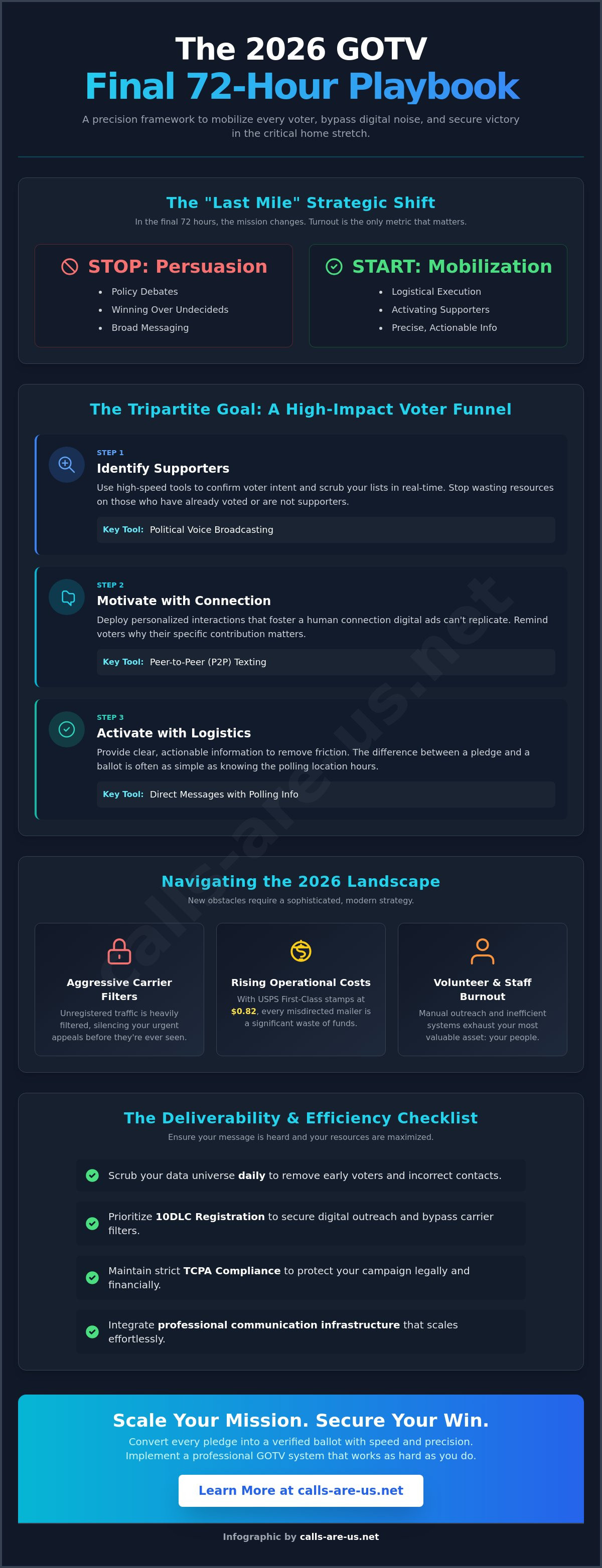
Victory is won in the final three days. This critical window represents the "Last Mile" of your election, where the focus shifts entirely from convincing the undecided to mobilizing the committed. Understanding Get Out the Vote (GOTV) is about recognizing this strategic pivot. It's no longer about policy debates; it's about logistical execution. Turnout is the only metric that matters when the polls open, and your infrastructure must be ready to deliver every single promised vote.
The rules of engagement have changed significantly for the 2026 cycle. Digital noise is at an all-time high, and aggressive carrier filtering has become a formidable barrier to voter contact. Mastering how to run a GOTV campaign in this environment requires a sophisticated understanding of deliverability, compliance, and timing. You don't just need a message; you need a delivery system that commands attention and bypasses the static of a crowded inbox.
To better understand the mechanics of a successful field operation, watch this helpful video:
Persuasion vs. Mobilization: Shifting Your Strategy
Stop arguing and start activating. Once you hit the 72-hour mark, your scripts must undergo a radical transformation. Persuasion ends; mobilization begins. You must identify your "Voter Universe" with surgical precision, focusing exclusively on supporters who haven't yet cast their ballots. Use psychological cues to help voters visualize their trip to the polls. Mental rehearsal significantly increases the likelihood of physical action, so ask voters exactly what time they plan to go and how they'll get there.
The Tripartite Goal: Identify, Motivate, and Activate
A visionary campaign operates through a tripartite lens to ensure no supporter is left behind. This structured approach moves voters through a logical progression toward the ballot box:
Identify: Use political voice broadcasting to confirm voter intent and clean your data in real-time. This ensures your ground team isn't knocking on the doors of people who have already voted.
Motivate: Deploy personalized peer-to-peer (P2P) texts that resonate with individual values. These interactions foster a human connection that digital ads cannot replicate, reminding voters why their specific contribution matters.
Activate: Provide clear, actionable logistics. Send direct messages containing specific polling locations, opening hours, and required identification. Removing these small friction points is often the difference between a pledge and a processed ballot.
By shifting your focus from broad messaging to precise activation, you transform your campaign into a high-impact mobilization engine. This framework ensures your resources are spent on the only thing that counts: turnout.
Phase 1 Checklist: Building Your GOTV Infrastructure and Data Universe
Efficiency starts with a pristine data universe. If you want to know how to run a GOTV campaign effectively, you must first eliminate the noise from your voter file. Every dollar spent on a voter who has already cast their ballot is a dollar stolen from your margin of victory. Professional campaigns treat data hygiene as an ongoing operation, not a one-time task. This focus on precision allows your team to operate with the speed and confidence required for the final 72-hour sprint.
Scrubbing your lists daily is non-negotiable in the high-stakes environment of 2026. With the USPS First-Class Forever stamp rate increasing to $0.82 on July 12, 2026, the financial cost of poor data is higher than ever. Your "Early Vote" filter must be airtight, removing those who have already returned ballots so your resources remain focused on the unactivated. This precision ensures your team stays motivated, your budget stays intact, and your messaging remains relevant to the recipient's current status.
Designing a specific workflow for the Vote-By-Mail (VBM) chase is equally vital. This process involves identifying supporters who requested a ballot but have not yet returned it to the registrar. An authoritative mass communication strategy integrates automated reminders via voice and text to close this gap. Before the peak traffic hits, you must verify your IVR and SMS pathways to ensure every message reaches its destination without delay, protecting your campaign from technical bottlenecks.
Data-Driven Targeting: Defining Your GOTV Universe
Precision targeting prevents resource waste. Focus your energy on "low-propensity" supporters who align with your platform but need an extra nudge to reach the polls. Use geographic clustering to organize outreach by precinct, allowing you to deliver hyper-local logistics tailored to specific polling locations. By filtering out those who have already voted, you create a lean, high-impact universe that maximizes your ground game efficiency. This data-driven approach transforms a broad outreach effort into a surgical strike.
Technical Readiness: Setting Up for High-Volume Contact
Infrastructure must be scalable and resilient. Your technical setup should prioritize three core areas to handle the final surge without compromising deliverability:
API Integrations: Connect your voter database directly to your calling and texting platforms to enable real-time data updates and automated list refreshing.
Load Balancing: Ensure your IVR system is stress-tested to handle thousands of simultaneous responses during peak hours on Election Day.
Script Finalization: Craft assertive, short messages that provide immediate value, reduce cognitive load, and offer clear instructions for the voter.
To ensure your communication pathways are ready for the 2026 surge, you can explore professional solutions at Calls-Are-Us to secure your outreach infrastructure and maximize voter contact.
Phase 2 Checklist: Deploying a Scalable Multi-Channel Outreach Strategy
Industrial-scale outreach is the backbone of a winning operation. While organic volunteer efforts provide the heart of a movement, they often lack the raw velocity required for the final 72-hour surge. Learning how to run a GOTV campaign in the modern era means embracing technology that multiplies your reach without diluting your message. You need a multi-channel approach that surrounds the voter with urgency, clarity, and support, ensuring no supporter is left behind due to a lack of information.
The Power of Voice: Using Broadcast and IVR for Speed
Voice Broadcast and Interactive Voice Response (IVR) offer unparalleled speed for delivering high-stakes alerts. A concise, 30-second recording can reach an entire precinct faster than a team of canvassers can walk a single block. Your messages should be urgent and instructional, providing immediate value to the listener. Use IVR polling to ask voters if they have a plan to reach the polls; those who press a specific digit to indicate they need assistance can be immediately flagged for follow-up. This active engagement ensures your message is heard and acted upon, rather than just being another stored voicemail.
Texting for Turnout: P2P vs. Mass SMS
Digital mobilization requires a dual-track strategy for SMS to maximize deliverability and impact. Peer-to-peer (P2P) texting remains the gold standard for high-stakes engagement because the human-to-human element helps bypass aggressive carrier spam filters. Conversely, Mass Texting is your best tool for rapid-fire alerts, such as polling place changes or final deadline reminders. Your scripts should always include "Plan to Vote" questions. Asking a voter to visualize their schedule and transportation increases their psychological commitment to casting a ballot, turning a vague intention into a concrete action.
Direct Mail: The Tangible Anchor
Direct mail serves as the tangible anchor of your digital blitz. In a week where screens are flooded with ads, a physical piece of mail in a voter's hand carries significant weight and staying power. Design your mailers with a "Final Notice" aesthetic to demand immediate attention upon arrival. Integrate QR codes that link directly to digital tools for finding polling places or checking registration status. Timing is critical for this channel; ensure your final drop hits mailboxes exactly 4-5 days before the election to maximize its influence during the voter's final decision-making process.
Live Calling Center agents provide the final layer of identification and problem-solving. These one-on-one conversations are essential for high-value voters who may have complex questions about new identification requirements or registration deadlines. By combining these channels, you create a comprehensive net that catches every potential supporter and guides them safely to the ballot box.
The Deliverability Checklist: Ensuring Your Message Reaches the Voter
Deliverability is the invisible gatekeeper of your victory. You can craft the most compelling call to action in political history, but it yields zero results if a carrier filter intercepts it before it reaches the voter's device. Understanding how to run a GOTV campaign in 2026 requires a deep respect for the technical and regulatory frameworks that govern modern communication. Precision in your message must be matched by precision in your delivery infrastructure to ensure your voice is heard above the digital noise.
Carrier scrutiny has reached unprecedented levels as we approach the 2026 midterms. Automated systems now use sophisticated pattern matching to identify and block high-volume traffic that appears unsolicited or non-compliant. To protect your outreach, you must prioritize list integrity and platform reputation. This involves more than just following the law; it involves building a relationship of trust with the telecommunications ecosystem through transparent practices and verified identities.
Regulatory Mastery: Staying TCPA and 10DLC Compliant
Compliance is your strongest shield against both litigation and message blocking. The Telephone Consumer Protection Act (TCPA) remains the foundational law, but 10-Digit Long Code (10DLC) registration is now the primary mechanism for carrier-level verification. Your campaign must undergo a rigorous 10DLC audit through The Campaign Registry to establish your brand's legitimacy. Documenting your consent frameworks is equally essential. You must be able to prove how you acquired every phone number in your database to satisfy both legal requirements and carrier inquiries. Some states have enacted local regulations that are even stricter than federal standards, so you must verify the specific rules for every jurisdiction in your target area.
Maximizing Engagement: Avoiding the Spam Folder
Engagement hinges on your ability to remain human at scale. Carriers look for repetitive, identical messages sent from a single source as a primary indicator of spam. To bypass these triggers, you should implement the following technical strategies:
Varied Content: Rotate your SMS scripts frequently. By using multiple variations of your message, you prevent carrier-level pattern matching from flagging your traffic as automated noise.
Sender ID Reputation: Monitor your outbound numbers constantly. If a number is flagged as "Scam Likely," it must be rotated out of your pool immediately to protect your campaign's overall deliverability.
Optimal Timing: Balance urgency with respect for the voter’s schedule. Avoid early morning or late-night contact, focusing your blitz during windows of high receptivity to minimize "STOP" requests.
Automating your opt-out management is the final step in maintaining list health. When a voter texts "STOP," your system must remove them instantly across all channels to prevent future violations. If you are ready to secure your outreach with a platform that prioritizes these standards, partner with Calls-Are-Us to ensure your 2026 mobilization reaches its full potential.
Scaling Your Impact: Integrating Professional Communication Tools for GOTV
Technology is the ultimate force multiplier. While grassroots energy provides the moral authority of a movement, industrial-scale tools provide the reach necessary to secure a win. Understanding how to run a GOTV campaign at a national or even local level requires a shift from manual labor to automated precision. Calls-Are-Us serves as the authoritative partner for campaigns that refuse to leave their turnout to chance, offering a suite of tools that bridge the gap between digital outreach and human connection. We empower you to communicate with confidence, ensuring your message is heard when it matters most.
Professional tools offer a level of consistency that volunteer-only models struggle to replicate during the final 72-hour blitz. A single voice broadcast can reach 100,000 voters in the time it takes a dedicated volunteer to complete fifty manual calls. This speed is not just about efficiency; it's about the ability to respond to breaking news or polling shifts in real-time. Reliability is another cornerstone of professional systems. Automated platforms eliminate human error, ensuring every supporter receives the exact instructions they need without the risk of miscommunication. Finally, real-time reporting provides a granular view of your progress. You can see exactly who answered, who opted out, and who requires an immediate follow-up from your ground team.
Why Professional Tools Beat Volunteer-Only Models
Relying solely on manual outreach creates bottlenecks that can stifle your momentum. Professional infrastructure provides three distinct advantages for modern campaigns:
Speed: Deploy high-volume voice broadcasting that delivers results in minutes, not days, allowing you to saturate your voter universe instantly.
Reliability: Ensure every voter hears the correct polling hours and locations through pre-recorded, authoritative messaging that never misses a detail.
Reporting: Access comprehensive data sets that track engagement levels and opt-out requests, allowing you to refine your strategy on the fly.
Getting Started with Calls-Are-Us
Our approach focuses on seamless integration and rapid deployment to meet the most demanding election deadlines. We don't just provide software; we provide strategic consulting to help you design a multi-channel mix that resonates with your specific demographic. Whether you need P2P texting platforms optimized for 2026 deliverability or a live calling center to handle complex voter inquiries, our infrastructure is built for high-pressure environments. We emphasize a tripartite path to success: Plan your outreach strategy with our seasoned experts, Execute with industrial scale, and Win your election through superior mobilization. Mastery of how to run a GOTV campaign starts with choosing a partner that values your mission as much as your metrics.
Secure Your Victory in the Final 72 Hours
Your success hinges on the transition from persuasion to precise mobilization. It's about more than just effort; it's about the industrial-scale precision of your final outreach. We have explored the essential mechanics of data hygiene, the necessity of multi-channel engagement, and the technical rigors of 10DLC compliance. Mastering how to run a GOTV campaign in 2026 requires a partner that can scale your mission with speed, authority, and integrity. You must prioritize high-volume infrastructure that bypasses digital barriers while maintaining a human-centric connection with every supporter.
With over 15 years of experience across 40+ states, we provide the seasoned expertise needed to navigate the complexities of modern election cycles. We are TCPA and 10DLC compliance experts who understand that deliverability is the absolute foundation of turnout. Scale your GOTV impact with Calls-Are-Us today.
The final sprint is yours to win. By combining authoritative technology with a principled approach to communication, you can turn every voter's pledge into a verified ballot. Your mission deserves a delivery system that is as dedicated and resilient as your team.
Frequently Asked Questions
What is the best time to start a GOTV campaign?
Start your intensive mobilization efforts as soon as early voting begins, though the most critical phase occurs in the final 72 hours before polls close. You should initiate the ballot chase for mail-in voters the moment ballots are distributed by the registrar. This early start allows you to scrub your data and focus your Election Day energy on low-propensity supporters who haven't yet cast their ballots.
How do I ensure my campaign text messages don't get blocked?
Secure 10DLC registration and maintain high list hygiene to prevent aggressive carrier blocking. You must register your campaign with The Campaign Registry to verify your identity and intent. Additionally, rotating your message content and avoiding spam-trigger words ensures your outreach bypasses modern filters. This technical preparation is a vital part of learning how to run a GOTV campaign that actually reaches the voter's device.
Is voice broadcasting still effective for political campaigns in 2026?
Voice broadcasting remains a powerful tool in 2026 for delivering high-stakes urgency and authoritative instructions at scale. It allows you to reach tens of thousands of households simultaneously with a consistent, recorded message. This speed is indispensable for last-minute polling place changes or final deadline reminders that require immediate attention. It provides a level of reach that manual volunteer calling simply cannot match in a crisis.
What is the difference between P2P texting and mass texting for GOTV?
Peer-to-peer (P2P) texting involves a human agent sending each message to foster connection, while mass texting uses automated systems for rapid-fire alerts. P2P is ideal for detailed conversations and bypassing carrier filters through human interaction. Mass SMS excels at delivering logistical data like polling hours to your entire universe in minutes. Using both ensures your strategy is both personal and technologically resilient.
How many times should I contact a voter during the GOTV phase?
Aim for three to five meaningful touches across multiple channels during the final mobilization window. A combination of a direct mail piece, a voice broadcast reminder, and a P2P text creates a necessary "surround sound" effect. This frequency keeps your candidate top-of-mind without causing supporter fatigue. It ensures you provide the consistent nudges required to turn a verbal pledge into a verified ballot on Election Day.
What are the TCPA regulations for political automated calls?
TCPA regulations prohibit automated calls to mobile devices without prior express consent, while landline rules vary by jurisdiction. You must ensure your calling platform distinguishes between these line types to remain compliant and avoid heavy fines. Professional campaigns document their consent pathways meticulously to protect their legal standing. This regulatory mastery ensures your budget is spent on voters rather than avoidable litigation and legal fees.
How do I calculate the budget for a multi-channel GOTV effort?
Determine your budget by multiplying your target voter universe by the frequency of contact across your chosen channels. You must account for the specific costs of voice broadcasting, P2P texting, and direct mail. Since the USPS First-Class Forever stamp rate rises to $0.82 in July 2026, your physical mail budget requires precise planning. Focus your resources on high-impact channels that offer the best verified deliverability for your specific demographic.
Can I use IVR to help voters find their polling locations?
Interactive Voice Response (IVR) is an excellent tool for providing voters with instant, automated polling location data. By asking voters to input their zip code or precinct number via their keypad, you can deliver precise logistical information without taxing your live staff. This self-service approach empowers voters and reduces friction. It ensures your live calling center remains available for high-value identification tasks and complex voter problem-solving.



Comments