
Mass Outreach Solutions for Nonprofits: The 2026 Multi-Channel Buying Guide

Updated: Jul 21
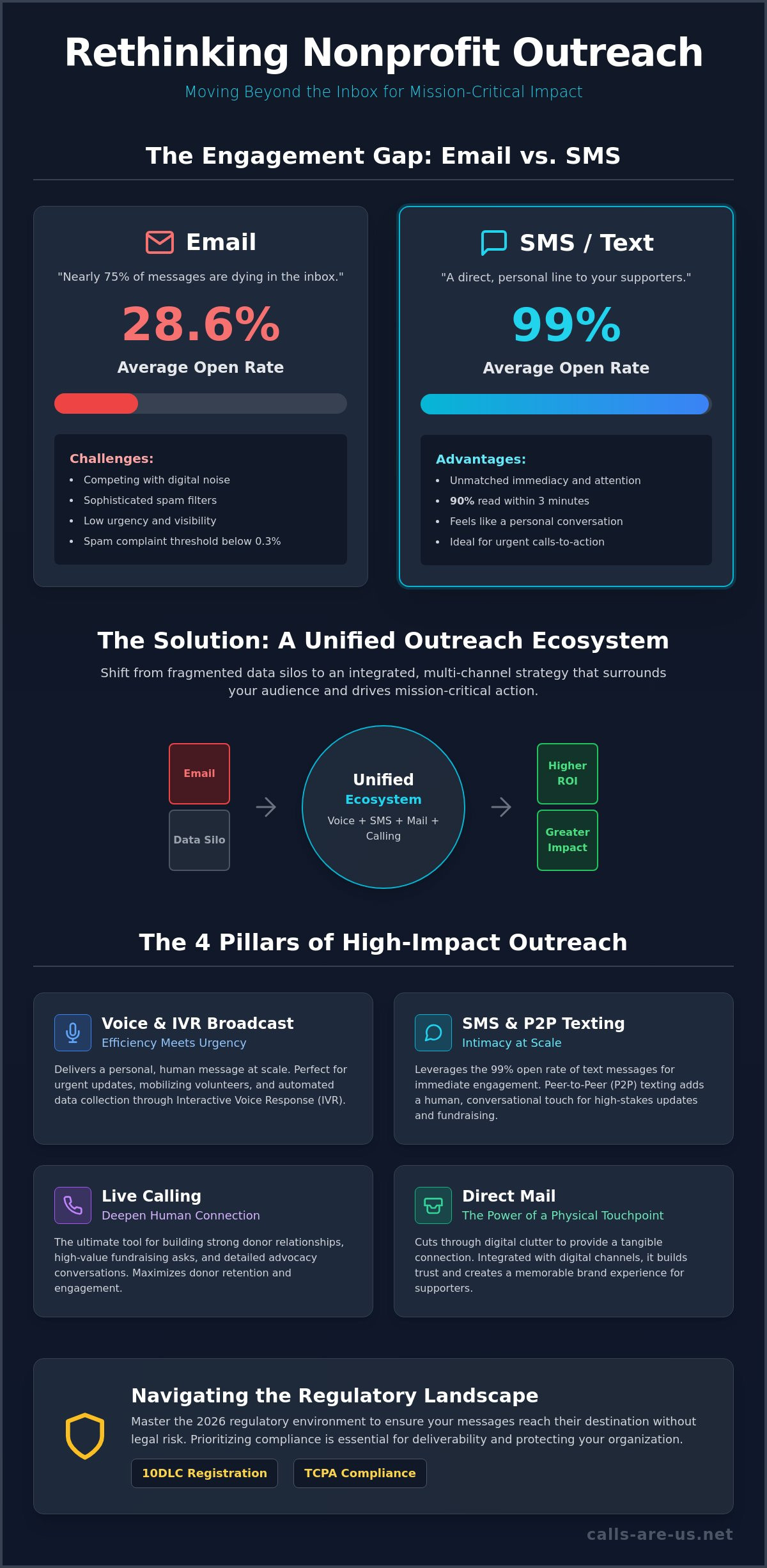
With the average nonprofit email open rate stalled at 28.6 percent, nearly three-quarters of your mission-critical messages are dying in the inbox. Meanwhile, SMS messages boast a 99 percent open rate, with 90 percent read within three minutes. This massive engagement gap is forcing leaders to rethink their mass outreach solutions for nonprofits to ensure their voices aren't lost in the digital noise. It's a high-stakes environment where traditional methods no longer guarantee the donor retention or volunteer mobilization your organization needs to thrive.
You've likely felt the frustration of declining engagement and the mounting pressure of complex 10DLC and TCPA compliance. We understand that managing fragmented data across multiple platforms is a drain on your resources. This guide promises to show you how to transcend saturated inboxes by utilizing a sophisticated, multi-channel approach. We will preview the latest in voice broadcast, peer-to-peer texting, and direct mail strategies to help you build a streamlined, high-ROI communication engine that respects your donors' time and honors your mission.
Table of Contents
Why Modern Nonprofits Are Moving Beyond Email for Mass Outreach
The digital inbox has become a graveyard for mission-critical messages. In 2026, relying solely on email means your cause is competing with an endless stream of commercial alerts, social notifications, and sophisticated spam filters. To truly understand what outreach is in this saturated environment, organizations must look toward a more direct line of communication. Modern mass outreach solutions for nonprofits have shifted from a single-channel approach to a robust ecosystem that prioritizes immediate visibility and human connection.
This "surround sound" strategy is no longer optional for advocacy and fundraising. While email remains a foundational tool, its limitations are clear when compared to the urgency of mobile and physical channels. By integrating voice, text, and mail, you ensure your message isn't just delivered; it's actually seen, heard, and acted upon by your most loyal supporters.
To better understand this concept, watch this helpful video:
The Limitations of a Single-Channel Strategy
Algorithms are changing the rules of engagement. Major email providers now enforce a spam complaint threshold of below 0.3 percent, making it easier than ever for your newsletters to be throttled or blocked entirely. This technical gatekeeping creates a significant barrier for organizations trying to mobilize volunteers quickly. Beyond the technical hurdles, there is a profound psychological difference between an unread email and a personalized text or voice message. A text feels like a conversation; an email feels like a chore. High-impact mass outreach solutions for nonprofits prove that "mass" communication doesn't have to be impersonal. By using data-driven segmentation, you can deliver high-stakes updates that maintain a warm, human-centric core.
The ROI of Direct Audience Engagement
True success is measured by donor retention and rapid mobilization. While email open rates hover around 28.6 percent, SMS boasts a staggering 99 percent open rate, with 90 percent of those messages read within just three minutes. This engagement gap directly impacts your bottom line. Multi-channel strategies reduce the cost-per-acquisition of new donors by creating multiple touchpoints that build trust over time. When you combine the speed of a voice broadcast with the intimacy of peer-to-peer texting, you create a resilient framework for growth. Multi-channel mass outreach is the integration of digital and physical touchpoints to drive mission-critical action.
Evaluating the 4 Pillars of High-Impact Outreach Solutions
High-impact communication rests on four distinct pillars. Each serves a specific strategic purpose within the broader mission of your organization. It is not enough to just send messages; you must choose the medium that aligns with the urgency and depth of the connection you seek to build. Comprehensive effective nonprofit outreach methods require balancing digital speed with a human-centric presence. By diversifying your mass outreach solutions for nonprofits, you create a resilient framework that can survive algorithm changes and shifting donor preferences.
Voice and IVR: Efficiency Meets Urgency
Voice remains the most personal way to deliver a message at scale. It carries the weight of a human voice, the urgency of a live update, and the clarity of a direct appeal. Interactive Voice Response (IVR) takes this further by enabling automated data collection and donor polling, allowing you to gather sentiment without intensive manual labor. During a crisis or a critical legislative session, a voice broadcast can mobilize thousands of volunteers in minutes. By adopting political voice broadcasting tactics, nonprofits can apply high-stakes advocacy techniques to their own community engagement, ensuring their calls to action are heard by decision-makers.
SMS Strategies: Mass vs. Peer-to-Peer (P2P)
Texting is the fastest way to get eyes on your mission. In an era where 90 percent of messages are read within three minutes, it provides a level of immediacy that email simply cannot match. Mass texting excels at "one-to-many" alerts, such as event reminders or urgent safety updates. Conversely, Peer-to-Peer (P2P) messaging facilitates "one-to-one" fundraising appeals that feel authentic and personal. This high-touch approach is essential for nurturing relationships rather than just broadcasting at them. For a deeper dive into which method fits your current campaign, review our P2P vs broadcast texting comparison to see how to best allocate your resources.
The Tangible Power of Direct Mail
Physical mail cuts through the digital clutter with a weight that screens cannot replicate. For older donor demographics, direct mail remains a high-trust channel that signals institutional stability and respect. Coordinating these mail drops with digital follow-ups often leads to a significant lift in response rates, as the physical piece serves as a permanent reminder on a donor's desk. Applying a political direct mail strategy to your donor retention efforts can turn a one-time contributor into a lifetime partner by using high-impact visuals and compelling storytelling. When you are ready to modernize your approach, exploring integrated mass outreach solutions is the first step toward reclaiming your audience's attention.
Live calling centers provide the final, non-negotiable bridge when human-to-human interaction is required. This is especially true for major gift solicitations where the nuances of a live conversation can secure a commitment that a text or email never could. A professional live agent can answer questions, address concerns, and build the rapport necessary for high-stakes fundraising.
A Buying Guide Framework: Matching Solutions to Nonprofit Goals
Efficiency is the byproduct of strategic alignment. When your outreach tools mirror your mission's specific objectives, you maximize both your impact and your budget. Selecting mass outreach solutions for nonprofits is not just a technical procurement; it's a visionary decision that determines how effectively you can translate supporter passion into measurable action. To find the right partner, you must first define whether your primary driver is capital, policy change, or long-term community stewardship.
Different goals require different tactical weights. For fundraising, the highest conversion rates often come from a blend of Peer-to-Peer (P2P) texting and coordinated direct mail. These channels provide the personal touch necessary to secure financial commitments. Conversely, if your focus is advocacy and mobilization, speed and deliverability become your primary KPIs. In these high-stakes moments, voice broadcasting and mass texting allow you to bypass digital gatekeepers and reach thousands of supporters instantly. When the goal shifts to donor stewardship, utilizing live calling center agents ensures that major contributors feel valued through authentic, human-to-human dialogue.
Assessing Your Organization’s Engagement Maturity
Modern outreach exists on a spectrum of complexity and connection. We categorize this maturity into three distinct tiers to help you identify your current position and your future path:
Tier 1: Basic Alerts and Reminders. This level focuses on "one-to-many" communication using mass texting and voice broadcast. It's ideal for event logistics, volunteer reminders, and general updates.
Tier 2: Interactive Engagement. Here, you introduce two-way dialogue. By implementing Interactive Voice Response (IVR) and P2P texting, you allow supporters to provide feedback, answer polls, and engage in deeper conversations.
Tier 3: Full-Scale Mission Mobilization. The most sophisticated tier integrates live calling centers with personalized direct mail. This creates a "surround sound" effect that builds high-trust relationships and drives significant fundraising results.
Key Features to Look for in a 2026 Outreach Partner
The right platform should simplify your operational workflows rather than fragmenting them. First, prioritize cross-channel reporting. You need to see the entire donor journey, understanding how a direct mail piece influenced a text response or how a voice broadcast led to a donation. Second, ensure ease of integration. Your mass outreach solutions for nonprofits must connect seamlessly with your existing CRM to maintain data integrity and prevent communication silos. Finally, demand scalability. Whether you are sending 1,000 messages to a local committee or 1,000,000 alerts during a national crisis, your partner must provide the infrastructure to move instantly without compromising deliverability or compliance.
Budgeting for this scale requires a shift from viewing outreach as a cost to seeing it as an investment in donor lifetime value. While pricing models vary, focus on providers that offer transparent structures for high-volume outreach. This allows you to plan your campaigns with confidence, knowing that your spend is directly tied to the mobilization of your mission.
Navigating the Regulatory Landscape: 10DLC, TCPA, and Deliverability
Compliance is the foundation of trust in digital communication. In 2026, the regulatory environment for mass outreach solutions for nonprofits is more structured and transparent than ever before. While 10DLC registration is critical for deliverability, ensuring your digital presence is inclusive for all donors is a parallel priority; specialized firms like 216digital help organizations navigate the complexities of ADA and WCAG compliance to ensure no supporter is left behind. Navigating 10DLC (10-Digit Long Code) registration ensures your mission-critical texts aren't flagged as spam or blocked by major carriers. Nonprofits enjoy a distinct "Tax-Exempt" status within the A2P (Application-to-Person) ecosystem, which typically grants them higher messaging throughput and specific campaign vetting advantages that commercial entities don't receive. By registering your brand, which involves a standard vetting fee of approximately $4.50, you establish your organization as a legitimate and verified sender.
TCPA compliance for nonprofits requires prior express consent for most automated outreach to mobile devices. This isn't just a legal suggestion; it's a financial necessity. Statutory damages for non-compliance can range from $500 to $1,500 per violation, which can quickly drain a nonprofit's budget. A clean, verified list is your most valuable asset. It allows you to bypass sophisticated carrier filters and maintain a spam complaint rate below the mandatory 0.3 percent threshold enforced by major providers. When you prioritize list hygiene, you protect your reputation and ensure your resources are focused on engaged supporters.
Turning Compliance into a Strategic Advantage
Registration increases deliverability and brand trust. When carriers recognize your organization through proper 10DLC registration, they deliver your messages with higher priority and fewer interruptions. It's essential to implement clear opt-in and opt-out mechanisms to maintain donor goodwill and legal standing. Remember that current regulations require all opt-out requests to be processed within 10 business days. While the FCC has delayed the "global revocation" rule until January 31, 2027, staying ahead of these changes by centralizing your consent data across all channels will give your organization a competitive edge in long-term donor retention.
Ensuring Message Integrity and Deliverability
Message integrity is about more than just avoiding "spammy" keywords. It's about maintaining a consistent and recognizable presence across all touchpoints. Carriers now monitor throughput and engagement closely, and additional activation fees, such as the $50 charge from T-Mobile for new campaigns, reflect the increasing cost of maintaining a secure network. Integrating a political campaign call center framework can provide your nonprofit with a blueprint for high-compliance, agent-led outreach. This model combines the efficiency of technology with the safety of human-guided interaction. To secure your organization's voice and ensure your messages reach their destination, explore our compliant mass outreach solutions today.
The Calls-Are-Us Advantage: Integrated Outreach for Lasting Impact
Impact requires more than just tools. It demands a unified philosophy that bridges the gap between digital efficiency and human connection. While many providers offer fragmented services, the most effective mass outreach solutions for nonprofits consolidate every touchpoint into a single, high-stakes ecosystem. At Calls-Are-Us, we provide a visionary platform where Voice Broadcast, Peer-to-peer texting, and Direct Mail work in concert to mobilize your mission. This integrated approach ensures your message remains consistent, your data stays synchronized, and your supporters feel seen across every channel.
Our technology is built for high-pressure environments. From national advocacy campaigns to local fundraising drives, we have proven that ethical, transparent communication drives superior results. Implementing a sophisticated mass communication strategy shouldn't be a burden on your internal team. We remove the friction of managing multiple vendors, allowing you to focus on what matters most: your impact on the world.
Why Partnerships Matter More Than Software
Software is a commodity; partnership is a strategic asset. Moving from a transactional vendor relationship to an authoritative visionary guide allows your organization to navigate the complexities of modern outreach with confidence. Our professional Live Calling Center services go beyond simple automation by providing human-centric support for complex donor inquiries. This human element is essential for fostering trust and resolving concerns that a text or email cannot address. By centralizing your Voice, SMS, and IVR workflows through an agentic platform like GraiaCX, you eliminate the data silos that often lead to donor fatigue and fragmented messaging.
Getting Started with a 2026 Outreach Strategy
Transitioning to a multi-channel framework is a journey of intentional growth. We recommend a methodical approach to ensure your mass outreach solutions for nonprofits deliver the highest possible ROI. Follow these three steps to begin your transformation:
Audit your engagement metrics. Review your current open rates, conversion data, and donor retention numbers to identify exactly where your current strategy is falling short.
Select a pilot channel. Choose a high-impact medium, such as Peer-to-peer texting, for your next campaign to experience the immediate lift in supporter engagement and response speed.
Partner with Calls-Are-Us to scale. Once you've seen the results of a targeted pilot, we'll help you scale your impact nationally by integrating Live Agents and Direct Mail into a cohesive, mission-driven engine.
The future of nonprofit communication is personal, urgent, and multi-dimensional. By choosing an integrated partner, you aren't just buying software; you are securing a principled guide dedicated to the social good. Let's build a movement that resonates far beyond the inbox.
Empowering Your Mission Through Strategic Multi-Channel Engagement
The era of single-channel outreach has ended. To thrive in 2026, organizations must adopt a "surround sound" approach that combines the speed of text with the authority of voice. We've operated in over 40 states supporting high-stakes national campaigns; this deep experience provides the multi-channel expertise necessary to reach supporters wherever they are. By mastering 10DLC and TCPA regulations with a dedicated partner, you transform complex legal requirements into a strategic advantage for your mass outreach solutions for nonprofits.
Your donors and volunteers are waiting for a connection that feels authentic and urgent. Moving beyond the saturated inbox allows your organization to reclaim its voice and drive measurable social change. Our sophisticated compliance management and integrated platform for Voice, SMS, and Direct Mail ensure your outreach is both effective and ethical. Scale your nonprofit's impact with Calls-Are-Us mass outreach solutions today. Your mission is too important to be left to chance; we're here to help you lead the way with confidence and integrity.
Frequently Asked Questions
Are mass outreach solutions for nonprofits different from political tools?
Nonprofit solutions share the same underlying technology as political tools but operate under different regulatory vetting. While both use voice, text, and mail, nonprofits benefit from specific "Tax-Exempt" status in the 10DLC ecosystem, which often grants them higher messaging throughput. Political tools focus on voter persuasion, whereas nonprofit outreach centers on long-term donor stewardship and mission-driven advocacy.
What is the most cost-effective mass outreach channel for small nonprofits?
SMS and peer-to-peer texting typically provide the highest return on effort for smaller organizations. Because these messages are read almost instantly, they drive immediate action without the high production costs of direct mail or the labor requirements of a live call center. It's an efficient way to scale engagement while maintaining a warm, personal touch that resonates with supporters.
How do nonprofits ensure 10DLC compliance for text messaging?
Compliance requires a structured process of brand registration and campaign vetting through a verified provider. Organizations must provide their Tax ID to verify their nonprofit status, which results in lower carrier surcharges and higher volume limits. Utilizing professional mass outreach solutions for nonprofits ensures these technical submissions are managed correctly so your messages reach their destination without interference.
Can we use voice broadcasting for emergency volunteer mobilization?
Voice broadcasting is one of the most effective tools for rapid response and emergency alerts. It allows you to deliver a consistent, urgent message to thousands of volunteers simultaneously, bypassing the delays of email or social media notifications. This speed is critical when mobilizing people for disaster relief or urgent legislative sessions where every second counts toward your mission's success.
How does direct mail integrate with digital outreach in 2026?
Direct mail acts as a high-trust anchor that reinforces your digital appeals. In 2026, sophisticated organizations use mail to follow up on high-value digital interactions, creating a physical reminder of the mission on a donor's desk. This integrated approach ensures your message exists in both the physical and digital worlds, which significantly increases the likelihood of long-term donor retention.
Do we need a specific CRM to use Calls-Are-Us outreach tools?
No, our platform is designed to integrate seamlessly with the industry's leading donor management systems. We prioritize flexibility, allowing you to sync your contact lists and engagement data regardless of your current CRM provider. This prevents fragmented data silos and ensures you have a unified view of every supporter's journey across voice, text, and mail channels.
What is the difference between P2P and A2P texting for nonprofits?
P2P involves a human sender initiating each message, while A2P uses automated systems for high-volume delivery. P2P is ideal for high-touch fundraising appeals that require a conversational response and a personal connection. A2P is better suited for mass alerts, event reminders, and one-way updates where speed and massive scale are the primary requirements for the campaign.
How can we measure the ROI of a multi-channel outreach campaign?
ROI is measured by tracking specific conversion rates across each touchpoint in the donor journey. By analyzing which channel triggered the final action, you can optimize your outreach spend for future initiatives. High-quality mass outreach solutions for nonprofits provide integrated reporting that links these interactions directly to your fundraising and mobilization goals, allowing for data-driven growth.


Comments