_edited.png)
Mastering Live Voter ID Calls: 2026 Campaign Guide

Updated: Sep 28
In a 2026 election cycle defined by shifting voter ID laws and a flood of digital noise, the most powerful tool in your campaign's arsenal isn't an algorithm. It's a human voice. You've likely realized that automated robocalls are increasingly ignored and that your outreach needs the precision of live voter identification calls to truly resonate with a skeptical electorate. It's frustrating to watch precious campaign resources disappear into voicemail boxes or be flagged by "Scam Likely" filters before a single meaningful connection is made.
This guide will show you how to deploy professional calling operations to cut through the static, refine your data, and build the "Yes" list you need for a decisive victory. We'll explore how to transform your outreach into a sophisticated operation that identifies your base, handles persuasion with grace, and secures your path to Election Day. By the end of this article, you'll understand how to integrate high-touch calling with your broader multi-channel strategy to ensure your candidate is represented with the authority, integrity, and warmth they deserve.
Table of Contents
What Are Live Voter Identification Calls in Political Campaigns?
Data drives every modern victory. It's the silent engine behind successful ground games and the primary tool for resource allocation. Live voter identification calls represent the most sophisticated way to refine that data by establishing a direct, human connection with the electorate. Unlike passive data scraping or automated messaging, these calls involve trained professionals engaging in real-time dialogue to determine exactly where a voter stands. This proactive outreach allows campaigns to move beyond guesswork and build a precise, actionable map of their support.
A deep understanding of the voter registration process is essential for any outreach program. The electoral roll serves as your foundational list, but it's often filled with outdated information or individuals who have moved since the last cycle. Live calls clean these lists, verify residency, and update contact preferences. This ensures your "win number" is based on reality, providing your campaign with a reliable list of supporters to mobilize when it matters most.
The Distinction Between Legal ID and Campaign ID
Confusion often arises between legal requirements and campaign strategy. Legal ID refers to the physical documentation, such as a driver's license or passport, that states require for a person to cast a ballot. As of 2026, 36 states have implemented some form of identification requirement at the polls. Campaign ID, however, is an internal metric. It's how your team categorizes a voter as "Support," "Oppose," or "Undecided" based on their responses during a call.
Campaigns must master both definitions to be effective. If your live agents identify a supporter who lacks the proper legal documentation, your team can provide immediate assistance or information on how to obtain it. This is especially critical in 2026 as states introduce new measures. For example, Arizona's Proposition 144 seeks to eliminate non-government IDs for in-person voting, while Florida is moving toward more restrictive photo ID lists. Your live callers act as a bridge, ensuring supporters aren't just willing to vote, but are legally prepared to do so.
The High Stakes of Accurate Data in 2026
Precision is the only path to victory in a divided landscape. Automated voice broadcasts can deliver a message, but they can't listen to a voter's concerns. Live calls capture nuance. They identify why a voter is hesitant, which issues drive their decision, and whether they are truly persuadable. This qualitative data allows your team to segment lists with surgical precision, focusing persuasion efforts on the voters who will actually move the needle.
Live voter ID is the strategic foundation of any modern ground game. By prioritizing human-to-human interaction, your campaign cuts through the digital noise of social media and the clutter of overflowing inboxes. You aren't just collecting data; you're building trust, fostering community, and ensuring that every supporter has the information they need to participate in the democratic process.
The Mechanism of a High-Performance Live Calling Center
Efficiency isn't accidental. It's engineered. A high-performance operation relies on a tri-fold foundation: robust VoIP technology, intelligent predictive dialers, and seamless CRM integration. When these systems work in harmony, agents spend less time waiting for a dial tone and more time engaging in live voter identification calls that actually move the needle. This technical backbone ensures every second of airtime is optimized for impact, allowing your message to reach the right ears at the right time.
Technology facilitates the call, but humans win the conversation. Professional agents bring a level of empathy and rapport that automated systems simply cannot replicate. They navigate complex questions, pivot based on voter sentiment, and record nuanced data that goes far beyond a simple binary response. This data loop is instantaneous; as soon as an agent logs a result, the campaign central voter file updates. This real-time synchronization allows leadership to adjust strategy based on live field conditions rather than relying on outdated reports from previous weeks.
Navigating the regulatory landscape is equally critical for maintaining campaign integrity. Understanding the FCC rules for political calls is not just about staying compliant; it's about protecting the candidate's reputation from "Scam Likely" labels and legal hurdles. Professional centers prioritize these standards, ensuring every interaction adheres to TCPA guidelines while maintaining a polished, authoritative register that reflects well on your candidate.
Professional Agents vs. Volunteer Phone Banks
Reliability is the currency of a closing campaign. While volunteers are the heart of a movement, they often struggle with consistency and the high-volume demands of a 2026 cycle. Professional agents maintain a steady "calls per hour" rate that ensures your outreach reaches the necessary scale. They undergo rigorous training to ensure strict script adherence and bias-free data entry, providing a clean dataset that volunteers might inadvertently skew. When you need guaranteed coverage during the high-stakes hours leading up to Election Day, professional operations provide the certainty that volunteer lists cannot always promise.
Integrating IVR and Live Agent Workflows
Efficiency thrives on smart segmentation. Modern campaigns often use Interactive Voice Response (IVR) for initial screening, allowing live agents to focus their energy on undecided or high-priority voters who require a human touch. These political campaign call center services bridge the gap between broad automation and focused engagement. This hybrid approach often includes "patch-through" capabilities, where a supporter can be instantly connected to headquarters or a legislative office. This creates a friction-less experience that empowers the voter and strengthens their connection to your cause. If you're ready to elevate your outreach, exploring integrated calling solutions can provide the competitive edge your campaign needs to win.
Live Calls vs. Voice Broadcast: Choosing Your Outreach Strategy
Strategy requires discernment. You must choose between the surgical precision of human engagement and the broad reach of automation. While voice broadcasts offer unmatched speed, live voter identification calls remain the gold standard for building a reliable, high-integrity voter file. This choice isn't merely about budget; it's about the depth of intelligence your campaign needs to win in 2026. You're balancing three critical factors: cost, engagement, and compliance.
Data quality varies significantly between these methods. Automated broadcasts typically yield binary results, such as asking a voter to press a number on their keypad, which often misses the nuance of voter sentiment. In contrast, live agents capture descriptive feedback that identifies "soft" supporters and hesitant voters. A study on voter notification suggests that the way voters are contacted significantly influences their likelihood to participate. By using live calls, you aren't just notifying; you're establishing a relationship that increases the voter's psychological commitment to the candidate.
Compliance is a major factor in the 2026 regulatory environment. With increasing scrutiny on automated outreach and the implementation of stricter carrier-level filters, live agent calls offer a safer, more resilient path. They are far less likely to be flagged as "Scam Likely" and carry a professional weight that protects your candidate's brand. Positioning live calls as your primary tool for identification allows you to save automated broadcasts for mass alerts where speed is the only priority.
When to Deploy Political Voice Broadcasting
Automation has its place in a well-rounded ground game. Use it for high-volume, low-complexity tasks like event reminders, polling location alerts, and simple "Go Vote" messages. For a deep dive into maximizing these tools at scale, consult The Ultimate Guide to Political Voice Broadcasting in 2026. This method excels when you need to deliver a single, clear piece of information to thousands of voters in a matter of minutes, providing a cost-efficient way to maintain visibility without the overhead of a live agent.
The ROI of Live Voter Identification
Quality justifies the investment. While the cost per contact is higher than a robocall, the accuracy of your "Win Number" data saves money across your entire budget. By identifying "Oppose" voters early, you stop wasting expensive direct mail and digital ad spend on individuals who will never support your candidate. This synergy between live calls, peer-to-peer texting, and physical mail creates a reinforced message that transforms a simple contact into a confirmed vote on Election Day.
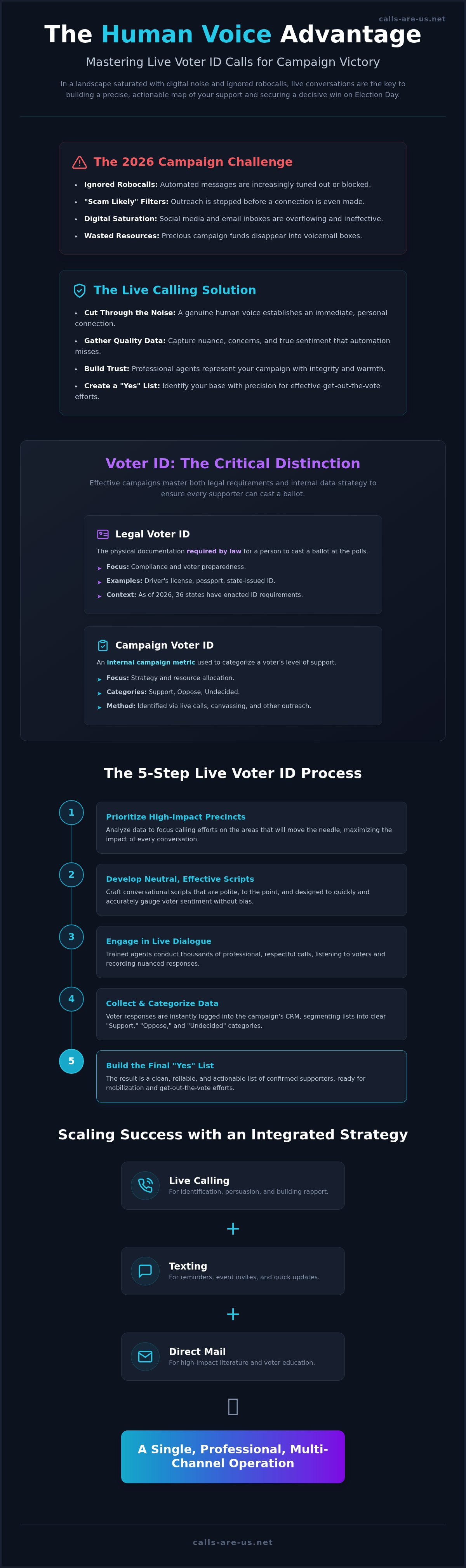
How to Execute a Live Voter ID Campaign: A 5-Step Process
Precision is the product of a disciplined workflow. To transform a raw electoral roll into a victory map, you must follow a structured approach that prioritizes data integrity and voter experience. Live voter identification calls are most effective when they're treated as a rigorous cycle of acquisition and refinement. This process ensures that your resources aren't just spent, but invested in the specific voters who will decide the election's outcome.
Segment your voter file: Divide your data to prioritize high-impact precincts where persuasion or turnout will decide the margin. Focus your initial energy where the "win number" is most vulnerable.
Develop a neutral script: Draft a script that encourages honest responses. If a script feels like a sales pitch, voters will provide the answer they think you want to hear rather than their true intention.
Train for excellence: Educate your agents on candidate platform points and common objections. They must be prepared to handle pushback with professional poise and factual accuracy.
Monitor real-time execution: Launch the program with active oversight. Use live dashboards to catch shifts in voter sentiment as they happen, allowing for immediate tactical adjustments.
Refine your target lists: Clean and export your "Yes" list for immediate reinforcement. This data should fuel your GOTV efforts and direct mail campaigns in the final weeks.
Crafting the Perfect Identification Script
A successful conversation is won or lost in the first few seconds. Your script acts as the roadmap for your agents, guiding them through the complexities of voter interaction with clarity and purpose. It's not about reading a monologue; it's about facilitating a dialogue that yields high-quality intelligence.
The Hook: Establish authority and purpose within the first five seconds to prevent early hang-ups. A clear, professional introduction sets the tone for a respectful exchange.
The Ask: Frame your identification question neutrally. This ensures the voter feels safe sharing their true intentions, providing you with data you can actually trust.
The Close: Provide immediate value by offering polling location details or registration deadlines. Leaving a positive impression reinforces your candidate's brand and builds community trust.
Handling Data and Compliance in 2026
Integrity is the bedrock of modern outreach. In the 2026 cycle, real-time CRM syncing is essential to prevent duplicate calls that lead to voter fatigue and negative brand perception. Your systems must be configured for manual-dial or human-initiated calling to ensure full TCPA compliance, protecting your campaign from legal risks while maintaining high-quality outreach. Data hygiene is the most critical part of the post-call process because it ensures your GOTV resources are spent only on voters you have actually confirmed. If you're ready to deploy a professional, high-impact program, you can launch your live calling campaign with our expert team to secure your path to victory.
Scaling Success with Calls-Are-Us: Your Integrated Partner
Victory is rarely the result of a single outreach channel. It's the product of a coordinated, multi-layered offensive that meets voters exactly where they are. At Calls-Are-Us, we provide the infrastructure for this comprehensive outreach, blending the human touch of live voter identification calls with the speed of digital engagement and the permanence of physical mail. This integrated approach ensures your message is heard, reinforced, and remembered by the people who will decide the 2026 cycle.
We specialize in the strategic synergy between different outreach modes. For instance, pairing your identification data with a political direct mail strategy allows you to send high-impact physical pieces specifically to the supporters you've already verified. This isn't just about volume; it's about the precision that comes from over 15 years of experience. Having operated in more than 40 states since 2010, we possess the national perspective required to navigate diverse state regulations with a single, trusted partner.
Our commitment to ethical, transparent, and high-stakes communication remains unwavering. We champion a philosophy of inclusive dialogue, ensuring your campaign projects authority while maintaining a warm, human-centric core. In the high-pressure environment of a modern election, we act as both a powerful ally and a principled guide through the complexities of regulatory standards and voter sentiment.
Multi-Channel Integration for 2026
Effective outreach requires a specific rhythm. Once a live agent identifies a supporter, we trigger a sequence of engagement that keeps your candidate top-of-mind. This might include a peer-to-peer (P2P) text follow-up for immediate event registration or a targeted mailer that addresses the specific concerns raised during the call. By following the Architect’s Guide to Voter Outreach, your team can build a cohesive plan that eliminates data silos and maximizes the impact of every interaction.
Getting Started with Professional Live Calling
We've streamlined our onboarding process to respect your campaign's timeline. It begins with a secure voter file upload, followed by tailored agent training that aligns with your candidate's specific platform, tone, and goals. Once the program is live, you'll have access to a daily campaign dashboard providing real-time analytics, sentiment tracking, and response reporting. This level of visibility allows you to make informed tactical decisions with total confidence. Secure your victory with professional voter identification and transform your outreach into a winning ground game.
Securing Your Path to Victory in 2026
Success on Election Day is built on the quality of your connections. Live voter identification calls aren't just a technical requirement; they're the heartbeat of a winning campaign. By prioritizing human engagement, you build a foundation of trust that purely automated systems can't touch. We've explored how a professional calling center provides the precision, reliability, and technical infrastructure required to navigate the high stakes of the 2026 cycle. You now have the roadmap to segment your voter file, craft neutral scripts, and integrate your outreach across mail and digital channels.
Scaling these operations requires a partner with proven authority and high-volume capacity. Calls-Are-Us brings a legacy of expertise in over 40 states since 2010. Our integrated live agent and IVR solutions ensure your outreach remains compliant, efficient, and deeply resonant with every voter you contact. We help you transform raw data into a sophisticated map of support that drives your ground game forward with confidence.
Contact Calls-Are-Us to launch your professional Live Voter ID campaign today. Your candidate deserves a voice that carries weight, integrity, and the power to inspire action. The road to victory is demanding, but with the right data and a human-centric approach, your goals are well within reach.
Frequently Asked Questions
What is the difference between voter identification calls and voter persuasion calls?
Voter identification focuses on objective data collection, while persuasion focuses on changing minds. ID calls are brief, neutral, and designed to categorize voters as supporters, opponents, or undecided. Persuasion calls delve into specific candidate platforms to influence a voter's choice through deeper dialogue and issue-based advocacy.
Are live voter identification calls legal under TCPA regulations in 2026?
Yes, live agent calls remain the safest path for regulatory compliance. Because these interactions involve human-to-human engagement, they are generally exempt from the stricter rules governing automated robocalls. Professional centers use manual-dial or human-initiated systems to ensure your campaign adheres to the latest FCC standards while protecting your candidate's reputation.
How many calls can a professional live agent make per hour for a campaign?
A professional agent typically averages 25 to 40 dials per hour. This rate varies based on the dialer technology used and the average length of successful conversations. High-performance centers optimize this flow to ensure agents spend the maximum amount of time speaking with voters rather than listening to ringtones or navigating busy signals.
Do I need a pre-existing voter list to start a live calling program?
You generally need a foundational voter file to begin your outreach. Most campaigns provide an electoral roll exported from their CRM or state party database. If you don't have a list, professional partners can often assist in procuring high-quality data through verified third-party providers to ensure your live voter identification calls reach the right households.
What is the best time of day to make live voter identification calls?
Voter contact rates are highest during weeknights and weekend afternoons. Aim for the 5:00 PM to 8:00 PM window on weekdays and 10:00 AM to 5:00 PM on weekends. These timeframes respect voter schedules while maximizing the likelihood of a successful live pickup and a meaningful interaction.
Can live calling centers handle bilingual voter outreach for diverse districts?
Yes, bilingual outreach is a critical component of a winning strategy in diverse districts. Professional centers employ native speakers to ensure cultural nuance and linguistic accuracy. For broader multilingual outreach and professional interpreter services, campaigns often rely on resources like dialog-one.com to bridge communication gaps. This fosters a sense of trust and inclusivity that generic translations or automated voices simply cannot achieve.
How does live voter identification data impact my direct mail strategy?
Accurate ID data eliminates waste in your physical mail budget. By identifying "Oppose" voters early through live voter identification calls, you can remove them from your distribution lists. This allows you to redirect those resources toward reinforcing your message with "Yes" and "Undecided" voters who actually influence the win number.
What happens to the data if a voter doesn't answer the live call?
Unanswered calls are logged as "No Answer" and recycled for future attempts. Most campaigns schedule three to five attempts at different times of the day before retiring a record. This persistent approach ensures you capture the most accurate snapshot of the electorate possible while minimizing data gaps in your final GOTV list.



Comments