
Mastering Voter Persuasion Techniques: A Strategic Guide for 2026 Campaigns

Winning in 2026 requires more than just a louder megaphone. With a projected 11.6 billion dollars pouring into the midterm cycle, traditional mobilization blasts are hitting a wall of voter fatigue and skepticism. You've likely noticed that the old playbooks are yielding diminishing returns, especially when trying to reach the movable middle through the thick digital noise. To break through, your strategy must evolve beyond simple outreach and master sophisticated voter persuasion techniques that prioritize genuine connection.
We understand the pressure of managing high costs for live agents while engagement rates on standard mass texts continue to drop. This guide provides a clear framework for persuasion messaging that actually converts undecided voters. You'll discover how to combine psychological triggers with high-impact communication technology like P2P texting, Voice Broadcast, and direct mail. We explore which tools establish authority, which foster trust, and how to build a multi-channel journey that gives your audience a face-saving reason to pivot their support.
Table of Contents
The Strategic Shift: Persuasion vs. Mobilization in 2026
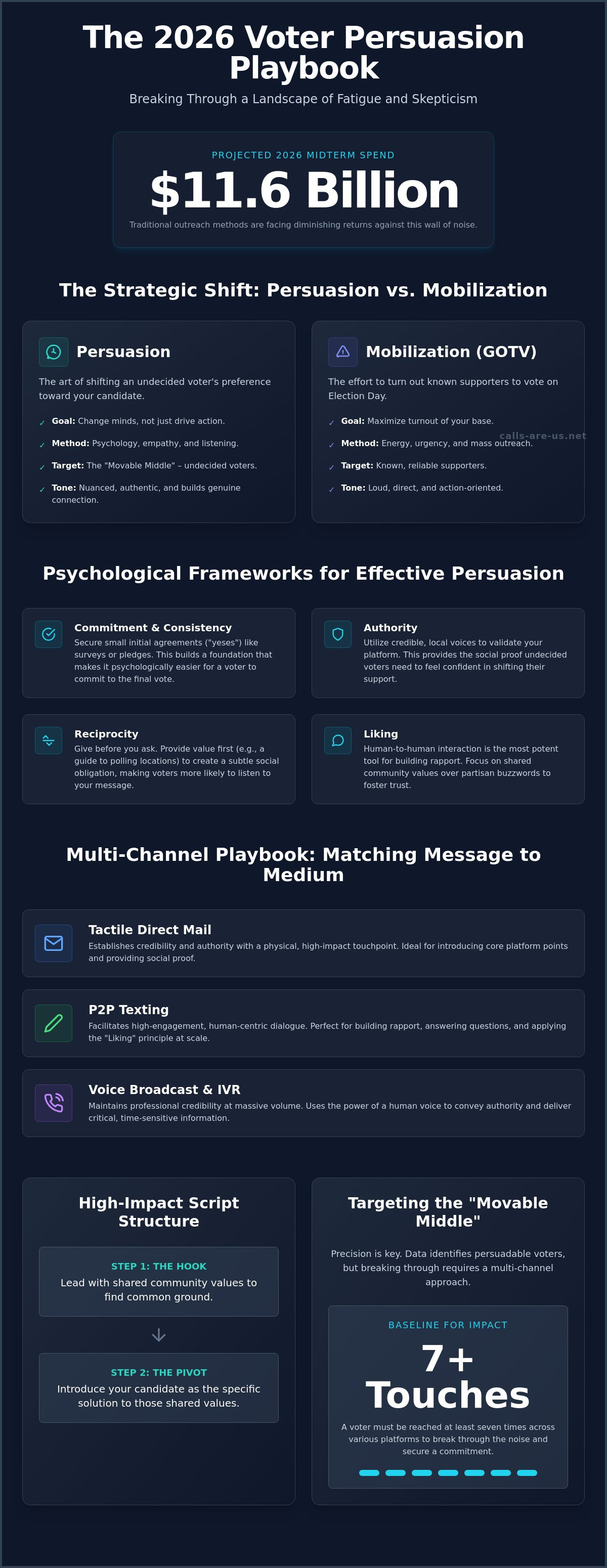
Persuasion is the art of shifting an undecided voter's preference toward your candidate. It differs fundamentally from mobilization, often called Get Out The Vote (GOTV), which focuses on turnout for known supporters. While mobilization is about energy, persuasion is about psychology. In the high-stakes environment of 2026, where total ad spend is projected to hit 11.6 billion dollars, the "movable middle" is shrinking and becoming harder to reach. Campaigns can no longer rely on generic messages to win. They must deploy sophisticated voter persuasion techniques that address the specific, often complex concerns of undecided individuals. Modern communication technology provides the essential infrastructure to scale these one-on-one psychological shifts across entire districts.
To better understand the historical and modern evolution of this concept, watch this helpful video:
Why Traditional Blasts Fail Persuasion Tests
Standard mobilization blasts often backfire when applied to persuasion. Voters are currently overwhelmed by the volume of political outreach, which leads to immediate opt-outs and deep-seated fatigue. When a message feels impersonal or purely transactional, it triggers a defensive mechanism in the recipient. Successful campaigns in 2026 prioritize nuance, authenticity, and empathy. They move away from "shouting" and toward listening. By utilizing Deep canvassing techniques, campaigns can build the trust necessary to change minds in a polarized landscape. This approach transforms a cold contact into a meaningful interaction that respects the voter's perspective.
Identifying the Persuadable Universe
Precision is the foundation of effective outreach. Data allows campaigns to separate "hard nos" from the "movable middle," ensuring resources aren't wasted on voters who will never shift. By analyzing historical voting patterns and demographic shifts, campaigns can pinpoint exactly where their voter persuasion techniques will have the most impact. This persuadable universe requires a multi-channel approach. Different segments respond to different mediums; some trust the authority of a voice call, while others prefer the interactive nature of a peer-to-peer text. Reaching a voter at least seven times across various platforms is now a baseline requirement for breaking through the noise and securing a commitment.
Psychological Frameworks for Effective Voter Persuasion
Psychology is the engine of electoral change. While data identifies who to reach, psychological frameworks explain how to move them. In 2026, Robert Cialdini’s principles remain the gold standard, though they require precise application to cut through modern cynicism. Successful voter persuasion techniques rely on the "Commitment and Consistency" principle. By securing small "yeses", such as a voter agreeing to a brief survey or a digital pledge, you build a foundation for the ultimate vote. This is reinforced by the Authority Principle. When a campaign utilizes credible, local voices to validate a platform through Voice Broadcast or direct mail, it provides the social proof undecided voters need to feel confident in their choice.
The Power of Reciprocity and Liking
Give before you ask. Providing value first, such as a localized guide to polling locations or a clear breakdown of complex ballot measures, creates a subtle social obligation. This is the principle of reciprocity in action. Once a voter feels they've received something useful, they are more likely to reciprocate by listening to your candidate’s platform. This connection is deepened through "Liking." Human-to-human interaction, facilitated by peer-to-peer (P2P) texting or live calls, is your most potent tool for building rapport. Effective scripts avoid partisan buzzwords and instead focus on shared community values, which fosters trust and reduces tribal defenses.
Cognitive Dissonance: The Secret to Shifting Attitudes
Shifting a voter’s mind requires resolving their internal conflict. Research discussed in The art of political persuasion suggests that actions often precede and cause political attitudes. When a voter voices their own concerns through Interactive Voice Response (IVR) or polling, they begin a self-persuasion process. This helps resolve cognitive dissonance, the mental discomfort felt when holding two conflicting beliefs. Your messaging must provide a "permission to pivot," offering a face-saving reason for a voter to change their allegiance based on new circumstances or information. This approach transforms the act of switching candidates from a betrayal of past values into a logical evolution of them.
Mastering these psychological drivers is essential for any modern campaign. If you are looking to implement these strategies across your district, you can explore professional outreach tools designed to scale human connection. By combining technical precision with a deep understanding of human behavior, you can move the movable middle with confidence and integrity.
Multi-Channel Persuasion: Matching Message to Medium
Persuasion is a journey, not a single touchpoint. In the hyper-competitive 2026 environment, where voters are bombarded with content, a one-off message is rarely enough to shift a long-held attitude. You must reach the "movable middle" at least seven times across different platforms to break through the noise. Integrating various psychological frameworks for voter persuasion into a multi-channel strategy ensures your campaign remains both visible and credible. Direct mail establishes a physical, tactile presence that conveys authority and lasting trust. Live call centers provide the human empathy needed to dismantle complex objections and build genuine rapport with undecided voters.
A multi-channel approach isn't just about repetition; it's about reinforcement. Each medium serves a specific psychological purpose. While a physical mailer might introduce a candidate's credentials, a follow-up text or call humanizes that information. This layering effect helps resolve cognitive dissonance by providing multiple streams of validation. By matching your message to the medium, you create a cohesive narrative that guides a voter from initial awareness to a final, firm commitment on Election Day.
P2P Texting: The Tool for Personal Persuasion
P2P texting is the modern equivalent of a door knock for persuasion. It's personal, immediate, and high-engagement. Unlike mass blasts that often trigger defensive reactions, P2P outreach fosters two-way mobile conversations that feel human and authentic. This is where the "Liking" principle shines. When a voter feels they're speaking with a real person who shares their concerns, their willingness to listen increases. Choosing the right messaging depth is vital for your strategy. Evaluating the differences between P2P vs Broadcast Texting helps you determine when to prioritize deep conversation over broad reach.
Voice and IVR: Establishing Scale and Authority
Voice and IVR tools establish scale and authority. In a high-stakes cycle, you need to deliver endorsements that carry weight. Utilizing political voice broadcasting allows you to share the voices of trusted community figures, creating an "Authority" play that validates your candidate’s platform instantly. Interactive Voice Response (IVR) acts as a data-collection powerhouse. It identifies specific voter anxieties, allowing your team to tailor subsequent live calls to the issues that matter most. These sophisticated voter persuasion techniques ensure that your campaign doesn't just reach people, but actually resonates with them on a personal level.
How to Build a Persuasion Script That Actually Works
A script is a strategic map. While technology provides the vehicle for outreach, the script ensures you're driving toward a meaningful connection rather than a defensive dead end. Effective voter persuasion techniques rely on a structural formula that moves from shared values to specific solutions. In 2026, voters don't want to be talked at; they want to be understood. By following a disciplined five-step sequence, your campaign can transform a standard contact into a powerful moment of influence.
Step 1: The Hook. Lead with a non-partisan, shared value or concern. Instead of "Vote for Candidate X," try "We all want our local schools to have the resources they need."
Step 2: The Pivot. Connect that shared concern directly to a campaign solution. This is where you introduce the candidate's specific policy as the logical answer to the voter's concern.
Step 3: The Validation. Back your claim with social proof or authority. Mention a local endorsement or a successful pilot program to provide the external validation undecided voters require.
Step 4: The Micro-Commitment. Ask for a small, non-binding action. Asking "May I send you a brief text with the candidate's education plan?" is far more effective than demanding a vote immediately.
Step 5: The Closing. Reiterate the shared goal you established in the hook. Thank the voter for their time and remind them that their voice is essential to the community’s progress.
Empathy-First Messaging
Listening is 70% of a persuasion call or text exchange. When a voter feels heard, their psychological defenses drop, making them more receptive to new information. Your agents shouldn't rush to the next bullet point when a voter expresses a concern. Instead, they should validate those feelings without necessarily conceding the campaign's entire position. Empathy-first is the bridge between voter pain and candidate solution. This approach builds the rapport necessary to move a voter from a place of skepticism to one of curious engagement.
Handling Objections with the 'Feel-Felt-Found' Method
Objections are opportunities for deeper persuasion. When a voter brings up a negative claim about your candidate, use the "Feel-Felt-Found" method to pivot back to your platform. Start by saying, "I understand how you feel." Follow up with, "Others in our district have felt the same way." Then, conclude with, "What they found after looking at the candidate's record was..." This technique validates the voter's perspective before gently introducing a corrective narrative. Integrating this into your political campaign call center workflow ensures your team is prepared for high-pressure interactions.
Ready to put these scripts into action? You can start building your persuasion campaign today with our expert infrastructure and support.
Scaling Persuasion with Calls-Are-Us Technology
Scaling a message across a district or state requires more than just volume. It demands a partner that acts as an authoritative visionary, blending technical speed with a deep commitment to human connection. At Calls-Are-Us, we provide the infrastructure that allows campaigns to stop focusing on the mechanics of outreach and start focusing on the impact of their message. Our tools facilitate the critical transition from "what we do" to "why it matters," ensuring your voter persuasion techniques resonate at every level of the electorate. To win in 2026, you need an integrated voter outreach strategy that combines multi-channel delivery with psychological precision.
Unified Messaging Across All Channels
Consistency builds trust. When a voter receives a P2P text, it must feel like a natural extension of the political direct mail they found in their mailbox earlier that day. Our platform ensures that your messaging remains unified across SMS, Voice, and Mail, protecting your brand's integrity during high-stakes cycles. We help you maintain this consistency while increasing efficiency. For instance, you can leverage IVR to pre-qualify undecided voters, identifying their specific anxieties before passing them to a high-value live agent for a final persuasion conversation. This structured workflow maximizes your resources, respects the voter's time, and drives higher conversion rates.
Technology Built for High-Stakes Influence
Reliability is the foundation of a successful campaign. In the final weeks before Election Day, you don't have time for technical glitches or slow delivery. Our infrastructure is designed for speed, scale, and significance. We support national-scale outreach that reaches millions of households without sacrificing the nuanced, human core that makes persuasion possible. Whether you're running a local race or a multi-state operation, our systems provide the stability you need to execute your vision with confidence. It's time to move beyond standard mobilization and embrace a sophisticated, multi-channel approach that actually changes minds.
Don't leave your campaign's success to chance. Partner with Calls-Are-Us for your 2026 persuasion strategy and discover how our expertise can transform your outreach into a winning movement.
Leading the Future of Electoral Dialogue
Success in 2026 belongs to the campaigns that prioritize authentic connection over mass-produced noise. By layering psychological triggers across a sophisticated multi-channel infrastructure, you can move the needle with precision and integrity. The journey from initial awareness to a firm commitment is built on trust, empathy, and the strategic application of voter persuasion techniques that respect the individual's perspective. Each touchpoint is an opportunity to resolve doubt and offer a face-saving path toward a new candidate preference.
Calls-Are-Us brings a legacy of high-stakes expertise from operations in over 40 states directly to your team. Our integrated outreach platform is founded on principles of ethical, inclusive communication, ensuring your message scales effectively without losing its human core. We provide the technological bridge between your campaign's vision and the voters' shared values, helping you navigate complex regulatory landscapes with confidence. This partnership transforms outreach from a transactional task into a powerful movement of influence.
Scale your voter persuasion strategy with Calls-Are-Us today. Your vision has the power to shape the future, and we're here to ensure that voice is heard clearly by those who matter most. Let's build a more connected and engaged electorate together.
Frequently Asked Questions
What is the most effective voter persuasion technique?
The most effective voter persuasion techniques involve deep canvassing, which centers on empathetic, two-way dialogue. This method shifts the focus from rigid talking points to active listening, allowing voters to share their personal stories and concerns. By validating their experiences, you build the trust required to introduce your candidate’s platform as a relevant solution to their community's specific needs.
How do you persuade a voter who is already leaning toward the opposition?
Persuading opposition-leaning voters requires a "permission to pivot" narrative that respects their past political choices. Avoid direct confrontation or aggressive fact-checking, as these tactics often trigger defensive mechanisms that reinforce their original stance. Instead, focus on shared values and changing circumstances that provide a face-saving reason for the voter to evolve their position without feeling they've betrayed their identity.
Is P2P texting or live calling better for voter persuasion?
Both channels serve distinct psychological roles and are most effective when used together. P2P texting is excellent for building "Liking" through immediate, low-pressure interaction and high engagement rates. Live calling, however, remains the gold standard for navigating complex objections and building the deep rapport necessary for a firm commitment. A balanced campaign uses texting for initial outreach and live calls for high-stakes persuasion.
How many times should you contact a voter for persuasion purposes?
Industry research suggests a minimum of seven contacts across multiple platforms to break through the 2026 digital noise. These touchpoints should be varied to prevent fatigue; a mix of tactile direct mail, personal P2P texts, and authoritative voice broadcasts creates a sense of momentum. Each contact should build on the last, moving the voter through a cohesive narrative journey rather than repeating the same message.
What is the difference between persuasion and mobilization?
Persuasion focuses on shifting a voter's attitude or preference, while mobilization, or Get Out The Vote (GOTV), focuses on turnout for known supporters. Persuasion is typically an early-cycle activity aimed at the "movable middle" of the electorate who haven't yet decided on a candidate. Mobilization happens closer to Election Day and assumes the voter already supports your candidate but needs a nudge to cast their ballot.
How do you measure the success of a persuasion campaign?
Success is measured by tracking micro-commitments and utilizing sentiment analysis through IVR or polling. You aren't just looking for a final "yes"; you're monitoring the incremental shift in a voter's openness to your candidate's message. High response rates to follow-up P2P texts or requests for specific policy information serve as reliable proxies for a successful persuasion effort before the final vote.
Can automated voice broadcasting be used for persuasion?
Voice broadcasting is a powerful tool for establishing authority and delivering high-impact endorsements from trusted community figures. While it lacks the two-way dialogue of a live call, it provides the scale needed to validate a candidate's platform across a broad district. It's most effective when used as a reinforcement tool, following a more personal interaction like a P2P text or a direct mailer.
How do you handle hostile voters during a persuasion call?
Handling hostility requires a disciplined approach of validation followed by a polite pivot. Acknowledge the voter's frustration without conceding your campaign's position, using empathetic language to de-escalate the tension. If the voter remains combative, it's best to thank them for their time and end the call professionally. Your resources are better spent on the "movable middle" where genuine persuasion is still possible.



Comments