
Maximizing Voice Broadcast ROI: The 2026 Strategic Guide for Campaigns and Businesses

Updated: Jul 21
What if the most effective way to cut through the noise of 2026 isn't a digital ad or a filtered text, but a human voice? You've likely noticed that response rates on digital platforms are plummeting, while strict 10DLC filtering makes SMS outreach feel like an expensive bureaucratic hurdle. It's frustrating to watch your budget disappear into black-hole algorithms or face the risk of TCPA violations that can cost up to $1,500 per willful occurrence. To stay competitive, you need a strategy that maximizes your voice broadcast ROI while balancing scale, compliance, and genuine connection.
This guide reveals how to quantify and skyrocket your outreach efficiency using a framework designed for the modern regulatory environment. We'll show you how to lower your cost-per-contact, achieve higher engagement for critical announcements, and use data-driven metrics to measure every interaction. By integrating high-quality AI voices and maintaining rigorous data hygiene, you can transform your outreach from a transactional expense into a powerful tool for social progress and organizational growth. Discover how to meet the latest TCPA standards while building the trust, influence, and momentum your mission deserves.
Table of Contents
Defining Voice Broadcast ROI in the 2026 Communication Landscape
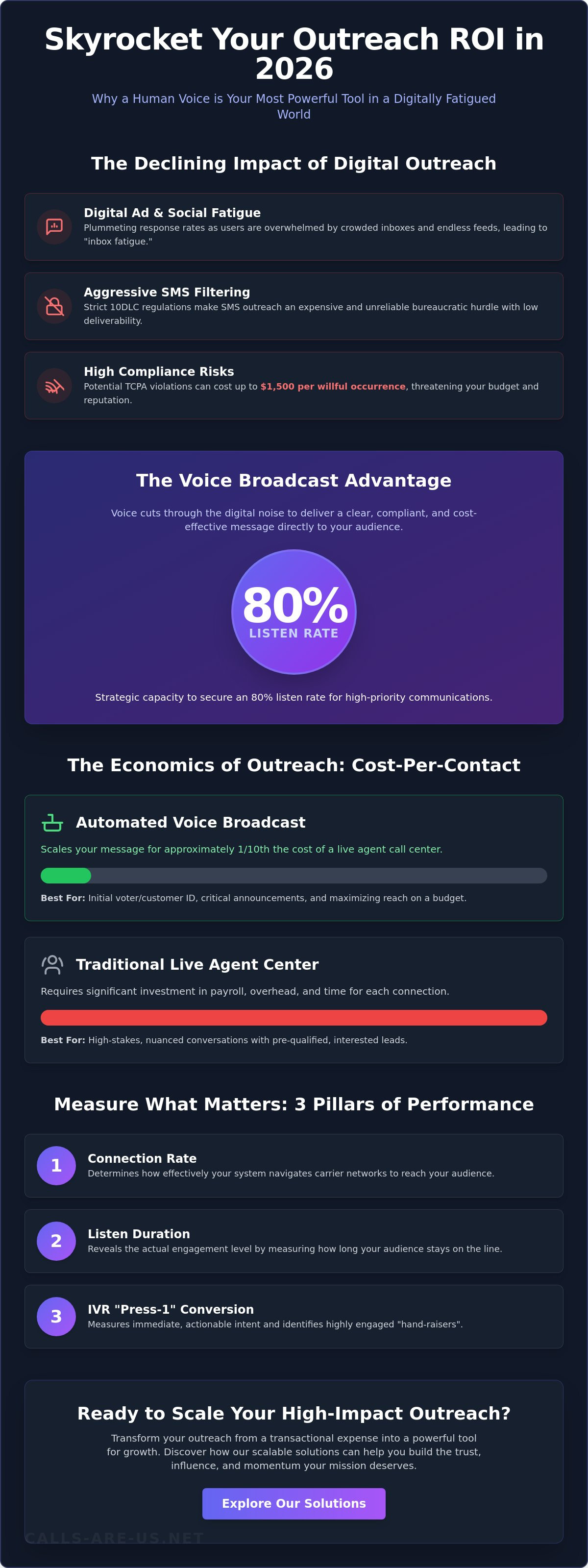
Efficiency drives impact. In 2026, voice broadcast ROI represents the measurable value your organization extracts from automated outreach compared to the investment in technology and data. It's a calculation of speed, reach, and resonance. As digital channels become increasingly congested, the ability to deliver a clear, audible message directly to a stakeholder's phone has become a premium asset. We define voice broadcast ROI as the strategic capacity to secure an 80% listen rate for high-priority communications, providing a stark contrast to the fleeting attention spans found in digital alternatives.
To better understand the mechanics of this technology and how it integrates into your workflow, watch this helpful overview:
To master your returns, you must track three critical pillars of performance. First, the connection rate determines how effectively your system navigates carrier networks. Second, listen duration reveals the actual engagement level of your audience. Finally, the IVR "Press-1" conversion rate measures immediate, actionable intent. These metrics transform a simple broadcast into a sophisticated data engine that powers informed decision-making.
The Core Components of an ROI Calculation
Calculating your return requires looking beyond the surface of a monthly bill. Direct costs are easy to spot: software licensing, per-minute rates, and list procurement. However, the true value emerges through indirect gains. By using automated systems, you reduce the operational load on live agents, accelerate data collection, and maintain a consistent brand voice. Silence has a price too. The opportunity cost of missed connections can stall a campaign's momentum, leave vital stakeholders unheard, and allow competitors to claim the narrative.
Why Voice Outpaces Digital Channels in 2026
Digital fatigue is a structural reality. In a screen-saturated world, the human voice offers a distinct advantage through tone, inflection, and warmth. Voice broadcasting allows you to bypass crowded promotions folders and aggressive SMS filters that often bury text-based outreach. It's a tool built for speed, compliance, and clarity. When you integrate political voice broadcasting into your broader strategic framework, you aren't just sending a message; you're building a bridge to your audience that digital algorithms simply can't block. This direct connection ensures your mission remains visible, audible, and influential.
The Economics of Outreach: Comparing Cost-Per-Contact
Precision in budgeting is as vital as precision in messaging. When you analyze the economics of large-scale outreach, the disparity between human-led efforts and automated systems is undeniable. Automated voice allows you to scale your message for roughly one-tenth of the cost of a live agent call center. For national-scale organizations, this cost-efficiency is the difference between reaching a fraction of your audience and achieving total market saturation. While a three-minute live agent call requires significant payroll and overhead, a thirty-second automated broadcast delivers the same vital information for a mere fraction of that investment.
Profitability begins with smart identification. Using automated systems for initial voter or customer ID is the most effective way to protect your resources. Instead of paying a live agent to navigate dial tones and answering machines, you use automation to find the "hand-raisers" first. This ensures that your high-value human assets only spend time on meaningful, high-stakes conversations. To see how these efficiencies can be applied to your specific goals, you can explore our scalable outreach solutions designed for high-impact results.
Voice vs. SMS: A Deliverability Analysis
Messaging costs are shifting rapidly in 2026. The rising expenses associated with 10DLC registration and increasing SMS carrier fees are placing a heavy burden on text-heavy campaigns. Voice broadcasting offers a resilient alternative. It reaches landlines that SMS cannot, ensuring your message penetrates demographics that digital texts often miss. By understanding the strategic use of P2P vs broadcast texting alongside voice, you create a multi-channel safety net. This approach maximizes your voice broadcast ROI by ensuring no contact is left behind due to technical or carrier-level barriers.
Calculating the Value of an IVR Interaction
Interactive Voice Response (IVR) transforms a one-way announcement into a dynamic dialogue. This technology allows you to conduct "Instant Polling," gathering vital data from thousands of respondents in minutes without the massive expense of manual surveys. It serves as a sophisticated lead qualification engine, routing only high-intent responders to your live team. This methodology drives a superior voice broadcast ROI by focusing your human talent where it matters most: closing the deal, securing the vote, or resolving the crisis. You gain speed, clarity, and a deeper understanding of your audience's needs through every automated interaction.
Compliance and Deliverability: Protecting Your Investment ROI
Compliance is the silent architect of profitability. In 2026, TCPA compliance isn't just a legal hurdle; it's the absolute prerequisite for maximizing voice broadcast ROI. The financial stakes are higher than ever. Fines for violating the Telephone Consumer Protection Act start at $500 and can climb to $1,500 for willful violations. Even more staggering, calling a number on the National Do Not Call Registry can lead to penalties of up to $43,792 per violation. A single oversight can erase years of campaign gains, making a clean data ecosystem and proactive list scrubbing non-negotiable for any serious organization.
Protecting your reputation requires a multi-layered technological approach. You must ensure your system fully supports STIR/SHAKEN protocols to achieve "Verified" status on recipient handsets. This certification increases answer rates by signaling to carriers and consumers that your call is legitimate. Furthermore, maintaining your Robocall Mitigation Database (RMD) filing is essential. New rules effective February 5, 2026, established a base forfeiture of $10,000 for submitting false or inaccurate information. By staying current with these certifications, you ensure your outreach is recognizable, trusted, and delivered.
Navigating the Regulatory Framework
Prior express consent is the foundation of your contact strategy. The 2024 FCC rule, which remains a critical factor in 2026, allows consumers to revoke consent using any reasonable method. Your organization must have robust systems to process these requests instantly to avoid litigation. Beyond federal rules, you must respect state-level variations. Texas restricts Sunday calling to between noon and 9 p.m., while Maryland maintains strict frequency caps on how often you can reach a single contact. Partnering with specialized providers ensures your outreach is lawful, ethical, and respected.
Deliverability and Caller ID Reputation
Your caller ID reputation determines your reach. If your calls are flagged as "Scam Likely," your engagement will fail before the first word is spoken. You must utilize smart number rotation, active reputation monitoring, and branded caller ID to maintain a professional image. When a recipient sees a verified organization name on their screen, connection rates soar. This trust is further reinforced by high-quality audio recordings. Using voices derived from real actors creates a human-centric experience that drives longer listen times and superior voice broadcast ROI. This attention to detail transforms a simple call into a meaningful interaction.
Strategic Optimization: How to Triple Your Broadcast Results
Segmentation is the engine of impact. To truly maximize your voice broadcast ROI, you must move beyond the antiquated "blast" mentality and embrace hyper-targeted outreach. By dividing your audience into specific cohorts based on demographics, past behavior, or geographic location, you ensure that your message resonates with the person on the other end of the line. A generic message is often ignored, but a relevant one commands attention. When you speak directly to a recipient's specific needs, you transform a cold contact into an engaged participant. This methodical approach reduces wasted dial time and ensures your resources are focused on the individuals most likely to respond to your call.
The first five seconds of your recording determine the trajectory of the entire interaction. Neuromarketing principles suggest that your hook must establish immediate trust and urgency. If you fail to capture interest in that initial window, the call is lost. Timing also plays a critical role in your success. National data suggests that sticking to peak engagement windows within federal calling hours of 8 a.m. to 9 p.m. is essential for maximizing answer rates. A clear, singular Call-to-Action (CTA) is the final piece of the puzzle, as it provides the direct path to conversion that anchors your final ROI calculation. Without a definitive next step, even the most engaging message fails to produce a measurable return.
The Multi-Channel Synergy Effect
Voice broadcasting shouldn't exist in a vacuum. It's a powerful tool for "warming up" your audience before they receive other forms of communication. For example, a brief voice alert can significantly boost the effectiveness of a political direct mail strategy by creating mental availability before the physical mailer arrives. Similarly, a voice broadcast can serve as a precursor to a text message, increasing response rates by providing a human context to the subsequent digital link. Integrating these touchpoints into a cohesive voter outreach strategy ensures that your organization remains top-of-mind across every available channel.
Advanced Scripting and Personalization
Personalization is the key to breaking through digital noise. Modern systems allow for dynamic field insertion, where automated calls can include specific details that make the message feel urgent and personal. You should also consider the source of your recording. While a "Professional Voice" conveys high-stakes authority, a "Local Volunteer" recording can sometimes build greater community trust. A/B testing these variations is the only way to find the winning hook before scaling your efforts nationally. To refine your approach and start seeing these results, you can consult with our strategic outreach experts today and begin building more meaningful connections.
Scaling High-Impact Outreach with Calls-Are-Us
Calls-Are-Us provides the infrastructure for influence. When your mission requires national-scale visibility, you need a partner capable of managing the immense speed and volume of 2026 outreach. We operate in over 40 states, supporting high-stakes communication needs for organizations that cannot afford a failure in deliverability or a lapse in compliance. Our philosophy centers on the Authoritative Visionary model; we combine cutting-edge technology with a deep commitment to ethical, inclusive dialogue. This ensures that every campaign we touch isn't just a broadcast, but a catalyst for social progress and measurable voice broadcast ROI.
Seamless integration is our hallmark. Our political campaign call center allows your organization to move from an automated broadcast to a live human conversation without a single moment of friction. By identifying high-intent responders through automation first, you protect your human resources and focus them on the interactions that drive the most significant results. It's a system built for momentum, allowing you to scale your influence while maintaining the human-centric core that builds long-term trust.
Integrated Solutions for National Organizations
Getting Started with a High-ROI Campaign
Partnership begins with a plan. We take a consultative approach, working alongside your team to build a strategy that aligns with your specific mission rather than just providing a dialer. From day one, we prioritize 10DLC and TCPA compliance to safeguard your organization's reputation and financial health. Our goal is to empower you with the tools and insights needed to foster meaningful connections at scale. If you are ready to elevate your outreach and secure your organization's future, you can calculate your potential impact with a Calls-Are-Us strategy session today.
Master the Future of Human-Centric Outreach
Success in 2026 requires more than just high-volume dialing; it demands a sophisticated blend of precision, trust, and technological agility. You've seen how strategic segmentation and rigorous compliance protocols serve as the bedrock of a high-performing campaign. By integrating voice broadcasts with mail and messaging, you create a resilient ecosystem that bypasses digital fatigue and fosters genuine connections with your audience. If your organizational mission involves international travel, you can explore Local eSIM Plans from Always Mobile to ensure your team remains connected and productive. Your ultimate voice broadcast ROI is found at the intersection of scale and sincerity, where every interaction is optimized for maximum impact.
The path to influence is clear for those ready to lead with integrity. Calls-Are-Us brings the weight of experience to your mission, operating in over 40 states with specialized expertise in high-stakes political and business outreach. We provide the integrated multi-channel reporting you need to track your progress in real time. It's time to move beyond transactional outreach and build a narrative that truly resonates. Maximize your outreach ROI with Calls-Are-Us today and transform your communication strategy into a powerful engine for progress. Your vision deserves a voice that carries weight.
Frequently Asked Questions
How do you calculate the ROI of a voice broadcast campaign?
ROI is calculated by subtracting the total campaign cost from the total value of gains and dividing that number by the total cost. This requires assigning a specific monetary value to actions like "Press-1" conversions or completed polling responses. By measuring these outcomes against your technology and data spend, you can accurately track your voice broadcast ROI and justify future budget allocations for high-impact outreach.
Is voice broadcasting more cost-effective than mass texting in 2026?
Voice broadcasting is frequently more cost-effective than mass texting because it avoids the escalating 10DLC registration fees and per-message carrier surcharges prevalent in 2026. Additionally, voice calls reach the millions of residential landlines that are inaccessible to SMS outreach. Using a multi-channel strategy allows you to optimize your budget by directing high-volume traffic through the most efficient channel for each demographic you target.
What is a good connection rate for a high-volume voice broadcast?
For high-volume campaigns, a strong live-answer connection rate generally falls between 15% and 25%. Your success depends heavily on your STIR/SHAKEN certification and the quality of your caller ID reputation. When your calls appear as "Verified" on a recipient's handset, they're more likely to answer, whereas unverified calls often get ignored or blocked by aggressive carrier-level filters designed to stop spam.
Can voice broadcasting be used for TCPA-compliant political outreach?
You can use voice broadcasting for political outreach if you maintain strict adherence to TCPA guidelines and state-specific regulations. You must honor the FCC's 2024 consent revocation rules and ensure your system can process opt-out requests immediately. Specialized providers help you navigate these complexities by managing list scrubbing and ensuring your calling windows align with local requirements, such as the restricted Sunday hours in Texas.
How does IVR integration improve the ROI of automated calls?
IVR integration significantly improves your voice broadcast ROI by filtering out low-intent contacts before they reach your live agents. This automation allows your team to focus exclusively on high-value interactions, such as securing a donation or resolving a complex issue. It also enables rapid data collection through automated polling, which provides immediate insights into your audience's sentiment and preferences without the cost of manual surveys.
What happens if my calls are flagged as 'Scam Likely'?
When calls are flagged as "Scam Likely," answer rates drop and your message loses its authority. You must implement proactive reputation management strategies, such as number rotation and branded caller ID, to ensure your organization's name appears clearly on the screen. This professional presentation builds immediate trust and encourages recipients to engage with your message rather than dismissing it as a suspicious or unsolicited robocall.
How many contacts can a voice broadcast system handle per hour?
A professional voice broadcast system can handle thousands of calls per minute, allowing you to reach an entire national database in a matter of hours. This high-capacity throughput is essential for time-sensitive announcements, emergency alerts, or last-minute campaign pushes. It provides a level of scale and speed that a traditional live-agent call center simply can't match without an unsustainable increase in payroll and physical infrastructure.
Does the time of day affect the ROI of my voice broadcast?
The time of day has a direct impact on both your answer rates and your legal compliance. While federal law permits calling between 8 a.m. and 9 p.m., calling during peak evening hours often yields the highest engagement for non-emergency messages. You must also account for state-specific rules, such as Maryland's frequency caps, to ensure your outreach remains respectful, productive, and within the bounds of the law.


Comments