
Navigating Voice Broadcast Regulations: The 2026 Compliance Guide for Modern Outreach

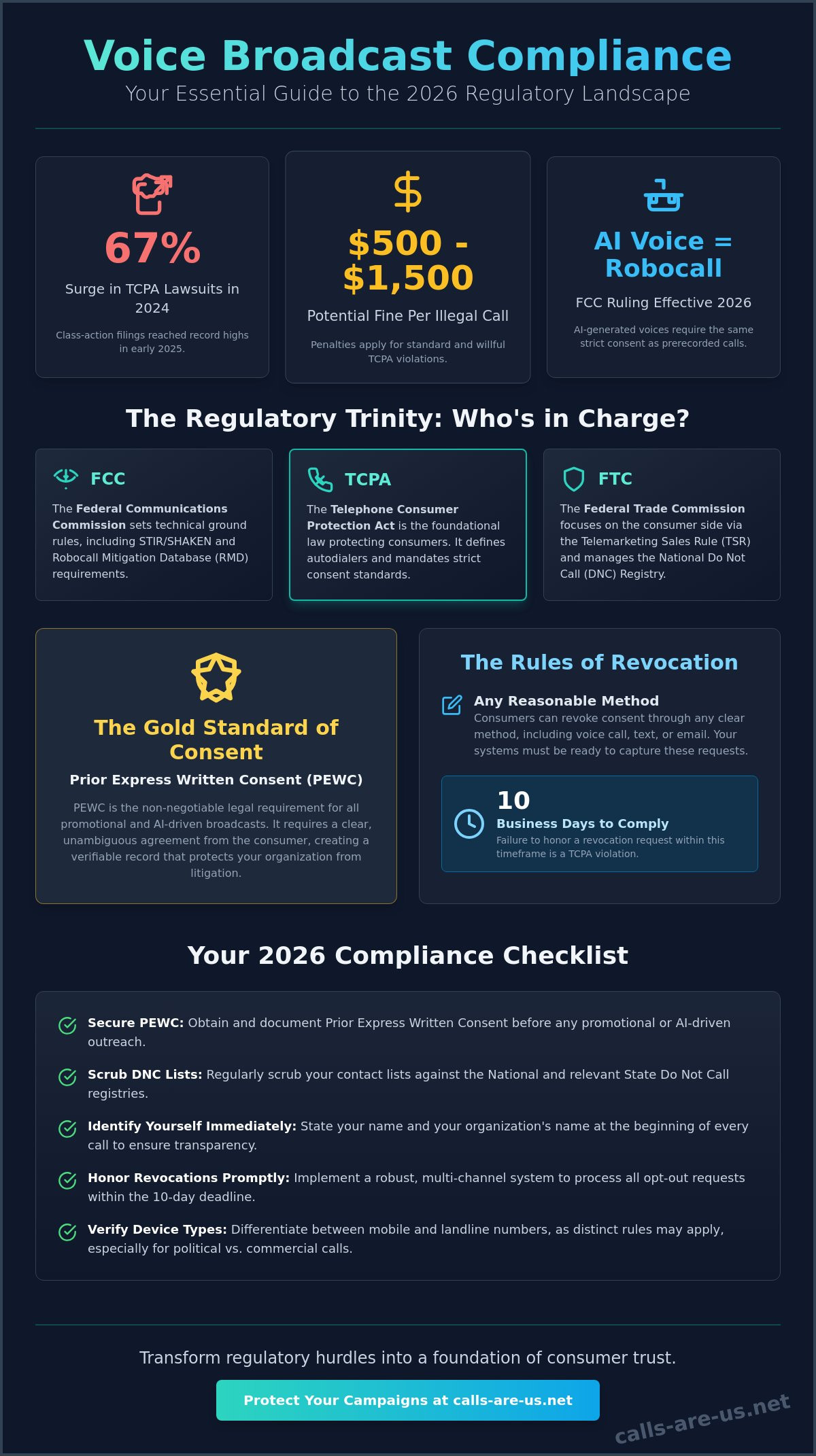
With TCPA lawsuits surging by 67% in 2024 and class-action filings reaching record highs in early 2025, the margin for error in automated calling has effectively vanished. Organizations today face a landscape where a single misstep in voice broadcast regulations can result in fines ranging from $500 to $1,500 per call. As of 2026, the FCC’s classification of AI-generated voices as artificial or prerecorded means your high-tech outreach must now meet the same strict consent standards as traditional robocalls. Staying ahead requires more than just luck; it demands a strategic commitment to compliance.
You probably feel the weight of these evolving FCC rulings and the constant anxiety that a minor oversight could lead to a massive legal headache. It is exhausting to track shifting consent revocation rules, annual Robocall Mitigation Database deadlines, and specific state-level prohibitions like Florida’s SB 1516. This guide empowers you to master these complex legal requirements so your 2026 campaigns remain impactful, ethical, and fully protected. We will provide a clear roadmap for legal outreach, explore strategies for higher deliverability, and build your confidence in a multi-channel strategy that respects both the law and the listener.
Table of Contents
The Regulatory Landscape of Voice Broadcasting in 2026
Modern communication isn't a Wild West; it's a highly calibrated legal ecosystem. Success requires a deep understanding of the voice broadcast regulations that protect the integrity of the American telephone network. This framework isn't just about avoiding fines. It's about building a foundation of trust with every person you reach. This Voice broadcasting overview highlights how these rules have evolved from simple anti-nuisance laws into complex technical standards that demand absolute transparency from every sender.
To better understand how technology and compliance intersect, watch this helpful video:
The Role of the FCC and FTC
The FCC wields immense power over interstate and international communications. They set the technical ground rules, including the STIR/SHAKEN framework and the Robocall Mitigation Database (RMD) requirements. These technical layers ensure that every call carries a digital "passport" that proves its origin. This includes the classification of AI-generated voices as "artificial" under the TCPA, which requires prior express written consent for all such broadcasts. Meanwhile, the FTC focuses on the human side of the equation through the Telemarketing Sales Rule (TSR). They manage the National Do Not Call (DNC) Registry, ensuring that commercial entities respect consumer boundaries. Enforcement is rarely a solo act. Federal bodies now work in lockstep with state Attorneys General to identify, track, and penalize bad actors who ignore these standards. This collaborative approach creates a safety net that spans from local jurisdictions to the highest federal levels.
TCPA: The Foundation of Voice Compliance
The Telephone Consumer Protection Act (TCPA) is the primary federal statute protecting consumers from unwanted calls. It acts as the ultimate gatekeeper for any organization using automated technology. By 2026, the interpretation of what constitutes an "autodialer" (ATDS) has become more nuanced, focusing on the capacity to store or produce numbers rather than just the active use of those features. This evolution means you must be precise, transparent, and disciplined in your data management. You don't just need consent; you need a verifiable paper trail that stands up to legal scrutiny. Staying TCPA compliant is the first step in any voter outreach strategy. It protects your reputation, secures your deliverability, and ensures your message actually reaches the intended recipient. Organizations that prioritize these rules find they build stronger, more resilient connections with their audience.
Decoding TCPA Compliance: Consent, Timing, and Identification
Transparency isn't just a virtue; it's a legal mandate. In 2026, voice broadcast regulations require a "Hook-and-Elaborate" strategy where the caller's identity and intent are immediately clear. This approach fosters trust, protects your reputation, and ensures your organization remains beyond reproach in an era of heightened scrutiny. When you prioritize clarity over cleverness, you build a foundation for sustainable outreach that resonates with your audience.
Prior Express Written Consent (PEWC) stands as the gold standard for all promotional broadcasts. Without it, you risk standard TCPA violations of $500 or willful violations reaching $1,500 per call. As of the rules that took effect on April 11, 2025, consumers can revoke this consent in any reasonable way. Your organization has exactly 10 business days to honor that request; failing to do so invites significant legal exposure. While the requirement for cross-channel revocation is delayed until April 11, 2026, proactive leaders are already unifying their opt-out data to stay ahead of the curve.
Understanding Express vs. Written Consent
Informational messages, such as school closures or emergency alerts, generally require only "Express Consent," which can be oral or implied. However, any message with a commercial component triggers the higher burden of "Written Consent." In 2026, this almost always involves digital signatures that comply with the E-SIGN Act, providing a secure, verifiable record of the recipient's agreement. Adhering to broadcasting industry standards ensures these digital agreements are robust enough to withstand legal challenges and regulatory audits.
Mandatory Caller Identification and Opt-Outs
You must respect the "2-second rule" by identifying your organization within the first two seconds of the audio. This identification must include the entity responsible for the call, a clear statement of the call's purpose, and a valid callback number. Federal rules also require providing a physical address for the organization if requested. For automated broadcasts, you must provide an Interactive Voice Response (IVR) mechanism that allows recipients to opt-out immediately by pressing a single key. This "Press 9" functionality isn't optional; it's a critical tool for maintaining a clean, compliant list.
Timing remains a critical pillar of compliance. Federal law restricts calls to between 8:00 AM and 9:00 PM in the recipient’s local time zone. Ignoring these windows or failing to scrub against the National Do Not Call Registry, which carries fines up to $50,120 per call, is a risk no professional organization should take. By integrating these safeguards into your daily workflow, you transform compliance from a burden into a competitive advantage.
Political vs. Commercial Regulations: Navigating the Nuances
Context determines the rulebook. While the First Amendment provides a robust shield for political discourse, it does not offer a total exemption from voice broadcast regulations. Organizations must distinguish between purely informational, political, and promotional messaging to avoid the steep penalties associated with non-compliance. In 2026, the distinction between a campaign update and a sales pitch is scrutinized more heavily than ever before by both federal regulators and state authorities. Understanding these nuances is the only way to ensure your message arrives legally and reaches the intended ears.
Rules for Political Campaigns and Candidates
Political speech enjoys broad protection, yet the technical delivery method matters immensely. When calling mobile devices, the TCPA mandates prior express consent, regardless of the message's non-commercial nature. This remains an absolute requirement to prevent intrusive automated outreach to personal cell phones. Conversely, the "Landline Loophole" allows for more flexibility when reaching residential lines. However, as of 2026, political robocalls to residential landlines without prior consent are strictly limited to a maximum of three calls within any consecutive 30-day period. This cap aims to balance campaign outreach with consumer privacy. Beyond federal rules, you must navigate a patchwork of state-level variations. For example, Connecticut imposes fines of up to $20,000 per violation under its "mini-TCPA" laws, proving that local oversight can often be more aggressive than federal standards.
Commercial and Sales-Driven Broadcasting
Commercial telemarketing faces the most restrictive environment. The FCC maintains a rigorous "Prerecorded Message" ban for sales-driven outreach unless you have secured prior express written consent. Even an Established Business Relationship (EBR) provides limited cover in 2026; it does not bypass the need for written consent when using artificial or prerecorded voices for promotional purposes. When budgeting for your next campaign, you must account for these technical hurdles. Integrating voice broadcast pricing with your compliance strategy is essential for long-term viability. Compliance costs, including list scrubbing, consent management, and technical attestation, are now a fundamental part of the outreach investment. Finally, remember that emergency exemptions still exist for public safety. Messages regarding school closures, utility outages, or health alerts are treated with significantly more leniency, ensuring critical information reaches the public during times of crisis without technical delay.
The 2026 Compliance Checklist: Auditing Your Outreach Strategy
Compliance is a living process rather than a one-time event. It requires a structured, repeatable framework to protect your organization from the financial and reputational risks of modern voice broadcast regulations. By implementing a rigorous audit process, you transform legal requirements into a competitive advantage that ensures your message actually reaches the people who need to hear it. This disciplined approach eliminates guesswork and builds a foundation of operational integrity.
Step 1: Scrub your lists against the National Do Not Call (DNC) Registry every 31 days. Failing to respect the registry can lead to staggering fines of up to $50,120 per call.
Step 2: Verify the cell phone vs. landline status for every record in your database. Because consent requirements differ drastically between these device types, knowing exactly what you are dialing is the only way to stay compliant.
Step 3: Audit your scripts for mandatory disclosures. Every message must clearly identify your organization, provide a valid callback number, and offer immediate opt-out instructions.
Step 4: Confirm your provider is registered in the FCC Robocall Mitigation Database (RMD). The FCC assesses a base forfeiture of $10,000 for false or inaccurate information in this database, making provider transparency vital.
Step 5: Implement STIR/SHAKEN protocols. These digital certificates verify your identity to carriers, helping you avoid the "Scam Likely" labels that kill engagement rates.
Technical Standards: STIR/SHAKEN and Caller ID
STIR/SHAKEN is the technical framework used to combat caller ID spoofing by digitally signing every call that leaves a network. To maintain high deliverability, your campaign numbers should carry "A-Level" attestation. This highest level of trust confirms that the provider knows the customer and that the customer has the legal right to use the caller ID number. Verified caller ID significantly increases answer rates and builds voter trust by proving you are exactly who you claim to be.
Maintaining the Internal Do Not Call List
You must honor opt-out requests immediately to remain within the law. Synchronizing your political campaign call center with your broadcast platform ensures that when a contact says "stop" on one channel, they are removed across all others. Record-keeping is equally critical. You must store all consent records for at least five years to provide a verifiable defense against potential TCPA claims. This documentation acts as your primary shield in the event of a regulatory audit or legal challenge. If you are ready to secure your outreach strategy, you can explore our compliant communication tools to get started today.
Partnering for Compliance: How Calls-Are-Us Protects Your Campaign
Compliance isn't a hurdle you should clear alone. It's a strategic partnership where sophisticated technology meets human-centric outreach goals. When you leverage a professional platform, you automate the complex voice broadcast regulations that often paralyze less-prepared organizations. This shift allows your team to move beyond the fear of litigation and focus on the potential for real-world impact. By integrating technical guardrails directly into your daily workflow, you ensure every interaction is ethical, legal, and effective.
Moving from transactional robocalls to meaningful interactions requires a multi-channel philosophy. A truly resilient strategy doesn't rely on a single touchpoint; it weaves together voice broadcast, peer-to-peer texting, and direct mail to create a cohesive narrative. This approach respects the recipient's preferences while maximizing your message's reach across different demographics. When communication is grounded in integrity and transparency, it ceases to be noise and becomes a valuable connection that drives social progress and community engagement.
Built-in Regulatory Safeguards
Technical compliance should be invisible to the user but absolute in its execution. Calls-Are-Us manages STIR/SHAKEN attestation for every client, ensuring your calls carry the digital trust markers needed to reach the handset without being flagged. Our platform provides automated scrubbing against the National DNC Registry and real-time device verification to distinguish between landlines and mobile phones instantly. These tools are especially critical when deploying voice broadcast for schools or emergency alert systems, where speed and reliability are paramount. We handle the 2026 standards so you can handle the mission.
The Authoritative Path to Impact
Principled communication consistently leads to higher engagement and better conversion rates. Voters and consumers respond to organizations that value their privacy and follow the established rules of the road. Our consultative support helps you navigate the high-pressure world of political voice broadcasting, ensuring your campaign stays on the right side of evolving FCC rulings and state-level mandates. We don't just provide a service; we champion a philosophy of inclusive, open, and compliant dialogue. If you're ready to master the 2026 landscape, speak with a compliance expert at Calls-Are-Us today and build a campaign that stands the test of scrutiny.
Master the Future of Compliant Communication
Integrity is your most valuable asset in the digital age. In 2026, navigating voice broadcast regulations isn't just a legal necessity; it's a strategic imperative that separates visionary leaders from those left behind. You now have the roadmap to master TCPA consent, implement STIR/SHAKEN protocols, and maintain the rigorous data hygiene required to protect your organization's reputation. By prioritizing transparency, technical attestation, and humanistic strategy, you transform regulatory hurdles into a clear path for authentic connection.
Success in high-pressure environments requires a partner who understands the stakes. Having operated in over 40 states, we specialize in high-stakes political compliance and offer expert STIR/SHAKEN implementation to ensure your voice is never silenced by a "Scam Likely" label. It's time to move forward with the confidence that your message will be heard, respected, and acted upon by the people who matter most. Protect your campaign and scale your reach with Calls-Are-Us today. The tools for impactful outreach are within your reach; now is the moment to use them with purpose and precision.
Frequently Asked Questions
Is voice broadcasting legal for political campaigns in 2026?
Yes, voice broadcasting is legal for political campaigns but follows strict operational limits. For residential landlines, you're capped at three calls within a 30-day window if you don't have prior consent. Mobile phones always require consent for automated messages. These voice broadcast regulations ensure that campaigns can reach voters without becoming an intrusive nuisance to the public.
Do I need written consent to send a voice broadcast to a cell phone?
You absolutely need prior express written consent to send automated voice messages to a mobile device. This standard applies to both commercial and political outreach in 2026. Because cell phones are considered private, personal spaces, the FCC requires a verifiable record of the recipient's agreement. Using digital signatures that comply with the E-SIGN Act is the most reliable way to document this permission.
What are the fines for violating TCPA voice broadcast regulations?
Standard TCPA violations carry a fine of $500 per call, while willful violations can reach $1,500. If you violate the National Do Not Call Registry, the penalties are even more severe, reaching up to $50,120 per call. These costs can bankrupt a campaign or organization quickly. Maintaining high compliance standards isn't just about ethics; it's a financial necessity in the current regulatory environment.
Are there specific hours when I am not allowed to send voice broadcasts?
You're legally permitted to send broadcasts only between 8:00 AM and 9:00 PM in the recipient's local time zone. Sending messages outside these windows is a direct violation of federal telemarketing rules. You must use a platform that automatically accounts for the recipient's geographic location to ensure your outreach never arrives at an inappropriate hour. Respecting these boundaries helps maintain your organization's integrity and prevents complaints.
Does the National Do Not Call Registry apply to political calls?
The National Do Not Call Registry generally doesn't apply to purely political calls or non-profit outreach. However, you're still required to maintain an internal Do Not Call list. If a recipient asks to be removed from your specific campaign, you must honor that request within 10 business days. Ignoring these individual opt-outs can lead to litigation, even if you are exempt from the broader national registry.
What is STIR/SHAKEN and why does it matter for my voice campaign?
STIR/SHAKEN is a digital framework that authenticates caller ID information to prevent spoofing and fraudulent robocalls. It matters because carriers use these "attestation levels" to decide whether to deliver your call or label it as "Scam Likely." Achieving an A-level attestation proves you're a verified sender. This technical layer is essential for ensuring your voice broadcast regulations strategy actually results in answered calls and meaningful engagement.
Can I use voice broadcasting for emergency notifications without consent?
Yes, you can use voice broadcasting for emergency notifications without prior consent if the message is vital to public safety. This exemption covers school closures, utility outages, or health alerts that require immediate dissemination. While the rules soften for these critical updates, you still need to identify your organization clearly. These emergency protocols ensure that life-saving information reaches the community without technical or legal delays.
How do I legally provide an opt-out option in an automated message?
You must provide an automated, interactive opt-out mechanism within every prerecorded message. Recipients should be able to "Press 9" or use a similar key-press to be added to your Do Not Call list immediately. You're also required to provide a valid callback number that allows them to make an opt-out request during normal business hours. This Interactive Voice Response (IVR) functionality is a non-negotiable requirement for compliant automated outreach.



Comments