
The 2026 Political Call Compliance Checklist: Securing Voter Trust and Legal Safety

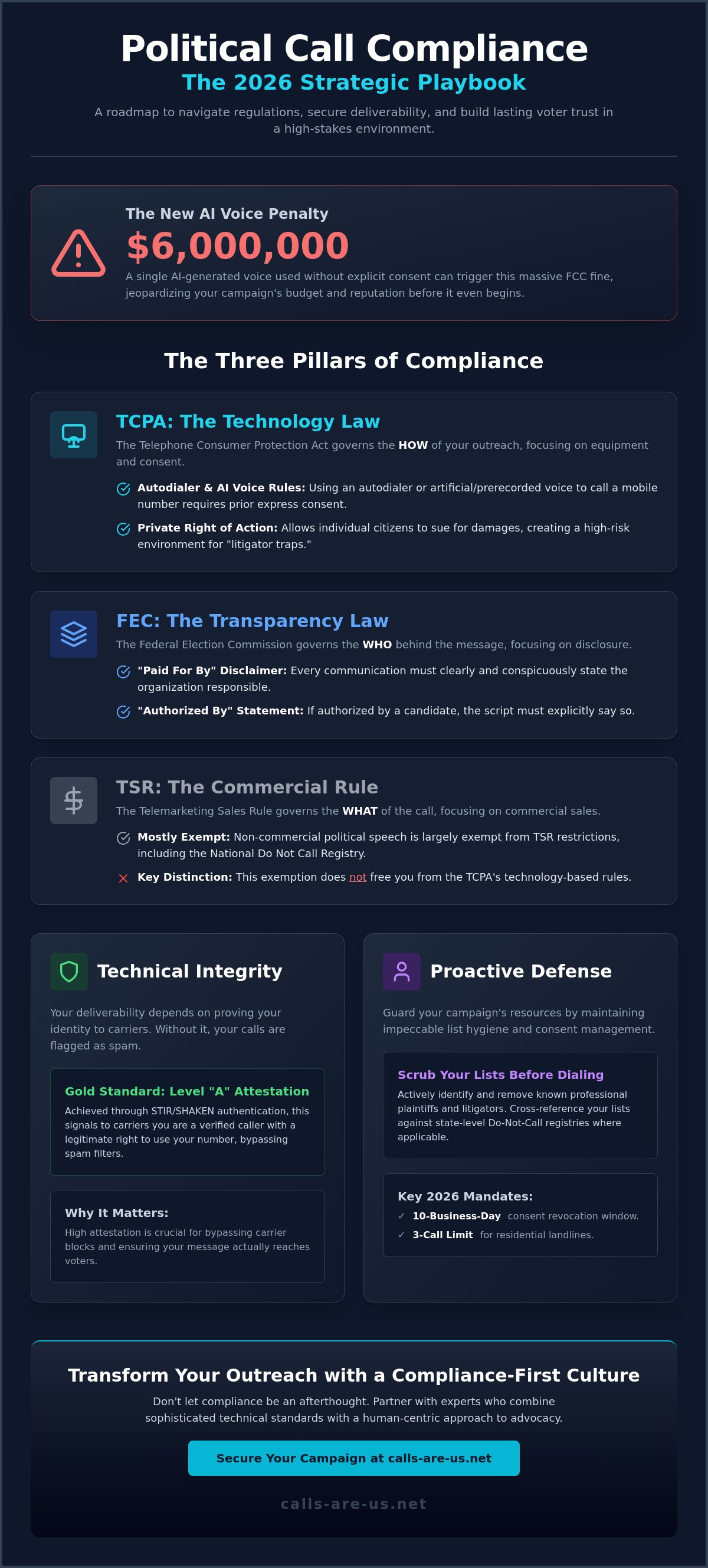
A single AI-generated voice used without explicit consent can now trigger a $6 million FCC fine before your campaign even hits its stride. In 2026, political call compliance isn't just a legal hurdle; it's the strategic foundation of voter deliverability. You likely feel the mounting pressure of rising call-blocking rates and the constant fear of litigator traps lurking in your contact lists. We understand that balancing federal FEC rules with a patchwork of state-level AI disclosure laws feels nearly impossible under the heat of a high-stakes campaign cycle.
Compliance is your engine. This article provides a clear, actionable roadmap to protect your reputation, secure your budget, and build lasting voter trust. You'll master the intricate web of TCPA, STIR/SHAKEN, and FEC regulations with our comprehensive, campaign-ready checklist. We'll break down the latest 2026 mandates, including the 10-business-day consent revocation window and the strict three-call limit for residential landlines, so you can focus on winning hearts and minds instead of fighting audits.
Table of Contents
Understanding the Regulatory Pillars: TCPA, TSR, and the FEC
Precision is non-negotiable when you're dialing for votes. Political call compliance serves as the essential bridge between aggressive voter outreach and long-term legal security. It's the strategic intersection where consumer protection laws, governed by the TCPA, meet the transparency requirements of the FEC. While campaigns enjoy certain liberties regarding the National Do Not Call Registry, they're never free from the fundamental requirement to respect voter privacy. You must navigate the overlapping jurisdictions of the FCC, the FTC, and the FEC to keep your campaign in the clear. The Telephone Consumer Protection Act (TCPA) is the primary federal statute governing automated outreach.
Gain a deeper perspective on these legal frameworks by watching this expert breakdown:
The TCPA vs. The TSR: Know the Difference
Technology dictates your risk level. The TCPA regulates the mechanics of how you reach people, specifically focusing on autodialers and artificial or prerecorded voices. Conversely, the Telemarketing Sales Rule (TSR) primarily targets commercial transactions and fraud prevention. Because political speech is non-commercial, it's exempt from many TSR restrictions, but the TCPA remains an absolute wall that no campaign can ignore. These distinctions matter for three critical reasons:
Technology Matters: Using an autodialer to reach a mobile phone without prior express consent is a violation, regardless of how important your message is.
Intent is Secondary: Even the most noble political message must follow the same technical protocols as a commercial sales call to avoid carrier blocking.
Private Right of Action: The TCPA allows individual citizens to sue for damages, creating a "litigator trap" that doesn't exist under the TSR.
FEC Disclosure Requirements for 2026
Transparency builds voter trust. Every political voice broadcast must include a "paid for by" disclaimer that clearly identifies the individual or organization responsible for the communication. This disclosure must be "standalone," meaning it's clear, conspicuous, and placed either at the beginning or the end of the call. If a candidate or their committee authorizes the outreach, the script must explicitly state that the message is "authorized by" that specific candidate. For communications from PACs or other non-authorized groups, the disclaimer must include the organization's full name along with a valid callback number or physical address. Failing to include these elements doesn't just hurt your credibility; it invites immediate regulatory scrutiny during the most sensitive weeks of your campaign.
Technical Compliance: STIR/SHAKEN and Carrier Reputation
Technical integrity is the invisible backbone of every successful voter interaction. If your infrastructure isn't vetted, verified, and valued by the network, your message won't just be ignored; it'll be silenced by carrier filters before the first ring. Political call compliance relies heavily on your ability to prove your identity through rigorous authentication protocols. By securing high-trust certificates, you ensure your voice remains a welcome part of the democratic process rather than a digital nuisance. Deliverability is a technical battleground.
STIR/SHAKEN authentication represents the industry standard for verifying caller identity. For campaigns, "Level A" attestation is the gold standard, signaling to carriers that you're a known entity with a legitimate right to use the phone number in question. This process aligns with the FCC rules for political calls, which aim to reduce the impact of spoofed numbers that erode public trust. When you operate at this level of technical transparency, you're not just following rules; you're protecting your campaign's most valuable asset: its reputation.
Multi-channel outreach requires even deeper registration to stay aggressive, effective, and compliant. If your strategy includes peer-to-peer or mass texting alongside voice, you must navigate 10-Digit Long Code (10DLC) registration. The Campaign Registry acts as the central gatekeeper, validating political entities so mobile carriers can prioritize their traffic. This validation process is essential for avoiding the "Scam Likely" or "Spam" flags that can devastate a ground game. Proactive reputation management ensures your calls reach the intended recipient without being diverted by aggressive carrier algorithms.
Achieving Full STIR/SHAKEN Compliance
STIR/SHAKEN prevents Caller Line Identification (CLI) spoofing by attaching a digital signature to every call. This signature confirms the call's origin and the caller's authorization. Securing "Level A" status requires working with a provider that possesses the high-level certificates needed to sign your traffic. Without this technical seal of approval, your campaign faces three severe consequences:
Blocked Calls: Carriers may stop your calls from reaching voters entirely.
Diverted Traffic: Your outreach could be routed to voicemail or labeled with warning tags.
Voter Distrust: A "Scam Likely" label on a voter's screen instantly destroys your credibility.
Managing Caller ID and Branding
Consistency creates recognition. Your Caller ID (CNAM) should be uniform across all channels, ensuring voters recognize your campaign name instantly. Advanced campaign communication tools integrate directly with carrier registries to manage these labels proactively. This integration allows you to update your branding in real-time, ensuring that when a voter looks at their handset, they see your organization's name clearly displayed. Maintaining this level of professional branding is a key component of a modern political call compliance framework. If you want to ensure your technical setup is airtight, you can optimize your technology stack to meet these evolving carrier standards.
List Hygiene and Consent Management Protocols
Data integrity is the shield that protects your campaign from costly legal ambushes. political call compliance begins long before the first number is dialed; it starts with the meticulous scrubbing of your voter files. While political organizations enjoy specific exemptions from the National Do Not Call Registry, ignoring state-level registries is a short-sighted strategy that erodes public goodwill. You're building a relationship with the electorate, and that relationship requires a foundation of respect for their privacy and preferences.
Professional plaintiffs and "TCPA litigators" actively monitor campaign outreach, looking for any technical slip-up to trigger a lawsuit. Scrubbing your lists against known litigator databases is a critical defensive measure that identifies these professional traps before they enter your funnel. Managing the "Consent Lifecycle" means tracking every interaction from the initial opt-in to the final revocation. Under current 2026 standards, you have exactly 10 business days to honor a voter's request to stop communications, regardless of whether that request was made via text, voice, or a live agent conversation.
The Anatomy of a Clean Voter List
Clean data is a perishable asset. To maintain compliance, your lists require real-time scrubbing, ideally within 15 to 30 days of the scheduled call. There's a significant technical difference between landline and wireless scrubbing protocols that you must account for in your workflow. While landlines offer more flexibility, mobile numbers require prior express consent for any automated outreach. When auditing your data providers, look for these three compliance markers:
Porting Accuracy: The ability to track when a landline number has been ported to a wireless carrier.
Certification: Verification that the provider adheres to FEC disclaimer requirements and data security standards.
Update Frequency: A guarantee that "Do Not Call" updates are reflected in the data in near real-time.
Handling Opt-Outs and Revocations
Respecting a "Stop" request is just as vital as delivering your message. Automated calls must include a mandatory IVR (Interactive Voice Response) mechanism that allows voters to opt out immediately with a simple keypress. Your live agents also need rigorous training to recognize and log verbal "stop calling me" requests the instant they occur. Friction in the opt-out process is the fastest way to trigger a regulatory audit. By integrating these preferences into a unified mass communication strategy, you ensure that a voter's choice on one channel is respected across voice, text, and direct mail, fostering a culture of ethical communication and trust.
The Political Scripting Checklist: Disclosures and Disclaimers
Words carry weight. Your script is more than a message; it's a legal document transmitted through the airwaves. Achieving political call compliance requires a meticulous approach to every sentence you record or speak. Regulatory bodies demand transparency, and voters deserve to know exactly who is reaching out to them. If your script fails to identify the responsible party within the first few seconds, you're not just risking a hang-up; you're inviting a federal audit.
The "Identification Rule" is your first hurdle. You must clearly state the name of the person, committee, or organization responsible for the call at the very beginning of the message. This is followed by the "Contact Rule," which mandates providing a valid callback number or physical address within the message body. Accuracy and clarity are paramount. If your disclaimer is spoken too quickly for the average voter to understand, or if it's in a different language than the primary message, it fails the "clear and conspicuous" test used by regulators.
Crafting the Compliant Disclaimer
Structure creates safety. A compliant disclaimer follows a tripartite structure: Identity, Authority, and Contact Information. You must explicitly state who paid for the communication and whether a candidate authorized it. This isn't just a best practice; it's a requirement in thirteen states, including California, New York, and Florida, which have specific "Paid for by" disclosure laws for political robocalls. Consider these two snippets:
Non-Compliant: "Hey, this is John Doe. I'm running for Senate and I need your vote this Tuesday. Call me back at this number."
Compliant: "I'm John Doe, candidate for Senate, and I approve this message. Paid for by the Doe for Senate Committee. You can reach us at 555-0199."
The difference is stark. The second example provides the necessary legal protection while maintaining the personal touch required for effective voter outreach. To ensure your scripts meet these rigorous standards, you can leverage our voice broadcast expertise to automate compliant messaging at scale.
Artificial Intelligence and Synthetic Voice Rules
The regulatory landscape for synthetic media shifted permanently in February 2024. The FCC now classifies any call using AI-generated voices as an "artificial or prerecorded voice" under the TCPA. This means you must have prior express written consent before using these tools to reach mobile phones. If you utilize synthetic voice technology, you must include a mandatory disclosure at the start of the call informing the listener that the voice is AI-generated. Using "Deepfake" technology to simulate a human voice without explicit labeling is a high-risk legal gamble that can lead to multimillion-dollar penalties and immediate campaign suspension.
Building a Compliance-First Culture with Calls-Are-Us
Efficiency is a strategic choice. While generic VoIP providers offer basic connectivity, they lack the deep regulatory intuition required for high-stakes political call compliance. We believe that technology should serve a higher purpose: fostering genuine, ethical connections between candidates and the communities they serve. At Calls-Are-Us, our approach blends sophisticated technical safeguards with human-centric advocacy to ensure your campaign remains both impactful and beyond reproach. We understand that your reputation is on the line with every dial, and we treat that responsibility with the weight it deserves.
Documentation is your safety net. Utilizing a professional political campaign call center ensures that every agent interaction adheres to the strict scripting and disclosure rules discussed earlier. We maintain exhaustive audit trails and documentation for every touchpoint to protect your campaign from bad-faith actors. This transparency is the final piece of the political call compliance puzzle, providing a robust defense that generic platforms simply cannot match. We don't just provide a service; we champion a philosophy of inclusive and principled dialogue that respects the voter and the law.
Integrated Multi-Channel Safety
Complexity shouldn't lead to vulnerability. Calls-Are-Us synchronizes compliance across Voice Broadcast, P2P Texting, and Direct Mail to create a unified voter experience. By centralizing your data management, we significantly reduce compliance fatigue for your staff, allowing them to focus on strategy rather than spreadsheets. This holistic oversight is critical for avoiding SMS filtering and ensuring your messages land where they belong. We automate the workflows so your vision can scale without increasing your legal exposure.
Your Partner in High-Stakes Communication
The final weeks are unforgiving. We provide 24/7 compliance monitoring during these critical periods to catch and correct potential issues before they escalate into audits. Our customized reporting provides legal teams and stakeholders with clear, data-driven insights into your outreach health and deliverability rates. You deserve a partner that understands the gravity of your mission and possesses the technical mastery to protect it. We are committed to your success and your integrity. Partner with Calls-Are-Us for compliant, high-impact outreach today to secure your campaign's future.
Mastering the Future of Voter Connection
Success in 2026 requires a shift from defensive compliance to strategic deliverability. By integrating high-trust technical standards with meticulous script disclosures and rigorous list hygiene, you transform legal safety into a competitive advantage. You've seen how a single technical oversight can derail months of progress; however, a proactive political call compliance framework ensures your message reaches the right ears at the right time. It's about protecting your budget, your reputation, and your path to victory.
You don't have to navigate this complex landscape alone. Calls-Are-Us has operated in over 40 states since 2010, specializing in high-volume, compliant political communication that wins elections. Our integrated solutions for voice, text, and direct mail provide the robust audit trails and documentation your legal team requires. Secure Your Campaign Outreach with Calls-Are-Us today and build the voter trust your mission deserves. Your vision is too important to be silenced by a filter or a fine. Take the lead with confidence and integrity.
Frequently Asked Questions
Are political calls exempt from the National Do Not Call Registry?
Political calls are exempt from the National Do Not Call Registry because they are considered non-commercial speech. This exemption allows campaigns to reach residential landlines without checking the national list. However, this does not grant total immunity; you must still maintain a rigorous internal opt-out list and follow TCPA restrictions for all mobile devices.
Do I need written consent to send political text messages in 2026?
You need prior express written consent to send autodialed political text messages to mobile phones. While peer-to-peer texting follows different operational guidelines, all 2026 campaigns must register their brand through the 10DLC system to ensure deliverability. Any message utilizing AI-generated voices or synthetic content also requires explicit consent under the latest FCC rulings.
What are the penalties for TCPA violations in political campaigns?
TCPA violations carry statutory damages ranging from $500 to $1,500 per individual call or text message. These costs escalate rapidly during high-volume outreach cycles. The FCC has already signaled a zero-tolerance policy for modern violations, recently proposing a $6 million fine in a high-profile case involving AI-generated voter suppression tactics.
How does STIR/SHAKEN impact my political call deliverability?
STIR/SHAKEN impacts your deliverability by digitally verifying that your caller ID information is legitimate and hasn't been spoofed. Achieving "Level A" attestation ensures your campaign name appears correctly on voter handsets rather than being blocked. Without this technical verification, carriers are significantly more likely to flag your outreach as "Scam Likely."
What disclaimers are required for a political voice broadcast?
Every political voice broadcast must include a "paid for by" disclaimer that clearly identifies the sponsoring organization. Federal candidates must also include the "Stand By Your Ad" statement where they personally approve the message. These disclosures must be spoken at a comprehensible speed and placed at either the beginning or the end of the call.
Can I use an autodialer for political calls to mobile phones?
You cannot use an autodialer to place political calls to mobile phones without prior express consent from the recipient. This restriction is a cornerstone of political call compliance. While landlines offer more flexibility, the rapid shift toward mobile-only households makes consent management the most critical component of your modern outreach strategy.
What happens if my campaign calls a number on our internal opt-out list?
Calling a number on your internal opt-out list is a direct violation of federal law and serves as a primary trigger for private litigation. As of April 2025, campaigns must honor these revocation requests within 10 business days. Failing to synchronize these requests across voice and text channels creates a legal vulnerability that professional plaintiffs frequently exploit.
How do state-level political call laws differ from federal FEC regulations?
State-level laws often impose stricter disclosure requirements than federal FEC regulations, specifically regarding AI-generated content and "Paid for by" announcements. States like California, Michigan, and Texas now require specific labels for synthetic media in political communications. Navigating political call compliance requires a dual focus on national statutes and the unique, evolving rules of each target state.


Comments