_edited.png)
The Modern Campaign Technology Stack: A 2026 Guide to Integrated Outreach

An 11 billion dollar political spending landscape means your outreach is either a precision instrument or expensive noise. Most organizers realize too late that a fragmented campaign technology stack is the primary reason their best messaging fails to reach the doorstep. You've likely felt the sting of high SMS filtering rates or the crushing anxiety of shifting 10DLC compliance rules that threaten to silence your digital voice overnight.
It's exhausting to manage data silos that separate your voice broadcasts from your peer-to-peer texting; it wastes time, drains budgets, and creates a disjointed experience for the voter. You deserve a system that works as hard as your volunteers do. This guide provides the blueprint to master a unified architecture that secures your data, automates your compliance, and maximizes your voter engagement.
We'll break down the essential execution layer for 2026. You will learn how to integrate mass texting with live call centers, navigate the latest FCC rulings on AI-generated content, and build a scalable infrastructure that turns raw data into meaningful human connections.
Table of Contents
What is a Campaign Technology Stack in 2026?
A campaign technology stack is the essential nervous system of modern political and advocacy operations. It's the integrated ecosystem of digital and physical tools used to identify, engage, and mobilize a target audience with surgical precision. In 2026, the definition has shifted from a simple collection of "good apps" to a resilient, unified infrastructure. This shift is a direct response to a landscape where carrier filtering is aggressive and AI-driven communication has made voters more skeptical than ever.
Your stack must serve three non-negotiable objectives: data unity, execution speed, and compliance safety. Without data unity, your voter files become fragmented; without execution speed, your messaging arrives too late to matter; and without compliance safety, your entire outreach effort can be silenced by a single regulatory block. Mastering this architecture is no longer optional for those who intend to win.
The Evolution of Campaign Operations
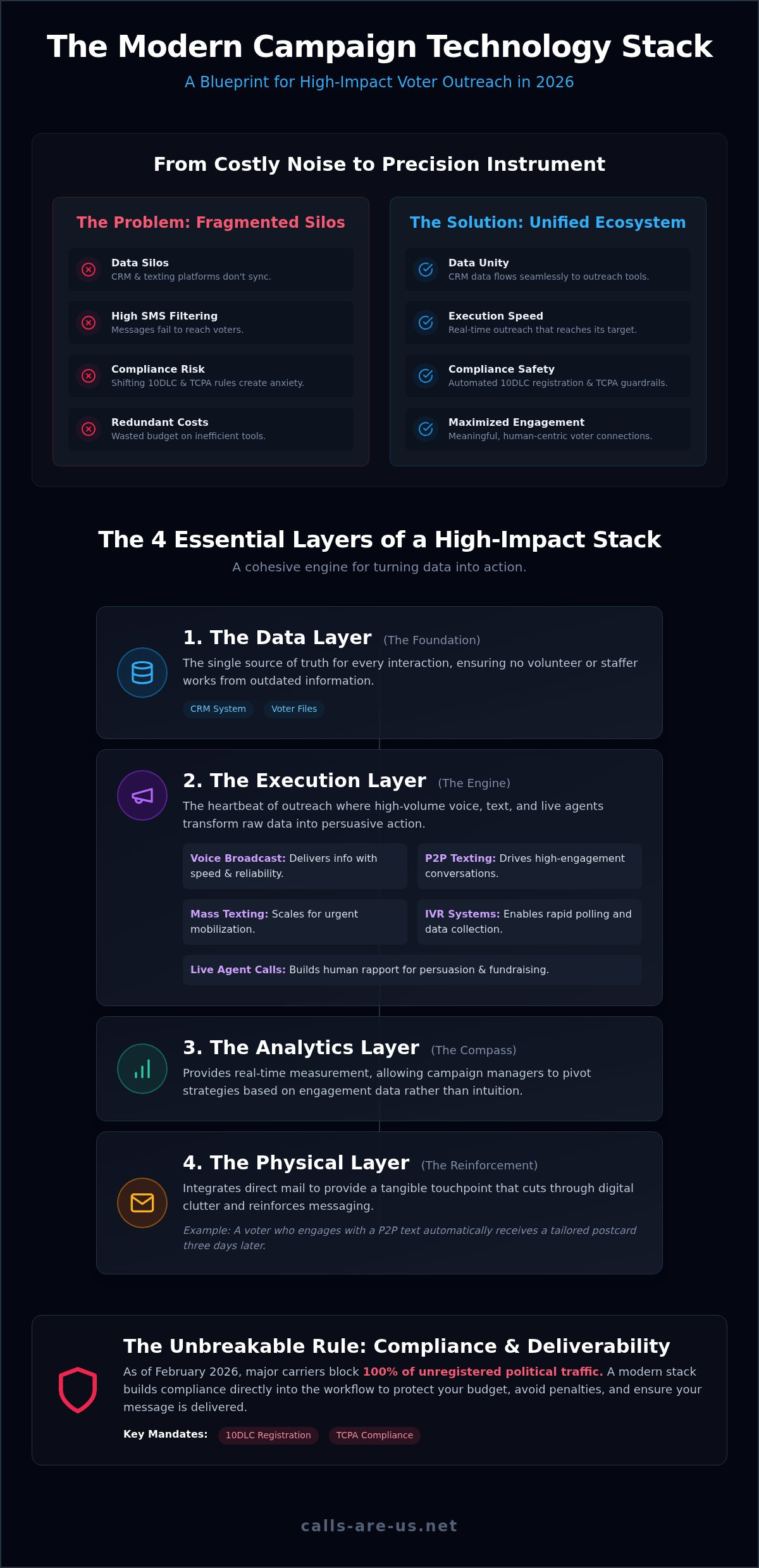
Campaigning has transformed from legacy manual phone banks into automated, multi-channel orchestration. We now rely on a sophisticated campaign management tool to handle the heavy lifting of voter contact. This evolution reflects the high-stakes reality of modern regulations. As of February 2026, major carriers block 100% of unregistered political traffic, making 10DLC registration the foundation of any viable stack. An authoritative visionary approach to technology prevents operational chaos by building these compliance requirements directly into the workflow, ensuring that your voice actually reaches the voter's ear.
Why Integration is the New Competitive Advantage
Disconnected tools are a drain on your most valuable resources: time and focus. When your texting platform doesn't talk to your CRM, you create data silos that lead to redundant outreach and voter irritation. This connectivity allows you to execute a definitive mass communication strategy that is both scalable and personal. Instead of sending generic, transactional messages, you can guide voters through a human-centric journey. By combining automated voice broadcasts, peer-to-peer texting, and live agent interactions, you build rapport and trust that a siloed approach simply cannot match.
The Essential Layers of a High-Impact Outreach Stack
A high-performance campaign technology stack operates as a multi-layered architecture where every component serves a specific strategic purpose. It's the difference between a collection of tools and a cohesive engine. At the base, you have the Data Layer. This utilizes your CRM and voter files as the single source of truth for every interaction, ensuring that no volunteer or staffer is working from outdated information. Above that sits the Execution Layer. This is where high-volume outreach via voice, text, and live agents transforms raw data into persuasive action. The Analytics Layer provides real-time measurement, allowing campaign managers to pivot strategies based on engagement data rather than intuition. Finally, the Physical Layer integrates direct mail to provide a tangible touchpoint that reinforces digital messaging.
The Execution Engine: Voice and SMS
This is the heartbeat of your outreach. Voice Broadcast remains a cornerstone of political voice broadcasting because it delivers critical information with unmatched speed and reliability. Peer-to-peer (P2P) texting drives high-engagement conversations, while mass texting provides the scale needed for urgent mobilization. Using Interactive Voice Response (IVR) systems allows for rapid polling and data collection, turning a simple call into a two-way dialogue. To truly excel, your campaign technology stack must balance these automated tools with live agent interactions. This combination allows for rapid-fire outreach while maintaining the human rapport necessary for deep persuasion and fundraising.
Bridging the Digital-Physical Divide
Digital fatigue is a growing challenge for any modern campaign. A sophisticated political direct mail strategy acts as the critical "offline" layer that cuts through the digital inbox clutter. Modern stacks now use digital triggers to automate physical mail drops. For example, a voter who engages with a specific peer-to-peer text might automatically receive a tailored postcard three days later. This multi-channel approach significantly increases voter recall and builds a deeper level of trust. As highlighted in UK Parliament evidence on digital campaign regulation, the transparency and regulation of these multi-channel strategies are becoming increasingly vital for maintaining democratic integrity and preventing disinformation. By bridging the digital-physical divide, you create a more resilient and persuasive presence in the voter's daily life.
Building this layered infrastructure requires a partner who understands the nuances of national scale. If you're looking to unify your execution layer, you can explore integrated outreach solutions that bridge the gap between digital and physical contact.
Navigating Compliance and Filtering in Your Tech Stack
Compliance is the invisible barrier between your message and the voter's pocket. In 2026, regulatory standards aren't just legal hurdles; they are the fundamental rules of engagement that dictate whether your communications are delivered or discarded. A fragmented campaign technology stack often leaves gaps in consent tracking and opt-out management, exposing your operation to aggressive carrier filtering and staggering legal penalties. To maintain a presence on the front lines, you must build your outreach around a framework of transparency, accountability, and technical precision.
A sophisticated stack automates the heavy lifting of regulatory safety by synchronizing data across every channel. When a voter opts out of a text message, that preference must instantly reflect in your voice broadcast lists and live calling queues. This integrated approach protects your campaign from TCPA violations, which can result in penalties ranging from $500 to $1,500 per message. By choosing providers that prioritize these standards, you transform compliance from a source of anxiety into a strategic shield that preserves your deliverability.
The 10DLC and A2P Ecosystem
The days of unregistered "gray route" texting are over. All major mobile carriers now block 100% of unregistered A2P (Application-to-Person) political traffic, making registration with The Campaign Registry (TCR) a non-negotiable step for any serious organizer. 10DLC compliance for national campaigns is the mandatory process of registering your organization's identity and specific messaging use case with mobile carriers to ensure your texts are verified, delivered, and protected from automated spam filters. To ensure your messages actually reach the device, your stack must support political identity verification tokens and maintain high trust scores through clean, consent-based data practices.
Voice Compliance and Legal Safety
Navigating the pitfalls of voice outreach requires a deep understanding of current FCC rulings and state-level disclosures. As of early 2026, political robocalls to residential landlines are strictly limited to three calls within any consecutive 30-day period. The use of AI-generated voices is now classified as "artificial" under the TCPA, necessitating the same rigorous consent standards as traditional recordings. Utilizing "Human-in-the-Loop" systems ensures that your outreach remains legally compliant while maintaining the personal touch that builds rapport. This level of oversight is essential for ensuring your voter outreach strategy stays within federal guidelines while maximizing the impact of every dial. When you prioritize legal safety, you aren't just avoiding fines; you're fostering a culture of ethical communication that respects the voter and strengthens the democratic process.
A Strategic Framework for Auditing and Building Your Stack
A winning strategy requires a blueprint. You cannot build a high-performance campaign technology stack by simply stacking software subscriptions on top of one another; you must architect a system that aligns with your specific mission. Whether your primary focus is persuasion, get-out-the-vote (GOTV), or fundraising, your technology must facilitate that goal without friction. This process begins with a rigorous five-step framework designed to eliminate waste and maximize impact.
Define your outreach goals: Clarify whether you are building for broad awareness or deep, one-on-one persuasion.
Audit your current tools: Identify data silos where voter information is trapped and look for redundant costs across platforms.
Select an 'Execution Engine': Ensure your platform can handle the massive volume spikes typical of the final days before an election.
Prioritize API-first tools: Choose software that allows for seamless data flow between your CRM and your outreach channels.
Test for adoption: Verify that your staff and volunteers can navigate the tools effectively before the campaign reaches its peak.
Identifying Gaps in Your Outreach
Effective organizing means reaching voters where they actually spend their time. Many campaigns settle for where it's easiest to reach them, often ignoring the power of voice in favor of cheaper, lower-impact digital channels. We recommend a "hook-and-elaborate" method for evaluating new tech: find a tool that provides a quick hook for voter attention and then allows your team to elaborate on the campaign's core message. For instance, your political campaign call center must be integrated with your SMS platform. This ensures that a voter who misses a call receives an immediate, personalized text, maintaining the momentum of the interaction.
Scaling for the High-Stakes Peak
The final 72 hours of a campaign are a crucible for your infrastructure. During this period, your stack must be capable of handling a 10x increase in volume without a drop in deliverability or speed. This is where professional live agent support becomes a critical asset, as they can manage complex inquiries that automated systems might miss. You want to avoid the trap of "shelfware," which is expensive software that sits idle because it's too complex to deploy. Instead, budget for a multi-channel approach that prioritizes high-touch connections when they matter most. If you are ready to streamline your operations, you can audit your campaign technology stack today to ensure you are prepared for the peak.
Optimizing Your Outreach with Calls-Are-Us Solutions
Efficiency defines the margin of victory. While many platforms offer fragmented tools that require constant manual intervention, Calls-Are-Us serves as the definitive execution hub for your campaign technology stack. We understand that a truly integrated outreach strategy requires more than just software; it needs a resilient infrastructure capable of bridging the gap between digital speed and physical impact. By unifying voice broadcast, P2P texting, and direct mail into a single, streamlined workflow, we empower your team to focus on strategy while we handle the technical orchestration.
Our multi-channel approach isn't just about volume; it's about creating a unified view of every voter interaction. When you synchronize your outreach, you eliminate the friction of data silos and ensure that your campaign speaks with one consistent, authoritative voice. This integrated philosophy allows national campaigns to scale rapidly across 40 states while maintaining the nuanced, human-centric core that drives mobilization. We provide the speed you need, the ease you want, and the significance your mission deserves.
High-Volume Voice and SMS Execution
Scaling your reach requires national-grade infrastructure that doesn't buckle under pressure. We leverage sophisticated IVR systems for instant data collection and polling, allowing you to gauge voter sentiment in real-time. However, technology is only half the battle. We believe in the power of professional live agents to build genuine rapport during complex inquiries. This combination of automated speed and human empathy ensures that your execution engine is both powerful and persuasive, turning raw data into meaningful connections at every touchpoint. Whether you're managing a local race or a national movement, our systems are built to handle the high-stakes spikes of the final 72 hours.
The Calls-Are-Us Advantage: Beyond Software
We prioritize impact over mere delivery. Our authoritative visionary approach means we don't just provide a service; we champion a philosophy of open, inclusive, and ethical communication. We take the weight of 10DLC registration and TCPA compliance off your shoulders, allowing you to be bold in your strategy without sacrificing legal safety. This commitment to integrity ensures that your campaign remains a principled guide in a complex communication landscape. It's time to move beyond transactional outreach and build a legacy of trust with every voter you reach. You can discover how to unify your campaign stack with Calls-Are-Us to ensure your message is heard, respected, and acted upon.
Future-Proof Your Mission Through Integrated Excellence
The path to victory in 2026 requires more than just high-volume outreach; it demands a unified strategy that respects the voter and the law. By mastering your campaign technology stack, you transform a collection of tools into a resilient execution engine. We have explored how the integration of voice broadcast, peer-to-peer texting, and direct mail creates a multi-touch journey that automated silos simply cannot replicate. You now have the framework to audit your current systems, automate your TCPA and 10DLC compliance, and scale your influence across 40 states with national-grade infrastructure.
The stakes are too high for fragmented data or filtered messages. You need a partner that combines technical expertise, national scale, and a deep commitment to ethical communication. Whether you're mobilizing a local community or launching a national movement, your infrastructure should empower your vision rather than limit it. It's time to bridge the gap between digital speed and human rapport.
Build your high-impact campaign stack with Calls-Are-Us today and ensure every voice is heard when it matters most. Your mission is vital, and with the right architecture, your impact will be undeniable.
Frequently Asked Questions
What are the most important tools in a campaign technology stack?
A robust CRM, a high-volume execution engine for voice and text, and a real-time analytics dashboard are the essential pillars. These tools work together to ensure that voter data flows seamlessly from identification to mobilization. By integrating these components, you create a unified campaign technology stack that eliminates data silos and maximizes the impact of every outreach attempt.
How do I ensure my campaign text messages aren't filtered by carriers?
You must register your campaign with The Campaign Registry and obtain a political identity verification token. As of February 2026, mobile carriers block 100% of unregistered A2P political traffic. Maintaining high trust scores through consent-based data and clean opt-out management is also critical for bypassing aggressive carrier filters and ensuring deliverability.
What is the difference between P2P and mass texting for campaigns?
Peer-to-peer (P2P) texting involves a human sender initiating each message to foster two-way dialogue, while mass texting sends messages to large groups simultaneously for urgent alerts. P2P is ideal for deep persuasion and rapport building. Mass texting excels at rapid mobilization, such as polling location reminders or emergency fundraising appeals that require immediate scale.
Is voice broadcasting still effective for voter outreach in 2026?
Yes, voice broadcasting remains a high-impact tool for delivering critical information with unmatched speed and scale. It's particularly effective for GOTV efforts and rapid-response messaging where time is the primary constraint. When combined with Interactive Voice Response (IVR) for polling, it turns a simple notification into a valuable data collection touchpoint for your team.
How does direct mail integrate with a digital campaign tech stack?
Modern stacks use digital triggers to automate physical mail drops based on voter engagement levels. For example, a voter who interacts with a specific P2P text can be automatically queued to receive a reinforcing postcard three days later. This multi-channel approach cuts through digital fatigue and increases voter recall by providing a tangible physical touchpoint that digital-only efforts lack.
What are the 10DLC requirements for political organizations?
Political organizations must register their legal identity and specific messaging use cases to send texts over standard 10-digit long code numbers. This registration is mandatory for all A2P channels in 2026. Failure to comply results in immediate blocking by major carriers, effectively silencing your digital outreach and preventing your messages from reaching the voter's device.
How can I manage TCPA compliance across multiple outreach channels?
Centralizing your opt-out management within your CRM is the most effective way to ensure legal safety. When a voter requests to be removed via a text message, that preference should automatically update your voice broadcast and live calling lists. This integrated governance prevents the costly penalties associated with contacting voters without prior express consent and maintains your reputation.
Can a small organization build a professional-grade campaign stack?
Small organizations can leverage scalable, API-first tools to build a professional-grade campaign technology stack without a massive upfront investment. By focusing on essential execution layers like voice and SMS, smaller teams can achieve national-scale reach. The key is choosing flexible providers that offer high-stakes authority and reliable deliverability regardless of the organization's current size.



Comments