
Voice Broadcast for Schools: The 2026 Guide to Reliable Campus Communication

Updated: Jun 26
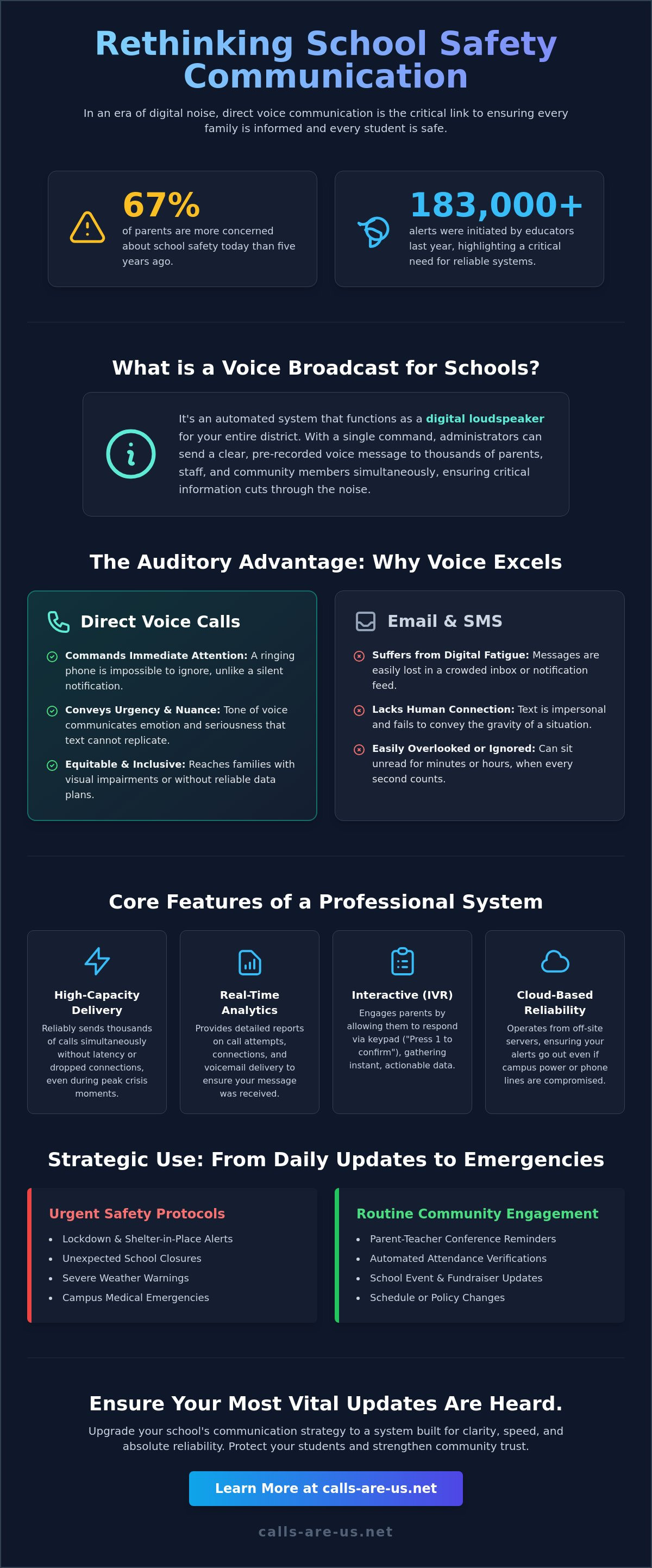
If 67% of parents are more concerned about school safety today than they were five years ago, why are we still relying on communication methods that fail under pressure? In an era where educators initiated over 183,000 alerts last year alone, a robust voice broadcast for schools isn't just a convenience; it's a critical safety bridge. You need a system that cuts through digital clutter, reaches families instantly, and operates with absolute reliability during a crisis.
You understand the high stakes of campus leadership and the exhaustion that comes from managing outdated, manual phone trees. It's time to replace administrative friction with automated precision that protects your students, empowers your staff, and strengthens community trust. This 2026 guide explores modern communication standards, technical workflows for instant delivery, and ethical strategies to maintain TCPA compliance. We'll show you how to turn every message into a clear, audible connection that ensures your most vital updates are heard immediately.
Table of Contents
What is Voice Broadcast for Schools?
Modern school leadership requires a communication strategy that transcends simple data delivery. A voice broadcast for schools is a sophisticated, automated telephonic outreach system that allows administrators to send high-volume messages to thousands of recipients simultaneously. It functions as a digital loudspeaker, projecting your voice across the entire district with a single command. Unlike manual phone trees that crumble under the weight of a crisis or email blasts that often go ignored, this technology ensures a consistent and professional message reaches every parent. It transforms a logistical hurdle into a powerful tool for connection, safety, and community trust.
To better understand how this technology integrates into a modern campus environment, watch this helpful overview:
The Mechanism of Automated School Alerts
Modern educational institutions utilize a "one-to-many" communication model to ensure no family is left in the dark. This system leverages voice broadcasting technology to distribute pre-recorded audio files across massive contact lists in a matter of seconds. Using pre-recorded messages is a strategic choice; it allows administrators to maintain a calm, authoritative, and clear tone even during high-stakes emergencies. Additionally, the reliance on cloud-based infrastructure provides a critical safety net. Since the broadcast originates from off-site servers, your alerts remain operational even if local school power is out or campus phone lines are compromised.
Why Voice Outperforms Email and SMS Alone
Digital fatigue has made it increasingly difficult to reach parents through traditional text-based channels. While a text message might sit unread for minutes, a ringing phone commands immediate attention and demands a response. The auditory advantage of voice communication is clear: it conveys human emotion, urgency, and nuance that text simply cannot replicate. This medium also champions inclusivity within your district. For parents with visual impairments or families without reliable high-speed data plans, a voice call is often the most accessible way to receive information. By prioritizing the human voice, you ensure that your voice broadcast for schools is equitable, urgent, and impossible to ignore.
Key Features of a Sophisticated School Broadcasting System
Efficiency is the benchmark of modern safety. A professional voice broadcast for schools must do more than just dial numbers; it must manage high-capacity traffic across an entire district without latency. While basic dialers often struggle with carrier throttling or limited bandwidth, a sophisticated system ensures that ten thousand calls go out as reliably as ten. This requires a robust backend capable of handling sudden spikes in volume, particularly during time-sensitive events. Reliable infrastructure ensures your message arrives when it matters most, not minutes after the window of opportunity has closed.
Transparency is non-negotiable in campus leadership. You need detailed analytics that track every call attempt, connection, and voicemail delivery in real time. This data allows administrators to identify disconnected numbers or unreachable families immediately. By understanding exactly who hasn't been reached, you can pivot your outreach efforts rather than waiting for a communication failure to become a crisis. This level of granular insight is a core component of a comprehensive mass communication strategy. It provides the accountability required to maintain community trust and operational integrity.
Interactive Voice Response (IVR) for Data Collection
Engagement requires a two-way street. Interactive Voice Response (IVR) technology empowers parents to interact with your broadcast by using their keypad. By asking recipients to "press 1" to confirm receipt or "press 2" to indicate a student's absence, you gather actionable data instantly. These keypad inputs create quick polling loops for schedule changes or event attendance. This functionality eliminates the need for manual follow-up calls, reduces the administrative burden on your front office, and provides a real-time feedback loop for decisive leadership.
Multi-Channel Redundancy and SMS Integration
Redundancy is the cornerstone of reliable communication. A "triple-threat" approach ensures your message penetrates the noise by utilizing voice, text, and email in unison. If a parent misses the voice call, an automated SMS provides a permanent written record of the alert. This multi-channel integration creates a unified messaging front across all campus touchpoints, ensuring no family is left behind due to a single points of failure. For those refining their internal protocols, federal emergency planning resources highlight the necessity of such redundant systems in maintaining order. If you're ready to upgrade your current infrastructure, exploring a professional voice broadcast solution can provide the stability your community deserves.
Strategic Use Cases: From Daily Updates to Emergency Alerts
Strategy dictates success. A voice broadcast for schools is only as effective as the framework guiding its deployment. Administrators must distinguish between high-stakes urgency and standard community engagement to prevent "alert fatigue" among families. While a live call from a principal might be necessary for sensitive, individual student matters, automated broadcasts are the superior choice for mass dissemination where speed, consistency, and reach are paramount. This distinction ensures your community pays attention when the phone rings, knowing the message contains vital information.
Precision in messaging is equally critical. Professional scripts ensure that even in high-pressure scenarios, your communication remains clear, calm, and actionable. You don't have to start from scratch when building your library of alerts. You can find inspiration and proven templates by reviewing these voice broadcast message examples. These resources help you maintain a tone of seasoned authority while fostering a human-centric connection with your parents and staff.
Critical Safety and Emergency Notifications
Safety is your primary mandate. During weather-related closures or last-minute delays, a voice alert provides the immediate clarity families need to adjust their morning routines. In more severe campus security threats, the system acts as a central nervous system for the entire district. Resources from the Cybersecurity and Infrastructure Security Agency (CISA) regarding school safety and security emphasize that rapid, reliable communication is a cornerstone of threat mitigation. Beyond the initial crisis, broadcasting is essential for parent reunification instructions, guiding families to specific locations with calm, pre-recorded directions that reduce chaos on the ground.
Administrative and Community Engagement
Operational efficiency drives community growth. Automating attendance notifications significantly reduces the daily administrative workload, allowing your front-office staff to focus on student needs rather than manual phone calls. For broader engagement, a warm voice message can boost turnout for PTA meetings, fundraisers, and school board sessions more effectively than an email that might land in a spam folder. It also serves as a reliable channel for time-sensitive enrollment deadlines and graduation logistics. By using a voice broadcast for schools for these touchpoints, you ensure every family feels connected, informed, and valued within your educational ecosystem.
Implementation: Setting Up Your School for Success
Implementation is where vision meets reality. Deploying a voice broadcast for schools requires a methodical approach that prioritizes data integrity, staff readiness, and long-term scalability. You aren't just buying software; you're building a communication infrastructure that must perform under the highest pressure. Start by auditing your current contact databases to ensure every entry is accurate and up to date. Clean data is the fuel for your outreach engine, ensuring that your messages reach the intended recipients without delay or technical failure.
Segmentation is your next critical step. You must categorize your lists into distinct groups such as primary guardians, faculty members, and local emergency responders. This allows you to send targeted, relevant messages rather than cluttering every phone in the district with non-essential updates. Before any live broadcast, dedicate time to rigorous staff training. Your team needs the muscle memory to launch an alert in seconds without hesitation or confusion. For those in the initial planning stages, understanding voice broadcast pricing is essential for sustainable district budgeting and resource allocation.
Compliance and Legal Safety in 2026
TCPA compliance is the mandatory legal framework for all automated telephonic outreach in the educational sector. While schools enjoy specific exemptions for health and safety emergencies, you must remain vigilant regarding informational messages to avoid costly penalties and legal friction. FERPA regulations also dictate how you manage and store student contact data, requiring a platform that prioritizes high-level encryption and data privacy. Ethically managing "Do Not Call" requests and maintaining clear opt-in records isn't just about legal safety; it's about respecting the boundaries of your community and fostering a culture of trust and consent.
Recording High-Impact School Messages
The voice behind the message determines its emotional weight and effectiveness. While a principal’s voice carries a sense of familiar authority and trust, professional voice talent can provide superior clarity for complex instructions. When recording, aim for brevity, precision, and a reassuring tone. Utilize a "hook-and-elaborate" structure: start with a punchy statement of the situation, followed by specific instructions for the recipient. This format maximizes information retention during stressful moments. If you're ready to secure your campus with a professional system, you can start your voice broadcast setup today to ensure your district is prepared for any scenario.
The Calls-Are-Us Advantage for Educational Institutions
Authority is earned through consistent performance in high-stakes environments. At Calls-Are-Us, we don't just provide a platform; we serve as a seasoned partner for educational leaders who cannot afford a communication failure. Our infrastructure is built to handle the weight of critical influence, ensuring your message carries the professional polish your community expects. Whether you're managing a single rural campus or a sprawling national district, our technology scales to meet your exact needs without sacrificing speed or clarity. We empower you to lead with confidence, knowing your voice will reach every ear it needs to.
Integrity is the foundation of every interaction we facilitate. We champion a philosophy of inclusive dialogue, believing that every parent and guardian deserves a clear, audible connection to their child's school. This commitment to social responsibility drives us to build tools that are accessible, ethical, and reliable. For administrators looking to apply high-level engagement strategies to local governance, our political campaign call center expertise provides the same scalable contact technology to help you navigate school board elections and community referendums with precision.
Reliability Built on Decades of Influence
Experience is our greatest asset. Supporting complex outreach efforts across 40+ states has allowed us to refine a system that is both technologically savvy and deeply human-centric. We provide more than just a voice broadcast for schools; we offer a principled guide through the complexities of modern communication. Administrators gain access to technical expertise that ensures every broadcast is optimized for delivery, compliance, and impact. Our team understands the nuances of regulatory standards, providing the weight of a seasoned expert to your district's daily operations and emergency protocols.
Next Steps for Your Campus Outreach
Transformation starts with a multi-channel perspective. While digital tools are efficient, a truly inclusive strategy reaches every household, including those without consistent internet access or mobile data. Integrating a political direct mail strategy allows you to reach non-digital parents who might otherwise miss urgent updates or enrollment deadlines. This holistic approach strengthens the bond between your campus and the community, fostering a culture of transparency and trust. Reliable communication is the heartbeat of a safe school; it's time to ensure yours is strong, clear, and heard by everyone. Reach out to our team today to schedule a strategic consultation and discover how a professional voice broadcast for schools can redefine your campus connection.
Elevating Your District's Voice for a Safer Tomorrow
School communication is undergoing a fundamental shift from passive notification to active engagement. By moving beyond the limitations of email and embracing a sophisticated voice broadcast for schools, you ensure that every critical alert cuts through the digital noise. True reliability requires more than just a dialer; it demands high-capacity infrastructure, real-time analytics, and a commitment to data integrity. These elements work together to build a communication ecosystem where every family is reachable and every message is heard.
Calls-Are-Us brings the weight of a seasoned expert to your campus, having operated in over 40 states to support high-stakes outreach. Our platform combines high-volume voice broadcast capability with sophisticated IVR and data collection tools to transform how you connect with families. This isn't just about sending alerts; it's about fostering a culture of trust through ethical, inclusive dialogue. Empower your school community with authoritative voice broadcasting, get started with Calls-Are-Us today. Your students and staff deserve a communication system that never falters. Take the first step toward a more connected, resilient, and secure campus environment.
Frequently Asked Questions
Is voice broadcasting for schools legal under TCPA regulations?
Yes, voice broadcasting for schools is legal, especially when messages relate to the school's educational mission or student safety. A landmark February 2026 court ruling in Bradford v. Sovereign Pest Control of TX, Inc. clarified that express consent can be given orally or in writing. Messages sent for health or safety emergencies are fully exempt from consent requirements. You should always consult with legal counsel to ensure your non-emergency outreach aligns with the latest regulatory standards.
How quickly can a school voice broadcast reach 10,000 parents?
A high-capacity voice broadcast for schools can reach 10,000 parents in mere minutes. Modern cloud-based infrastructure bypasses the limitations of local phone lines, allowing for massive, simultaneous outbound dialing across a district. This speed is critical during active crises where every second impacts student safety. By utilizing professional-grade servers, your district ensures that urgent instructions are delivered nearly instantly across your entire community without the delays common in manual outreach.
Can parents opt-out of non-emergency school voice messages?
Parents have the right to opt-out of any communications that aren't related to an immediate health or safety emergency. While emergency alerts are exempt to ensure public safety, ethical communication requires an easy way for families to manage their preferences for routine updates. You can manage these requests through your platform's dashboard, ensuring your contact lists remain clean and compliant. Respecting these boundaries fosters community trust and prevents your vital messages from being perceived as intrusive noise.
Does our school need special hardware to use a voice broadcast system?
Can we send voice broadcasts in multiple languages simultaneously?
Yes, you can deliver messages in multiple languages by utilizing segmented contact lists. By identifying the preferred language of each family in your database, you can ensure they receive a recording that is clear and accessible. This approach is a key component of universal contactability, which many states now require as a matter of leadership accountability. It ensures that language barriers don't prevent critical safety information from reaching every home in your district.
What happens if a parent doesn’t answer the phone during a broadcast?
If a parent doesn't answer, the system is designed to detect the difference between a live human and a machine. It will automatically leave your pre-recorded message on their voicemail or answering machine, ensuring the information is still delivered. Some sophisticated systems also allow for automated retries if the line is busy or the call fails. This ensures a high delivery rate even when families are away from their phones during the initial broadcast period.
How does voice broadcasting integrate with our existing student information system (SIS)?
Integration typically occurs through automated data syncs or secure CSV uploads. Many professional platforms offer API connections that allow your voice broadcast for schools to pull the most current contact information directly from your SIS. This ensures that you aren't relying on outdated phone numbers during an emergency. Maintaining this sync reduces the administrative burden on your staff and guarantees that your safety ecosystem is always powered by accurate, real-time data.
Is voice broadcasting more effective than mass texting for schools?
Voice broadcasting and mass texting serve different strategic purposes. While text messages have a 98% open rate, a ringing phone provides an auditory advantage that commands immediate attention during a crisis. Voice calls convey human emotion and urgency that text cannot replicate, making them superior for safety alerts. Using both channels in unison creates a redundant communication net that ensures no family misses a critical update due to a single platform's limitations.



Comments