_edited.png)
15+ High-Impact Voice Broadcast Message Examples for 2026

Updated: Jun 18
A voice broadcast isn't just a recording; it's a structured human interaction optimized for a three-second attention span. In a communication landscape where 58% of Americans still rely on voice calls for essential information, the difference between a hang-up and a conversion lies in the first few words. You likely feel the pressure of low listen-through rates or the constant anxiety of navigating the FCC’s latest "Know Your Customer" requirements. Finding effective voice broadcast message examples shouldn't feel like a gamble against compliance or a frustrating battle with writer's block.
We understand that you want your outreach to feel personal, professional, and impactful. It's vital to balance high-speed efficiency with a human-centric approach that respects your audience's time. This guide provides the proven script templates and strategic frameworks you need to transform automated outreach into meaningful connections. You'll learn how to craft the perfect hook, maintain TCPA compliance through 2026, and use 15 specific templates to drive higher engagement. We'll break down the exact language that fosters trust, facilitates action, and delivers significant results for your organization.
Key Takeaways
Master the "3-Second Rule" to capture immediate attention. Learn how to structure your opening sentence to maximize campaign ROI and prevent early hang-ups.
Access 15+ high-impact voice broadcast message examples designed for political, emergency, and business outreach. These templates serve as a strategic bridge to foster deeper connections with your target audience.
Prioritize clarity and calm delivery during critical moments. Discover how to position your organization as an authoritative visionary using precise community notification frameworks.
Humanize your digital brand by leveraging the emotional weight of a human voice. Shift from transactional broadcasts to approachable partnerships that build long-term trust.
Optimize your delivery by choosing professional voice talent over robotic AI alternatives. Understand the nuanced best practices that transform a simple recording into a meaningful human interaction.
Table of Contents
The Anatomy of a High-Impact Voice Broadcast Message
Voice broadcasting is a strategic bridge. It connects your organization to a live audience with the resonance and nuance of a human voice. To understand the foundational technology, one might ask What is Voice Broadcasting? from a technical perspective, but for leaders, it represents a high-stakes opportunity for influence. We've moved beyond the era of intrusive "robocalls" toward interactive, high-value voice experiences that prioritize social responsibility and trust. Analyzing successful voice broadcast message examples reveals a common thread: they treat the recipient as a partner rather than a target.
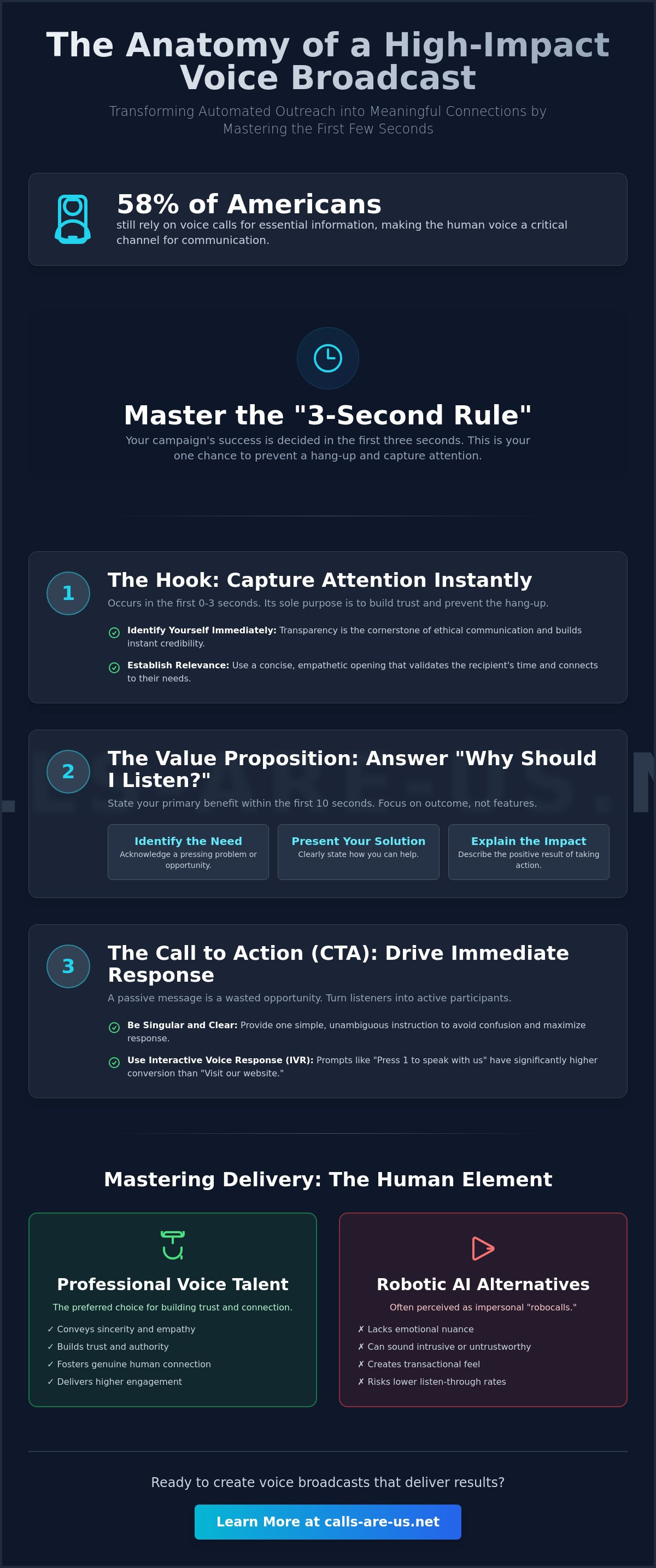
Your campaign ROI lives or dies in the first three seconds. This "3-Second Rule" dictates whether a recipient stays on the line or dismisses the call as digital noise. In an age of screen saturation, voice remains the most human-centric channel available. It allows for a level of empathy, authority, and connection that text alone cannot replicate. By mastering the structure of your recording, you transform a simple notification into a powerful tool for engagement.
To better understand how this technology integrates into a modern business strategy, watch this helpful video:
The Hook: Capturing Attention Instantly
Identify yourself immediately to build essential trust. Transparency is the cornerstone of ethical communication, and recipients are more likely to listen when they know exactly who is speaking. You can utilize curiosity gaps to prevent hang-ups, provided they're grounded in genuine relevance to the listener's life. A High-Impact Hook is a concise, empathetic opening that validates the recipient's time while establishing your organization’s credibility. When you review various voice broadcast message examples, the most effective scripts always lead with a clear statement of identity and intent.
The Value Proposition: Why Should They Listen?
State your primary benefit within the first 10 seconds. Don't get bogged down in feature-heavy descriptions that confuse the listener. Instead, focus on benefit-driven outcomes that solve problems, provide value, or offer relief. This approach is critical in political voice broadcasting, where immediate relevance determines voter sentiment. Use a tripartite structure to deliver your message: identify the pressing need, present your specific solution, and explain the positive impact of taking action.
The Call to Action (CTA): Driving Immediate Response
Drive an immediate response with a singular, clear instruction. A passive message is a wasted opportunity for connection. By integrating Interactive Voice Response (IVR) into your mass communication strategy, you turn passive listeners into active participants. Compare the high conversion of a "Press 1 to speak with us" prompt against a vague "Visit our website" suggestion. Simplicity is your strongest ally in this high-pressure environment. Provide one message and one clear action step to ensure your outreach achieves its maximum potential.
Political Campaign and Voter Outreach Examples
Voice is the backbone of any sophisticated mass communication strategy in the political sphere. It carries an emotional weight that digital text simply cannot replicate. A candidate’s voice conveys sincerity, urgency, and passion. These auditory cues build a bridge of trust between the campaign and the voter. When you study successful voice broadcast message examples, you'll see that the most effective campaigns prioritize human connection over transactional data collection.
Timing and personalization transform a generic recording into a meaningful interaction. Morning deliveries often resonate with retirees and early risers, while evening windows are better for reaching the workforce at home. You must tailor your scripts to reflect the specific concerns of different voter demographics. While you scale these efforts, staying aligned with FCC Robocall Rules ensures your campaign maintains integrity and legal compliance.
Voter Identification and Polling Scripts
"Hi, this is [Candidate Name]. I’m calling to hear what matters most to you and your family this year." This opening shifts the dynamic from an interrogation to a consultation. By using Interactive Voice Response (IVR), you can empower voters to share their priorities. Ask them to "Press 1 for Economy, 2 for Healthcare, or 3 for Education." This data allows you to refine your platform while making the voter feel heard.
Get Out The Vote (GOTV) and Election Day Alerts
"Urgent: Polls close in 4 hours. Your vote is your voice in our community." This script focuses on community responsibility rather than just the act of voting. Effective voice broadcast message examples for GOTV often include "Plan to Vote" reminders. Ask the recipient if they have a ride to the polls or if they know their precinct location. These small nudges are proven to increase turnout by helping voters visualize their participation.
Telephone Town Hall Invitations
"Join me live in 10 minutes to discuss our plan for the new city park." Use active verbs like engage, influence, and join to drive participation. These invitations often utilize a "Live Transfer" feature. Recipients can stay on the line to be automatically connected to a town hall meeting. It's a seamless way to foster inclusive dialogue. If you're ready to elevate your outreach, consider how a Live Calling Center can complement your automated efforts.
Emergency Alerts and Community Notification Examples
Clarity is the ultimate currency in an emergency. When disaster strikes, your organization must step into the role of an authoritative visionary to guide the community through uncertainty. Effective emergency notifications must be immediate, accurate, and actionable. While the Emergency Alert System (EAS) handles broad national warnings, local organizations use voice broadcasting to deliver hyper-local instructions that save lives. Voice remains the primary fail-safe channel because it often bypasses the data network congestion that cripples SMS and mobile apps during high-traffic crises.
Maintaining a calm, professional delivery in your recordings fosters trust and prevents panic. It's not just about what you say, but how you say it. In a diverse nation, your strategy must also account for inclusivity through multi-language scripts. Providing information in a recipient's native tongue ensures that safety instructions are understood by everyone, regardless of their background. Reviewing specialized voice broadcast message examples for crisis management helps you prepare for the unexpected before it happens.
Critical Safety and Weather Alerts
"This is an urgent safety alert. A severe weather warning is in effect for your area." This script identifies the threat immediately to capture attention. You must follow the warning with concrete next steps to empower the listener. For instance, "Please move to the lowest floor of your building and stay away from windows until the alert is lifted." Every word in these scripts must serve the singular purpose of safety. Avoid fluff or unnecessary introductions; your goal is to facilitate rapid, decisive action through clear communication.
Utility Outage and Service Restoration Updates
Proactive messaging protects your operational bandwidth. When you notify residents about a service disruption, you significantly reduce the volume of inbound calls to your service center. "We are aware of the power outage in your sector. Crews are on-site now." This punchy opening acknowledges the problem and confirms that a solution is in progress. Using a hook-and-elaborate structure allows you to provide essential details, such as an estimated repair time of two hours. By keeping the community informed, you transform a frustrating outage into a demonstration of your commitment to reliable service. These voice broadcast message examples prove that transparency is the fastest way to maintain public trust during utility failures.
Business and Nonprofit Engagement Examples
Voice broadcasting humanizes your digital brand. It transforms a faceless corporation into an approachable partner that listens and responds. While email and SMS provide essential data points, voice adds the emotional resonance necessary for a comprehensive tripartite communication strategy. A sophisticated outreach plan relies on a rhythm of diverse touchpoints; layering voice on top of text and digital ads creates a narrative that is seen, heard, and felt. This multi-channel approach prevents "caller fatigue" by ensuring every interaction delivers genuine value. When you examine these voice broadcast message examples, you'll see how organizations move from transactional noise to meaningful engagement.
Maintaining a balance between frequency and value is essential for long-term trust. You don't want to be a nuisance; you want to be a resource. By focusing on utility and social responsibility, businesses can foster deeper connections that survive the volatility of the digital marketplace. Using the right tone and structure allows you to project an authoritative yet accessible persona that resonates with modern audiences.
Appointment and Service Reminders
"Hello! This is [Business Name] reminding you of your visit tomorrow at 2 PM. We're looking forward to getting your car road-ready for your weekend trip." This script focuses on the ultimate benefit of the service rather than just the time slot. Integrating Interactive Voice Response (IVR) empowers your customers to take immediate action. Use a simple prompt: "Press 1 to confirm, or 2 to speak with our coordinator." This streamlined workflow respects their schedule while reducing no-show rates for your team. If you're ready to improve your operational efficiency, explore our Voice Broadcast solutions to automate these vital touchpoints.
Nonprofit Fundraising and Supporter Appreciation
"Because of you, we provided 500 meals today. Thank you for being a hero." Narrative-driven scripts focus on social impact to foster a sense of shared victory. Appreciation calls that don't immediately ask for money are powerful tools for long-term donor retention. They build trust, reinforce mission alignment, and validate the supporter's contribution. By highlighting specific outcomes, you move beyond generic voice broadcast message examples and create a lasting connection with your community. This human-centric core is what separates successful advocates from mere solicitors.
Customer Feedback and Net Promoter Score (NPS) Surveys
"On a scale of 1 to 5, how would you rate your recent experience with us?" Voice surveys often yield higher emotional honesty than text-based alternatives. The nuance in a customer's tone provides deeper insights into their satisfaction level. To ensure completion, keep your survey to three questions maximum. Capturing the "why" behind a score is just as important as the number itself. This transparency is vital for organizations committed to inclusive dialogue and continuous improvement. It shows your audience that their voice truly matters to your mission.
Mastering Delivery: Best Practices for Professional Results
Professional delivery is the final mile of your communication strategy. It’s the moment your planning meets the ear of your audience. Calls-Are-Us serves as a principled guide, helping you navigate the technical and ethical complexities of modern voice outreach. While AI technology has advanced, professional human voice talent remains the gold standard for creating genuine connection. A human voice carries nuance, warmth, and sincerity that algorithms simply cannot replicate. By prioritizing high-quality production, you ensure your voice broadcast message examples translate into real-world impact.
Communication rhythm determines whether you’re a welcome guest or an intrusive caller. You must respect the recipient's daily flow by choosing appropriate delivery windows and maintaining a sensible frequency. Staying silent is often as important as speaking; over-saturation leads to "caller fatigue" and diminished trust. To remain helpful, your message must provide immediate utility, offer a clear benefit, and respect the listener's time. This balance transforms a simple broadcast into a tool for empowerment and social progress.
TCPA Compliance and Ethical Broadcasting
Integrity is non-negotiable in digital outreach. You must obtain Prior Express Written Consent before sending certain types of automated messages to ensure you’re acting within legal boundaries. Every broadcast requires a functional "Opt-Out" mechanism, allowing recipients to revoke consent easily. To maintain legal safety across national campaigns, follow this essential checklist:
Verify that all numbers are scrubbed against the National Do Not Call Registry.
Ensure your message identifies your organization within the first few seconds.
Provide a clear, automated way for listeners to stop future calls.
Recording Tips for a Human-Centric Sound
Warmth and pacing define your auditory brand. Utilize the "smile through the phone" technique to inject a sense of approachable partnership into your recording. For anyone recording their own broadcast, the InPronunci: American Accent Program App offers the specialized training needed to ensure your delivery is both clear and professional. Technically, you must eliminate background noise and maintain consistent volume levels to project professional authority. We suggest recording two or three variations of your hook to A/B test which version resonates most with your specific audience. This iterative process allows you to refine your voice broadcast message examples based on actual performance data.
Scaling Your Message with Calls-Are-Us
Our robust infrastructure is built to facilitate massive impact. We handle millions of calls with zero latency, ensuring your message reaches its destination exactly when it matters most. We invite you to see how your custom scripts perform on a platform designed for speed, reliability, and inclusive dialogue. Ready to launch your campaign? Get a custom quote from Calls-Are-Us today.
Transforming Your Outreach into Meaningful Connection
The right words have the power to mobilize voters, protect communities, and humanize global brands. You've explored the foundational anatomy of successful scripts and reviewed high-impact voice broadcast message examples designed for the evolving regulatory landscape of 2026. By prioritizing the "3-Second Rule" and maintaining a warm, human-centric core, you transform automated outreach into a sophisticated bridge for connection. True success depends on balancing high-speed efficiency with a deep respect for the recipient's time and attention.
Impactful communication requires more than just a script; it demands a partner committed to ethical standards and technological excellence. We've operated in over 40 states and built a scalable infrastructure capable of managing millions of calls with zero latency. Our expertise in TCPA and 10DLC compliance ensures your campaigns remain secure, principled, and effective. This approach allows you to mobilize voters, protect residents, and engage customers with total confidence. Empower your outreach with the industry’s most reliable voice broadcasting platform. Your message deserves to be heard, and your audience deserves a connection built on trust. We're ready to help you lead the way and foster meaningful social progress through every call.
Frequently Asked Questions
How do I write a voice broadcast script that people won’t hang up on?
Start with immediate identification and a value-driven hook. People decide within three seconds whether to stay on the line. Clearly state who you are, why you're calling, and what the listener gains from the interaction. By studying successful voice broadcast message examples, you'll notice that empathy and relevance are the most powerful tools for retention. This approach builds trust and reduces the likelihood of an immediate hang-up.
What is the ideal length for an automated voice message?
Keep your message between 30 and 45 seconds to maximize engagement. Listeners lose focus quickly during automated calls, so every word must serve a specific purpose. Aim for a concise structure: a 5-second hook, a 20-second value proposition, and a 5-second call to action. This rhythm respects the recipient's time while delivering your core message effectively without causing listener fatigue.
Can I use a voice broadcast for political fundraising in 2026?
Yes, you can use voice broadcasting for political fundraising, provided you adhere to the latest FCC "Know Your Customer" rules and TCPA guidelines. These regulations require transparency and specific disclosures about the caller's identity. Using recorded messages to invite supporters to telephone town halls or direct them to secure donation portals is a highly effective way to humanize your campaign's financial needs and foster donor trust.
What are the legal requirements for voice broadcasting in the US?
Legal requirements include obtaining prior express written consent for most non-emergency calls and providing an automated opt-out mechanism. You must also comply with the FCC’s STIR/SHAKEN framework to ensure your calls aren't flagged as spam. Organizations must recertify their filings in the Robocall Mitigation Database annually by March 1 to maintain operational status and protect their reputation for ethical, compliant communication.
How does an IVR "Press 1" campaign work with a recorded message?
An IVR campaign integrates a recorded message with a keypad prompt to trigger an immediate action. When the listener presses a specific digit, the system can transfer them to a live calling center, record their feedback, or send an automated text. This interactive layer transforms a passive broadcast into a two-way dialogue. It drives higher conversion rates and facilitates deeper audience engagement through a single, simple interaction.
Is it better to use a professional voice actor or text-to-speech?
Professional voice actors are almost always better because they provide the emotional nuance and warmth that AI often lacks. Human voices build trust through natural pacing and inflection, which is vital for high-stakes outreach. While text-to-speech is efficient for dynamic data, a real person’s voice reinforces your brand’s personality as an approachable and authoritative partner. This human-centric core is essential for fostering genuine connections.
How can I track the success of my voice broadcast campaign?
Track success by monitoring key metrics such as listen-through rates, IVR transfer numbers, and opt-out percentages. Most professional platforms provide real-time dashboards to analyze how many recipients stayed on the line for the full duration. By comparing different voice broadcast message examples through A/B testing, you can identify which hooks and CTAs generate the highest response. This data-driven approach ensures your campaigns remain both efficient and impactful.
What is the best time of day to send a mass voice message?
Send your messages between 10:00 AM and 12:00 PM or 4:00 PM and 6:00 PM for the highest answer rates. Avoid early mornings, late nights, or typical dinner hours to respect the recipient's personal boundaries. Choosing these strategic windows ensures your outreach is viewed as a helpful notification rather than a nuisance. This thoughtful timing protects your organization’s reputation and fosters a more positive relationship with your audience.



Comments