
Advocacy Texting Campaigns: The 2026 Guide to Mobilizing Movements

Did you know that 95% of text messages are read within just three minutes of receipt? The mobile screen is the most direct path to meaningful action, yet many organizations struggle to launch effective advocacy texting campaigns without hitting technical walls. You've likely felt the frustration of high filtering rates or the mounting complexity of 10DLC and TCPA regulations. It's exhausting to see your message stalled by carrier blocks or lost to supporter fatigue. We understand that your mission depends on clear, compliant, and high-impact communication.
This 2026 guide empowers you to master these sophisticated strategies by blending technical frameworks with human-centric outreach. You'll learn how to transform passive supporters into active advocates who show up for key votes and community events. We will explore the latest carrier requirements, the shift toward two-way conversational texting, and the exact steps to maintain a clean, high-performing database. By the end of this article, you'll have the tools to build trust, drive engagement, and mobilize your movement with precision.
Table of Contents
Understanding Advocacy Texting Campaigns: The Architecture of a Movement
P2P vs. Mass Texting: Selecting the Strategic Engine for Your Mission
Crafting the Message: Psychology, Segmentation, and Supporter Agency
Navigating Compliance: Ensuring Deliverability in the 10DLC Era
Scaling Impact: Integrating Texting into a Multi-Channel Outreach Stack
Understanding Advocacy Texting Campaigns: The Architecture of a Movement
Influence is built on connection. At its core, advocacy texting campaigns represent the strategic use of SMS and MMS to shape public opinion and drive legislative change. While traditional outreach often feels like a one-way broadcast, modern advocacy turns the mobile phone into a tool for collective power. It's about moving beyond simple updates to foster a community that's ready to act at a moment's notice. This approach transforms passive supporters into an active, vocal force for social progress.
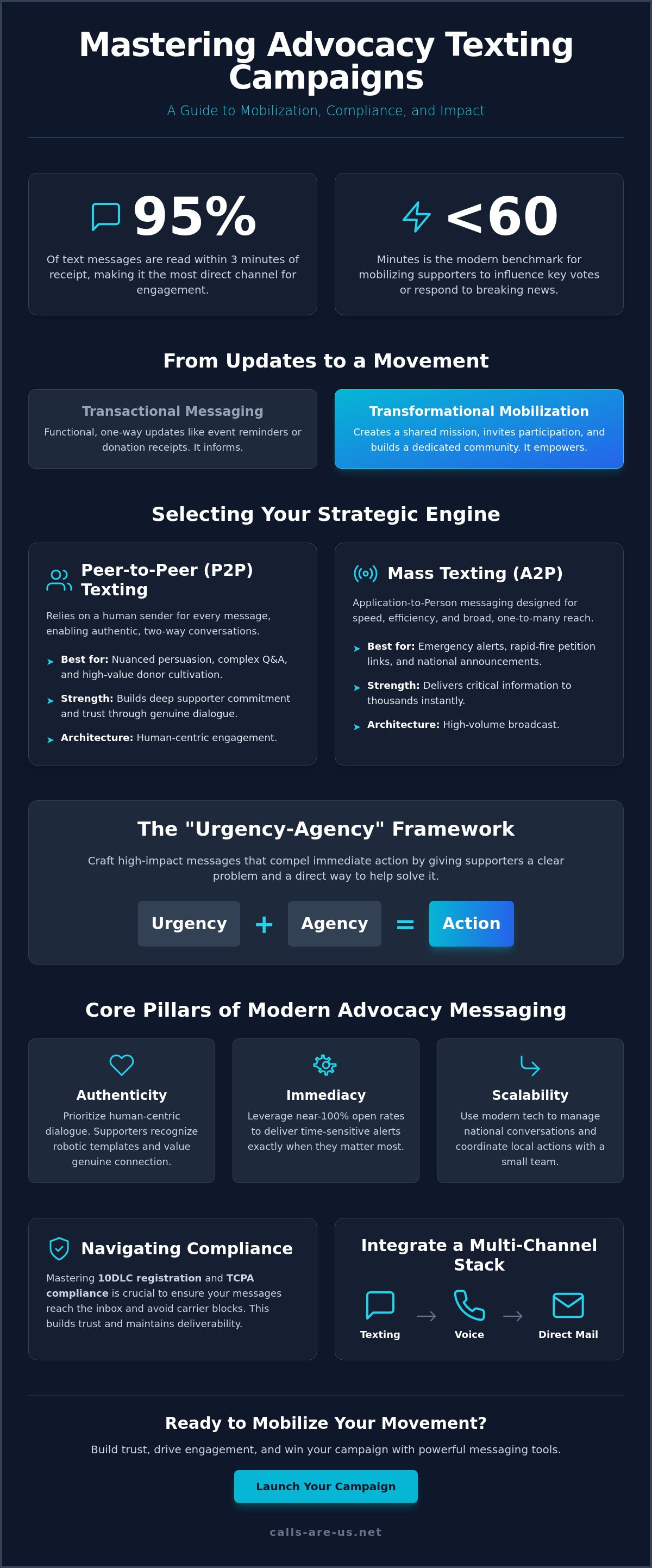
Distinguishing between transactional and transformational messaging is vital for success. Transactional texts are functional, providing donation receipts or event reminders. Transformational mobilization, however, creates a sense of shared mission and agency. It invites supporters to participate in the democratic process, offering them a clear seat at the table. When you move from "telling" to "engaging," you build a movement that sustains itself through meaningful interactions and shared victories.
To better understand this concept, watch this helpful video:
The mobile-first imperative is no longer optional. Texting outpaces email engagement speed by 10x, with 95% of messages being read within three minutes of receipt. In the high-stakes environment of 2026, the benchmark for "high-impact" response times has shifted. Organizations must now be capable of mobilizing thousands of supporters within a sixty-minute window to influence key legislative votes or respond to breaking news events. Speed is the new currency of influence.
The Core Pillars of Modern Advocacy Messaging
Authenticity drives engagement. Supporters can spot a robotic template from a mile away, so your messages must prioritize human-centric dialogue. Immediacy is your greatest asset; you leverage that 98% open rate to deliver time-sensitive alerts exactly when they matter most. Finally, scalability ensures your impact grows. Modern technology allows small, dedicated teams to manage national conversations, coordinate local chapters, and track real-world outcomes without losing the personal touch that defines successful advocacy texting campaigns.
Advocacy vs. Political Texting: The Nuance of Long-Term Influence
Advocacy is a marathon, not a sprint. While the history of political texting is often tied to specific candidate cycles, advocacy focuses on long-term issue education and systemic change. You aren't just looking for a vote on Tuesday; you're building a supporter life cycle that thrives long after the polls close. This trust-building is essential for non-partisan mobilization. By integrating these efforts with tools like political voice broadcasting, you create a multi-layered reinforcement strategy that keeps your cause at the forefront of the public consciousness.
P2P vs. Mass Texting: Selecting the Strategic Engine for Your Mission
Choice defines impact. Selecting between peer-to-peer and mass texting isn't just a technical decision; it's a strategic one that dictates the emotional depth of your advocacy texting campaigns. While both tools deliver messages to a mobile device, their functional architectures serve vastly different goals within a movement's lifecycle. Successful organizations don't choose one over the other; they deploy each where its specific strength creates the most leverage.
Mass texting, often referred to as A2P (Application-to-Person) messaging, is your high-volume engine. It's built for speed, efficiency, and broad reach. Use this for emergency alerts, rapid-fire petition links, or national announcements where every second counts. Conversely, Peer-to-Peer (P2P) texting relies on a human sender for every outgoing message. This architecture allows for the nuanced persuasion, complex Q&A, and high-value donor cultivation that automated systems simply cannot replicate.
The cost-benefit analysis hinges on your specific objectives. While automated delivery offers a lower cost per message segment, it faces stricter carrier scrutiny and requires explicit opt-in consent. Human-powered P2P messaging requires more labor, yet it yields an average response rate of 45%. This high level of engagement often justifies the investment, especially when the goal is building a long-term relationship rather than a one-off action.
Peer-to-Peer Messaging for Deep Advocacy
P2P facilitates genuine two-way conversations that naturally bypass traditional spam filters. Because each message is sent individually, the traffic patterns mirror standard human interaction, which carriers prioritize. This approach empowers your volunteers to act as true movement ambassadors through intuitive mobile interfaces. To ensure your technical framework can handle this human-centric outreach at scale, follow these peer to peer texting best practices for API-driven workflows.
Mass Texting for Rapid Mobilization
When you need to notify 100,000 supporters about a legislative hearing in under ten minutes, mass texting is the only viable path. This method utilizes specialized A2P routes to ensure high-volume delivery without triggering carrier blocks. You must decide between dedicated short codes or 10-digit long codes (10DLC) based on your budget and throughput needs. Comparing P2P vs broadcast texting helps clarify which tool fits your national advocacy goals. Regardless of your choice, staying compliant with the FCC rules for political texts is the only way to safeguard your deliverability. If you're ready to start, you can explore professional texting solutions tailored for high-stakes mobilization.
Crafting the Message: Psychology, Segmentation, and Supporter Agency
Effective communication is a psychological bridge between awareness and action. In high-impact advocacy texting campaigns, you must balance urgency with agency to prevent supporter paralysis. Urgency establishes the immediate threat or opportunity, such as a pending floor vote, while agency provides the specific tool to resolve it. Without a clear path to help, urgency merely leads to anxiety and eventual disengagement. You're not just sending a notification; you're offering your supporters a way to reclaim their power in a complex political environment.
Precision beats volume every time. You shouldn't blast your entire list when a bill only affects a specific legislative district. Segmenting your audience by district, past action history, and interest level ensures your message remains relevant and respected. Sometimes, a text alone isn't enough to convey the gravity of a situation. MMS allows you to include visual assets, such as a short video from a community leader or an infographic showing the impact of a policy change, which can significantly increase conversion rates compared to standard SMS. This visual layer adds an emotional depth that plain text often lacks.
Optimization is a continuous process of refinement. You should constantly A/B test your "ask" to determine which call-to-action resonates most with your specific demographic. Does "Sign the petition" outperform "Join the movement"? Small shifts in language can lead to substantial differences in click-through rates. By testing these variables, you refine your strategy, maximize the ROI of every message sent, and build a more resilient foundation for your advocacy texting campaigns.
The Anatomy of a High-Conversion Advocacy Text
To maximize impact within 160 characters, your message must lead with a compelling hook, define the immediate value of participation, and conclude with a singular, unmistakable action. Personalization must go beyond just using a first name; it should leverage local data to highlight how a specific issue affects the recipient's own neighborhood or local economy. Maintaining list health is equally critical, so ensure your opt-out instructions are transparent, professional, and easy to follow. This clarity respects the supporter's time and fosters long-term trust.
Data-Driven Segmentation for National Campaigns
National movements require surgical precision to remain effective across different time zones and jurisdictions. Moving from a "blast all" mentality to "targeted impact" means using supporter tags to deliver messages that align with individual values and geographic priorities. Integrating your CRM data allows you to synchronize mobile outreach with broader organizational goals, ensuring your advocates never receive redundant or irrelevant requests. Utilizing the right political campaign texting software simplifies this process, allowing you to manage complex audience clusters and track engagement in real-time.
Navigating Compliance: Ensuring Deliverability in the 10DLC Era
Compliance isn't a hurdle; it's a shield. In the high-stakes environment of 2026, advocacy texting campaigns live or die by their reputation with major carriers. Since February 1, 2025, unregistered business SMS traffic has been blocked across all major US networks, making 10DLC registration the absolute gatekeeper of your mission's success. You don't just need to send messages; you need to prove you're a legitimate entity with a validated purpose. The Campaign Registry acts as this central verification hub, confirming your non-profit or advocacy status to ensure your voice isn't silenced by automated filters.
Legal integrity is equally non-negotiable. A new FCC rule effective January 27, 2026, mandates one-to-one consent, which means you must obtain individual permission for your specific brand rather than relying on shared or sold lists. Failure to comply is a significant financial risk, as TCPA penalties range from $500 to $1,500 per violation. With TCPA lawsuits increasing by nearly 27% in early 2026 compared to the same period in 2025, rigorous consent management is your best defense against litigation. Carriers prioritize traffic that demonstrates clear, documented permission, rewarding compliant organizations with higher delivery speeds.
Understanding carrier filtering is the final piece of the deliverability puzzle. Carriers use sophisticated algorithms to identify "spammy" patterns that kill advocacy texting campaigns before they even start. These triggers include high-frequency messaging from unvetted numbers, the use of public link shorteners, and language that mirrors known phishing attempts. By maintaining a high trust score through proper registration and ethical sending habits, you ensure your time-sensitive alerts reach the supporter's inbox instead of the spam folder.
The 10DLC Registration Workflow
Success begins with a structured registration process. You must first register your brand for a one-time fee of approximately $4, followed by a recommended brand vetting fee of $41.50 to avoid low throughput caps. Finally, you verify each specific campaign for a one-time fee of $15. This tripartite structure establishes your credibility, unlocks higher messaging volumes, and protects your outreach from being flagged as unregistered traffic. For more technical depth, refer to our comprehensive guide on mass texting compliance for deep regulatory details.
Maintaining Outreach Integrity
Database hygiene is the backbone of long-term deliverability. You must honor opt-out requests made through "any reasonable method"—including email or voicemail—within 10 business days as required by the April 2025 update. Avoid aggressive language or repetitive "shouting" in all-caps, as these patterns trigger carrier blocks. By monitoring deliverability metrics in real-time, you can identify and resolve carrier filtering issues before they compromise your entire movement. If you're ready to build a secure, high-impact outreach strategy, you can partner with us for compliant texting solutions that protect your mission.
Scaling Impact: Integrating Texting into a Multi-Channel Outreach Stack
Isolation is the enemy of influence. High-impact advocacy texting campaigns reach their full potential only when they serve as the connective tissue of a broader outreach stack. While a single text can spark interest, an integrated campaign ensures that interest translates into sustained action. By weaving mobile messaging into every touchpoint, you create a seamless environment where supporters feel seen, heard, and valued across every channel. This multi-layered approach prevents the "silo effect" that often leads to fragmented messaging and supporter confusion.
Synergy creates strength. When you pair mobile outreach with political voice broadcasting, you provide a high-touch reinforcement that text alone cannot achieve. A voice message adds a layer of human emotion and authority, while a follow-up text provides the immediate, clickable link to take action. This combination respects the supporter's preference for different mediums while significantly increasing the likelihood of a successful conversion. It's about meeting people where they are with the right tool at the right time.
Bridging the digital and physical worlds remains a critical component of mobilization. Texting provides the perfect support for your political direct mail strategy by acting as a real-time notification. You can send an automated text the day a mailer is scheduled to arrive, ensuring your physical assets aren't overlooked in a crowded mailbox. Once the supporter takes action, the "Follow-Up" loop closes the circle by sending an immediate confirmation text. This simple step reinforces the value of their contribution and keeps the momentum moving toward the next goal.
The Integrated Supporter Journey
Data should flow freely between your communication channels to create a unified experience. Interactive Voice Response (IVR) data collection can trigger personalized follow-up texts based on specific caller inputs or survey responses. You should coordinate your live calling efforts with P2P texting to manage persuasion tasks that require a nuanced, human touch. This unified approach is the foundation of a modern mass communication strategy that scales across every device and demographic, ensuring your mission stays top-of-mind for your most valuable advocates.
The Calls-Are-Us Advantage in Advocacy
We provide the high-volume infrastructure required for high-stakes environments where reliability is non-negotiable. Our unified platform manages the complexity of multi-channel outreach, allowing you to synchronize voice, text, and mail from a single command center. We empower your movement with tools that bridge the gap between digital engagement and physical advocacy. By choosing a partner that understands the technical and ethical requirements of 2026, you ensure your advocacy texting campaigns remain unstoppable and your supporters remain deeply engaged in the work that matters most.
Mobilize Your Mission with Precision and Purpose
The mobile landscape is evolving rapidly, yet the core of influence remains rooted in the twin pillars of trust and timing. You've seen how mastering 10DLC compliance and the "Urgency-Agency" framework can turn a simple notification into a powerful catalyst for change. By integrating advocacy texting campaigns into a sophisticated multi-channel stack, you ensure your message resonates across every device and doorstep. It's about building a resilient ecosystem where technology serves the human mission rather than hindering it.
Success in high-stakes public affairs requires more than just a platform. It requires a partner who understands the unique pressure of the moment. With a decade of experience and a proven track record of operating in over 40 states, Calls-Are-Us provides the high-volume voice and text infrastructure your movement needs to scale effectively. Elevate your movement with the authoritative outreach tools at Calls-Are-Us. Your cause deserves a voice that cannot be ignored, and we're ready to help you amplify it. Let's build a more connected and impactful future together.
Frequently Asked Questions
What is the difference between advocacy texting and regular SMS marketing?
Advocacy texting focuses on driving systemic change and public policy influence rather than commercial product sales. While marketing seeks a simple transaction, advocacy texting campaigns aim for transformation by mobilizing supporters around a shared mission or urgent legislative goal. This sophisticated approach prioritizes long-term relationship building, social responsibility, and ethical communication over simple click-through rates or immediate revenue.
Do advocacy texting campaigns require 10DLC registration in 2026?
Yes, 10DLC registration is a mandatory requirement for all business and non-profit SMS traffic as of 2026. Major US carriers began blocking unregistered traffic in early 2025 to protect consumers from unsolicited messages. Completing this registration process is the only way to ensure your messages reach their intended recipients without being flagged as spam. It establishes your brand's legitimacy and unlocks the throughput needed for national mobilization.
How can I prevent my advocacy texts from being filtered by carriers?
Ensuring deliverability requires a combination of proper technical registration and high-quality content. You must register your brand and specific campaigns through the Campaign Registry to establish a high trust score with carriers. Additionally, avoid using public link shorteners or aggressive, all-caps language that triggers carrier algorithms. Consistent database hygiene and honoring opt-outs are essential for maintaining a clean reputation for your advocacy texting campaigns.
Is peer-to-peer (P2P) texting better than mass texting for advocacy?
The choice between peer-to-peer (P2P) and mass texting depends entirely on your specific strategic objectives. P2P is superior for high-stakes persuasion and two-way dialogue, yielding average response rates of 45% through human-powered interaction. Mass texting is the ideal engine for rapid mobilization, delivering time-sensitive alerts and broad announcements to thousands of supporters in minutes. Successful movements often use a hybrid approach to balance speed and depth.
What are the TCPA requirements for sending advocacy text messages?
TCPA compliance hinges on obtaining prior express written consent and providing clear opt-out mechanisms. A significant update in early 2026 mandates one-to-one consent, meaning you cannot share or sell supporter permissions across different organizations. You must also process any opt-out request made through reasonable methods, including email or voicemail, within 10 business days. This rigorous attention to legal detail protects your organization from statutory damages and builds long-term trust.
Can advocacy texting be integrated with direct mail or voice broadcasts?
Texting serves as the vital connective tissue between your digital and physical outreach efforts. You can use automated texts to notify supporters of a direct mail arrival or to follow up on a voice broadcast. This multi-channel approach ensures your mission remains top-of-mind by reinforcing your message across different devices and touchpoints. It creates a "surround sound" effect that makes your advocacy efforts feel more personal, urgent, and pervasive.
How do I measure the ROI of an advocacy texting campaign?
Measure success by tracking real-world actions rather than just digital open rates. Focus on concrete metrics like petition signatures, legislative office calls made, and physical attendance at mobilization events. By linking your texting data to your CRM, you can see exactly how mobile engagement translates into policy influence and supporter growth. This data-driven approach allows you to refine your strategy, optimize your spend, and prove the tangible impact of your work.
What is the best time of day to send advocacy text alerts?
The most effective window for sending alerts is generally between 8 a.m. and 9 p.m. in the recipient's local time zone. For high-impact legislative alerts, mid-day messages often perform best as they align with active government sessions and committee hearings. Always respect "quiet hours" to avoid supporter fatigue and maintain a reputation as a trusted, professional advocate. Timing your messages strategically ensures they are seen when supporters are most ready to act.


Comments