_edited.png)
Automated Message Delivery: The 2026 Strategy for High-Impact Outreach

Most outreach strategies are failing not because of the message, but because they never reach the recipient's screen. You’ve likely felt the frustration of watching high-value campaigns stall due to aggressive carrier filtering or the sheer complexity of managing disjointed channels. It’s a common hurdle for organizations aiming for national influence. To break through the noise, you need a sophisticated approach to automated message delivery that prioritizes both technical precision and human connection.
This guide will empower you to master the technology and strategy behind large-scale messaging to drive meaningful engagement across voice and text. You'll learn how to navigate the strict 2026 regulatory environment, including the FCC’s one-to-one consent rule effective January 26 and the expanded opt-out requirements coming in April. We’ll explore how to integrate mass texting, voice broadcast, and peer-to-peer messaging to create a seamless, compliant, and high-impact outreach engine. By the end of this article, you will understand how to transform your communication from a series of disjointed broadcasts into a unified system that fosters trust, ensures delivery, and achieves measurable results.
Table of Contents
Defining Automated Message Delivery in a Multi-Channel World
Automated message delivery is the programmatic distribution of voice or text content designed to reach massive audiences with surgical precision. It represents the essential infrastructure for modern organizational influence. In 2026, this discipline has matured into a sophisticated ecosystem of voice broadcasting, mass SMS, and interactive response systems. While the early days of digital communication relied on a simple Autoresponder to handle basic replies, modern organizations use these tools to build complex, data-driven engagement workflows. These workflows maintain absolute consistency across national outreach campaigns, ensuring your brand voice remains steady from the first contact to the final follow-up.
Effective outreach is about transformation and facilitation. It's about moving a recipient from a state of unawareness to a state of action through a series of intentional, automated touchpoints. When you treat automated message delivery as a strategic asset rather than a technical chore, you unlock the potential for massive social progress and organizational growth. It's the bridge between a visionary idea and a mobilized community.
To better understand how this technology simplifies outreach in just a few clicks, watch this helpful video:
The Evolution from Robocalls to Intelligent Automation
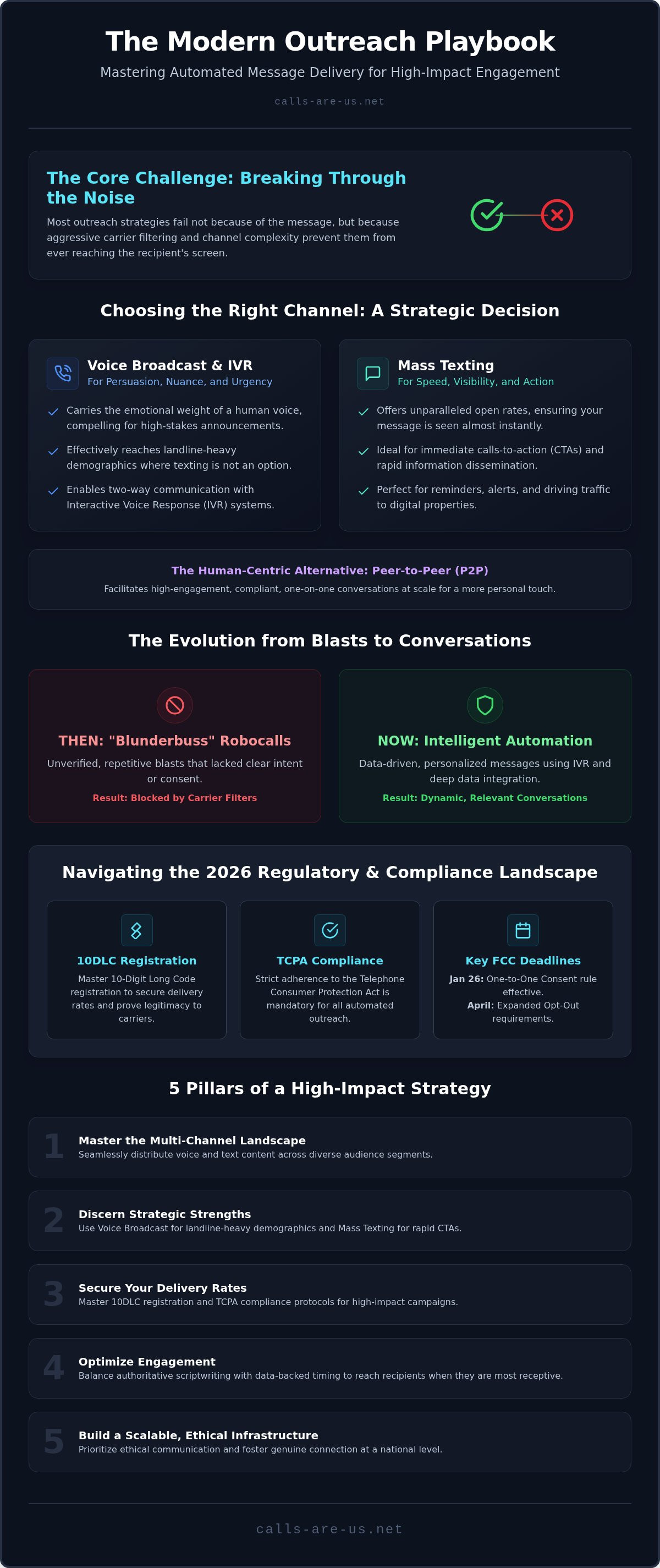
Traditional 'blunderbuss' methods are dead. Modern carriers use advanced filtering to block unverified, repetitive blasts that lack clear intent or consent. This technological wall has forced a shift toward Interactive Voice Response (IVR) systems. These systems facilitate two-way automated communication, allowing recipients to interact, provide data, and route themselves to the right resource. Intelligent automation transforms a cold broadcast into a dynamic conversation. By integrating deep data sets, you can now deliver personalized automated messages at scale, ensuring every interaction feels relevant, timely, and respectful of the recipient's needs.
Why Multi-Modal Infrastructure is Non-Negotiable
True impact requires a presence across every touchpoint. There's a powerful synergy between political voice broadcasting and text outreach that creates a unified brand presence. You must meet your audience where they are, whether that's on their mobile phone, through a text notification, or via a physical mailbox. Multi-modal delivery is the integration of diverse communication channels to ensure message saturation. This approach ensures your message isn't just sent; it's absorbed, remembered, and acted upon. By diversifying your delivery methods, you bypass the limitations of any single channel and build a more resilient outreach strategy.
Comparative Analysis: Voice Broadcast vs. Mass Texting
Choosing the right channel is a strategic decision that defines the success of your campaign. It requires a deep understanding of your audience's habits and the specific outcome you desire. While some organizations view automated message delivery as a singular tool, the most effective leaders recognize it as a specialized toolkit where each channel serves a distinct purpose. Voice Broadcast excels in delivering urgency and nuance; Mass Texting dominates in visibility and speed. Selecting the wrong medium can lead to wasted resources and diminished influence.
Voice Broadcast remains the gold standard for persuasion and reaching demographics that still rely on landline infrastructure. It carries the emotional weight of a human voice, which is often more compelling than a text string during high-stakes organizational announcements. Conversely, Mass Texting offers unparalleled open rates, making it the ideal choice for immediate call-to-action clicks and rapid information dissemination. For those seeking a more personal touch, Peer-to-Peer (P2P) messaging offers a human-centric alternative that facilitates high-engagement, compliant conversations at scale.
When to Prioritize Voice and IVR
Urgency demands a voice. When you need to deliver emergency alerts or critical time-sensitive announcements, the direct nature of a phone call ensures the message is heard immediately. Beyond simple alerts, Interactive Voice Response (IVR) allows you to capture sentiment data through instant polling, turning a one-way broadcast into a source of real-time intelligence. The psychological impact of a professional voice recording fosters a sense of trust and authority that text often lacks. It feels like a partnership rather than a transaction, which is vital for building long-term relationships.
Maximizing Impact with Texting Strategies
Texting is not a monolith. Understanding the strategic nuances of P2P vs broadcast texting is essential for any modern advocacy group or business. P2P messaging provides a compliant path that bypasses many carrier filters by facilitating genuine one-on-one interactions. For broader reach, using short codes can optimize delivery for high-volume campaigns, while 10-digit long codes maintain a local, approachable feel. You can even automate follow-up messages based on how a recipient interacts with your initial text, ensuring your automated message delivery leads to a continuous engagement loop.
Adhering to FCC regulations on automated messages is critical to maintaining your reputation and delivery rates. Non-compliance is not just a legal risk; it's a barrier to connection. If you are looking to refine your multi-channel approach, you might consider how the integrated systems at Calls-Are-Us can simplify this complexity for your team. Selecting the right channel based on your specific goals ensures your outreach is both efficient and impactful.
Navigating the 2026 Regulatory and Compliance Landscape
Compliance is the bedrock of influence. In a world where carrier filters are increasingly sophisticated, adhering to the Telephone Consumer Protection Act (TCPA) is no longer just a legal hurdle; it is a prerequisite for successful automated message delivery. Organizations that prioritize ethical communication build long-term trust, secure their delivery rates, and protect their brand from significant financial liabilities. Achieving this requires a tripartite focus on explicit consent, technical transparency, and rigorous list management.
The regulatory environment shifted significantly on January 26, 2026, when the FCC implemented the "one-to-one consent" rule. This change effectively closed the lead generator loophole, requiring that consent be specific to a single, clearly identified marketer. To maintain a high-impact outreach engine, you must ensure every recipient has intentionally opted into your specific communications. This level of accountability transforms your outreach from a perceived intrusion into a welcomed interaction, fostering a deeper sense of social responsibility and partnership.
10DLC and A2P: The New Standards for Texting
Carriers now utilize AI-driven filtering to identify and block unregistered traffic, making 10-Digit Long Code (10DLC) registration the only viable path for sustained text outreach. This 2026 carrier ecosystem demands that every campaign be vetted and tied to a verified brand identity. Maintaining a clean sender reputation is essential; if your messages are frequently flagged or lack clear opt-out instructions, your deliverability will plummet. You must integrate transparent opt-in and opt-out mechanisms into every workflow, ensuring that your automated message delivery remains a tool for connection rather than a source of frustration. Consistent, high-quality engagement is the only way to bypass the digital gatekeepers of the modern mobile network.
Legal Safety for Voice and Political Outreach
Voice outreach requires an even higher level of technical validation to ensure your calls reach their destination without being marked as "Scam Likely." Implementing Stir/Shaken protocols is non-negotiable, as these digital certificates verify that the caller ID displayed is legitimate and has not been spoofed. For those developing a voter outreach strategy, you must also navigate specific rules regarding automated calling to mobile devices and the management of national "Do Not Call" lists. Federal law mandates that you must clearly state the identity of the person or entity initiating the call at the beginning of every automated voice recording. Adhering to FCC rules on automated messages, including the new revocation of consent standards effective April 11, 2026, ensures that your organization remains a principled guide in the complex world of modern communication.
Best Practices for High-Volume Engagement and Response
Engagement is the currency of influence. In high-stakes outreach, your automated message delivery must bridge the gap between technical efficiency and genuine human connection. Using the "Hook-and-Elaborate" method ensures your audience is captured within the first three seconds and then provided with the substance they need to take the next step. This approach respects the recipient's time while establishing your organization as a credible, authoritative voice that values their attention. High-volume campaigns fail when they feel transactional; they succeed when they feel like the start of a partnership.
Timing is equally critical to your success. Leveraging historical interaction data allows you to hit the "golden window" when recipients are most likely to answer a call or read a text. By integrating these automated touchpoints with live support, you create a seamless user journey that guides a person from a simple notification to a meaningful conversation. This synergy ensures that your automated message delivery acts as a powerful facilitator for deeper, human-centric engagement.
Designing High-Conversion Scripts
A successful 30-second voice broadcast requires a meticulous balance of speed, clarity, and intent. You should avoid the "robotic trap" by employing professional voice talent that reflects the warmth and values of your brand. Natural language and varied inflection foster trust in a way that synthetic voices often cannot. In text messaging, use tripartite structures to build rhythm and impact. For example, grouping three key benefits, such as security, reliability, and ease, creates a sense of comprehensive utility that resonates with the reader and drives them toward your call to action.
Data-Driven Optimization and Reporting
You cannot improve what you don't measure. Tracking delivery rates, open rates, and IVR completion percentages provides the visibility needed to refine your strategy in real-time. Use A/B testing to compare different script variations across national segments to see which specific messaging drives the highest response. These automated responses aren't just numbers; they are actionable insights that can be fed directly into your political campaign call center to empower your live agents. Data allows you to move from guesswork to a position of informed authority.
If you're ready to transform your outreach into a high-performance engagement engine, consult with the experts at Calls-Are-Us to build a custom solution tailored to your goals. Strategic automation combined with human-centric design is the only way to achieve lasting impact in 2026.
Scaling Outreach with the Calls-Are-Us Infrastructure
Scaling a national campaign requires more than just software. It demands a partner who understands the weight of your mission and the complexities of high-stakes influence. A sophisticated mass communication strategy is no longer an optional luxury; it is the essential framework for modern organizational success. At Calls-Are-Us, we move beyond the limits of transactional broadcasting to offer a holistic partnership that prioritizes delivery, compliance, and connection. Our infrastructure is built to facilitate meaningful interactions that drive social progress while maintaining the technical precision required for 2026.
We believe that technology should be a bridge, not a barrier. By choosing a partner committed to ethical, high-impact dialogue, you ensure that your organization's voice is heard with clarity and integrity. Our role is to act as a powerful ally, providing the tools and expertise necessary to navigate the shifting digital landscape. We empower you to foster deeper connections with your audience, turning every touchpoint into an opportunity for transformation and facilitation.
Integrated Solutions for National Organizations
True influence happens when you combine digital speed with the tangible impact of a political direct mail strategy. We have operated in over 40 states, providing the local insight and national scale necessary for high-volume outreach. Our integrated suite allows you to reach recipients through voice broadcast, P2P texting, and physical mailboxes within a single, unified workflow. This multi-modal approach ensures message saturation while our IVR and P2P platforms significantly reduce the technical burden on your internal team. We manage the intricacies of carrier registration and regulatory compliance so you can focus on the core of your mission.
Your Next Steps in Automated Engagement
Your current outreach stack may have hidden gaps in delivery or compliance that are limiting your potential. It is vital to assess your sender reputation and opt-in protocols to ensure your automated message delivery remains uninterrupted. We recommend developing a 90-day roadmap that integrates these automated channels with your broader organizational goals. This roadmap should prioritize three key pillars: technical reliability, ethical transparency, and human-centric design. By aligning your technology with your values, you transform every message into a catalyst for change.
We invite you to consult with a Visionary Partner at Calls-Are-Us to explore how our specialized tools can empower your next campaign. Our commitment to high-impact dialogue and social responsibility makes us a principled guide in the complex world of modern communication. Let us help you build a communication engine that is both technologically savvy and deeply committed to the common good. Your mission deserves a platform that is as ambitious as your vision.
Mastering the Future of Organizational Influence
Success in modern outreach depends on your ability to blend technological speed with human-centric integrity. You have seen how the strategic balance between voice and text, the mastery of the 2026 regulatory landscape, and the application of data-driven best practices create a resilient communication engine. By prioritizing ethical engagement and technical precision, you ensure that your message cuts through the noise to foster genuine connection. A sophisticated strategy for automated message delivery is the essential foundation for any organization aiming to drive meaningful change at scale.
Navigating this complex environment requires a partner who possesses both high-stakes authority and a commitment to your mission. With operational experience in over 40 states and an integrated infrastructure spanning voice, text, and direct mail, Calls-Are-Us provides the sophisticated compliance management and technical weight your campaign demands. We are ready to act as your visionary ally, transforming your goals into measurable results while upholding the highest standards of communication. Empower your organization with Calls-Are-Us automated delivery solutions and take the next step toward high-impact outreach. Your vision for progress is within reach; let's deliver it together.
Frequently Asked Questions
What is the difference between voice broadcast and a robocall?
Voice broadcast is a professional outreach tool used by organizations to deliver pre-recorded messages to recipients who have provided explicit consent. While the term "robocall" often carries a negative connotation associated with unsolicited spam, a compliant voice broadcast follows strict legal protocols. It requires the caller to identify themselves immediately and provides a clear, interactive path for the recipient to opt out of future communications at any time.
How does 10DLC registration affect my organization's texting campaigns?
10DLC registration acts as a digital passport that verifies your brand identity with mobile carriers to ensure high deliverability rates. In the 2026 carrier ecosystem, unregistered traffic is frequently flagged as spam and blocked before it reaches the recipient's screen. By completing this registration with your Business Registration Number, you secure a trusted sender reputation, reduce filtering risks, and gain the ability to send higher volumes of messages.
Can I use automated message delivery for emergency notifications?
Automated message delivery is an ideal solution for emergency notifications due to its ability to reach thousands of people in seconds. Organizations use these systems to broadcast critical safety alerts, weather warnings, and urgent operational updates across both voice and text channels. This multi-modal approach ensures the message is received regardless of the recipient's current device or location, providing a vital layer of security and community support when it matters most.
What are the TCPA requirements for automated voice messages in 2026?
The 2026 TCPA requirements mandate that you obtain specific one-to-one consent for every recipient before initiating an automated call. You must also clearly state the name of the entity or individual responsible for the call at the very beginning of the recording. Additionally, you are required to provide an automated, interactive opt-out mechanism that allows recipients to immediately add themselves to your "Do Not Call" list during the interaction to remain fully compliant.
How do I ensure my automated texts don't get filtered by mobile carriers?
Ensuring your messages reach the screen requires a combination of technical verification and high-quality content. You must use a registered 10DLC or short code and include a mandatory "STOP" to opt-out instruction in every initial outreach. Avoid using excessive capitalization, suspicious link shorteners, or aggressive sales language, as these are common triggers for carrier-level AI filters that protect consumers from intrusive or irrelevant content.
Is it possible to integrate automated messaging with my existing CRM?
Modern platforms for automated message delivery are designed to integrate seamlessly with your existing CRM through robust API connections. This integration allows you to trigger messages based on specific user actions, update contact records in real time, and maintain a unified history of every interaction. By syncing these systems, you eliminate data silos and empower your team to build more personalized, data-driven engagement workflows that respect the recipient's unique journey.
What is the typical response rate for a P2P messaging campaign vs. mass SMS?
P2P messaging typically yields significantly higher response rates because it facilitates a genuine, two-way conversation between a live agent and the recipient. While mass SMS is superior for rapid, large-scale information dissemination, P2P allows for nuanced answers, personal persuasion, and deeper rapport. Organizations often use mass SMS for broad awareness and P2P for high-stakes advocacy where individual engagement, trust, and conversion are the primary goals of the outreach.
Do I need a professional voice actor for my automated voice broadcasts?
Professional voice talent is highly recommended to foster a sense of authority and human-centric warmth in your automated message delivery. While synthetic voices have improved, they often fail to capture the subtle inflections and emotional resonance that build trust with a listener. A professional recording ensures your organization sounds credible, approachable, and deeply committed to the message you are delivering, which directly impacts the overall success and impact of your campaign.



Comments