
Automated Voice Broadcast System: How to Choose and Use One in 2026

Updated: Sep 30
More calls don’t automatically mean more connection. An automated voice broadcast system can help an organization reach many people efficiently, but a message that feels irrelevant, unclear, or impersonal may be ignored. To make each call useful, match the message to the audience and give recipients a clear next step.
If you’re deciding whether automated calls suit your outreach, or comparing software with a managed service, start with the response you need. The right approach depends on your purpose, your audience, and whether recipients need to hear information, make a selection, or talk with someone. Automation can extend your reach, but it still requires thoughtful planning and a message written for people, not just a calling list.
This guide explains how voice broadcasting works, where it can help, and what to compare when evaluating an approach. You’ll learn how voice broadcasts and interactive voice response (IVR) can support outreach and response collection, then follow a practical workflow for planning, measuring, and refining calls responsibly. The goal isn’t simply to dial more numbers. It’s to make each call clear, relevant, and worth answering.
Table of Contents
What Is an Automated Voice Broadcast System, and What Can It Do?
An automated voice broadcast system sends a recorded phone message to a selected list of recipients, often at a planned time. Organizations use it to share announcements, conduct outreach, send reminders, or invite people to provide information. The system distributes the message at scale. The content and response options determine whether the call feels clear and useful to the recipient.
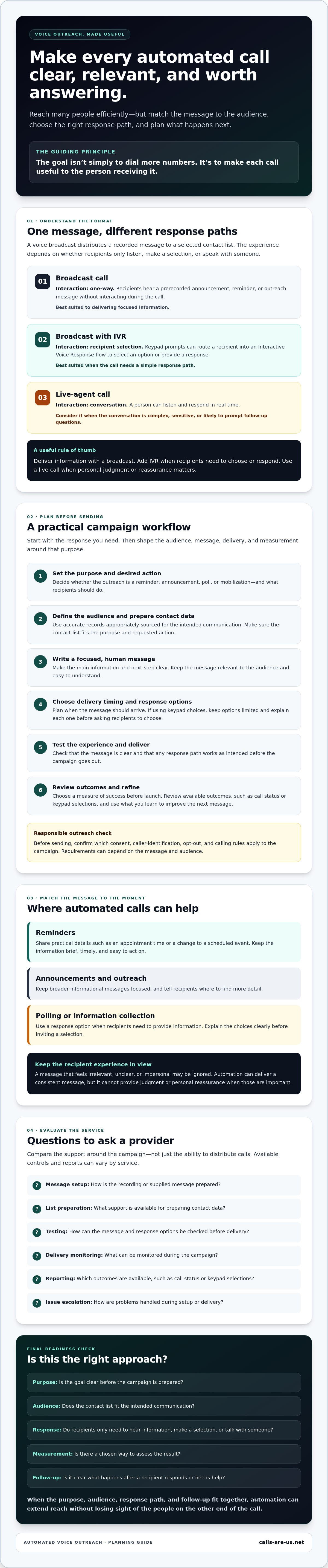
A basic broadcast is one-way: recipients hear the message but don’t interact during the call. Some campaigns include keypad options that lead into an Interactive Voice Response (IVR) flow, where recipients select from prompts or provide a response. A live-agent call offers a different experience because a person can listen and respond in real time. This distinction matters when deciding whether you need to deliver an announcement or support a conversation. For a neutral overview of the technology and its applications, see Voice broadcasting.
How does an automated voice broadcast work?
The process begins with contact data prepared for the intended outreach. The organization defines the audience, records or supplies a message, chooses delivery timing, and plans any response options. The provider or service setup then distributes the calls and may capture outcomes such as keypad selections or call status. Ask which controls and reports are available for the specific service and campaign, since these can vary.
If a message includes keypad choices, a recipient’s selection can direct them into an IVR workflow. For example, an announcement might offer one key to hear information again and another to continue to a response menu. Keep the options limited and explain each one before asking recipients to choose.
When are automated reminder calls a good fit?
Reminder calls can help organizations share practical details with opted-in or otherwise eligible contacts, such as an appointment time or a change to a scheduled event. They work best when the information is brief, timely, and easy to act on. For a time-sensitive announcement, make the main update and next step clear near the start. For broader informational outreach, keep the message focused and tell recipients where to find more detail.
Choose a live call when the conversation is complex, sensitive, or likely to prompt follow-up questions. Automation can deliver a consistent message, but it can’t provide judgment or personal reassurance when those are important.
Plan Automated Voice Broadcasts: Audience to Follow-Up
A reliable broadcast starts before anyone presses “launch.” Define the purpose, match the contact list to that purpose, write a focused message, test the experience, deliver it, and review the results. An automated voice broadcast system can distribute a message, but careful planning helps make the outreach relevant to the people receiving it.
Before building a campaign, write down four things: who you need to reach, what you want them to do, when the message should arrive, and how you’ll assess the result. A reminder might aim to help recipients confirm an appointment, while a poll might ask for a keypad response. Each goal calls for a suitable audience, message, response path, and measure.
Prepare contact data and a clear call objective
Use accurate contact records that are appropriately sourced for the intended communication. Outdated or mismatched details can frustrate recipients and undermine delivery. Decide whether the campaign is for a reminder, announcement, polling, or mobilization before selecting contacts. Then make sure the list and requested action are consistent with that purpose.
Before sending, confirm which consent, caller-identification, opt-out, and calling rules apply to your campaign. Requirements can depend on the message and audience, so seek qualified guidance and consult the FCC rules on robocalls rather than assuming one checklist applies to every situation.
Write, test, and measure the voice message
Get to the point quickly. Identify your organization, explain why you’re calling, and deliver one primary message in plain language. Close with a simple next step, such as a clear keypad choice or directions for finding more information. Avoid combining several requests in one call. Recipients should understand the message without needing to replay it.
Review the recording for clarity and tone, then test the experience before expanding delivery to the full audience. Check that names, dates, prompts, and response paths work as intended. After launch, review delivery, response, and completion reports where available. Use what you learn to refine the next campaign, rather than relying on a benchmark that may not fit your audience or objective.
Define: Set the goal, audience, desired action, timing, and success measure.
Prepare: Check contact accuracy, appropriate sourcing, and applicable requirements.
Create and test: Record one clear message and verify it with a test.
Launch and review: Deliver the campaign, assess available reports, and adjust follow-up.
A successful broadcast is relevant to its audience, clear in its message, and measured against its goal. If managed support would help you plan voice outreach, review Calls-Are-Us voice broadcast services as one option.
Automated Voice Broadcast vs. IVR and Live Calling: Which Fits?
Choose a channel based on the response you need, not just the number of people you want to reach. An automated voice broadcast system delivers a consistent recorded message; IVR, live calls, and texting offer different ways to respond. The right mix depends on the purpose, complexity, and recipient experience you want to support.
When does one-way voice broadcasting make sense?
Use a broadcast call when the core information is brief, consistent, and useful to everyone on the selected list. An appointment reminder or organization-wide announcement may work well when each recipient needs the same details. A recording keeps the message consistent, but it can’t answer unexpected questions. If recipients may need reassurance or sensitive information, plan an interactive or human response path rather than leaving them without a next step.
When should you add IVR, live agents, or another channel?
Add IVR when recipients need to make structured choices, such as selecting a response by keypad. Choose live-agent calls when context, clarification, or rapport matters more than uniform delivery. A follow-up text can complement a call when a written reminder or reply option better suits the next step. Don’t assume everyone prefers the same format. Choose channels based on the task and audience.
For campaign-specific considerations, see this guide to political voice broadcasting. For sales campaigns, review the FTC's Telemarketing Sales Rule and seek qualified guidance on which requirements apply to your outreach.
How to Evaluate an Automated Voice Broadcast Provider
The right provider should make responsibilities clear before a campaign begins. Compare more than features. Find out who prepares the list, sets up the message, monitors delivery, handles responses, and addresses problems. An automated voice broadcast system is only as useful as the workflow and support behind it.
Questions to ask before selecting a provider
Ask what the provider manages and what your organization must supply, approve, or monitor. A managed service may suit a team looking for hands-on campaign support, while a software platform may fit better when internal staff can manage setup and delivery. Confirm who is responsible at each stage instead of assuming how the work is divided.
Campaign support: Who helps prepare contact data, configure delivery, and confirm the campaign is ready?
Message setup and testing: How can you review the recording, prompts, and response path before launch?
Delivery monitoring: What delivery or call-status information is available, and when can you review it?
Response handling: How are keypad selections or other responses captured, and who follows up?
Issue escalation: Whom should your team contact if a message, list, or delivery issue arises?
Data and responsibilities: How is contact information handled, and which compliance responsibilities remain with your organization?
Request clear answers in writing, including details about the reports available for the specific service you’re considering. Don’t assume every provider offers the same controls or reporting.
How to assess fit for your organization
Start with your campaign’s complexity and your team’s capacity. A straightforward announcement may need a different level of support than an outreach effort with multiple response paths. Confirm whether IVR or live-agent follow-up is available if recipients may need to respond, ask questions, or speak with someone. Calls-Are-Us offers voice broadcasting and IVR services, rather than presenting itself here as a standalone software platform.
Separate essential capabilities from optional channels. If your plan calls for voice outreach only, prioritize message setup and delivery support. If coordinated contact across channels matters, consider whether texting or direct mail suits your audience and workflow. The mass communication strategy guide offers broader context for planning coordinated outreach.
Treat performance claims as evidence to validate, not promised outcomes. Ask what results the provider is describing, how they were measured, and whether they relate to a campaign like yours. A good fit aligns with your audience, internal capacity, and response needs. To assess managed support, explore Calls-Are-Us voice broadcast services.
Launch Responsibly With Calls-Are-Us Voice Broadcast Support
A well-planned campaign starts with a clear purpose and ends with a review of what happened. Before choosing an automated voice broadcast system or managed service, check that the audience, message, response path, and measurement plan work together. The technology supports outreach, but your choices shape whether a call is relevant and useful to recipients.
What to prepare before discussing a campaign
Bring a short campaign brief to the conversation. It can clarify what you need and help you assess whether voice broadcasting or another service fits. Include:
Objective and audience: What should the outreach accomplish, and who is it intended for?
Draft message and timing: What should recipients hear, and when should delivery take place?
Response path: Should recipients respond by keypad, speak with an agent, or take another action?
Questions for the provider: Ask about contact data preparation, available delivery reporting, testing, and how applicable compliance responsibilities will be reviewed.
Your draft doesn’t need to be final. It should make the purpose, key information, and requested action easy to understand. Confirm who reviews and approves the message before delivery, and ask what information the provider needs from your organization.
Choose a service path that supports meaningful contact
Calls-Are-Us offers voice broadcasting and Interactive Voice Response (IVR) for organizations to assess against their outreach needs. High-volume voice broadcasting may suit a clearly defined task where recipients need consistent information. If recipients need to make structured selections, IVR may support that response path. If questions call for a person’s judgment or a more individual exchange, consider live calling instead.
Other channels can complement a voice campaign when they serve a clear purpose. Peer-to-peer texting or mass texting may offer a written way to share information or invite a reply, while direct mail can support outreach that benefits from a physical format. Meanwhile, if your organization also broadcasts ongoing audio content or community programming, you can explore Internet Radio Hosting Subscriptions to stream over the web. These options aren’t necessary for every campaign. Choose based on the audience, objective, and follow-up plan.
Before launch, confirm the audience and purpose, review the message, test the response path, and decide how you’ll assess the results. Calls-Are-Us can help you explore whether voice broadcasting, IVR, or another listed service fits your plan. Discuss voice broadcast options with the team when you’re ready to consider the right path for your organization.
Make Your Next Outreach Call Count
Effective voice outreach starts with a clear purpose, a well-matched audience, and a response path suited to what recipients need. An automated voice broadcast system can deliver consistent information at scale, while IVR or live calling can add interaction when the situation calls for it. Compare providers by the support, reporting, and responsibilities they clearly explain, then test your workflow before expanding a campaign.
Calls-Are-Us provides voice broadcasting and IVR as core services and serves organizations nationally across the United States. These services may suit teams looking for support with outreach operations rather than software alone. The right fit depends on your audience, campaign goals, and internal capacity.
If you’re ready to explore whether voice broadcast support fits your outreach plan, discuss your voice broadcast needs with Calls-Are-Us. Start with your audience, message, and desired response, then discuss which service path fits your organization.
Frequently Asked Questions
What is an automated voice broadcast system?
An automated voice broadcast system delivers prerecorded phone messages to a selected contact list without requiring an agent to make each call individually. Organizations may use it to share announcements, reminders, or outreach messages consistently. Depending on the service setup, recipients may hear a one-way message or respond using keypad options. If the message requires conversation or personal judgment, a live-agent call may be a better fit.
How does an automated voice broadcast system work?
An organization prepares contact records for its outreach, creates or records a message, and arranges when calls should be delivered. The provider or service setup distributes the message and may report delivery details or responses, depending on available features. Some campaigns include keypad prompts that lead into an Interactive Voice Response (IVR) flow. Before launch, clarify how lists, testing, response handling, and reporting will work.
Can automated voice broadcasts be used for appointment reminders?
Yes. Organizations can use voice broadcasts to remind opted-in or otherwise eligible contacts about appointments, provided the message and calling approach suit the audience and purpose. Keep the call brief, identify the organization, state the relevant appointment information, and explain any next step. If recipients may need to reschedule or ask questions, provide a suitable response path, such as an IVR option or a way to reach a person.
When should an organization use IVR instead of a prerecorded broadcast?
Use a prerecorded broadcast when recipients mainly need to hear the same concise information. Choose IVR when they need to make structured choices or provide a response, such as selecting a keypad option after an announcement. IVR can collect defined inputs, but it may not suit questions that need explanation or empathy. For complex or sensitive conversations, consider a live-agent call or a clear route to human assistance.
How do I choose an automated voice broadcast provider?
Compare the provider’s campaign support, message setup, testing process, delivery monitoring, response handling, and reporting. Ask what your organization must supply or approve, how contact data is handled, and how issues are escalated. Confirm whether IVR or live-agent follow-up is available if your workflow needs it. Evaluate performance claims carefully and ask what evidence supports them rather than treating results as guaranteed.
Are automated voice broadcast calls subject to calling regulations?
They may be. Requirements can depend on factors such as the message, recipient, and calling context, so don’t assume one rule applies to every campaign. Before launching, have qualified guidance review applicable consent, identification, opt-out, and calling requirements. The Federal Communications Commission’s consumer guidance on unwanted calls can be a useful starting point, but it isn’t a substitute for advice about your specific outreach.
Can automated voice broadcasts connect recipients with a live agent?
That may be possible, but it depends on the provider’s service setup and the campaign workflow. Ask whether a keypad response can route a recipient into IVR or to a live agent, and confirm how that handoff is managed. Calls-Are-Us lists voice broadcasting, IVR, and a Live Calling Center among its services. Confirm directly which response paths are available for the outreach you’re planning.



Comments