_edited.png)
Avoid SMS Filtering: 2026 Guide to Campaign Deliverability

Updated: Oct 1
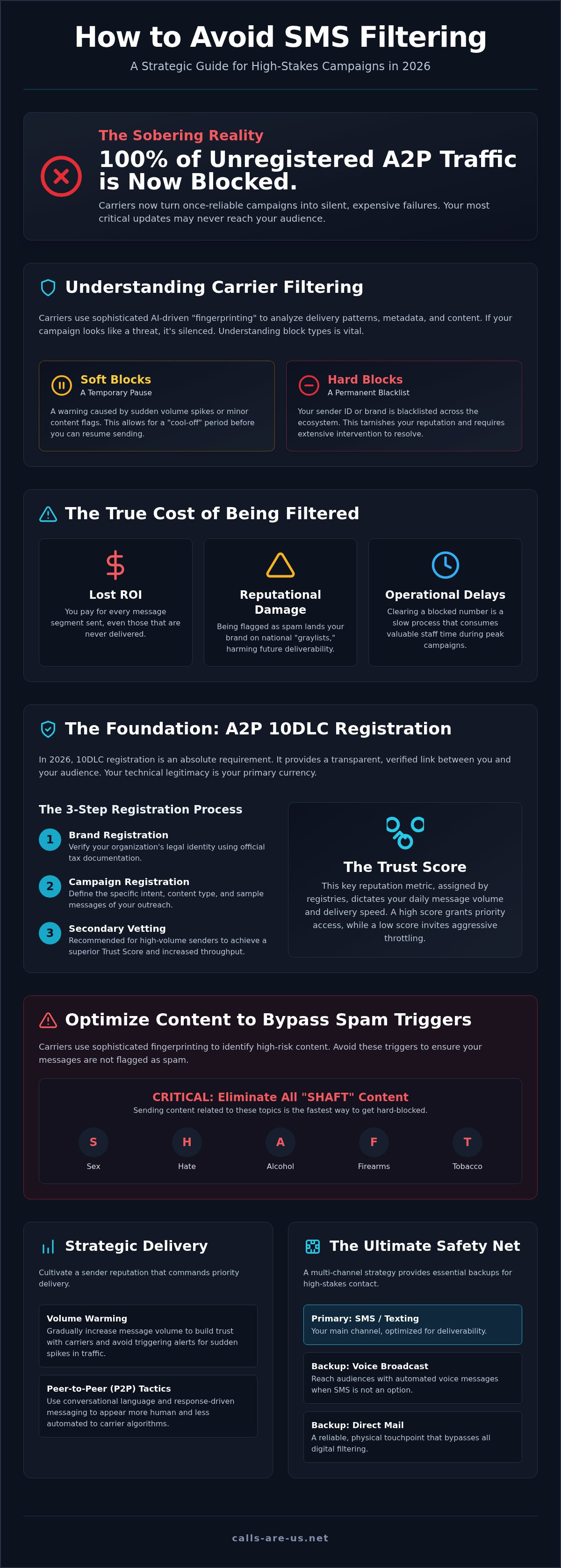
Carriers now block 100% of unregistered A2P traffic, turning once-reliable campaigns into silent, expensive failures. It's a sobering reality for high-stakes operations; if you haven't mastered how to avoid SMS filtering, your most critical updates are likely being incinerated before they reach a voter's pocket. You've likely felt the frustration of a wasted budget, the confusion of shifting regulations, and the sting of a missed connection. We understand that behind every blocked message is a lost opportunity for meaningful progress.
This guide provides the technical clarity and strategic foresight you need to reclaim your outreach momentum. You'll master the sophisticated protocols required to ensure your messages bypass automated filters and land exactly where they belong. We will break down the mandatory registration steps, explore content shifts that build trust, and examine how a multi-channel approach serves as the ultimate safety net for your strategy. It's time to transform your communication from a risky gamble into a precise, high-impact tool for change.
Table of Contents
Understanding Carrier Filtering in the 2026 Messaging Landscape
Carrier filtering is the invisible wall between your campaign and your audience. It is an automated, real-time defensive mechanism where telecommunications providers analyze and intercept messages before they ever reach a mobile device. In 2026, this process has evolved from simple keyword lists into sophisticated AI-driven "fingerprinting." These algorithms scrutinize delivery patterns, metadata, and semantic intent across national networks to identify anomalies. If your campaign looks like a threat, it is silenced. Understanding this logic is the first step in learning how to avoid SMS filtering and maintaining your influence.
Distinguishing between block types is vital for any campaign director. Soft blocks are temporary pauses; they are often the result of sudden spikes in volume or minor content flags. These act as a warning, allowing for a "cool-off" period. Conversely, hard blocks are a permanent blacklisting of your sender ID or brand. Once you're hard-blocked, your reputation is tarnished across the entire ecosystem; this often requires extensive manual intervention to resolve. Political and national campaigns face the highest levels of scrutiny because their messages are high-volume, time-sensitive, and frequently reported by users.
Why Carriers Filter: Protection vs. Suppression
Carriers prioritize the user experience above all else. Their primary goal is to prevent churn by shielding customers from intrusive or deceptive content. The CTIA (Cellular Telecommunications Industry Association) sets the rigorous standards that define what is messaging spam and how legitimate traffic should behave. By filtering, carriers protect their networks from "smishing" attacks and unauthorized political outreach that could lead to legal liabilities or regulatory fines. They aren't trying to suppress your message; they are trying to preserve the integrity of the medium.
The True Cost of Being Filtered
The consequences of a filtered campaign extend far beyond a missed notification. It creates a ripple effect of wasted resources and lost momentum.
Lost ROI: You pay for every message segment sent, regardless of whether it was delivered to a voter or incinerated by a carrier filter.
Reputational Damage: Being flagged as a spammer can land your brand on national "graylists," making it harder for future messages to get through.
Operational Delays: Clearing a blocked number is a methodical, slow process that consumes valuable staff time during the peak of a campaign.
Mastering how to avoid SMS filtering ensures your budget is an investment, not a donation to a carrier's discard pile. By building a compliance-first architecture, you protect your ability to connect with voters when it matters most.
The Foundation of Deliverability: 10DLC and Explicit Opt-In
Compliance is the architecture of modern influence. In 2026, 10DLC registration has shifted from a recommended practice to an absolute requirement for any campaign that values its voice. Carriers no longer tolerate "gray route" traffic; instead, they demand a transparent, verified link between a sender and their audience. If you are strategizing on how to avoid SMS filtering, you must first accept that your technical legitimacy is your primary currency. Without a registered brand and a vetted campaign, your messages will be blocked with 100% certainty across all major U.S. networks.
Central to this ecosystem is the "Trust Score." This reputation metric, assigned by carrier registries, dictates your daily message volume and delivery speed. A high score grants you priority access to the network, while a low score invites aggressive throttling. To maintain a high standing, you must provide a clear Privacy Policy that explicitly details your SMS usage. Vague promises or hidden clauses won't pass modern audits. Your digital footprint must reflect a commitment to ethical communication, professional standards, and voter privacy.
Navigating A2P 10DLC Registration
The Non-Negotiable Rule of Explicit Consent
Consent is the bedrock of deliverability. Under 2026 standards, "Express Written Consent" must be documented, timestamped, and easily retrievable. Carriers now employ zero-tolerance policies for missing or vague opt-in records. Purchased lists are an immediate trigger for filtering because they inevitably lead to high complaint rates and "STOP" replies. These negative signals alert algorithms to potential abuse, often resulting in a permanent hard block. The FCC's text blocking rules have empowered carriers to take decisive action against any traffic that lacks a clear audit trail of permission.
Your digital opt-in forms must be beyond reproach. Use clear, unchecked boxes and provide immediate "HELP" and "STOP" instructions in your initial contact. This transparency builds trust with both the carrier and the voter. If you're managing complex lists, our P2P messaging strategies can help you maintain high engagement while adhering to these rigorous compliance standards. By prioritizing permission over reach, you ensure that every message sent is a message welcomed.
Optimizing Content to Bypass Automated Spam Triggers
Content is the final checkpoint. Even with perfect 10DLC registration, the actual substance of your message can still trigger a carrier's defensive algorithms. These systems perform real-time semantic analysis to distinguish between a trusted update and a malicious intrusion. If you are refining your strategy on how to avoid SMS filtering, you must treat your copy with the same technical precision as your registration. Your goal is to prove value, establish identity, and demonstrate human intent within the first 160 characters of every interaction.
Certain topics act as immediate "tripwires" for carrier networks. The industry utilizes the "SHAFT" acronym-Sex, Hate, Alcohol, Firearms, and Tobacco-to categorize content that is blocked at the gateway regardless of consent. Beyond these obvious restrictions, carriers look for "spammy" syntax that mimics known fraudulent patterns. Using excessive emojis, stringing together multiple exclamation points, or writing in ALL CAPS alerts AI-driven filters that your message lacks professional integrity. High-volume batches require human-like variability; sending identical text to 50,000 people simultaneously is a hallmark of bot behavior that invites a hard block.
The Hidden Danger of Public Link Shorteners
Public link shorteners like bit.ly or tinyurl are a primary target for carrier scrutiny. Because these services mask the final destination, they are frequently exploited by bad actors to hide malicious redirects. Carriers often block these generic domains entirely to protect their users from lack of transparency. The solution is to utilize branded, dedicated domains that match your organization's identity. A custom shortener provides a clear audit trail, ensures your link preview doesn't trigger "malicious site" filters, and reinforces your brand authority with every click.
Formatting for Humans, Not Bots
Structure your messages to prioritize clarity and recognition. Avoid "naked links" that appear without context; always surround your URLs with descriptive, relevant text that explains exactly what the recipient is clicking. To maintain a high delivery reputation, rotate your message templates frequently. This variability prevents "identical content" flags across massive sends and keeps your engagement rates high. Most importantly, include a clear, recognizable sender name in the very first sentence. When a voter knows exactly who is reaching out, they are less likely to report the message as spam, which is the single most important factor in how to avoid SMS filtering at the network level.
Strategic Delivery: Volume Management and P2P Tactics
Strategy dictates success. While content and registration form the foundation, your delivery cadence determines whether carriers view you as a trusted partner or a disruptive bot. Learning how to avoid SMS filtering at scale requires a deep understanding of behavioral velocity. Carriers monitor the speed and volume of your traffic; sudden bursts of millions of messages from a fresh number are the most common indicator of unauthorized activity. To protect your campaign's voice, you must adopt a methodical approach to volume management, real-time monitoring, and human-centric delivery.
Monitoring is your early warning system. You should track delivery rates, error codes, and opt-out percentages in real-time across every major carrier. If you see a sudden drop in throughput on a specific network, it's a signal that your content or volume has triggered a localized filter. This data-driven approach allows you to pivot instantly, whether that means rotating your message templates, slowing your send speed, or switching to a different outreach channel. In addition, when technical teams need to verify new campaign platforms or test code delivery across different regions without using personal SIMs, resources like RentalNumbers.com provide disposable numbers for verification. High-stakes campaigns cannot afford to fly blind; they require a sophisticated dashboard that provides total visibility into the network’s response.
Warming Up Your Sender Reputation
Trust is earned incrementally. Volume warming is the tactical process of gradually increasing your send rates over a 7 to 14 day period. Start by messaging your most engaged "warm" leads-those who have recently opted in or interacted with your brand-to establish a high response-to-send ratio. This positive engagement signal tells carrier algorithms that your traffic is expected and valued. A high opt-out rate is the fastest way to trigger a carrier-level block. By scaling slowly, you allow the network to recognize your traffic patterns as legitimate, high-integrity communication rather than a sudden spam attack.
Leveraging P2P Messaging for High-Stakes Outreach
Human interaction remains the gold standard for deliverability. Peer-to-Peer (P2P) texting offers a unique strategic advantage by mimicking organic human behavior. Because each message is sent individually by a real person, it bypasses many of the automated filters designed to catch mass-automated blasts. This is particularly effective for voter persuasion and "Get Out The Vote" (GOTV) efforts where nuance and personal connection are paramount. Managing a volunteer team requires strict oversight to ensure every interaction remains compliant with your registered campaign intent. You can empower your advocates, foster genuine connections, and protect your sender reputation simultaneously. If you're ready to secure your outreach, explore our high-deliverability P2P solutions today.
Partnering for Reliable National Outreach with Calls-Are-Us
Technical mastery is only half the battle. While understanding the mechanics of delivery is essential, high-stakes advocacy requires a partner who can translate those protocols into a cohesive mass communication strategy. At Calls-Are-Us, we act as your authoritative visionary in a world of shifting carrier logic. We take the heavy technical burden of 10DLC registration, secondary vetting, and compliance audits off your shoulders. This allows your team to stop troubleshooting error codes and start focusing on the mission that actually matters. We don't just provide a platform; we provide a principled path to high-impact connection.
Reliability is built on expertise and vigilance. Our team has operated at the highest levels of influence, and we bring that seasoned perspective to every campaign we support. If you are struggling with how to avoid SMS filtering during critical windows, we offer the real-time monitoring and strategic adjustments necessary to keep your lines open. We understand that behind every data point is a real person you need to reach. By merging technologically savvy workflows with a deep commitment to ethical communication, we ensure your outreach remains both powerful and professional.
Integrated Multi-Channel Resilience
True resilience requires more than a single digital channel. Even the most optimized text campaign can encounter unexpected network congestion or localized carrier pauses. To mitigate this risk, we leverage a multi-channel approach that creates a unified communication loop. You can use political voice broadcasting to reinforce your text messages, creating a multi-sensory touchpoint that increases recognition. For your most critical announcements, the tactile reliability of direct mail serves as the ultimate safety net, ensuring 100% reach even when digital noise is at its peak. This integrated strategy ensures your voice is never silenced by a single bottleneck.
Expert Guidance for High-Volume Success
Data should drive your decisions, not just your reports. Our platform provides sophisticated, real-time analytics that offer a clear window into your deliverability across every national network. We offer dedicated support to help you navigate the 2026 regulatory landscape, providing the foresight needed to pivot before issues escalate. We've mastered how to avoid SMS filtering at scale so that you don't have to. It's time to transform your outreach from a technical gamble into a precise instrument for social progress. Scale your outreach with confidence-Contact Calls-Are-Us today.
Securing Your Message in a Compliance-First Era
Carrier logic is no longer a mystery to be solved; it is a rigorous standard to be met. Success in 2026 relies on a foundation of technical legitimacy, content that prioritizes the voter experience, and strategic delivery rhythms. You now have the essential roadmap for how to avoid SMS filtering by combining 10DLC registration with sophisticated P2P outreach. By rotating templates, utilizing branded domains, and monitoring real-time logs, you ensure your voice remains audible above the digital noise.
You don't have to navigate this complex regulatory landscape alone. Calls-Are-Us brings industry-leading 10DLC compliance expertise and multi-channel outreach integration to your high-stakes mission. Trusted by national organizations in over 40 states, we manage the technical hurdles so you can focus on your broader goals. Ensure your messages reach every voter-Partner with Calls-Are-Us. Your impact is too important to be left to chance. With the right partnership, your communication will be clear, consistent, and unstoppable.
Frequently Asked Questions
What is the primary reason my campaign texts are being filtered?
Failure to register your brand is the primary cause of filtering. As of 2026, carriers block 100% of unregistered A2P traffic to protect their users. Beyond registration, high opt-out rates and "spammy" content triggers like all-caps or SHAFT keywords signal that your messages are intrusive. If your campaign deviates from professional, expected communication patterns, it'll face immediate interception by automated network defenses.
Is 10DLC registration mandatory for political campaigns in 2026?
Registration is an absolute requirement for all political and advocacy campaigns. Carriers have implemented mandatory 10DLC registration to prevent unauthorized spam and protect network integrity. To ensure your voice is heard, you must verify your organization's legal identity and register every specific campaign use case. This transparency is the only way to secure high throughput and avoid being silenced by national carriers.
Can I use link shorteners like Bitly in my campaign texts?
You should avoid public link shorteners because they're frequently flagged as high-risk for smishing attacks. These generic links hide the final destination, which triggers automated filters designed to protect users from deceptive content. Instead, use a branded, dedicated domain that matches your organization's name. A custom shortener builds trust with both the carrier and the recipient while ensuring your links remain functional.
How do carriers identify a message as spam?
Carriers utilize AI fingerprinting to analyze message patterns and semantic intent in real-time. They look for high-velocity bursts of identical text, "spammy" syntax like excessive emojis, and links to unverified domains. Additionally, if a high percentage of recipients report your message as junk, your brand will suffer a permanent hard block. Maintaining a clean sender reputation is the only way to stay off carrier graylists.
What is the difference between P2P and Mass Texting deliverability?
P2P messaging offers superior deliverability because it mimics organic human interaction. This one-to-one behavior is less likely to trigger the automated filters that target mass-automated blasts. While mass texting is efficient for broad alerts, P2P is the strategic choice for high-stakes persuasion. It allows you to bypass many bot-detection algorithms while fostering genuine, high-engagement connections with your audience.
What should I do if my number is blacklisted by a carrier?
You must immediately pause your campaign and investigate the specific trigger for the block. This often involves checking for high opt-out rates or content flags that violate carrier standards. You may need to appeal through your provider or rotate to a fresh, vetted number once you've corrected the compliance issues. Proactive monitoring is the best way to learn how to avoid SMS filtering before it halts your momentum.
Does including 'STOP to opt-out' actually help with filtering?
Opt-out instructions like "STOP to end" are a mandatory requirement that significantly improves your deliverability. Carriers look for these keywords to verify that you're respecting user consent and federal regulations. Providing a clear way to opt-out reduces the likelihood that a recipient will manually report your message as spam. This protects your long-term sender reputation and ensures your traffic remains in the "trusted" category.
How many texts can I send per day without being flagged?
Your daily send limit is dictated by your 10DLC Trust Score rather than a single fixed number. High-vetted brands can send hundreds of thousands of messages, while new or low-score brands face strict daily caps. Learning how to avoid SMS filtering involves gradually warming your volume over two weeks. This proves to carriers that your traffic is legitimate, consistent, and welcomed by your recipients.



Comments