
Avoiding Campaign Communication Mistakes: A 2026 Checklist

A campaign can send the right message through the wrong channel, to the wrong audience, at the wrong moment. Avoiding campaign communication mistakes starts before the first call, text, or mail piece goes out: audience, message, channel, and follow-up need to work from the same plan.
Inconsistent information, late outreach, and feedback that goes nowhere can quickly create uncertainty. A channel list alone won’t prevent those problems. You need a practical way to catch gaps before launch and make informed adjustments once responses come in.
This 2026 checklist helps you set clear goals, match channels to audience needs, coordinate automated and live outreach, and build in compliance and measurement checks. It also explains how voice broadcasting, peer-to-peer and mass texting, live calling, IVR, polling, and direct mail can support a coordinated effort when each has a deliberate role. Use the steps to spot planning and execution gaps, learn from responses, and keep every touchpoint aligned with clear goals and consistent information.
Table of Contents
Where campaign communication mistakes begin: goals, audiences, and ownership
Start with six decisions: define the outcome, audience, message, channel, owner, and measure. If one is missing, the campaign can drift. Teams may send communications without knowing whom they are for, what action they support, or how to assess whether they worked.
A goal such as “get the word out” doesn’t say what people should know or do. That can lead to broad, unfocused messages and busy outreach schedules with no useful way to assess their value. A deliberate communication strategy connects the audience, message, and channels to a defined purpose. The mass communication strategy guide offers a broader planning framework.
Set one clear communication objective before choosing channels
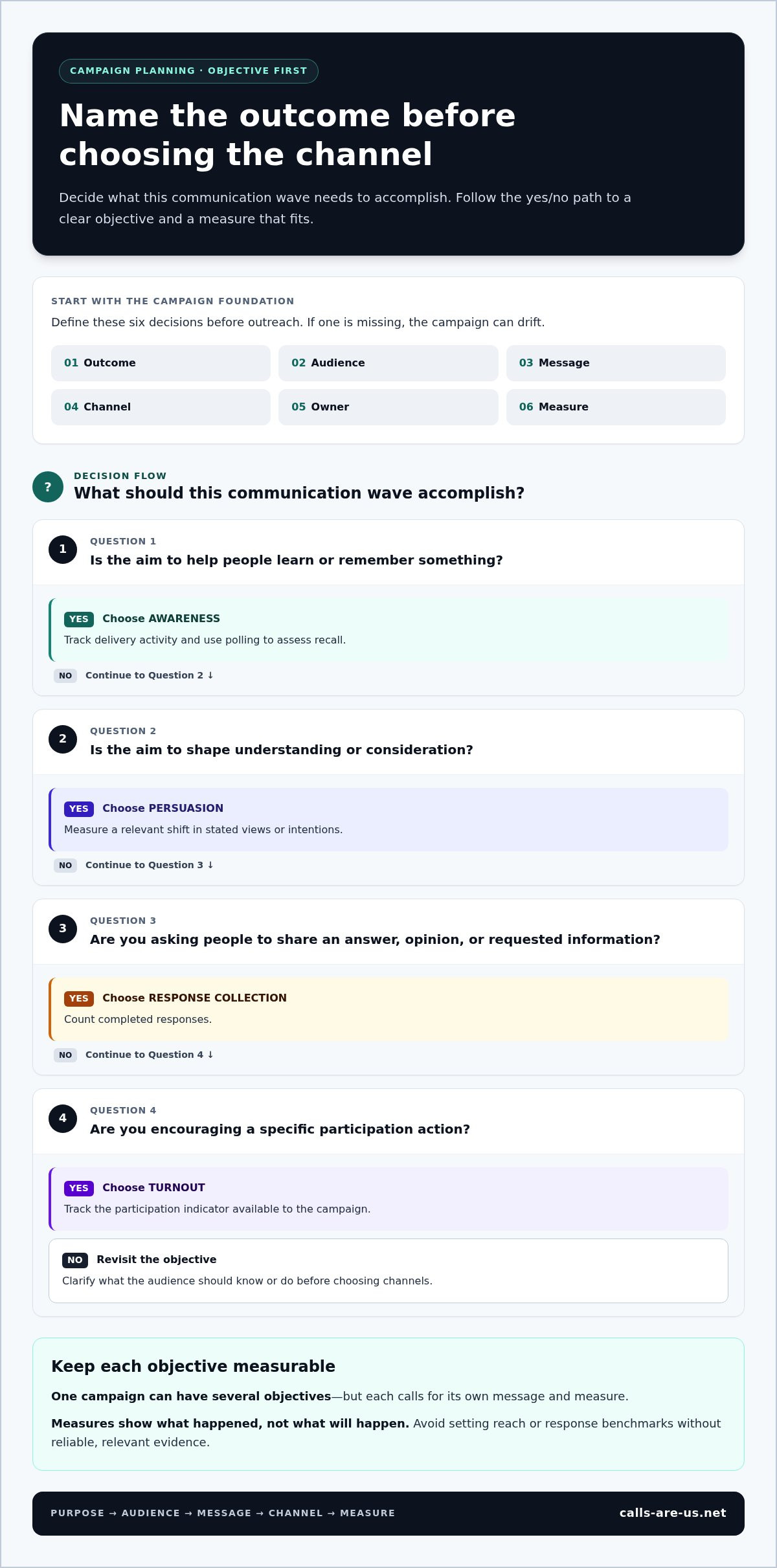
Decide what each communication wave needs to accomplish before choosing how to deliver it. Awareness helps an audience learn or remember something. Persuasion aims to shape understanding or consideration. Response collection asks people to share an answer, opinion, or requested information. Turnout communications encourage a specific participation action. These objectives can support the same campaign, but each calls for its own message and measure.
Make the objective observable. For awareness, you might track delivery activity and use polling to assess recall. For persuasion, measure a relevant shift in stated views or intentions. For response collection, count completed responses. For turnout, track the participation indicator available to the campaign. These measures show what happened, not what will happen. Avoid setting reach or response benchmarks without reliable, relevant evidence.
Define the audience, message owner, and approval path
Choose the audience based on the objective, not convenience. A reminder about an event may need a different audience from a message explaining a policy position or requesting feedback. Build segments around the purpose of the communication and data the campaign can appropriately use. Keep the criteria clear, relevant, and consistent so teams don’t rely on vague labels or outdated assumptions.
Answer three operational questions: who drafts the message, who approves the final version, and who handles replies or follow-up? Assigning responsibility prevents last-minute uncertainty, duplicated outreach, and unanswered responses. It also makes clear when a message is ready to send and who can authorize a change.
Keep one current source of truth for approved copy and audience criteria. Record the message version, intended audience, objective, channel, owner, approval status, and measure. Before launch, compare the scheduled communication with that record. This helps prevent one team from using outdated language while another shares revised information.
Strong foundations make avoiding campaign communication mistakes a practical discipline, not a last-minute cleanup. Once the purpose, audience, and responsibilities are clear, the campaign can choose channels deliberately and assess each outreach wave against its objective.
How campaign communication mistakes spread across messages and channels
One mismatch can spread across a campaign. A revised event date may appear in a text but not a calling script. One team may use a current audience list while another relies on an older export. Each communication may look correct on its own, yet the campaign feels fragmented to recipients. To prevent that drift, connect the audience, approved message, channel, owner, and follow-up.
For example, a reminder sent by text might be reinforced by a live call. If the call gives an outdated time or different response instructions, the second touchpoint creates uncertainty instead of reinforcing the first. Similar gaps happen when teams schedule outreach without sharing list changes, replies, or campaign decisions. A political voice broadcasting guide can help clarify how that format fits into a coordinated outreach plan.
Keep campaign messages consistent without making every channel identical
Consistency doesn’t mean copying the same script everywhere. Keep the central facts and intended action stable, then adapt the wording, length, and format to the channel. A voice broadcast may need a concise spoken message, while a text may need a shorter prompt. Both should use the same approved details and point people to a clear next step.
Before deployment, compare each version with the approved source material. Check names, dates, locations, claims, and calls to action, then have a designated reviewer look across all versions together. This cross-channel review can catch contradictions that a separate proofread of each channel might miss. Freeze the approved versions for launch, and share any later edits with every team using that content.
Plan handoffs and feedback before outreach launches
A reply is useful only when someone knows what to do with it. Decide in advance who monitors responses, who handles routine questions, and who receives issues that need a campaign decision. Set a clear handoff path between field, calling, texting, and campaign teams. Relevant updates shouldn’t sit in one team’s notes while another continues outreach with stale information.
Don’t treat delivery activity as proof of understanding or action. A sent message, completed call attempt, or delivered mail piece records an outreach step. It doesn’t establish that someone noticed the information, understood it, agreed with it, or followed through. Pair delivery records with an appropriate indicator, such as collected answers, requests for follow-up, or a defined participation measure. Assign someone to review those signals and share useful patterns with the teams planning the next wave.
Confirm every channel uses the current approved message and audience criteria.
Record who owns replies, escalations, and updates to campaign teams.
Review delivery and response information separately, then decide what warrants a change.
Calls-Are-Us provides automated and live campaign communication services to support a planned, connected approach. Clear handoffs and consistent information help each touchpoint contribute to the same purpose.
Choose the right campaign communication channel instead of forcing one tool
Each channel has a different job. Choose based on the audience, campaign objective, message, and team’s ability to manage what happens next. A recorded announcement, a personal exchange, and a printed piece aren’t interchangeable, even when they carry the same core information. Use the comparison below to narrow the options before planning a coordinated sequence.
Match the communication method to the job it needs to do
Start with the interaction you need. Voice broadcast delivers a recorded message; mass texting distributes concise information; peer-to-peer texting is organized around individual exchanges. This P2P versus broadcast texting comparison explains the distinction between the two approaches.
Live calling gives callers room for conversation, while IVR structures responses around prompts. Direct mail offers a physical way to share information and can complement a later call or text. No channel is automatically the right choice. Match the format to the message’s complexity, audience needs, and available follow-up.
Avoid channel overlap, gaps, and confusing repetition
Map each audience to the communication they should receive, why they should receive it, and what happens next. For example, a broad announcement might establish the key information, while a later conversation or response request serves a distinct purpose. Coordinate timing and calls to action so multiple channels reinforce one another rather than compete for attention.
Before launch, review the sequence from the recipient’s perspective. Check whether someone could receive duplicate reminders, conflicting instructions, or a follow-up with no clear connection to the first message. This helps with avoiding campaign communication mistakes by aligning channel choice with the campaign workflow, not just the message itself.
Pre-launch and live campaign checklist to catch errors
A reliable checklist gives the team a pause point before outreach, a way to spot problems while it’s active, and a record to learn from afterward. Use the phases below to catch gaps early and keep decisions tied to the campaign’s purpose. The checks apply across channels, though the details will depend on the communication and audience.
Before launch: review data, message, and execution readiness
Don’t launch until the audience, content, and delivery plan line up. Confirm that the audience fits the communication, the message is approved, and someone is accountable for addressing problems. Keep a record of the materials and audience version used for each wave.
Audience: Confirm the selection criteria, list version, and intended recipients. Review whether the data is appropriate for the planned use and whether exclusions or suppression information has been applied.
Message: Proofread names, dates, claims, sender identification, and calls to action against current approved source material. Check that each channel’s version preserves the same essential facts.
Channel and schedule: Confirm the format suits the message and audience. Verify the planned timing, sequence, and any handoff to another communication team.
Ownership: Name who authorizes launch, monitors delivery, handles replies, and escalates questions or concerns. Make sure each person knows where to find the current instructions.
Consent, suppression, disclosures, and other applicable requirements need current review, not assumptions based on an old campaign. Have qualified counsel review the relevant federal and state requirements for the campaign, audience, and communication methods before launch. Record resulting instructions in the working plan so the teams executing outreach can follow them.
During and after outreach: monitor, learn, and adjust
Once a wave begins, compare activity with the plan and watch for issues that need attention. A delivery record tells you an outreach step occurred; it doesn’t prove a recipient understood the message or acted on it. Track operational activity separately from responses and other indicators connected to the communication objective.
During outreach: Monitor scheduled activity, channel handoffs, reported errors, and incoming questions. Route responses to the assigned owner and document unresolved issues for follow-up.
After each wave: Record what was sent, to which audience, through which channel, and when. Summarize meaningful responses, recurring questions, corrections, and actions taken.
Before adjusting: Compare findings with the intended measure. Look for patterns across relevant evidence rather than changing course based on one anecdote.
Metrics are campaign-specific. Choose indicators that fit the objective, audience, channel, and available information; don’t treat an unverified response rate as a universal benchmark. This disciplined review is central to avoiding campaign communication mistakes: it helps teams distinguish findings from assumptions and carry useful lessons into the next wave.
Calls-Are-Us provides campaign communication services that can be part of a plan built around clear roles, channels, and response handling.
Build a coordinated campaign communication plan with the right support
A checklist becomes useful when it turns into a brief people can act on. Bring the campaign’s key decisions into one working document, then use it to guide outreach, handoffs, and review. This gives campaign staff and communication partners a shared reference without assuming every audience or objective needs every channel.
Include the essentials:
Objective and audience: State what the communication should accomplish and whom it is intended to reach.
Message: Record the approved core information, the action recipients should take, and any channel-specific versions.
Channels and sequence: Identify which methods fit the objective, who receives each touchpoint, and how the communications relate to one another.
Roles and handoffs: Assign responsibility for preparation, delivery, response handling, and escalation.
Measurement: Name the indicators the team will review and how findings will inform the next outreach decision.
This brief makes it easier to identify operational needs before launch. It also helps prevent a common planning trap: choosing tools first and trying to force the campaign’s objective into them later.
Coordinate automated outreach and live conversations
Automated and human-led communications can serve different roles in one plan. Voice broadcasting and texting can carry campaign information to an audience, while live calling offers a human-to-human option for conversations. A clear handoff plan helps teams understand how these touchpoints relate, who manages follow-up, and what information should be shared across the workflow.
For structured response collection, IVR and polling provide ways to ask questions and gather input. Define what the campaign wants to learn, who will review responses, and how the information may guide later decisions. These tools support a planned process, but they don’t guarantee a particular response or outcome. Direct mail can also fit when the message and audience call for a physical format.
Turn the checklist into clear next steps
Before selecting support, clarify the campaign goal, intended audience, preferred channels, and operational needs. For example, a plan may call for broad informational outreach, a separate path for live conversations, and a structured way to gather feedback. The right mix depends on the campaign’s purpose and capacity to manage responses, not on using every available method.
Calls-Are-Us supports campaigns and organizations with voice broadcast, peer-to-peer and mass texting, live calling, IVR, polling, and direct mail. These options can be considered individually or coordinated around a campaign’s defined workflow. Clear objectives and responsibilities help teams use support purposefully, maintain consistency, and learn from each communication wave. That’s the practical value of avoiding campaign communication mistakes: turning planning into outreach that stays connected to its goals.
Explore campaign communication services to consider outreach options for your plan.
Make your next campaign communication decision count
Your next step doesn’t need to be a major overhaul. Choose one upcoming outreach effort and use it to strengthen how your team shares decisions, handles responses, and learns from each communication. A clear, repeatable process can make avoiding campaign communication mistakes a habit that supports trust and more purposeful contact.
Campaigns benefit from support that fits their practical communication needs. Calls-Are-Us works with organizations on communication needs, including automated outreach, live calling, and direct mail. Identify what your team needs to coordinate next, then choose options that fit the plan rather than defaulting to every available channel.
Explore campaign communication services and take a confident next step toward outreach that feels clear, coordinated, and responsive.
Frequently Asked Questions
Is there a simple checklist for avoiding campaign communication mistakes?
Yes. A simple checklist can keep the team aligned, but tailor it to the campaign rather than treating it as a complete compliance review. Record the objective, audience, approved message, channel, owner, and measure in one place. For an event reminder, for example, check that the date and participation instructions match across every version. Review the audience list and applicable requirements before launch, then log feedback and changes after each communication wave.
Can a campaign use multiple communication channels without confusing its audience?
Yes, provided each channel supports the same central information and a clear next step. A campaign might use a mailed announcement to introduce an event, then send a brief text reminder to the intended audience. Keep the core details aligned, but adapt the length and format to the medium. Before adding another touchpoint, check who already received outreach and make sure response-handling teams know what was sent and what follow-up is expected.
How do you choose the right communication channel for a campaign?
Start with the communication task, then consider who needs the information and what kind of response, if any, the campaign expects. A concise recorded announcement, a text exchange, a live conversation, a structured IVR prompt, and a physical mail piece create different experiences. A nuanced question, for example, may call for human conversation rather than a short broadcast. Compare options based on message complexity and the team’s capacity to manage follow-up, not reach alone.
What happens if campaign messages give voters conflicting information?
Conflicting details can undermine confidence and leave people unsure which instruction to follow. If a discrepancy appears, pause affected outreach when practical and identify the authorized version before sending a correction. For instance, if two messages give different event times, verify the current detail, notify teams responding to questions, and correct it through a suitable channel. Keep a brief record of the error and correction so outdated copy doesn’t return in a later wave.
How can a campaign measure whether its communications are working?
Choose a measure that reflects the intended action, then interpret it in context. If a message asks people to complete a survey, count submitted responses rather than treating attempted deliveries as participation. Where data allows, compare results across channels or audience segments, while noting differences that could affect interpretation. Avoid universal response-rate assumptions. For avoiding campaign communication mistakes, use verified patterns to guide the next communication, and treat isolated comments as signals to investigate, not proof of a broad trend.
Should campaigns review legal requirements before sending calls or texts?
Yes. Requirements can vary with the message, technology, audience, and applicable federal or state rules, so have qualified counsel review current guidance before outreach. Keep the review tied to the actual campaign plan, including the communication method and relevant audience criteria. Save approved materials and document review decisions for the team responsible for execution. This FAQ provides general planning information, not legal advice, and can’t determine whether a specific campaign complies.



Comments