
Campaign Messaging for Trust: A Practical 2026 Guide

Updated: Oct 1
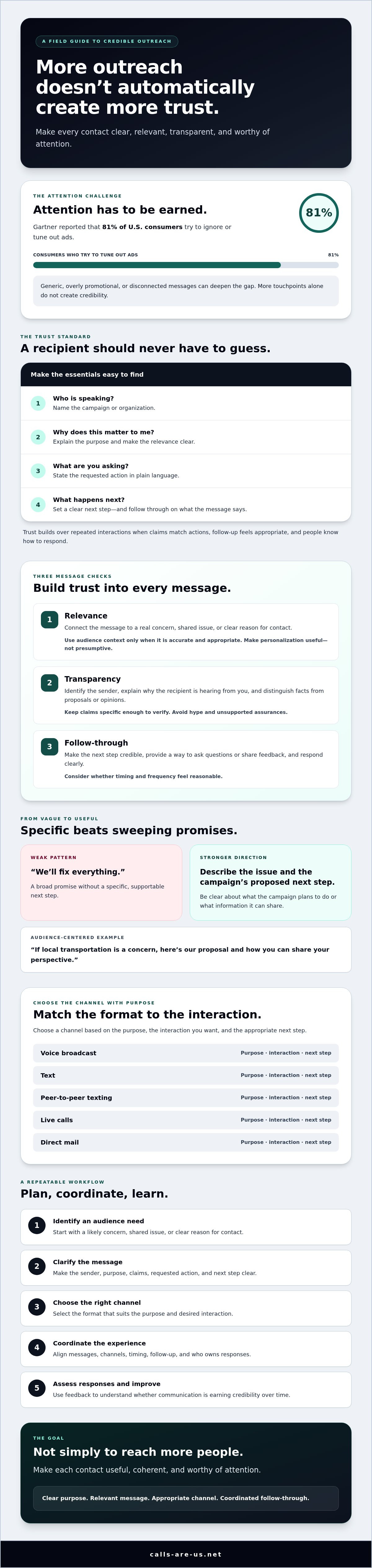
More outreach doesn’t automatically create more credibility. In October 2025, Gartner reported that 81% of U.S. consumers try to ignore or tune out ads, a reminder that campaign messaging that builds trust must earn attention rather than demand it. If your messages feel generic, overly promotional, or disconnected from people’s concerns, adding more touchpoints may deepen the disconnect.
Campaigns need to communicate at scale while staying clear, relevant, and respectful across texts, calls, and direct mail. Trust grows when people understand why you’re contacting them, what you’re asking, and what will happen next.
This practical 2026 guide shows you how to plan messages around audience needs, choose channels that suit each interaction, and coordinate follow-up. You’ll also learn how to use feedback to assess whether your communication is earning credibility over time. The goal isn’t simply to reach more people. It’s to make each contact useful, coherent, and worthy of attention.
Table of Contents
What Does Trust-Building Campaign Messaging Look Like?
Trustworthy campaign messaging is clear, relevant, transparent, and consistent. It tells recipients who is speaking, why the message matters to them, and what they can do next. Campaign messaging that builds trust makes its purpose and next step clear, then follows through on what it says. That standard applies whether a campaign is sharing information, asking for support, or inviting people to respond.
Trust isn’t created by one polished line or a single channel. It develops through repeated experiences: a message matches its claims, follow-up feels appropriate, and people know how to respond. The idea of source credibility helps explain why the perceived trustworthiness and expertise of a communicator can affect how a message is received. A campaign’s words matter, but so do the identity and conduct behind them.
For a practical perspective on planning campaign communications, watch this video:
Why do campaign messages lose credibility?
Generic wording can make people feel treated as a segment rather than as individuals with distinct concerns. “We’re fighting for a better future” may sound positive, but without a specific issue or reason for contact, it gives recipients little to connect with. Relevance doesn’t require intrusive personalization. It means making the message useful and understandable to its intended audience.
An unclear sender or purpose creates avoidable uncertainty. Recipients shouldn’t have to guess who contacted them or why. Vague promises also weaken confidence when they lack a credible next step. If a campaign says it will address a concern, it should explain what action it plans to take or what information it can share, without claiming results it can’t substantiate.
What signals respect and credibility to recipients?
Make the basics visible. Name the sender, explain the purpose, and state the requested action in plain language. Keep claims specific enough for the campaign team to verify, and avoid hype that makes a message feel more persuasive than informative. For example, replace “We’ll fix everything” with a clear description of the issue and the campaign’s proposed next step.
Respect also shows in the experience around the message. Consider whether the timing and frequency are reasonable, and give people a meaningful way to ask a question or share feedback. A campaign can’t control every recipient’s reaction, but it can communicate with care, answer clearly, and plan for follow-through.
Build Trust Into Every Message With Three Practical Principles
Use three checks before a message goes out: Is it relevant? Is it transparent? Does it follow through? Together, these principles make campaign messaging that builds trust a repeatable editorial practice, not a last-minute tone adjustment.
1. Relevance: Connect the message to a real need
Start with a recipient’s likely concern, a shared issue, or a clear reason for contact. Use audience context only when it’s accurate and appropriate. Personalization should make a message more useful, not imply that the campaign knows someone personally when it doesn’t.
Weak pattern: “We know exactly what matters to you.” This claims knowledge the campaign may not have. Stronger direction: “If local transportation is a concern, here’s our proposal and how you can share your perspective.” The revised message offers a relevant entry point without assuming every recipient has the same priorities.
2. Transparency: Make the basis of the message clear
Identify the campaign or organization, explain why the recipient is hearing from it, and distinguish facts from proposals or opinions. Replace broad assurances like “We’ll solve the problem” with a precise, supportable statement about the intended action. Public-sector research such as Government Communication Strategies offers a useful lens on the role of openness and two-way communication in building public trust.
Weak pattern: “Big changes are coming.” Recipients can’t tell what’s changing or who is responsible. Stronger direction: Name the proposed change, attribute it to the campaign, and explain what people can review or discuss. Specificity gives recipients something meaningful to assess.
3. Follow-through: Close the loop
A request should lead somewhere. If a message invites a reply, question, or action, explain what happens next and make sure the team has a plan for handling responses. Don’t promise a personal answer or a particular result unless the campaign can deliver it.
Weak pattern: “Tell us what you think, we’re listening,” with no clear response path. Stronger direction: State how to share feedback and how the campaign will use or respond to it. Even a concise explanation is more credible than an invitation without clear ownership.
Use this editorial test: Is the message relevant to a real concern, transparent about who is speaking and what’s known, and clear about what happens next? Applied consistently, this question helps teams align outreach with the respect and openness recipients deserve. Campaign teams planning voice broadcast, texting, live calling, IVR, polling, or direct mail can review available campaign outreach channels as part of that process.
Choose the Right Campaign Channel Without Sacrificing Trust
The right channel fits the message and the recipient’s expectations. A brief update may suit an automated format, while a complex question may call for conversation. Campaign messaging that builds trust depends less on the medium itself than on whether the channel, message, urgency, and follow-up plan make sense together.
Use this comparison as a planning guide, not a ranking. No format inherently earns more trust or guarantees a response. Choose based on what recipients need, how quickly they need it, and what your team can support.
When should campaigns use automated voice or text outreach?
Voice broadcast and mass texting can suit concise information that needs to stay consistent across recipients. Keep the message focused: identify the sender, explain the point, and make any requested action easy to understand. If people may have questions, don’t leave them at a dead end. Provide a clear response route or plan a follow-up channel. For more planning considerations, consult a guide to political voice broadcasting, such as The Ultimate Guide to Political Voice Broadcasting in 2026.
When do live calls or direct mail add a human dimension?
Live calls give agents room to listen, clarify, and respond to concerns that a short automated message can’t address. Direct mail offers a tangible format with more space to explain a position or proposal, and can reinforce related outreach. A campaign can coordinate these channels without repeating the same message everywhere: give each one a distinct task, then keep the next step consistent. Further reading may include Political Campaign Call Center: The 2026 Guide to Scalable Voter Contact and a direct mail strategy guide.
Before choosing a channel, check audience expectations, urgency, and team capacity. A channel supports credibility only when the campaign can deliver the interaction and follow-up it implies.
How to Create, Review, and Improve a Trustworthy Campaign Message
A consistent review process helps catch confusion before it reaches recipients. Use this five-step workflow to make campaign messaging that builds trust a practical team habit.
Start with an audience need. Identify the concern, question, or information gap the message should address. Don’t assume every recipient shares the same priorities.
Set the message purpose. Decide whether you’re informing, asking for input, or requesting a specific action. One clear purpose keeps the message focused.
Draft in plain language. Name the campaign, explain the reason for contact, support the central claim, and make the next step easy to understand.
Review from the recipient’s perspective. Ask someone unfamiliar with the draft to read it. Can they explain who sent it, what it says, and what they’re being asked to do?
Measure and refine. Look beyond delivery figures. Review comprehension, questions, feedback themes, and whether recipients can follow the intended next step.
What questions should a message review checklist include?
Before approval, check the essentials. Each question tests whether the message is understandable, credible, and respectful:
Sender identity: Can recipients tell which campaign or organization is contacting them?
Purpose: Is the reason for the message clear?
Factual claims: Is the central claim specific, supportable, and easy to understand?
Tone: Does the wording sound respectful rather than pressuring or presumptive?
Action: Is the requested step clear and proportionate to the message?
Response path: If recipients have a question or reply, is it clear what they can do and who will handle it?
For example, replace “We’ll make your community better” with a verifiable description of the proposal and a clear way to learn more. Specific language gives readers a fair basis for evaluating the message.
How can campaigns learn from responses without over-contacting people?
Treat feedback as a guide to improving communication, not as a reason to send more messages by default. Note recurring questions, concerns, requests for next steps, and points where people seem confused. Then adjust the wording, channel, or follow-up plan. If responses show that recipients need clarification, revise the message before expanding outreach.
Compare response patterns across peer-to-peer and broadcast texting to understand which format fits the purpose and the interaction your team can support. The article P2P vs Broadcast Texting: The 2026 Strategic Comparison for High-Impact Outreach can help frame that choice. Before sending, verify applicable consent, platform, and legal requirements with qualified guidance, since obligations can vary by campaign and context.
To align outreach channels with your review and follow-up process, explore campaign communication services.
Put Trust-Building Messaging Into Practice With a Coordinated Outreach Plan
Coordination makes a campaign feel coherent. Build one plan that connects the message to its channel, timing, and response owner. That way, recipients hear a consistent explanation while each outreach method serves a distinct purpose. A channel or vendor can support delivery, but trust depends on what the campaign says and how it follows through.
How can a campaign coordinate outreach across channels?
Start with a core message: the central fact, proposal, or request that must remain consistent. Adapt its length and interaction style to the channel rather than copying the same script everywhere. Document handoffs so replies and promised follow-up don’t fall between teams.
Message: Record the main point, supporting claims, and requested action.
Channel and timing: Note which audience need each contact serves and when it makes sense to send it. Avoid scheduling contacts simply because another channel is available.
Response ownership: Name the person or team responsible for questions, feedback, and follow-up, and specify how they’ll close the loop.
For example, a campaign might use voice broadcast for a concise update, follow with a text containing the next step, and reserve live calling for conversations that need discussion. IVR, polling, and direct mail can support other tasks, such as offering structured interaction, gathering feedback, or sharing more detailed information. Each contact should add value rather than simply repeat the previous one. For a broader planning perspective, see The Definitive Mass Communication Strategy Guide for 2026.
A shared plan can help staff and outreach partners stay aligned on wording, schedule, and response responsibility. Use it to check that each message matches the campaign’s purpose before it goes out.
What can a communications partner support?
Calls-Are-Us provides voice broadcast, mass texting, peer-to-peer texting, live calling center operations, Interactive Voice Response (IVR), polling, and direct mail. These options serve different communication tasks; none automatically creates trust or guarantees a campaign result. Before selecting a channel or combination, assess audience expectations, goals, available capacity, and how the team will handle responses.
Use that decision framework to identify where outside support may fit your outreach plan. If you’re ready to review channel options, explore Calls-Are-Us services and consider which capabilities align with your campaign’s communication needs.
Make Your Next Campaign Message Count
Trust takes shape through the full experience, not a single well-written appeal. Clear, relevant messages show recipients why you’re contacting them. Transparent claims and thoughtful follow-up show that your campaign respects their time and attention. That’s the foundation of campaign messaging that builds trust.
Choose each channel for a reason, then coordinate the core message, timing, and response ownership across your outreach. Review messages from the recipient’s perspective, learn from questions and feedback, and refine what isn’t clear. Consistency matters, but so does adapting the format to the interaction people need.
Calls-Are-Us offers automated outreach and live agent calling, with capabilities spanning voice, text, IVR, polling, and direct mail. These options can support different campaign communication tasks, but trust comes from how your team uses them and follows through. Explore campaign communication services from Calls-Are-Us to consider which channels may fit your goals and operational needs.
Start with one message your audience needs to hear, make its purpose clear, and give people a meaningful next step. Every respectful interaction is an opportunity to strengthen credibility over time.
Frequently Asked Questions
What makes a campaign message trustworthy?
A trustworthy campaign message is clear, relevant, transparent, and consistent. Recipients should be able to identify who’s contacting them, understand why they’re receiving the message, and see what action is requested. Claims should be specific and supportable, not inflated or vague. Trust also depends on follow-through: if the campaign invites questions or promises an update, it should have a clear plan for handling replies and completing that next step.
How can a political campaign build trust with voters through messaging?
A political campaign can build trust by addressing real concerns, explaining its positions plainly, and showing how its stated actions connect to its promises. The messenger matters just as much as the medium, leading many cause-driven efforts to collaborate with Advocators to engage authentic voices that emotionally connect with their communities. Keep communication consistent across channels, but adapt the format to the audience and purpose. Invite questions when appropriate, assign someone to handle responses, and use feedback to clarify confusing messages. Trust isn’t earned by a persuasive line alone; it grows through repeated communication that respects people’s attention and expectations.
Automated calls and texts can support trust when they deliver useful, accurate information in a concise and respectful way. Identify the campaign, state the purpose, and make the next step clear. If recipients may need to ask questions or discuss a complex issue, provide a suitable response path, such as a live call or another planned follow-up. Automation can help deliver consistent updates, but it can’t replace responsible message choices or thoughtful handling of responses.
How do you make campaign messages feel personal without being intrusive?
Make a message feel personal by connecting it to a relevant issue or clear reason for contact, not by pretending to know someone’s private concerns. Use audience context only when it’s accurate and appropriate. For example, name the topic the message addresses and explain why the campaign is sharing it. Avoid language that implies a close relationship that hasn’t been established. Respectful relevance helps a message feel considered without crossing into unwarranted familiarity.
Which campaign communication channel is best for building trust?
No single channel is always best for building trust. Choose based on the message, recipient expectations, urgency, and your team’s ability to respond. Voice broadcast or mass texting may suit concise updates; peer-to-peer texting or live calls can support exchanges; direct mail allows more room for detail. Interactive Voice Response (IVR) and polling can serve distinct response or feedback tasks. Match the channel to the interaction you can genuinely support.
How can a campaign tell whether its messaging is building trust?
Look beyond delivery or response totals. Review whether recipients understand who contacted them and why, what questions they ask, which concerns appear repeatedly, and whether promised follow-up happens. You can test a draft with readers unfamiliar with it and ask them to explain its main point and requested action. Use the findings to improve clarity, channel fit, and response handling. These signals inform the team, but no single metric proves that trust has been earned.
How often should a campaign follow up with the same audience?
There’s no universal follow-up frequency that fits every campaign. Set timing according to the message’s urgency, the value of new information, audience expectations, and your capacity to handle replies. Avoid repeating a message without a clear purpose or sending another contact before the previous one has been addressed. Coordinate outreach across channels, monitor questions and negative feedback, and adjust the plan when contact feels excessive. Verify applicable consent, platform, and legal requirements with qualified guidance.



Comments