_edited.png)
Choosing the Best Political Campaign Texting Software in 2026

Updated: May 18
If your outreach is sitting in a carrier's spam filter, does your campaign even exist? In 2026, choosing the right political campaign texting software is no longer just about hitting send. It's a high-stakes challenge of managing carrier trust, ensuring 10DLC compliance, and maintaining multi-channel synchronization. You need a partner that understands the technical nuances of deliverability while prioritizing the human connection at the heart of every vote.
You've likely felt the sting of registration delays or the high costs of managing manual labor for peer-to-peer outreach. It's frustrating to watch critical voter data remain trapped in silos when you need your text, voice, and mail efforts to work as one. We promise to provide a clear framework for selecting software that ensures high deliverability, seamless voter file integration, and scalable outreach that respects your budget. We'll examine the essential features for carrier approval, the importance of unified communication workflows, and the strategies that turn digital pings into real-world momentum.
Key Takeaways
Precision is the new standard. Learn how the right political campaign texting software transforms cold lists into active, engaged voter communities.
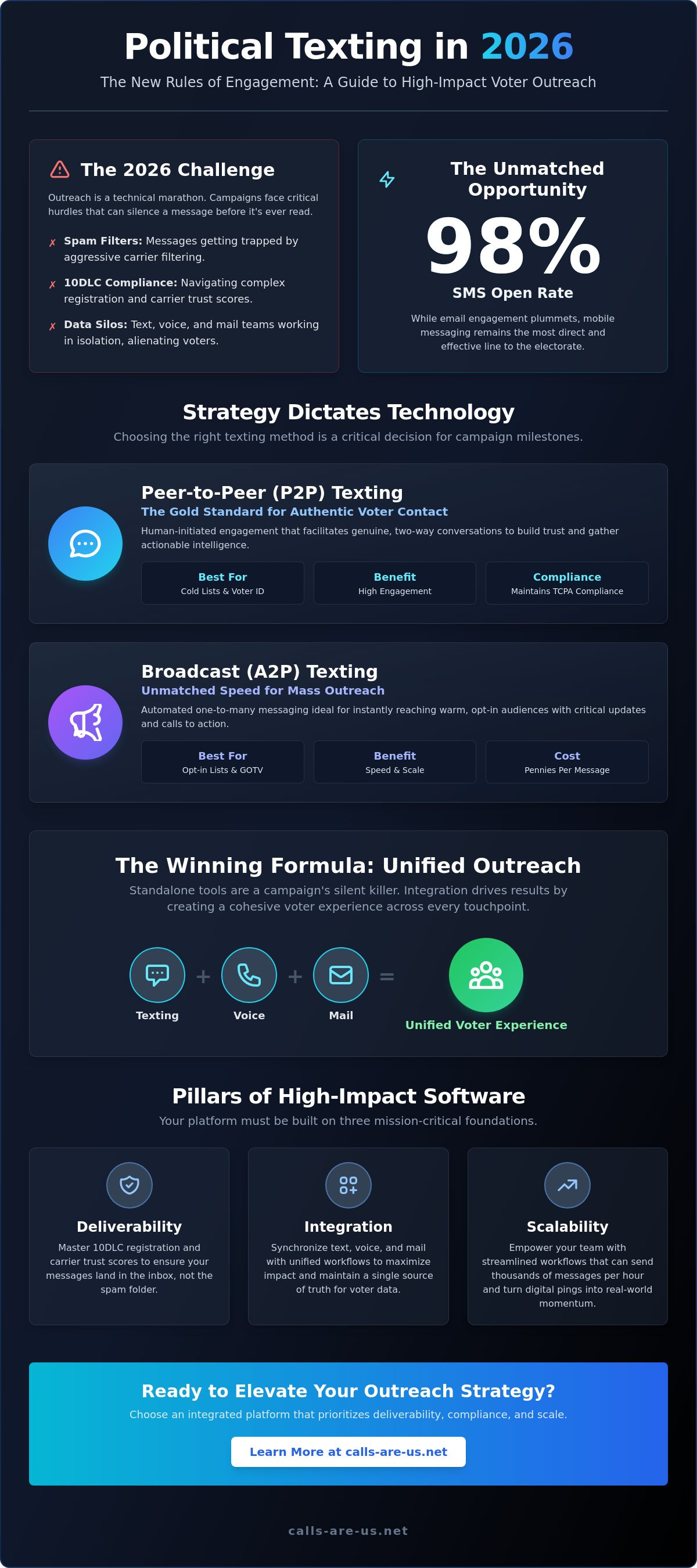
Strategy dictates technology. Distinguish between Peer-to-Peer and Broadcast texting to ensure your outreach method aligns with specific campaign milestones.
Deliverability is non-negotiable. Master the complexities of 10DLC registration and carrier compliance to keep your messages out of the spam folder.
Integration drives results. Maximize your impact by combining text with voice broadcasts and direct mail for a truly unified voter experience.
Table of Contents
The Evolution of Political Texting: Why 2026 Demands Smarter Software
Outreach is a technical marathon. In 2026, political campaign texting software is the mission-critical engine that drives your entire field operation. It's no longer about sending as many messages as possible to see what sticks. Instead, the focus has shifted toward carrier-verified, highly targeted communication that respects both the voter and the regulatory environment. This evolution demands a platform that prioritizes speed, scale, and security. By focusing on these three pillars, campaigns can navigate the complexities of 10DLC registration while maintaining the momentum needed to win.
The Shift from Simple SMS to Strategic Outreach
Voters demand relevance. They've grown tired of generic blasts that offer no value. While email engagement has plummeted, mobile messaging remains the most direct line to the electorate. Research indicates that nearly 98% of SMS messages are opened, making it the most effective tool in your arsenal. However, this dominance has led carriers to implement "Trust Scores" to filter out low-quality traffic. Looking back at the history of political texting, it's clear that the era of unregulated outreach is over. Your political campaign texting software must prove its integrity to the carriers before a single message is ever sent. This requires a sophisticated approach to data hygiene and recipient segmentation that goes far beyond the capabilities of basic messaging tools.
Why Standalone Tools Are No Longer Enough
Data silos are a campaign's silent killer. When your texting team doesn't know what your calling team is doing, you risk alienating the very voters you're trying to win over. A truly effective mass communication strategy requires every channel to work in harmony. Your texting outreach should mirror your voice broadcasts and direct mail efforts to create a unified narrative. By integrating these tools, you ensure that your message is consistent, your data is clean, and your budget is spent where it has the most impact. Standalone tools simply can't provide the level of coordination required for a modern, high-stakes campaign. In 2026, the winner isn't the one who sends the most texts; it's the one who builds the most cohesive and trusted relationship with the voter across every available touchpoint.
P2P vs. Broadcast Texting: Aligning Tech with Campaign Goals
Strategy dictates your survival. Choosing between Peer-to-Peer (P2P) and A2P Broadcast texting isn't merely a technical preference; it's a legal and psychological decision that defines how you interact with the electorate. While both methods deliver messages to a mobile device, their impact on voter sentiment and carrier deliverability differs significantly. Peer-to-Peer (P2P) texting is a human-initiated engagement tool that facilitates genuine connection at scale. By understanding the nuance between these two technologies, you can deploy your political campaign texting software with maximum efficiency during critical milestones like GOTV or donor surges.
The cost-to-impact ratio for these technologies shifts based on your specific goals. P2P texting requires more human labor, yet it yields deep engagement and high-quality voter data. Conversely, Broadcast texting offers unmatched speed for pennies per message, making it ideal for reaching warm, opt-in audiences instantly. The sophisticated use of digital marketing in political campaigns ensures that every text message serves a specific purpose, whether it's building a relationship or triggering a rapid response. If you're ready to scale your outreach, exploring integrated peer-to-peer texting solutions is the next logical step in your strategic planning.
Peer-to-Peer (P2P): The Gold Standard for Voter Contact
Human interaction is the bedrock of persuasion. For campaigns reaching out to voter files where explicit opt-in hasn't been established, P2P is often a legal necessity to comply with TCPA regulations and carrier requirements. This method allows your team to engage in two-way conversations, answer specific policy questions, and identify voter leanings in real time. Modern software streamlines these volunteer workflows, enabling a single person to send thousands of messages per hour. This creates a powerful tripartite benefit: it maintains legal compliance, fosters authentic dialogue, and gathers actionable intelligence for your ground game.
Broadcast SMS: Efficiency for Opt-In Audiences
Speed is the primary advantage of automation. Broadcast SMS is the workhorse for rapid response, fundraising alerts, and event reminders sent to your most loyal supporters. Because these messages are sent to a pre-verified, opt-in list, they enjoy high trust scores with carriers. Automated delivery allows you to reach hundreds of thousands of subscribers in seconds, which is vital when responding to a breaking news cycle or a late-night fundraising deadline. To maintain your standing with carriers, strict adherence to opt-in protocols is required, ensuring your broadcast efforts remain a welcome presence in a supporter's inbox rather than a nuisance.
Essential Features for High-Impact Political Texting Software
Precision requires a specific toolkit. When evaluating political campaign texting software, you must look beyond basic message delivery to find a platform that empowers your team, segments your data, and analyzes your results in real time. High-performance campaigns in 2026 categorize their technical requirements into three distinct buckets to ensure total operational coverage. These include:
Operational: Tools that manage volunteers, streamline workflows, and secure sensitive data.
Strategic: Capabilities like MMS and video that drive higher engagement and deeper voter persuasion.
Analytical: Real-time reporting and API integrations that eliminate data silos and track deliverability.
With 97% of Americans owning a cell phone and 95% of texts being read within minutes of receipt, the stakes for your software's feature set couldn't be higher. You need a system that doesn't just send data but manages relationships at scale.
Operational Efficiency: Managing the Ground Game
Your ground game lives or dies by its organization. Advanced political campaign texting software provides permission-based access, allowing you to delegate tasks to volunteers without compromising the security of your entire voter file. Efficiency is further amplified through the use of canned responses and dynamic variables. These tools ensure that every interaction feels personal and authentic while maintaining a consistent campaign voice across thousands of conversations. To make this data actionable, your software should offer automated tagging based on voter replies. This allows your team to instantly categorize voters by their concerns or support levels, feeding that intelligence directly back into your broader strategy.
Advanced Media: Beyond Plain Text
Static text is the baseline; rich media is the differentiator. In 2026, MMS and video texting have become essential for cutting through the noise of a crowded election cycle. Images and GIFs capture attention in a way that plain text cannot, often leading to significantly higher engagement rates than standard SMS. Video texting effectively bridges the gap between traditional television advertising and personal mobile outreach, putting your candidate's face and voice directly into the voter's hand. It's vital that your software handles media compression automatically. This ensures that high-quality content reaches voters across all carriers without technical glitches or delivery failures.
Real-time delivery reporting is the heartbeat of a successful campaign. You can't afford to wait 24 hours to find out if your GOTV surge was blocked by carrier filters. You need immediate visibility into delivery rates to pivot your strategy if necessary. This analytical depth must be supported by seamless API integrations with your primary voter file. When a volunteer records a preference or a voter opts out, that information must sync instantly across your entire communication stack, including your voice broadcast and direct mail efforts. This level of synchronization ensures you're always working with the most accurate data available.
Navigating 10DLC and Carrier Compliance in 2026
Deliverability is the only metric that truly matters. Even the most persuasive message fails if it never reaches the voter's screen. In 2026, the gatekeeper for your outreach is 10DLC (10-Digit Long Code), a regulatory framework designed to verify the identity of every sender. Your political campaign texting software must act as more than a delivery vehicle; it must be your primary advocate in a complex ecosystem of carrier trust and technical verification. Understanding how The Campaign Registry (TCR) functions is no longer optional for serious campaigns. It's the difference between a successful GOTV surge and a campaign silenced by carrier filters.
The 10DLC Registration Workflow
Registration is a methodical three-step process. First, you complete Brand Registration to verify your campaign's legal identity. Second, you undergo Campaign Vetting to describe your message intent and obtain carrier approval. Finally, Number Provisioning assigns specific codes to your traffic. This sequence ensures your messages are recognized as legitimate A2P (Application-to-Person) traffic rather than unauthorized spam. Most campaigns should expect a lead time of several days to a week to move through these stages, so early preparation is vital. Your software provider should guide you through this, acting as a bridge between your campaign and the major carriers.
Maintaining High Deliverability Scores
Carrier trust is earned through consistent behavior. High "STOP" rates are a red flag that can lead to shadow-banning, a state where your messages are accepted by the network but never actually delivered to the handset. To maintain a high deliverability score, you must prioritize the voter experience. Use branded URL shorteners instead of generic ones, as carriers frequently block unverified links to protect users. Respect the voter’s time by scheduling messages during peak engagement hours and avoiding excessive frequency that triggers churn. If you want to ensure your outreach meets these rigorous standards, consider compliant political texting solutions that prioritize carrier transparency.
Shadow-banning is often invisible to the sender. Without real-time delivery reporting, you might continue sending messages to a void, wasting your budget and volunteer hours. Modern software helps you avoid this by monitoring your reputation in real time and providing feedback on your message content. By following these best practices, you protect your campaign's voice and ensure that your supporters actually receive the information they need to head to the polls. Compliance isn't just a legal hurdle; it's a strategic advantage that keeps your communication lines open when they matter most.
Choosing Calls-Are-Us for Integrated Outreach and Scalability
Victory requires a unified front. While many platforms offer political campaign texting software as a standalone silo, Calls-Are-Us views messaging as one piece of a comprehensive voter engagement strategy. We believe that true impact is achieved when your digital outreach, voice communications, and physical mailers work in perfect synchronization. This integrated approach ensures that your candidate's message isn't just heard once but felt across every relevant touchpoint, building the trust and frequency necessary to move the needle on election day.
The Power of Multi-Channel Synchronization
Frequency builds familiarity. When you pair P2P texting with political voice broadcasting, you create a multi-sensory experience for the voter. Industry observations suggest that a text follow-up sent shortly after a voice broadcast can significantly increase engagement rates, sometimes doubling the response compared to a single-channel approach. Calls-Are-Us provides unified data reporting that eliminates the guesswork of multi-channel management. By seeing your text, voice, and direct mail results in one place, you can identify which voters are responding and where you need to double down. This synergy transforms isolated pings into a cohesive narrative that drives action.
Scalability for National and Local Races
Capacity is the foundation of confidence. Whether you're running a local school board race or a national presidential campaign, your infrastructure must handle the pressure of the final 72 hours. Calls-Are-Us maintains the robust capacity to deliver millions of messages per day, ensuring your GOTV surge never hits a technical ceiling. Beyond the technology, we provide high-touch support from seasoned outreach experts who understand the high-stakes environment of modern elections. We don't just provide tools; we offer a principled partnership dedicated to inclusive dialogue and social progress. Our mission is to empower your message, facilitate meaningful connections, and ensure that every voter in your district is reached with clarity and integrity.
Securing Your Path to Electoral Impact
Winning an election in 2026 requires more than a loud voice; it requires a strategic presence in the pockets of every voter. You've seen how the right political campaign texting software serves as the foundation for this outreach, bridging the gap between high-level strategy and ground-level execution. By prioritizing 10DLC compliance and breaking down data silos, you ensure your message isn't just sent but actually delivered and read.
Calls-Are-Us brings the weight of experience to your campaign, having operated in over 40 states with a deep commitment to expert 10DLC advocacy. We don't just offer a tool. We provide a unified platform where voice, text, and mail work together to amplify your influence. This integrated approach allows you to scale your efforts with confidence, knowing your outreach is backed by technical precision and a human-centric philosophy. Your vision deserves a partner that can turn technical challenges into strategic victories.
Launch your compliant outreach strategy with Calls-Are-Us today.
The road to the ballot box is complex, but you don't have to navigate it alone. Step forward with a strategy that connects, persuades, and wins.
Frequently Asked Questions
What is the difference between P2P and broadcast texting for campaigns?
Peer-to-peer (P2P) texting requires a human volunteer to initiate every individual message, while broadcast texting uses automated systems for mass delivery. P2P is the standard for persuasion and voter identification because it facilitates genuine two-way conversations. Conversely, broadcast texting is an efficiency tool designed for rapid response and event reminders sent to supporters who have explicitly opted into your subscriber list.
How long does 10DLC registration take for a new political campaign?
Expect the 10DLC registration process to take between three and seven business days. This methodical workflow involves verifying your campaign's legal identity, vetting your specific message use cases through The Campaign Registry, and provisioning your numbers. Starting this process at least two weeks before a major launch ensures that your outreach is fully live and carrier-approved before your critical deadlines arrive.
Can we use our own voter files with political texting software?
You can integrate your proprietary voter files through secure API connections or standard CSV uploads. Professional political campaign texting software acts as a strategic hub that synchronizes your data in real time. This allows your team to tag voter preferences and opt-outs instantly, ensuring that your text, voice, and mail efforts always reflect the most current information available in your database.
Is political campaign texting software compliant with TCPA regulations?
Compliance depends on the specific technology used and the source of your contact list. Peer-to-peer texting is generally considered compliant for voter contact because the human-initiated nature of the send distinguishes it from prohibited autodialers. For automated broadcast messaging, you must maintain documented, explicit opt-in consent from every recipient to meet legal standards and protect your campaign from potential regulatory penalties.
How much does political campaign texting software typically cost?
Pricing models are usually structured around your campaign’s specific volume and the level of technical support required. Most providers bill through a combination of monthly platform subscriptions, per-message fees for SMS or MMS, and pass-through carrier surcharges for 10DLC registration. You should evaluate costs based on your total expected outreach and the value of having an integrated partner that manages deliverability and compliance on your behalf.
What is the average delivery rate for political SMS in 2026?
Registered and compliant political traffic currently sees delivery rates that often exceed 95%. While SMS open rates remain remarkably high at 98%, your actual handset delivery depends on your 10DLC trust score and the quality of your message content. Maintaining a clean list and keeping your opt-out rates low are the most effective ways to ensure your messages consistently bypass carrier filters.
How do we avoid our campaign texts being marked as spam by carriers?
Avoiding spam filters requires strict adherence to carrier-approved communication standards. You must complete your 10DLC registration, use branded URL shorteners instead of generic ones, and avoid "spammy" keywords or excessive capitalization. Monitoring your delivery reports in real time allows you to identify and resolve issues before they impact your overall reputation with major mobile networks like Verizon, AT&T, and T-Mobile.
Can we send video and images through P2P texting platforms?
Modern P2P platforms fully support MMS capabilities, which allow you to send images, GIFs, and short video clips directly to voters. These rich media formats are essential for cutting through the noise and often drive significantly higher engagement than plain text alone. Your software should automatically handle media compression to ensure that your high-impact visuals reach the voter's handset exactly as you intended.



Comments