_edited.png)
Cost-Effective Voter Outreach: A Strategic Guide to High-ROI Campaigning in 2026

Updated: Jun 18
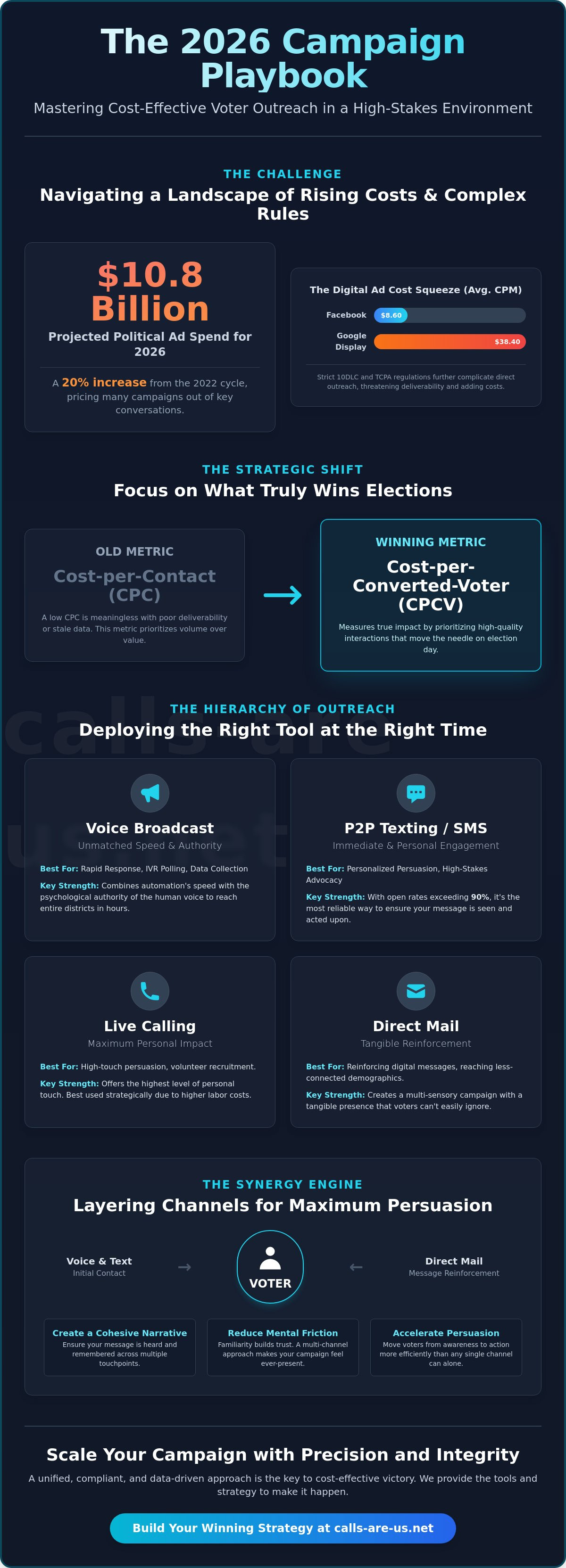
With political ad spending projected to hit $10.8 billion for the 2026 cycle, a 20% increase from 2022, many campaigns find themselves priced out of the very conversations they need to win. You've likely felt the squeeze as Facebook CPMs climb toward $8.60 and Google Display costs skyrocket to $38.40. It's frustrating to watch your budget evaporate into digital noise while strict 10DLC regulations and TCPA hurdles threaten to silence your most direct lines of communication. Achieving cost effective voter outreach in this environment requires more than just spending; it requires a sophisticated shift in strategy.
We're here to help you master the art of high-impact voter contact without overextending your resources. By leveraging multi-channel synergy and data-driven insights, you can lower your cost-per-converted-voter and build a scalable operation that works across entire states. This guide provides a roadmap for integrating peer-to-peer texting, direct mail, and live calling into a unified engine. You'll learn how to navigate the latest regulatory shifts, maximize the impact of every touchpoint, and turn limited volunteer capacity into a formidable force for change.
Key Takeaways
Shift your focus from the cost of a single message to the cost of a converted voter. You'll learn how to prioritize high-ROI interactions that move the needle on election day.
Discover how to layer Voice Broadcast, texting, and direct mail to create a cohesive narrative. This integrated approach reduces mental friction and accelerates voter persuasion.
Protect your budget from the efficiency tax of carrier filtering and regulatory fines. Navigating 10DLC and TCPA compliance is a critical step in maintaining cost effective voter outreach while ensuring your messages land.
Master the hierarchy of outreach by matching specific tools to your tactical goals. Choosing the right channel, whether it's the speed of automation or the authority of a live call, is key to maximizing reach.
Scale your campaign with the precision of a local operation by integrating your communication tools into a single workflow. A unified approach provides the data-driven insights needed for rapid, informed decision-making.
Table of Contents
Rethinking the Budget: What Truly Defines Cost-Effective Voter Outreach?
The Hierarchy of Outreach: Comparing High-Volume Tools by ROI
Optimizing the Mix: Strategic Multi-Channel Integration for 2026
Avoiding the Efficiency Tax: Compliance and Deliverability as Cost Savers
Scaling with Integrity: Why Calls-Are-Us is the Strategic Choice for National Campaigns
Rethinking the Budget: What Truly Defines Cost-Effective Voter Outreach?
Efficiency isn't just about spending less. It's about winning more. In a cycle where total political spending is projected to reach $10.8 billion, every dollar must perform with clinical precision. Viewing voter contact as a simple line-item expense is a strategic mistake; it's an investment in persuasion, trust, and mobilization. Many campaigns fall into the trap of choosing the lowest bidder. They often find their messages blocked by carriers or ignored by the electorate because "cheap" tools lack the infrastructure to handle modern regulatory hurdles. True cost effective voter outreach prioritizes the end result over the initial price tag by focusing on the quality of the connection.
To better understand how to refine your campaign's core message for maximum impact, watch this helpful video:
The CPC Advantage: Measuring What Matters
Success in modern Get-out-the-vote (GOTV) efforts requires a shift from Cost-per-Contact (CPC) to Cost-per-Converted-Voter (CPCV). A low CPC is meaningless if deliverability is poor or the data is stale. You must analyze the math of volume, deliverability, and response rates to find the real value in your spend. High-integrity data serves as the foundation of this strategy, ensuring you don't waste resources on disconnected numbers or non-voters. Cost-effective outreach is the balance between reaching the widest possible audience and achieving the highest possible conversion rate.
The Human Element in Digital Scalability
Scalability shouldn't come at the cost of sincerity. While manual canvassing is effective, it simply cannot reach the volume required for statewide success in 2026. You need tools that offer automated efficiency while maintaining a warm, human-centric tone. Sophisticated messaging strategies increase trust and engagement without requiring an increase in your budget. By moving away from generic outreach and toward tactical engagement, you turn a simple broadcast into a meaningful conversation. This approach ensures your campaign remains both authoritative and approachable, even when communicating with millions of voters at once.
The Hierarchy of Outreach: Comparing High-Volume Tools by ROI
Every channel in your arsenal has a specific tactical job to do. Success in 2026 doesn't come from using every tool available; it comes from deploying the right tool at the right moment to maximize impact. Voice Broadcasting offers the unparalleled speed of automation combined with the psychological authority of the human voice, making it ideal for rapid response. Meanwhile, SMS and Peer-to-Peer (P2P) texting provide immediate engagement for time-sensitive mobilization. When these digital and telephonic efforts are reinforced by the tangible presence of direct mail, you create a multi-sensory campaign that voters simply can't ignore. Balancing these channels is the secret to cost effective voter outreach that actually moves the needle.
Voice vs. Text: Which Wins on Efficiency?
Efficiency depends on your immediate goal. Voice Broadcasting excels at rapid-fire data collection and Interactive Voice Response (IVR) polling, allowing you to gauge public sentiment across an entire district in hours. Conversely, P2P texting is the gold standard for personalized persuasion and high-stakes advocacy. With text message open rates regularly exceeding 90%, it's the most reliable way to ensure your message is seen. While live calling centers offer the highest level of personal touch, they carry higher labor costs compared to automated systems. Smart managers use automated voice for broad reach and reserve P2P texting for deep engagement, ensuring every dollar spent is optimized for the specific stage of the voter journey. Understanding the infrastructure behind these systems, much like the insights found in The Future of Voter Registration, helps you build a more resilient outreach engine.
Direct Mail as a Strategic Support
Physical mail remains a high-ROI tool for a simple reason: it's harder to ignore. A post-2024 election study found that 57% of voters felt direct mail was more difficult to overlook than online or TV ads. It serves as a strategic anchor for your digital efforts, especially when targeting older, high-propensity voter blocs who value traditional communication. You can reduce waste and lower costs by using digital triggers to time mail delivery, ensuring a postcard arrives just as a voter receives a follow-up text. This hyper-targeted approach minimizes the "efficiency tax" of broad, unsegmented mailers. If you're looking to refine your channel mix, you might consider how a comprehensive suite of outreach tools can streamline your operations and improve your overall ROI.
Tactical integration is the final piece of the puzzle. By layering these tools, you ensure that your campaign isn't just loud, but effective. You're not just reaching voters; you're building a cohesive narrative that resonates across every device and every mailbox in your district.
Optimizing the Mix: Strategic Multi-Channel Integration for 2026
Integrated outreach reduces the mental friction voters feel when they encounter fragmented, disconnected political messages. It moves them toward a firm decision faster by building a sense of familiarity and trust. When your campaign speaks with one voice across multiple platforms, you aren't just repeating a slogan; you're creating a cohesive narrative that resonates deeply. Strategic layering of Voice Broadcast, texting, and direct mail ensures your message remains top-of-mind without becoming an annoyance. This synchronized approach is the most reliable way to achieve cost effective voter outreach in a crowded 2026 media environment.
Execution requires a disciplined framework to ensure resources aren't wasted on redundant efforts. To help your team stay organized during the final push, we've developed How to Run a GOTV Campaign in 2026: The Professional Outreach Checklist. This resource bridges the gap between high-level strategy and daily operational success.
The Integrated Campaign Workflow
A successful multi-channel strategy follows a logical progression that respects the voter's journey. You can maximize your ROI by following this three-step sequence:
Step 1: Broad-reach Voice Broadcast. Use automated IVR systems to identify supporter leanings early. This high-volume tool allows you to segment your audience based on their responses, ensuring you don't waste expensive resources on voters who are already committed elsewhere.
Step 2: Targeted SMS Follow-ups. Once you've identified your base, use mass texting or P2P texting to "warm" these supporters. These quick, mobile-first touchpoints keep your candidate's name and key issues fresh in their minds as the election approaches.
Step 3: Direct Mail Reinforcement. Reserve your direct mail budget for voters in the most competitive districts. A physical postcard serves as a tangible anchor that reinforces the digital and telephonic messages they've already received.
Data-Driven Re-Targeting
Real-time analytics are the greatest cost-saver in a modern campaign. You shouldn't spend a single cent contacting a voter who has already cast their ballot or converted to a donor. Unified reporting allows you to see exactly where each voter stands, preventing the operational waste of over-contacting. This is particularly important for maintaining trust; voters often become frustrated when they receive multiple texts or calls after they've already engaged with your campaign. Multi-channel synergy lowers the overall cost of persuasion by reinforcing the candidate’s message across different psychological touchpoints without requiring redundant, high-cost interactions. By integrating your data streams, you ensure that every Voice Broadcast and every text message is a purposeful step toward victory.
Avoiding the Efficiency Tax: Compliance and Deliverability as Cost Savers
Efficiency is often stolen by the obstacles you never see. While many campaign managers obsess over the sticker price of a text or a call, they often overlook the "efficiency tax" that quietly drains their resources. This tax comes in the form of carrier filtering, regulatory fines, and the operational cost of messages that simply never reach their destination. Achieving true cost effective voter outreach requires a proactive approach to compliance that ensures every cent of your budget is working toward voter contact, not being swallowed by penalties or technical blocks.
Protecting your campaign from these hidden costs starts with understanding the technical landscape of 2026. If you're utilizing automated tools, you should consult The Ultimate Guide to Political Voice Broadcasting in 2026 to ensure your strategy aligns with the latest industry standards. Compliance isn't just a legal hurdle; it's a deliverability strategy that keeps your lines of communication open and your budget intact.
Maximizing SMS Deliverability
Registration is now the non-negotiable price of admission for text-based outreach. As of February 2025, major U.S. carriers block 100% of unregistered 10-digit long code (10DLC) traffic. If your campaign hasn't properly registered through The Campaign Registry, your outreach efforts will fail before they even begin. Beyond registration, you must actively avoid carrier spam filters by practicing message variance. Sending identical messages to thousands of voters triggers automated blocks, leading to "ghosted" messages where you pay for the send but the voter never sees the content. You can maintain high deliverability by rotating your copy, using personalized fields, and avoiding high-risk keywords that signal automation to carrier algorithms.
Legal Safety as a Budget Protector
Litigation is the ultimate budget killer for any political operation. Under the Telephone Consumer Protection Act (TCPA), violations can result in fines ranging from $500 to $1,500 per individual call or text. For a campaign operating at scale, even a small compliance oversight can lead to catastrophic financial liability. Implementing robust opt-out management is essential for maintaining long-term list health and legal safety. Professional vetting of your Voice Broadcast and texting campaigns ensures that you're honoring consent revocation requests, which must be processed within 10 business days as of April 2025. By building these safeguards into your workflow, you maintain your outreach momentum without risking the integrity of your campaign's finances. If you need a partner to help you navigate these complex requirements, you can explore our fully compliant outreach solutions to ensure your messages always land safely.
Scaling with Integrity: Why Calls-Are-Us is the Strategic Choice for National Campaigns
National campaigns demand a rare combination of massive reach and surgical precision. You can't win a statewide race with fragmented tools or unreliable vendors that fail when the pressure peaks. Calls-Are-Us provides a comprehensive suite of Voice Broadcast, SMS, and direct mail services designed to function as a single, high-performance engine. This unified approach is the only way to maintain cost effective voter outreach when communicating with millions of citizens across diverse demographics. By consolidating your efforts under one roof, you eliminate the technical friction that often slows down large-scale operations and drains your budget. We don't just provide a service; we champion a philosophy of open, inclusive, and ethical communication that turns a simple contact into a lasting relationship.
The Calls-Are-Us Difference
Experience matters in high-stakes environments where every second counts. We've operated in over 40 states, supporting campaigns through the most intense election cycles in modern history. Our platform facilitates meaningful interactions through rigorous compliance standards that protect your campaign's reputation and build long-term voter trust. Whether you're deploying an IVR poll for instant feedback or a peer-to-peer texting campaign for deep persuasion, our infrastructure handles the volume without compromising on speed or data security. This balance of technological power and human-centric core values makes us a powerful ally in your pursuit of victory. To see how these pieces fit into a broader organizational plan, explore The Definitive Mass Communication Strategy Guide for 2026.
Next Steps for Your 2026 Strategy
Winning requires early preparation, seamless execution, and constant optimization. Integrating our tools into your existing campaign technology stack is straightforward, allowing your team to focus on the narrative rather than the troubleshooting. We're committed to your success and offer a clear path to achieving your goals. You can begin transforming your strategy today by following these steps:
Request a customized outreach audit to identify hidden cost-saving opportunities in your current communication plan.
Sync your voter files with our IVR and live calling center systems for real-time data updates and cleaner lists.
Coordinate your direct mail drops with digital triggers to maximize the psychological impact of every piece sent to the mailbox.
Our philosophy is rooted in the idea that technology should facilitate progress and foster genuine connection. If you're ready to move beyond the rising costs of traditional digital advertising, it's time to build a strategy that prioritizes high-ROI interactions. We're here to act as your principled guide through the complexities of modern political communication. Partner with Calls-Are-Us for scalable, high-impact voter outreach and ensure your message is heard, respected, and acted upon by the voters who matter most in 2026.
Mastering the Future of Voter Engagement
Victory in 2026 belongs to the campaigns that move beyond fragmented tactics and embrace a unified strategy. You've seen how true efficiency isn't found in the cheapest message, but in the most meaningful connection. By integrating Voice Broadcast, SMS, and Direct Mail, you create a narrative that is impossible to ignore. Protecting your budget from the efficiency tax of non-compliance ensures that every dollar reaches a real voter instead of a carrier filter. Implementing cost effective voter outreach is the baseline for success in an increasingly crowded and expensive media environment.
With experience in over 40 states and deep expertise in 10DLC and TCPA compliance, we provide the tools you need to scale with confidence. Our comprehensive multi-channel suite is built to handle the pressure of national outreach while maintaining the warmth of a local conversation. It's time to stop spending and start investing in results. Empower your campaign with high-ROI outreach solutions from Calls-Are-Us. You have the roadmap to lead with authority, connect with sincerity, and secure the win your movement deserves.
Frequently Asked Questions
How much does cost-effective voter outreach typically cost per voter?
Determining the exact cost per voter depends on the efficiency of your conversion funnel rather than just the price of a single contact. You should focus on your Cost-per-Converted-Voter (CPCV) by analyzing how data quality and channel selection impact your final turnout. High-integrity data and strategic multi-channel integration are the primary drivers of cost effective voter outreach. This approach ensures your budget is spent on high-propensity targets who are most likely to respond to your candidate's message.
Is automated voice broadcasting still effective for modern political campaigns?
Voice broadcasting remains a powerful tool for campaigns that need to deliver a message with speed and psychological authority. It's particularly effective for rapid-fire data collection and Interactive Voice Response (IVR) polling to gauge district sentiment. By using automated voice for broad reach, you can identify supporter leanings quickly. This allows your team to reserve more labor-intensive methods for the final persuasion push, maximizing both your time and your campaign's financial resources.
What is the most cost-effective way to reach younger voters?
Reaching younger voters requires a mobile-first engagement strategy that prioritizes high-visibility channels like Peer-to-peer (P2P) and mass texting. Voters under 45 primarily consume political information on their devices; therefore, your outreach must be optimized for small screens. Texting offers open rates exceeding 90%, which is significantly higher than traditional email. Combining these digital touchpoints with authentic, less-produced content helps build the trust necessary to move younger demographics from interest to action.
How does 10DLC registration affect my campaign budget?
10DLC registration is a critical operational investment that protects your campaign from the efficiency tax of carrier filtering. As of February 2025, major U.S. carriers block 100% of unregistered traffic, meaning your messages won't even reach the voter's inbox without it. While there is a registration process involved, it's far less expensive than the cost of failed outreach. Proper registration ensures your texts land safely, maintaining the integrity of your budget and your reach across the state.
Can I combine direct mail with digital outreach for better ROI?
Integrating direct mail with digital outreach creates a multi-sensory experience that reinforces your campaign's narrative. A post-2024 election study revealed that 57% of voters found direct mail harder to ignore than online or TV ads. You can optimize this by using digital triggers to time a mail drop just as a voter receives a follow-up text. This strategic layering reduces mental friction, builds candidate recognition, and ultimately delivers a much higher ROI than any single-channel approach.
What is the difference between P2P and broadcast texting in terms of cost?
Peer-to-peer (P2P) texting and mass texting serve different tactical roles based on your need for personalization versus volume. P2P texting involves manual sending by volunteers or staff, which makes it ideal for high-stakes advocacy and personalized persuasion. Mass texting is a high-volume tool designed for rapid mobilization and urgent updates. Choosing the right balance between these two methods is essential for maintaining cost effective voter outreach while ensuring your engagement feels authentic and purposeful.
How do I ensure my campaign texts are not marked as spam?
Maintaining high deliverability requires a combination of technical registration and smart messaging practices. You must utilize 10DLC registration and practice message variance to avoid triggering automated carrier spam filters. Rotating your copy and using personalized fields prevents your outreach from looking like generic automation. Additionally, you must honor all opt-out requests within the required 10 business days to protect your list health and ensure your campaign remains in good standing with major carriers.
What are the legal requirements for cost-effective automated calling?
Compliance with the Telephone Consumer Protection Act (TCPA) is the foundation of any automated calling strategy. As of February 2024, calls using AI-generated voices require prior express written consent, and all campaigns must honor consent revocation requests within 10 business days. Furthermore, political robocalls to residential landlines are limited to three calls within any 30-day period. Adhering to these regulations prevents catastrophic litigation fines and ensures your campaign operates with the highest level of integrity and transparency.



Comments