
Direct Mail vs. Digital Ads for Fundraising: How to Choose in 2026

What if the best fundraising channel isn’t the one with the clearest dashboard? Choosing between direct mail vs digital ads for fundraising means weighing a tangible appeal against paid online placements, especially when budgets are limited and donor behavior varies.
To compare the channels fairly, look beyond immediate clicks or gifts. Consider audience habits, campaign goals, timing, and the possibility that a message in one channel influences a response through another.
This guide explains how to choose based on what your campaign needs to accomplish. You’ll compare the strengths and limits of direct mail and digital advertising, plan how to track direct and assisted responses, and build a practical sequence you can refine using results. The aim is a coordinated approach that respects donor preferences, uses resources thoughtfully, and gives your team clearer evidence for what to do next.
Table of Contents
Direct Mail vs. Digital Ads for Fundraising: What Each Channel Does
How Direct Mail and Digital Ads Compare on Reach, Response, and Trust
Direct Mail vs. Digital Ads: A Fundraising Decision Framework
How to Plan and Measure a Fundraising Campaign Across Both Channels
Build a Fundraising Outreach Plan That Connects Mail and Follow-Up
Direct Mail vs. Digital Ads for Fundraising: What Each Channel Does
The right channel depends on who you need to reach, what you’re asking them to do, how quickly the campaign needs to move, and what you can measure. Direct mail puts a physical appeal in a selected audience’s hands. Digital ads are paid online placements that can bring people to a donation page or campaign experience. In direct mail vs digital ads for fundraising, the useful question isn’t simply which channel is better. It’s what role each can play in reaching people and helping them respond.
These channels also sit within a wider fundraising mix. Direct mail fundraising uses a physical format, while digital advertising is one form of paid online outreach. Email, peer-to-peer texting, and organic social posts are separate channels, each with different delivery methods and measurement considerations.
What counts as direct mail in a fundraising campaign?
Direct mail is a physical fundraising appeal delivered to a selected mailing audience. It might be an appeal letter, postcard, or another printed piece. Choose a format that gives the message enough space and makes the ask easy to understand. Include a clear response route, such as a donation page or return method, so recipients know what to do next. Audience selection and delivery timing also affect how relevant the appeal feels. Calls-Are-Us provides direct mail campaign management as part of fundraising outreach.
What counts as a digital ad for fundraising?
A digital ad is a paid placement on an online platform that directs people to donate or engage with a campaign. It may appear in search results, on a website, or within a platform’s ad space. Unlike email, peer-to-peer texting, or an unpaid social post, the organization pays for the placement. Paid digital advertising buys placement; owned outreach channels communicate through an organization’s existing email, text, or social accounts.
Define success before choosing a channel. Reach describes how many people an appeal or ad is presented to. Response means someone takes a measurable action, such as visiting a donation page or returning a response. A donation is a completed gift. Donor acquisition means gaining a new donor, not simply generating activity from existing supporters.
These outcomes aren’t interchangeable. An ad can reach people without prompting a visit, and a mailpiece can prompt interest that leads to a later online gift. Set the outcome first, then decide what to track. That way, impressions, clicks, responses, and donations aren’t treated as equivalent results.
How Direct Mail and Digital Ads Compare on Reach, Response, and Trust
Each channel has different strengths, but neither guarantees attention or giving. Direct mail offers a tangible appeal with planned delivery. Digital ads can be adjusted and tested quickly, though platform rules affect who sees them and how often. The better fit depends on the audience, campaign design, and outcome you’re measuring.
Which channel gives fundraisers better targeting and reach?
Mailing audiences are shaped by address data and the organization’s selection criteria. Ad audiences are shaped by the targeting options a platform makes available. In either case, use relevant data, thoughtful exclusions, and a clear connection to the mission. A broad audience may increase exposure without reaching likely supporters, while a carefully chosen group may be more relevant. Reach alone doesn’t show whether people paid attention, donated, or gave because of the campaign.
How do fundraising teams compare results fairly?
Report each stage separately: ad impressions, mail pieces delivered, visits, gifts, and donor retention. Someone might see an ad, receive a letter, and then give through a bookmarked page. Last-touch reporting can miss earlier influence. The Direct mail vs. digital marketing data can offer comparison context, but your own audience and campaign design should guide decisions.
A tracked response shows a connection to a campaign, not necessarily that the campaign caused an additional gift. Neither channel is automatically more trustworthy or effective for every donor. Compare similar audiences, use consistent campaign identifiers, and interpret results in light of who received each message. Calls-Are-Us can coordinate physical appeals through direct mail campaign management.
Direct Mail vs. Digital Ads: A Fundraising Decision Framework
Choose the channel that fits the campaign your team can execute. Start a practical direct mail vs digital ads for fundraising decision with five questions:
Goal: Are you seeking gifts, introducing your mission to new people, or re-engaging supporters?
Audience: Can you identify a relevant mailing audience, or is online discovery central to reaching the people you want?
Ask: What action should someone take, and can the channel make that action clear?
Timing: Does the campaign calendar allow for print production and mail delivery, or do you need a channel that supports faster testing?
Measurement: Can you track the response route and distinguish exposure, visits, and gifts?
Next, consider execution constraints. Incomplete address data can weaken a mailing plan. Limited creative or landing-page capacity can make digital ads harder to run effectively. Staff time matters, too. A channel is practical only if your team can prepare the message, coordinate delivery, and review results.
When should a fundraiser prioritize direct mail?
Consider mail when you can identify a relevant audience and prepare a clear physical appeal. Allow time for production and delivery, review mailing-list quality, and give recipients a trackable response route, such as a campaign-specific donation page. These steps connect the piece to the ask and make the campaign easier to assess. For political fundraising, apply the same attention to audience and timing when planning a political direct mail strategy.
When should a fundraiser prioritize digital ads?
Paid ads may fit when online discovery or a direct path to digital giving is central to the campaign. Before launch, prepare the creative, check that the donation page works smoothly, and confirm that the platform’s available targeting options can reach the intended audience. Decide in advance how to measure visits and completed gifts. Ad platforms can support creative testing, but your team still needs time to review performance and refine the campaign.
The decision doesn’t have to be exclusive. A physical appeal can reach known supporters while paid ads help people discover the campaign online. Give each channel a distinct role, keep the ask consistent, and plan follow-up your team can manage. Calls-Are-Us provides direct mail campaign management, which can sit within a broader outreach sequence alongside voice or text follow-up. Choose a lead channel based on audience fit and readiness to execute, then use results to guide the next campaign.
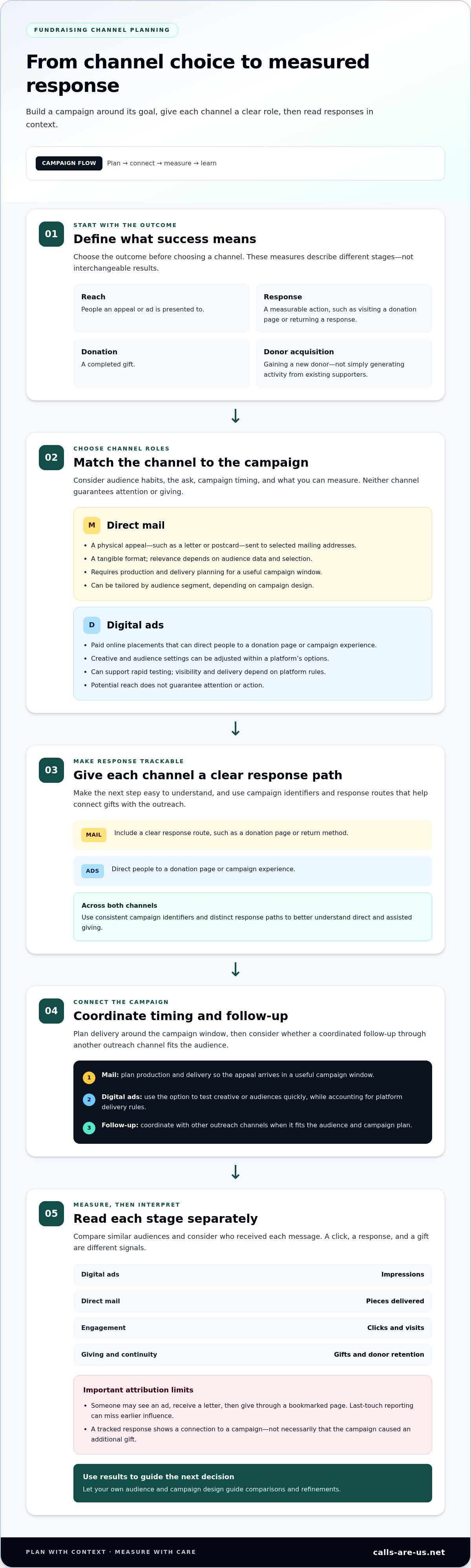
How to Plan and Measure a Fundraising Campaign Across Both Channels
A coordinated campaign needs one plan and a shared definition of success. Use these five steps to connect direct mail and digital ads while keeping response data useful:
Set the goal. Decide whether the campaign is meant to raise gifts, reach new supporters, or encourage another specific action.
Define the audience. Identify who each channel is meant to reach and note exclusions that prevent irrelevant or duplicate outreach.
Coordinate the creative. Align the core message, fundraising ask, and donation destination so the campaign feels connected across formats.
Track the response. Use consistent campaign names, distinct response paths where practical, and a shared process for recording gifts.
Review the results. Compare each channel’s exposure, visits, donations, and retention separately, then use what you learn to refine the next campaign.
For a first test, keep the scope manageable. Choose a defined audience and campaign window, set up tracking before launch, and review the results before expanding. This helps your team assess execution without assuming every gift recorded during the campaign came from one message.
What should a fundraising campaign track?
Separate delivery from action. Record mailed pieces sent or delivered and digital ad impressions as exposure measures. Then track donation-page visits, completed gifts, and donor retention as distinct outcomes. Use consistent campaign names across reports. For digital links, add UTM parameters so analytics can identify the campaign and source. For mail, record response details in the CRM using an agreed naming and entry process. Donation forms, campaign links, and CRM records are easier to reconcile when they use compatible identifiers.
How can direct mail and digital ads reinforce one another?
Keep the central message and ask aligned, while adapting each channel to its format and audience. A mailpiece might direct supporters to the same donation destination promoted in a paid ad. Digital reminders or other follow-up can reinforce the appeal when audience permissions and applicable rules allow. For broader coordination across outreach channels, develop a mass communication strategy that gives each message a clear role.
Interpret combined results with care. A donor might encounter a digital ad, receive a mailed appeal, and then give through a saved link. Attribution can show which response path was recorded, but it can’t always establish which message caused the gift. For direct mail vs digital ads for fundraising, consistent tracking supports comparison, while a small test and cautious interpretation help teams make better decisions.
Calls-Are-Us supports coordinated outreach with direct mail campaign management and complementary voice and text options. Plan your fundraising outreach with a clear role for each channel and a measurement process your team can maintain.
Build a Fundraising Outreach Plan That Connects Mail and Follow-Up
A strong outreach plan gives every message a job. Your lead channel should fit the audience, fundraising objective, and operational capacity. Follow-up should make it easier for supporters to respond, not create a disconnected stream of asks. Use this checklist to turn a channel decision into a workable plan:
Define the audience and objective. Specify who you want to reach and what you’re asking them to do.
Set the core message. Keep the purpose and fundraising ask consistent across the mailpiece and follow-up.
Map the channel sequence. Choose the lead channel, then decide whether voice or text outreach should support it and when.
Provide a clear response path. Make it easy to give or respond, and use campaign identifiers that connect activity to the outreach.
Assign ownership. Name who will coordinate production, monitor delivery, handle donor responses, and report results.
Schedule a review. Compare responses with the original objective, note gaps in execution, and use the findings to refine future outreach.
What should a fundraising outreach plan include?
Put the audience, objective, message, channel sequence, and response path in one shared plan. Assign an owner to each task and set a review point after the campaign. For example, a mailed appeal might lead, with planned voice or text follow-up for an appropriate audience. Keep the sequence within your team’s capacity and in line with donor preferences instead of adding messages without a clear purpose.
How can Calls-Are-Us support coordinated outreach?
Calls-Are-Us provides direct mail campaign management alongside voice broadcast, mass texting, peer-to-peer texting, live calling, and Interactive Voice Response (IVR). These services can support a broader outreach sequence: mail can carry the appeal, while voice or text channels provide complementary follow-up or a way to engage and collect audience responses. Choose the mix according to your campaign needs and the people you’re trying to reach.
The decision behind direct mail vs digital ads for fundraising comes down to fit: which channel can reach your intended audience with a clear ask, and how will your team support and assess the response? For help connecting direct mail with follow-up outreach, Explore Calls-Are-Us outreach capabilities.
Choose Your Next Fundraising Channel with Confidence
Build your channel plan around your audience, fundraising objective, timeline, and ability to measure what happens next. Direct mail can provide a tangible appeal with planned delivery, while digital ads can support online discovery and testing. Neither works apart from the ask and response path. Choose a lead channel that fits your campaign, then track exposure, visits, gifts, and donor retention as distinct outcomes.
That’s the practical answer to direct mail vs digital ads for fundraising: match the channel to the people you need to reach, coordinate follow-up, and use campaign results to refine your next step. Calls-Are-Us supports direct mail campaign management alongside voice broadcast, text outreach, live calling, and IVR. The company has operated in over 40 states supporting national and local elections.
Explore Calls-Are-Us outreach capabilities to plan how direct mail and complementary outreach can support your next campaign. With a clear plan and thoughtful measurement, your team can make more confident choices and build stronger connections with the people behind your mission.
Frequently Asked Questions
Is direct mail or digital advertising more effective for fundraising?
Neither channel is automatically more effective. Results depend on your audience, fundraising ask, campaign timing, and measurement plan. Direct mail may suit an appeal that benefits from a physical format and planned delivery. Digital ads may help people discover a campaign or reach an online giving page. To assess direct mail vs digital ads for fundraising, compare similar audiences and track exposure, visits, gifts, and retention separately.
Can nonprofits use direct mail and digital ads in the same fundraising campaign?
Yes. Nonprofits can coordinate direct mail and digital ads in one campaign. Give each channel a clear role, align the core message and ask, and direct supporters toward a consistent donation experience. For example, a mailed appeal can introduce the campaign while a paid ad offers another route to its giving page. Track responses by channel, but interpret combined results carefully because donors may encounter multiple messages before giving.
How do you measure the return on direct mail fundraising?
Track the number of pieces sent or delivered and the gifts connected to the appeal through a distinct response path, such as a campaign-specific donation page. Record campaign expenses and calculate net revenue or return using your organization’s consistent accounting method. Keep response, gift, and donor-retention measures separate. A gift associated with a mailing is useful attribution, but it doesn’t prove that the mailing alone caused the donation.
How can a nonprofit track donations that follow a digital ad?
Use tagged campaign links, such as URLs with UTM parameters, to identify ad-driven visits in your analytics. Keep campaign names consistent across ad reports, donation forms, and CRM records, and preserve source information when a donor completes a gift. Review clicks, donation-page visits, completed donations, and later retention as distinct measures. These methods help identify recorded paths to giving, though they can’t always show whether an ad prompted a donation that otherwise would not have happened.
What should a fundraiser consider before choosing direct mail or digital ads?
Consider your fundraising objective, audience data, ask, campaign calendar, and team capacity. For mail, assess whether your mailing audience is relevant and whether you have time to prepare and deliver a physical appeal. For digital ads, consider creative readiness, the donation-page experience, available audience targeting, and measurement. Choose the channel your organization can execute well and evaluate fairly, rather than basing the decision on reach alone.
Do digital ads replace direct mail for fundraising?
No. Digital ads and direct mail have different formats and roles, so one doesn’t automatically replace the other. Ads can direct people to online giving and support message testing, while mail delivers a physical appeal to a selected audience. A nonprofit may prioritize one channel or combine them, depending on donor behavior, campaign goals, timing, and resources. Measure each channel’s contribution without assuming that exposure guarantees a gift.
How can direct mail and follow-up outreach work together?
Use the mailpiece to make a clear appeal, then plan follow-up that reinforces the same message and gives supporters a suitable response path. Depending on audience preferences and campaign needs, follow-up may include voice broadcast, texting, live calling, or an Interactive Voice Response system. Calls-Are-Us supports direct mail campaign management alongside these outreach options. Coordinate timing and track responses consistently so your team can learn from the combined effort.



Comments