
Emergency Notification Service for Business: The 2026 Buyer’s Guide to Resilient Communication

Updated: Jul 21
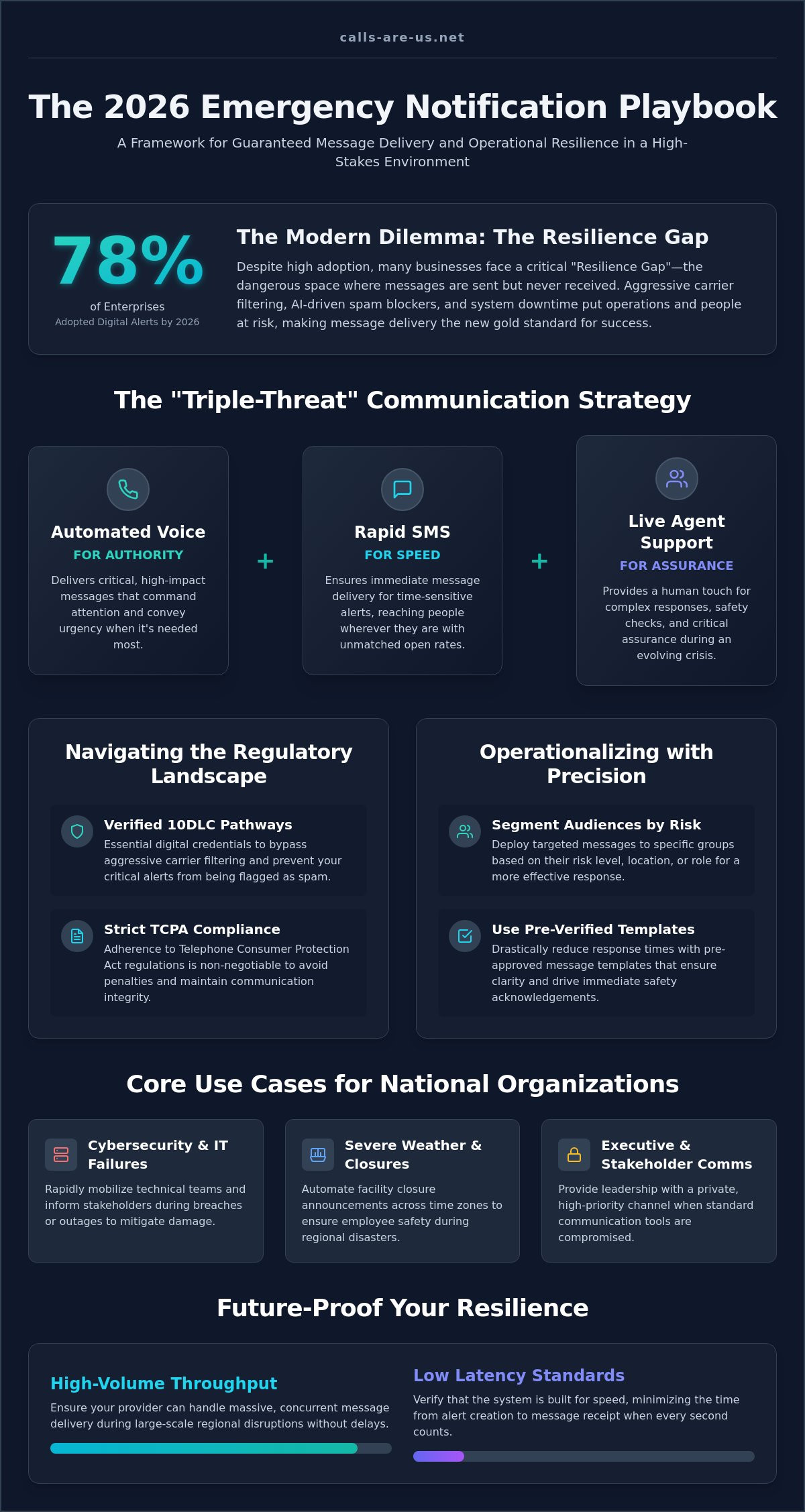
What if your most critical alert never reached its destination because a carrier flagged it as spam? In 2026, 78% of enterprises have adopted digital alert systems, yet many still struggle with the fear of SMS blocking or system downtime during a real crisis. Selecting a robust emergency notification service for business is no longer just about sending a text. It demands a sophisticated approach to TCPA regulations, message delivery, and operational continuity. When every second counts, a single point of failure puts your operations and your people at risk.
Resilience requires a strategy that never sleeps. We recognize the pressure of managing multi-channel responses while trying to verify who is safe and who needs immediate assistance. This guide provides a clear roadmap to safeguarding your operations through a resilient communication framework that guarantees delivery. You'll discover how to implement a "Triple-Threat" strategy using automated voice for authority, rapid SMS for speed, and live agent support for assurance. We'll break down how to maintain compliance with the latest 10DLC standards, maximize engagement rates, and foster a culture of safety that protects your team's most valuable asset, their trust.
Table of Contents
The Evolution of Emergency Notification Services for Business in 2026
Multi-Channel Architecture: Engineering a Fail-Safe Notification System
Essential Selection Criteria: Evaluating 2026 Regulatory and Technical Standards
Operationalizing Your Response: Designing a High-Impact Notification Protocol
Calls-Are-Us: Advanced Outreach Solutions for Resilient Organizations
The Evolution of Emergency Notification Services for Business in 2026
Speed is a commodity. In 2026, delivering an alert in seconds is no longer the benchmark for success; ensuring that message is actually read and acknowledged is the new gold standard. An emergency communication system is now defined as a strategic framework designed for rapid, multi-channel communication during critical disruptions. We've moved beyond the era of simple "mass blasting" into a period of high-stakes precision. A modern emergency notification service for business must navigate a digital environment that's more protective and restrictive than ever before.
2026 is defined by a landscape where carriers are more aggressive. The rise of AI-driven filtering means that unverified traffic is discarded without warning. This is why 10DLC (10-Digit Long Code) pathways are essential; they provide the digital credentials needed to pass through carrier gates. Intelligent outreach means your system understands which channel is most likely to reach a specific individual at a specific time. It's about being smart, being fast, and being certain. To better understand how public and private alert systems interact, watch this helpful video from the Federal Communications Commission:
The High Cost of Silence: Why Businesses Invest
Silence is the enemy of safety. When a major IT outage halts production, the financial bleeding starts immediately. A resilient emergency notification service for business provides the tourniquet. We see organizations moving toward these systems to satisfy both their duty of care and their bottom line. Regulatory pressure is also mounting. For instance, California's SB 294, the Workplace Know Your Rights Act, reflects a growing trend where failure to provide adequate emergency notifications can lead to penalties reaching $10,000 per employee. We define the "Resilience Gap" as that dangerous space where technology stops and human confusion begins; it's where messages are sent but never received, leaving people vulnerable and operations stalled.
Core Use Cases for National Organizations
High-stakes coordination requires more than just a "send" button. National organizations rely on these frameworks for diverse, high-pressure scenarios that demand 100% reliability. Resilience isn't a one-size-fits-all solution, and it typically involves three main pillars of outreach:
Cybersecurity and IT Failures: Rapidly mobilizing technical teams and informing stakeholders during system breaches or server outages to prevent lateral threat movement.
Executive Protection and Stakeholder Alignment: Providing leadership teams with a private, high-priority channel for coordination when standard email or chat tools are compromised.
Multi-Channel Architecture: Engineering a Fail-Safe Notification System
Redundancy is the cornerstone of resilience. Relying on a single communication vector during a crisis is a gamble that puts lives and operations at risk. A sophisticated emergency notification service for business must employ a multi-channel architecture to ensure that every alert penetrates the digital noise. This strategy involves a synchronized deployment of voice, text, and interactive feedback loops. By mirroring the standards of the Integrated Public Alert & Warning System (IPAWS), businesses can build a fail-safe environment that remains operational even when individual networks fail.
The Power of Voice Broadcast for Immediate Impact
Voice commands attention. In high-stress scenarios, the human voice carries an inherent authority and urgency that a standard text notification cannot match. We utilize Voice Broadcast to deliver clear, intrusive instructions that demand immediate focus. This is about more than just talking; it's about listening. Through Interactive Voice Response (IVR), recipients can confirm their status, request help, or acknowledge orders with a single touch. This level of enterprise-grade reliability leverages the same high-capacity infrastructure found in a political campaign call center, ensuring that thousands of calls reach their destination without latency.
Strategic SMS: Balancing Speed and Deliverability
Speed defines the first response. Mass Texting (SMS/MMS) serves as the primary vector for immediate situational awareness, delivering critical data directly to the user's pocket. To succeed in 2026, organizations must prioritize deliverability over simple volume. This means securing verified 10DLC pathways to bypass AI-driven carrier filtering that often blocks unauthenticated traffic. While short-code systems are built for massive throughput, long-code messaging allows for a more personalized and localized connection. Understanding the distinction between P2P vs broadcast texting is vital for choosing the right tool for specific crisis tiers.
Human assurance bridges the gap. While automation handles the initial surge, complex emergencies often require the nuance of a real person. Peer-to-Peer (P2P) texting allows for high-engagement safety checks that feel personal and supportive. If your organization faces a widespread disruption, partnering with a Live Calling Center ensures that every "Need Help" response from an IVR or text is met with an immediate, human follow-up. This integrated approach transforms a simple alert into a comprehensive lifeline.
Essential Selection Criteria: Evaluating 2026 Regulatory and Technical Standards
Trust is earned through delivery. In the high-stakes environment of 2026, an emergency notification service for business lives or dies by its ability to navigate the complex web of carrier regulations and technical throughput standards. Selecting a provider isn't merely a software procurement; it's a commitment to a partner that understands the legal and technical friction points that can silence a critical alert. A resilient system must authenticate identity, encrypt data, and guarantee delivery across every possible network condition.
Navigating the Compliance Landscape
Compliance is the non-negotiable foundation for every message you send. While the TCPA provides certain "Emergency Purpose" exemptions, these aren't a free pass to ignore carrier standards. In 2026, carriers use aggressive AI-driven filtering to protect their networks, and unverified traffic is often flagged as spam before it ever reaches a handset. Proactive 10DLC registration is essential to establish your organization's reputation as a trusted sender. Without a definitive mass communication strategy that includes pre-verified pathways, your most urgent notifications risk being discarded by the very networks they rely on. Professional management ensures your alerts are recognized as life-safety communications rather than intrusive noise.
Scalability and Infrastructure Redundancy
Latency is the enemy of safety. When a crisis occurs, you need a provider capable of handling thousands of calls and texts per minute without bottlenecking. True resilience requires a multi-carrier approach that avoids single points of failure common in basic cloud-based platforms. We evaluate infrastructure based on three primary pillars: diverse carrier relationships, real-time API uptime, and geographic redundancy. If one carrier experiences a regional outage, your emergency notification service for business must automatically re-route traffic to maintain momentum. High-volume throughput isn't just a technical spec; it's the difference between an alert that arrives in seconds and one that arrives too late.
Data sovereignty and security form the final piece of the selection puzzle. Your system holds sensitive employee contact information that must be protected with enterprise-grade encryption and strict access controls. Furthermore, ease of integration is vital for operational efficiency. Your notification framework shouldn't exist in a silo. It needs to connect seamlessly with your existing HRIS and Business Continuity Planning (BCP) software stacks to ensure contact lists are always accurate. This automated synchronization eliminates the manual errors that lead to missed connections during a real-world emergency. By prioritizing these technical and regulatory standards, you build a communication framework that's as reliable as it is resilient.
Operationalizing Your Response: Designing a High-Impact Notification Protocol
Sending an alert is only the beginning. In a crisis, the most sophisticated emergency notification service for business is merely a dormant tool until it is activated by a precise, battle-tested protocol. True communication isn't measured by the messages sent, but by the actions taken and the safety confirmed. You shouldn't be designing your strategy while the alarm is sounding. You need a repeatable, structured workflow that removes the burden of decision-making from your team when stress is at its peak.
To ensure your organization remains resilient, follow this methodical five-step framework for activation:
Segment your audience: Group recipients by geographic location, operational role, and immediate risk level to ensure information is relevant and actionable.
Craft channel-specific templates: Prepare clear, punchy, and pre-verified message scripts for Voice Broadcast, Mass Texting, and P2P channels to save vital seconds.
Establish a multi-wave delivery schedule: Deploy alerts in stages. For example, send an immediate SMS for speed, followed by an authoritative Voice Broadcast for those who haven't acknowledged the text.
Implement the feedback loop: Use Interactive Voice Response (IVR) or text-back polling to track safety in real-time. Knowing who is safe is important; knowing who isn't safe is critical.
Conduct live-fire drills: Regularly test your system’s throughput and your team's response behavior to ensure the technology and the people are in sync.
Message Crafting for High-Pressure Situations
Clarity saves lives. During an emergency, cognitive load increases and the ability to process complex instructions decreases. We utilize the "Hook-and-Elaborate" method for all scripts. Start with a short, assertive statement of the situation. Follow it with exactly one clear action. For example: "Fire Drill in Building B. Evacuate to the North Parking Lot immediately." Use IVR to triage responses automatically, allowing employees to press "1" for safe or "2" for assistance, which instantly prioritizes your help desk's outreach list.
Drills and Optimization
Static plans are a liability. A protocol that hasn't been tested in six months is a plan that might fail when you need it most. We recommend conducting quarterly communication audits to identify "Dead Zones" where cellular signals are weak or contact data is outdated. By analyzing real-world delivery metrics from your drills, you can refine your templates and adjust your multi-wave timing for maximum impact. If you're ready to build a protocol that stands up to real-world pressure, see how Calls-Are-Us can help you architect a resilient response system.
Refining the protocol based on real-world delivery metrics ensures that your emergency notification service for business evolves alongside your organization. This proactive approach transforms a simple alert system into a comprehensive lifeline that fosters trust and guarantees safety when every second counts.
Calls-Are-Us: Advanced Outreach Solutions for Resilient Organizations
Technology is a tool, but partnership is the solution. Software alone cannot solve a human crisis. While many platforms offer automated alerts, Calls-Are-Us provides the authoritative partnership required for high-volume, high-stakes outreach. We understand that an emergency notification service for business is only as effective as its ability to bridge the gap between a sent message and a confirmed response. Our approach combines cutting-edge automation with a human-centric core, ensuring that your organization remains resilient when standard systems falter. We don't just deliver data; we deliver certainty.
The true advantage lies in our Live Calling Center. During complex disruptions, an automated text might not be enough to provide the assurance your people need. Our agents provide immediate follow-up and real-time polling, transforming raw data into meaningful dialogue. We also integrate long-term recovery tactics, adapting principles from a political direct mail strategy to ensure that even if digital networks remain unstable, your physical outreach remains impactful. This comprehensive integration of Voice, Text, and Direct Mail creates a safety net that software-only platforms simply cannot match. It allows your organization to maintain a presence across every possible touchpoint, fostering trust even in the aftermath of a disaster.
Our Technology, Your Peace of Mind
Speed and certainty drive our infrastructure. We utilize high-velocity Voice Broadcasting and IVR systems engineered for zero-failure delivery. These systems are built to handle the immense throughput required for national organizations without compromising on latency. Our team manages the complexities of 10DLC registration and carrier relations, ensuring your critical texts reach every mobile device without being intercepted by AI-driven filters. We're committed to ethical, inclusive, and transparent communication. This means your alerts are delivered with the respect and clarity your employees deserve, reinforcing your brand's integrity during its most vulnerable moments.
The Calls-Are-Us Difference
Experience matters in high-pressure environments. With over 15 years of expertise in national outreach, we act as a mentor to help you design and execute a notification strategy that works. We've operated at the highest levels of influence, and we bring that same weight of authority to your business continuity planning. Our team doesn't just hand you a login; we partner with you to architect a resilient communication framework tailored to your specific operational risks. We believe in fostering connections that empower people and protect the future of your organization. Partner with Calls-Are-Us for your business continuity needs.
Future-Proofing Your Business Continuity
Resilience isn't a static destination; it's a constant state of readiness. We've explored how a modern emergency notification service for business must balance high-velocity automation with the precision of verified carrier pathways and the empathy of human outreach. By integrating Voice Broadcast, 10DLC-compliant SMS, and real-time safety polling, you create a fail-safe environment that protects your most valuable assets. Success in 2026 requires moving beyond simple mass alerting toward an intelligent, multi-channel strategy that guarantees delivery when every second counts.
You don't have to navigate these technical and regulatory complexities alone. Calls-Are-Us brings over 15 years of high-pressure outreach expertise to your organization, offering national coverage and an integrated Live Calling Center for that critical human-to-human assurance. This partnership transforms your crisis protocol from a dormant plan into a dynamic, reliable lifeline. It's about combining sophisticated technology with a human-centric core to foster connections that matter most during a disruption.
Secure Your Organization with a Calls-Are-Us Emergency Notification Strategy
Your team's safety is the ultimate metric of success. Build a communication framework that honors their trust and guarantees your operational resilience for years to come.
Frequently Asked Questions
What is the difference between an emergency notification service and a standard SMS marketing tool?
An emergency notification service for business differs from marketing tools through its focus on mission-critical reliability and regulatory compliance. While marketing platforms prioritize clicks and conversions, an ENS is engineered for high-velocity delivery across voice, text, and email. It utilizes dedicated, pre-verified pathways to ensure messages penetrate network congestion during a crisis. Standard tools often lack the throughput and the "Triple-Threat" redundancy required to safeguard your people when every second counts.
Is an emergency notification service for business required by law for employee safety?
Legal requirements are becoming more stringent across many jurisdictions. In 2026, regulations like California's Workplace Know Your Rights Act (SB 294) mandate that employers provide clear, timely notifications regarding workplace safety and employee rights. Failure to comply can result in significant penalties, sometimes reaching $10,000 per employee. Beyond specific statutes, businesses have a fundamental "duty of care" to protect their workforce, making a resilient notification framework both a legal necessity and an ethical imperative.
How does 10DLC compliance affect emergency alerts for businesses in 2026?
10DLC compliance is the digital foundation of message deliverability. This standard requires businesses to register their brands and use cases with carriers to prevent alerts from being flagged as spam. For an emergency notification service for business, 10DLC registration acts as a trusted credential. It guarantees that high-volume emergency texts bypass AI-driven carrier filters, ensuring your critical instructions reach their destination without being silenced by aggressive network security protocols.
Can I send voice broadcasts and text messages simultaneously through one platform?
Yes, you can trigger multi-channel alerts simultaneously through a unified platform. Our framework allows you to launch Voice Broadcasts, Mass Texting, and IVR sequences with a single command. This synchronized approach maximizes the probability of contact, reaching employees whether they are at their desks, in the field, or away from their data connections. Orchestrating these channels together eliminates the latency of manual deployment and ensures a consistent, authoritative message reaches everyone at once.
What happens if an employee does not have a smartphone or data connection during an alert?
Resilience requires reaching people where they are, not just where they are online. If an employee lacks a data connection or a smartphone, our system utilizes Voice Broadcast to reach standard mobile phones and landlines directly. For long-term recovery or permanent facility updates, we can even deploy direct mail. This multi-vector strategy ensures that your communication remains inclusive and effective, regardless of the individual's specific technology or local network availability during a disruption.
How quickly can an emergency notification service deliver messages to 10,000+ employees?
Delivery happens in seconds, not minutes. High-velocity systems are engineered to handle massive throughput, capable of launching thousands of calls and texts per minute. For a workforce of 10,000+ employees, a professional platform ensures that the initial wave of notifications is received almost instantaneously across the entire organization. Real-time reporting allows you to monitor these delivery rates as they happen, providing immediate visibility into who has received and acknowledged the alert.
Does Calls-Are-Us offer live agent support for crisis management follow-up?
We provide a dedicated Live Calling Center to bridge the gap between automation and human assurance. While automated alerts handle the initial surge, complex crises often require the nuance of a real person. Our live agents can conduct safety follow-ups, manage detailed polling, and provide personalized support to employees who indicate they need help through an IVR or text response. This human-centric layer ensures that no individual is left behind during a high-stakes emergency.
Can I integrate my existing employee database with an emergency notification system?
Integration is a critical component of system accuracy. You can seamlessly connect your existing HRIS, payroll, or Business Continuity Planning software with our platform to automate contact list management. This synchronization ensures that your employee database is always current, reflecting new hires, role changes, and updated contact information without manual data entry. Accurate data is the first step toward a successful response, ensuring your alerts reach the right people every time.



Comments