
Getting Survey Responses from a Large Group: A Practical 2026 Guide

A high response count can still produce a misleading survey. When getting survey responses from a large group, the goal isn’t simply to collect more answers. It’s to hear from the right people, ask questions they can answer clearly, and choose outreach methods that fit how they can be reached.
If you’re deciding between digital outreach, phone-based collection, or a mix of channels, start by considering who might be missed by each option. Even a strong response rate can hide gaps if some parts of your intended audience are less likely to participate. A practical plan helps you encourage participation while keeping representation, response quality, and how you’ll use the findings in view.
This guide covers the process from research goal to analysis: define whose input you need, write concise and neutral questions, match distribution to your audience, and follow up thoughtfully. It also explains when voice broadcast with IVR may suit structured questions and when live agents can support more nuanced conversations. The aim is to turn broad outreach into clear, actionable feedback.
Table of Contents
Getting survey responses from a large group starts with a clear research goal
Design a survey that earns responses and produces useful data
Choose the right channel for collecting responses from a large group
Launch, monitor, and improve a large-group survey step by step
Turn survey responses into trustworthy findings and a clear next step
Getting survey responses from a large group starts with a clear research goal
Start with the decision, not the questionnaire. Are you exploring what people think, measuring how common an experience is, or comparing feedback across groups? Your answer determines who you need to hear from and what evidence will be useful. For planning purposes, define a survey response as a completed, usable set of answers, not a link click or a partial submission that cannot address the research question.
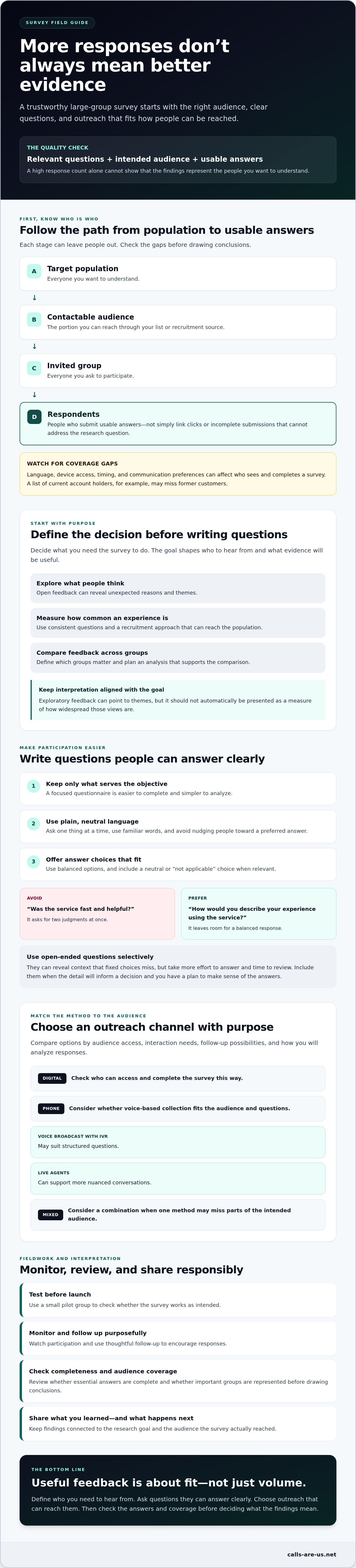
Keep four groups distinct: the target population is everyone you want to understand; the contactable audience is the portion you can reach; the invited group is everyone you ask to participate; and respondents are those who submit usable answers. The gap between these groups matters. A large response count alone cannot show that findings represent the target population if some people were never reachable or were less likely to respond. Survey methodology provides a useful foundation for understanding how sampling, questionnaire design, and response quality work together.
Survey quality depends on fit: the right audience answering relevant questions in a way that supports the decision at hand. Set practical targets for usable completions and coverage of important audience segments, but don’t treat a universal response-rate benchmark as proof of quality.
What does a large-group survey need to accomplish?
Translate the decision into specific information needs before writing questions. If you’re exploring why customers stopped using a service, invite open feedback that may reveal unexpected reasons. If you need to describe how common a known issue is across a population, use consistent questions and a recruitment approach that can reach that population. Exploratory feedback can point to themes, but it shouldn’t automatically be presented as a measure of how widespread those views are.
Define success in usable terms: complete answers to the essential questions, enough participation to support your planned analysis, and coverage of the groups whose perspectives matter. The right targets depend on the purpose, audience, and method.
Who should receive the survey?
Set inclusion criteria using characteristics that connect to the research question, such as location, role, behavior, or prior experience. Then check whether your contact list or recruitment source actually reaches people who meet those criteria. For example, a list of current account holders won’t necessarily include former customers whose reasons for leaving you want to understand.
Look for barriers before choosing how to invite people. Language, device access, timing, and communication preferences can affect who sees the survey and who can complete it. Plan for those differences so the collected answers reflect the intended audience more closely, rather than only the people who are easiest to reach.
Design a survey that earns responses and produces useful data
A focused survey respects people’s time and gives you cleaner evidence. Keep only questions that contribute to the research objective. If an answer won’t help you interpret a result or make a decision, consider removing the question. A shorter, purposeful questionnaire is easier to complete and simpler to analyze across a large group.
Make every question accessible and precise. Use familiar language, ask one thing at a time, and include clear instructions. Avoid wording that nudges participants toward a preferred answer. For example, “How easy was it to use the service?” assumes the experience was easy; “How would you describe your experience using the service?” leaves room for a balanced response. The survey research best practices guide from Washington State University offers further guidance on developing and fielding a survey.
How do you write questions people can answer accurately?
Make answer choices clear and appropriate to the question. For a satisfaction question, a balanced scale should offer meaningful options on both sides, along with a neutral or “not applicable” choice when relevant. Avoid combining separate topics: “Was the service fast and helpful?” asks for two judgments, so someone who found it fast but unhelpful can’t answer cleanly.
Use open-ended questions selectively. They can reveal context that fixed choices miss, but they take more effort to answer and time to review. Include them when the detail will inform a decision and you have a plan to make sense of the answers.
How can you protect response quality?
Test the survey before launch. Ask a small pilot group similar to the intended respondents to complete it and flag unclear wording, confusing answer choices, technical issues, and repetitive or burdensome sections. Check that responses are captured as intended and that participants can finish on the devices and through the channels you plan to use. Revise the survey, then test again if key problems remain.
Use eligibility questions only when they’re needed to include the right respondents. After collection, apply documented criteria to review incomplete submissions, possible duplicates, inconsistent answers, and unusually fast completions. Don’t discard responses based on a hunch. Record the reason for any exclusion and apply the same rule consistently.
Be transparent about who is collecting responses, how the information will be used, and how participants can ask questions. Before launch, verify which privacy requirements apply to your survey and audience. Accessible question design supports completion and makes answers easier to interpret. If structured phone questions fit your survey, review voice broadcast and IVR options as part of your collection plan.
Choose the right channel for collecting responses from a large group
The best channel is one your intended respondents can access and that suits the questions you need to ask. Online surveys can be convenient, but convenience doesn’t guarantee reach: you still need a usable way to contact people, and they need to use that channel. Compare options by the audience you can reach, the interaction your questions require, accessibility, follow-up, and how you’ll review the data.
Assess the options against your survey purpose and resources, rather than choosing a channel solely for its potential reach. Calls-Are-Us outreach and response-collection services can be considered as components of a broader collection plan.
When do online surveys, text, and email fit best?
Use an online form when respondents can open the link and answer independently. Text can work for a short, mobile-friendly interaction or as an invitation to a survey; email fits when you have a relevant contact list and respondents are likely to use it. In each case, consider who may be missed because of limited device access, outdated contact details, or channel preferences.
When should you consider voice broadcast, IVR, or live calling?
IVR lets respondents answer structured questions using their phone keypad, making it an option when fixed choices are enough. Live agents can help when a survey benefits from conversation, clarification, or more complex responses. For more on human-led calling operations, see this political campaign call center guide. Getting survey responses from a large group depends on matching the channel to the audience and the kind of answer you need, not on reach alone.
Launch, monitor, and improve a large-group survey step by step
A strong launch is a managed process, not a single send. Use a small pilot to catch problems before they affect the full collection, then monitor participation and make careful, documented adjustments. This keeps the survey experience consistent and helps you spot groups that may need a different way to participate.
Finalize. Confirm the questionnaire, audience criteria, collection channel, invitation wording, and plan for handling responses.
Test. Run a small pilot with people similar to your intended respondents. Check whether questions are clear, the channel works as expected, the survey functions on likely devices, and answers are captured correctly.
Launch. Send invitations according to your plan. Explain why people are being asked, how to respond, and what to expect after completing the survey.
Monitor. Review usable completions and participation across the audience segments that matter. Early patterns can flag access or delivery issues, but they aren’t conclusive evidence about the wider population.
Follow up. Send planned reminders where appropriate, taking audience preferences and applicable requirements into account. Record when and where each reminder goes.
Close. End collection consistently, note the final counts and any outreach changes, and communicate what happens next to participants when practical.
What should you check before sending the survey?
Test the complete respondent journey through the channels and on the devices your audience is likely to use. Confirm that questions, answer options, instructions, and completion messages display and function as intended. Check that response data is recorded correctly and handled according to your plan. Prepare invitations and reminders in advance so messages stay consistent, respectful, and aligned with applicable requirements.
How can you adjust outreach without distorting results?
Compare participation across planned segments, such as regions or respondent types, and investigate groups that remain underrepresented. A reminder or suitable additional channel may help reach them, but record the timing, audience, and method so you can account for those differences during analysis. Avoid changing question wording once collection begins unless necessary. If you do, document when the change occurred and assess answers collected before and after separately.
Coordinating messages across channels takes planning. For broader guidance on aligning outreach, see the mass communication strategy guide. A disciplined process for getting survey responses from a large group can improve access without mistaking early participation for a complete picture. Survey outreach and response-collection options are one part of planning your next campaign.
Turn survey responses into trustworthy findings and a clear next step
A completed survey is evidence, not automatic proof of what an entire population thinks. Report what respondents said separately from conclusions about people who didn’t respond or weren’t reached. For example, “respondents who completed the survey reported…” is more accurate than claiming the result represents everyone unless the sampling approach supports that broader conclusion.
Before interpreting patterns, review the quality and reach of the collected data:
Eligibility and completeness: Confirm respondents fit the intended criteria and answered the questions needed for analysis.
Duplicates and inconsistencies: Apply documented review rules consistently, and note any records excluded from the findings.
Segment coverage: Check whether relevant groups are represented or whether some are missing or underrepresented.
Collection method and nonresponse: Consider how the invitation channel, recruitment source, and people who chose not to respond could shape the results.
Look for patterns in missing answers and participation, not just the overall total. If one audience segment is less likely to respond, its views may be less visible in the results. Question wording and the collection method can also influence answers, so describe these factors when they matter to interpretation.
How do you know whether responses are useful?
Useful responses address the research question and come from people who meet the intended eligibility criteria. If you need statistical precision, don’t assume a large response count is enough. Use an appropriate sample-size calculation or seek specialist review, and verify the calculation’s assumptions, including the population, sampling method, and level of precision you need. In your report, state who was invited, how responses were collected, what you excluded, and what limitations remain.
When can an outreach partner help with collection?
Outside support may be worth considering when the planned channel or volume requires additional coordination. Voice broadcast with IVR can collect structured keypad responses, while live calling can support conversations that need clarification or more nuanced answers. Before selecting a provider, assess audience fit, data handling, reporting needs, and how the work will coordinate with your wider survey plan.
For getting survey responses from a large group, match the outreach capacity you need with the interaction depth your questions require. Voice broadcast, IVR, and live calling options may form part of your collection plan, but no channel alone guarantees representative results.
Build a survey plan that turns feedback into action
Getting survey responses from a large group takes more than broad outreach. Start with the decision your survey needs to inform, ask focused and accessible questions, and choose channels that fit both your audience and the answers you need. Then pilot the experience, monitor participation across relevant groups, and review limitations before drawing conclusions.
Response totals matter, but reliable findings depend on who responded, how they were reached, and whether their answers address the research goal. A clear account of your methods and gaps helps decision-makers use the feedback responsibly.
Calls-Are-Us offers voice broadcast and IVR for high-volume outreach and keypad response collection, while live calling center operations can support polling and more nuanced human conversations. The company has operated in over 40 states supporting national and local elections. These options may suit different collection plans, but channel choice alone can’t guarantee representative results.
Discuss the right outreach and response-collection approach for your audience. A thoughtful plan and a commitment to listening can turn participation into clearer decisions and meaningful next steps.
Frequently Asked Questions
How do you get survey responses from a large group?
Start by defining what decision the survey should inform and who needs to answer. Write focused, accessible questions, then choose outreach channels your intended audience can use. Pilot the full experience, launch with a consistent invitation plan, and monitor usable completions across relevant audience segments. Getting survey responses from a large group is not just about increasing the count; check who participated, who may be missing, and whether the answers address your research goal.
What is a good response rate for a large-group survey?
There isn’t one response rate that makes every large-group survey good. Participation varies with the audience, topic, contact method, and relationship respondents have with the organization. Treat response rate as one monitoring measure, not proof that findings are reliable or representative. Also review whether respondents match your intended audience, whether key groups are missing, and whether answers are complete enough to use. Set a practical target based on your study’s purpose and analysis needs.
How many survey responses do I need for reliable results?
The number depends on what you want to conclude, the size and diversity of the population, your sampling approach, and the precision required. A broad exploratory survey may help identify themes without supporting precise population estimates. If you need statistical precision, use a sample-size calculation based on explicit assumptions, such as confidence level and margin of error, and verify those assumptions with a research specialist. A large count cannot correct a biased or incomplete sample.
Which survey channel works best for reaching a large audience?
The best channel depends on how your audience can be reached and how they should respond. Online forms work for self-guided questions when people can access a link; text or email can deliver invitations when you have suitable contact information. Automated voice and IVR suit structured phone questions, while live calls allow clarification and conversation. Compare reach, accessibility, follow-up, response format, and analysis requirements before choosing, and consider whether one channel may leave some groups out.
How can I increase survey responses without creating bias?
Make participation easier without changing what you ask or selectively pursuing only people likely to agree. Keep questions clear, explain the survey’s purpose, use a channel suited to the intended audience, and plan reminders consistently. Track participation across relevant groups so you can identify who may be underrepresented. Document changes to timing, channel, or recruitment, and account for them during analysis. More responses help only if you also consider who responded and who did not.
Can IVR collect survey responses from a large group?
Yes. Interactive Voice Response can deliver automated calls and collect answers through keypad inputs, making it an option for structured questions with clear, predefined choices. It is less suited to questions that require detailed written answers or follow-up clarification. Before selecting IVR, check whether phone outreach fits your audience, whether the response format matches your research objective, and how captured answers will be reviewed. Calls-Are-Us provides voice broadcast and IVR for outreach and keypad-response data collection.
How do you make survey results representative of a larger population?
Plan for representation before collecting responses: define the population, select a sampling approach that can reach it, and check whether your contact source covers the people you intend to describe. During analysis, review segment coverage, nonresponse, eligibility, and collection methods. Report who participated and note limitations. If your sample is not designed to support population-wide conclusions, describe the results as feedback from respondents rather than claiming they represent everyone. Statistical weighting or specialist review may be appropriate in some studies.



Comments