_edited.png)
How to Implement a Peer to Peer Texting API for Scalable Outreach in 2026

Updated: Jun 18
In 2026, your peer to peer texting API isn't just an automation tool; it's a sophisticated connectivity engine that bridges the gap between massive datasets and meaningful human interaction. To succeed, you must move beyond basic messaging and adopt peer to peer texting best practices that prioritize carrier compliance and agent efficiency. You've likely felt the frustration of carrier filtering, the complexity of 10DLC registration hurdles, and the struggle of managing manual agent workflows at scale. It's a high-stakes environment where a single compliance oversight can halt your entire outreach strategy.
This article promises to help you master the technical integration and strategic deployment of P2P APIs to drive high-engagement, compliant communication. We agree that the old ways of blanket consent are over, especially with the FCC's one-to-one consent rules now in full effect as of January 27, 2026. We'll walk through a methodical process to secure high deliverability, automate your reporting, and sync real-time conversation data back to your primary CRM. By the end, you'll have the roadmap to empower your agents, protect your brand's reputation, and foster genuine connections in a digital-first world.
Key Takeaways
Establish a robust Human-in-the-Loop (HITL) framework to maintain legal P2P status while maximizing the impact of your human agents.
Streamline your technical environment by aligning CRM fields with secure API parameters for real-time data synchronization and automated reporting.
Navigate the 2026 regulatory landscape by implementing peer to peer texting best practices for 10DLC brand registration and carrier vetting.
Utilize dynamic scripting and multi-tenancy support to transform cold outreach into hyper-personalized, one-on-one conversations across local chapters.
Amplify your outreach by combining P2P texting with high-capacity tools like Voice Broadcast and Direct Mail for a cohesive multi-channel experience.
Table of Contents
What is a Peer to Peer Text Messaging API?
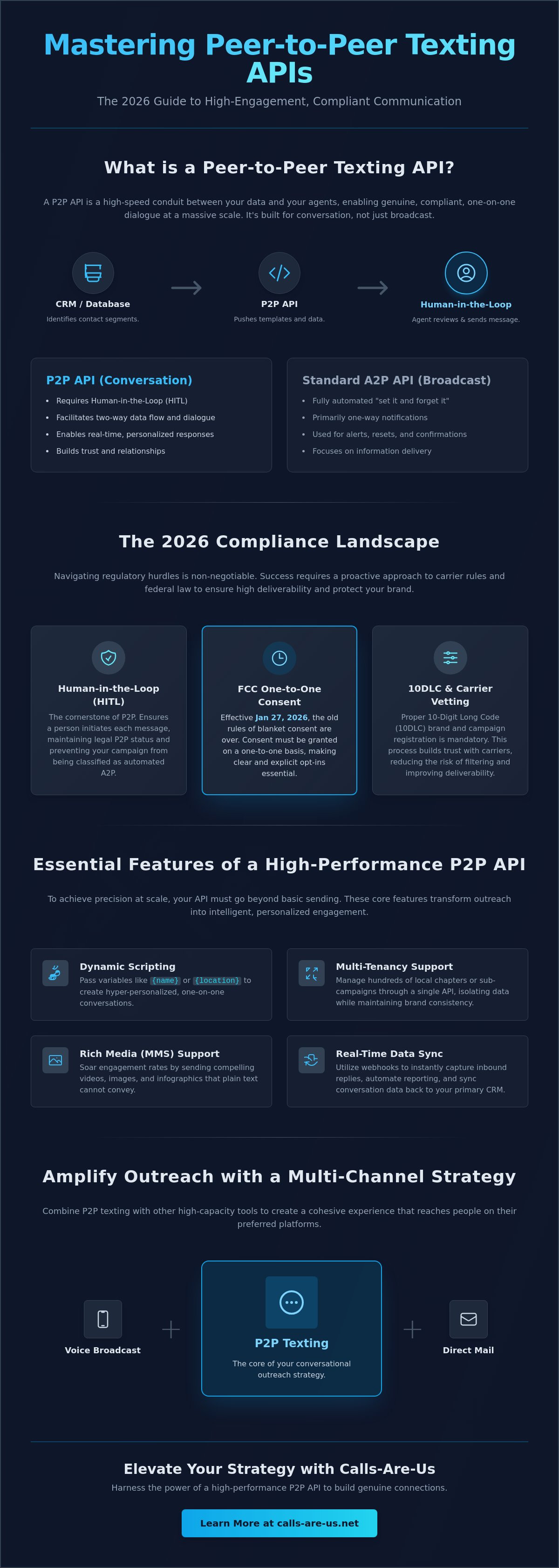
A Peer to Peer (P2P) Text Messaging API acts as a high-speed conduit between your centralized CRM and the human agents who deliver your message. It functions as a gateway that translates your database information into an actionable interface for your team. Unlike automated systems that fire off thousands of texts without oversight, a P2P API requires a Human-in-the-Loop (HITL). This distinction isn't just a technical preference; it's a regulatory necessity. By ensuring a person physically initiates each message, organizations can maintain compliance while fostering genuine, one-on-one dialogue at a massive scale.
While the API provides the modern interface for developers, much of the underlying infrastructure relies on the Short Message Peer-to-Peer (SMPP) protocol to exchange data between applications and mobile carriers. This protocol ensures that your outreach remains reliable even when sending millions of messages across different networks. To better understand the strategic impact of this technology, watch this helpful video on advancing campaign goals:
Standard A2P broadcast APIs are designed for "set it and forget it" notifications like shipping alerts or password resets. P2P APIs are built for conversation. They facilitate a two-way data flow that allows your team to react to voter sentiment, answer specific questions, and adjust campaign messaging in real-time. Adhering to peer to peer texting best practices means leveraging this interactivity to build trust rather than just broadcasting noise. When you can see a reply and respond instantly, you transform a simple notification into a relationship.
The Architecture of a Scalable P2P Workflow
A professional workflow starts with an API trigger. When your CRM identifies a specific segment of contacts, the API pushes pre-approved templates to an agent interface. The agent reviews the text and clicks to send, satisfying the HITL requirement. Webhooks play a critical role here by capturing inbound replies instantly. These replies are then routed back to the correct agent or synced with political campaign texting software to ensure every interaction is logged and actionable within your unified management system.
Why API Integration Trumps Out-of-the-Box Software
Off-the-shelf software often forces you into a rigid user interface that may not suit your team's rhythm. An API integration allows you to build a custom agent dashboard that mirrors your specific operational needs. You can integrate directly with proprietary voter databases or custom scoring models to provide agents with rich context for every conversation. This level of customization is a cornerstone of peer to peer texting best practices, as it automates administrative burdens like provisioning new agents or segmenting lists, allowing your team to focus entirely on the human element of outreach.
Essential Features of a High-Performance P2P API
Precision at scale is the hallmark of a superior API. To move beyond simple messaging, your infrastructure must support dynamic scripting. This allows you to pass specific variables like a recipient's first name, local polling station, or previous donation amount directly into your templates. By personalizing at this level, you adhere to peer to peer texting best practices that prioritize meaningful engagement over generic noise. It's about making every recipient feel like they're having a unique conversation with a real person.
Robust multi-tenancy support is equally vital for national organizations. This capability allows you to manage hundreds of local chapters or distinct sub-campaigns through a single, unified API. You can isolate data, track independent budgets, and maintain brand consistency across the board. When these features are paired with rich media support (MMS), engagement rates often soar. Sending a short video or an infographic can convey urgency and emotion in a way that plain text simply cannot.
Reliability depends on sophisticated rate limiting and queue management. Modern carriers are highly sensitive to sudden bursts of traffic. A high-performance API intelligently staggers message delivery to mimic human patterns, ensuring you stay within the bounds of A2P 10DLC regulations without sacrificing throughput. If you're looking for a partner that understands these technical nuances, exploring scalable peer-to-peer texting solutions is a logical next step for your growth.
Advanced Data Handling and Webhooks
Real-time delivery receipts (DLRs) provide the pulse of your campaign. They allow you to monitor health, identify carrier blocks, and adjust your strategy instantly. Inbound message parsing is another essential tool; it automates the heavy lifting of opt-out processing and sentiment analysis. By utilizing real-time webhooks, organizations can virtually eliminate the latency that often plagues high-volume GOTV efforts, ensuring every second counts on election day.
Agent Management and Performance Tracking
Accountability drives impact. Your API should offer dedicated endpoints to track agent send-rates, response times, and conversation outcomes. This transparency helps you identify top performers, provide targeted coaching, and ensure high-quality interactions. Dynamic assignment ensures that incoming replies are routed to available agents based on their specific expertise or current workload. This alignment with peer to peer texting best practices ensures your mass communication strategy remains deeply personal, leveraging agent-specific data to foster trust and drive action.
Step-by-Step: Integrating Your P2P Texting API
Technical integration is the bridge between your strategic vision and real-world impact. It requires a methodical approach that balances rigorous security with operational speed. By following a structured implementation path, you ensure that your technology serves your mission without creating technical debt or compliance vulnerabilities. Integration is not merely a task for developers; it's the foundation of a high-engagement outreach engine that respects both the agent and the recipient.
Authentication and Security Protocols
Securing your gateway is the primary objective. You should implement robust authentication using OAuth 2.0 or secure API keys to protect your communication infrastructure from unauthorized access. IP whitelisting adds a critical second layer of defense; it prevents external environments from exhausting your messaging credits or accessing sensitive campaign data. Robust payload encryption is essential for voter privacy because it ensures that personal information remains protected from the moment it leaves your CRM until it reaches the carrier network.
Developing the Human Initiation Layer
The human element defines the integrity of P2P outreach. You need to build a 'Click-to-Send' interface that strictly complies with the latest carrier guidelines for human-initiated messaging. This portal should empower agents to edit templates for authentic, non-canned responses while maintaining the efficiency of your overall campaign. Implementing P2P texting best practices involves finding the perfect equilibrium between user experience speed, agent empowerment, and regulatory compliance within your interface design.
Database mapping follows the establishment of your secure environment. You must align your CRM fields, such as voter IDs, geographic tags, and previous interaction history, with the API’s contact parameters. This alignment ensures that when an agent clicks "send," the message is enriched with the correct data points for hyper-personalization. Precise mapping reduces errors, improves agent confidence, and ensures that every conversation feels relevant to the recipient's specific context.
Testing remains the most critical phase before a full-scale launch. Use a sandbox environment to validate your delivery logic and webhook responses without sending live messages to your entire list. Small-scale tests allow you to verify deliverability across different carriers, confirm that your opt-out logic functions perfectly, and ensure that data is syncing correctly back to your CRM. Once you've validated these technical milestones, you can move to production rollout, scaling your outreach to your full list with the confidence that your technical foundation is sound and your peer to peer texting best practices are fully operational.
Compliance Engineering: 10DLC and A2P Standards in 2026
Compliance is your strategic advantage. It protects your reputation, ensures deliverability, and builds recipient trust. In 2026, navigating the 10DLC (10-Digit Long Code) ecosystem requires a deep understanding of Brand registration, Campaign vetting, and the shifting expectations of major carriers. Integrating peer to peer texting best practices into your technical stack ensures that your messages actually reach the inbox instead of dying in a carrier filter. This isn't just about following rules; it's about respecting the digital space of your audience.
For political organizations, Campaign Verify remains the gold standard for identity verification, providing the necessary credentials to unlock higher throughput for critical outreach. Since February 2025, U.S. carriers have blocked 100% of unregistered traffic, making the registration of your Brand and specific Campaigns mandatory. You must also provide valid, publicly accessible Privacy Policy and Terms and Conditions URLs for all new registrations as of June 30, 2026. Partnering with a provider that prioritizes compliant P2P texting infrastructure is the most effective way to protect your brand's reputation.
Vetting and Brand Registration via API
Efficiency starts with automation. Your API should allow you to programmatically submit Brand details to The Campaign Registry (TCR), managing the one-time $4 Brand fee and the $15 Campaign vetting fee without manual data entry. It's critical that your political voice broadcasting and texting campaigns use identical Brand profiles to maintain a unified Trust Score across all communication channels. When vetting delays occur, having a pre-built re-submission workflow within your API integration can save days of downtime during high-stakes campaign cycles.
Avoiding Carrier Filtering and Shadow Bans
Carrier filters are more aggressive than ever. You should use your API to analyze message content for "spammy" triggers before your agents hit send, allowing for real-time adjustments to your templates. In 2026, the industry standard for SHAFT compliance requires rigorous screening of all message templates to ensure they're entirely free from references to sex, hate, alcohol, firearms, or tobacco. Monitoring opt-out rates serves as a vital KPI for campaign health; if your "STOP" requests spike, it's a clear signal that your content or targeting needs immediate refinement.
Automated opt-out management is non-negotiable for ethical communication. Your API must handle keywords like STOP and UNSUBSCRIBE instantly, updating your database in real-time to prevent non-compliant follow-ups that could trigger heavy fines. Maintaining a high Trust Score through peer to peer texting best practices requires clean data, low spam report ratios, and strict adherence to the FCC’s one-to-one consent rule enacted on January 27, 2026. By focusing on these technical and regulatory pillars, you ensure your outreach remains a powerful tool for connection rather than a source of digital noise.
Elevating Your Strategy with Calls-Are-Us P2P Solutions
Impactful outreach requires more than a simple connection; it demands a resilient infrastructure capable of sustaining high-stakes dialogue at a national level. Calls-Are-Us provides the high-capacity engine needed for this transformation. Our platform allows you to move beyond the limitations of standard messaging, empowering your organization to reach millions while maintaining the personal touch that defines peer to peer texting best practices. We serve as a sophisticated ally, ensuring your technical integration is seamless, your compliance is ironclad, and your impact is measurable.
True influence often resides at the intersection of multiple communication channels. By combining P2P texting with Voice Broadcast and Direct Mail, you create a comprehensive narrative that meets your audience where they are. This multi-channel approach ensures that your message isn't just delivered; it is reinforced through diverse touchpoints that build familiarity and trust. Our team provides the expert support necessary to navigate the complexities of 10DLC and A2P registration, allowing you to focus on the humanistic core of your mission rather than the hurdles of carrier vetting.
Empowerment is the ultimate goal of our technology. We provide the tools that enable your team to foster inclusive dialogue, bridge social divides, and drive meaningful action. Whether you are managing a local initiative or a national movement, our infrastructure scales to meet your ambition without compromising on speed or reliability. We champion a philosophy of ethical communication, ensuring that every interaction respects the recipient and strengthens the bond between your brand and the community you serve.
Why High-Stakes Campaigns Trust Calls-Are-Us
Precision and reliability are non-negotiable in high-pressure environments. We have a proven track record of success in over 40 states and national elections, providing the steady hand needed for critical outreach. Our scalability handles millions of messages without performance degradation, ensuring your momentum remains constant throughout the entire campaign cycle. We maintain a deep commitment to social responsibility, viewing our technology as a vehicle for facilitation, transformation, and social progress.
Next Steps: Launching Your Integrated Campaign
Your transition to a more powerful outreach strategy begins with a strategic technical roadmap. We encourage you to consult with our technical team to audit your API architecture and ensure it aligns with current peer to peer texting best practices. You can explore our comprehensive developer documentation to understand our full range of integration capabilities. Contact Calls-Are-Us today for a personalized walkthrough of our P2P texting platform and discover how we can help you build a more connected and engaged audience.
Mastering the Future of Ethical Outreach
Impact depends on trust. We've discussed how a well-integrated P2P API serves as a bridge, connecting complex databases with the genuine voices of your agents. By prioritizing a secure environment, seamless CRM mapping, and rigorous 10DLC vetting, you ensure that your message is heard, respected, and prioritized. Implementing peer to peer texting best practices isn't just a regulatory requirement; it's a fundamental commitment to building lasting, meaningful connections with your audience.
Success in high-stakes environments requires a partner that understands the technical and regulatory nuances of modern delivery. We've operated in over 40 states, establishing ourselves as seasoned TCPA and 10DLC compliance experts who prioritize your campaign's long-term integrity. Whether you require Voice Broadcast, Peer-to-peer texting, or Direct mail, we offer the integrated multi-channel support your strategy demands to drive real-world results. Scale your outreach with our high-performance P2P Texting API today. Your vision for a more inclusive and impactful dialogue is within reach; let's build the infrastructure to make it a reality.
Frequently Asked Questions
Is peer to peer texting still legal for political campaigns in 2026?
Yes, peer to peer texting remains a legal and highly effective tool for political outreach in 2026. However, you must strictly adhere to the FCC one-to-one consent rule that went into effect on January 27, 2026. This mandate requires explicit, individual consent for each specific seller or organization. Organizations must also ensure their messaging infrastructure is fully registered within the 10DLC ecosystem to avoid carrier blocking.
How does a P2P texting API differ from a mass texting API?
A P2P texting API requires a human agent to physically initiate every individual message, whereas a mass texting API uses automation to send one-to-many broadcasts. While mass texting is ideal for urgent notifications or alerts, P2P APIs are designed for two-way conversational engagement. This human-in-the-loop requirement is what distinguishes P2P legally and operationally, allowing for more personalized and compliant dialogue at a massive scale.
What is 10DLC and why is it mandatory for P2P texting?
10DLC stands for 10-Digit Long Code, which is the standard system carriers use to regulate business-to-consumer messaging over local phone numbers. It is mandatory because, as of February 2025, U.S. carriers block 100% of unregistered A2P traffic. Registering your brand and campaigns through 10DLC provides the transparency carriers require. This process protects the ecosystem from spam while granting your organization higher deliverability and throughput.
Can I send images and videos through a P2P texting API?
Yes, modern P2P APIs fully support Multimedia Messaging Service (MMS), enabling you to send high-resolution images and short videos. Including rich media is a proven way to boost engagement rates, as visual content often captures attention more effectively than plain text. High-performance campaigns use these features to share infographics, candidate messages, or event invitations, creating a more immersive experience for the recipient.
How do I ensure my campaign messages aren't filtered by carriers?
Maintaining high deliverability requires following peer to peer texting best practices such as using clean, opted-in data and avoiding aggressive, spam-like language. You should use your API to monitor real-time delivery receipts and opt-out rates to identify filtering issues early. Consistency is key; ensuring your message content matches your registered campaign brief helps maintain a high Trust Score and prevents shadow bans across major networks.
What are the human-initiation requirements for P2P texting compliance?
Compliance hinges on the "Human-in-the-Loop" (HITL) model, where a real person must take a physical action to send each message. This usually involves an agent clicking a "send" button within a custom interface for every recipient on your list. This manual trigger ensures the communication is not classified as an automated broadcast. It preserves the legal distinction of P2P messaging while allowing your agents to personalize responses.
How long does the 10DLC registration process take for new campaigns?
Registration typically takes between three to seven business days for standard brand and campaign vetting. However, high-volume campaigns or those requiring special vetting, such as political outreach, may experience longer timelines depending on carrier volume. We recommend initiating your registration at least two weeks before your planned launch date. This buffer allows you to resolve any vetting delays and ensure your T-Mobile campaign activation fee is processed.
Does Calls-Are-Us provide developer support for API integration?
Calls-Are-Us provides comprehensive technical consulting and detailed developer documentation to ensure your integration is successful and secure. Our team assists with environment setup, CRM database mapping, and the implementation of secure authentication protocols like OAuth 2.0. We act as an approachable partner, guiding you through the complexities of API architecture and 10DLC registration so your team can focus on driving meaningful impact through your outreach.



Comments