
How to Improve Call Answer Rates: A Practical Guide for 2026

More calls aren’t always the answer. If outreach keeps going to voicemail, it’s natural to wonder how to improve call answer rates without wasting time or putting trust at risk. Start by diagnosing the pattern, not increasing the number of calls. Timing, audience data, and whether people recognize the caller can all affect what happens when the phone rings.
A higher answer rate means more calls were picked up, but it doesn’t show whether those calls led to useful conversations or meaningful outcomes. This guide explains how to interpret the metric, identify practical changes in your campaign data, and choose an outreach approach that fits your audience and purpose. You’ll learn how to assess timing, caller recognition, and list quality, then choose between live conversations, consistent voice messages, and complementary texting. The aim is a more informed, responsible calling strategy, not a one-size-fits-all promise.
Table of Contents
What Does Call Answer Rate Measure, and Why Can It Fall?
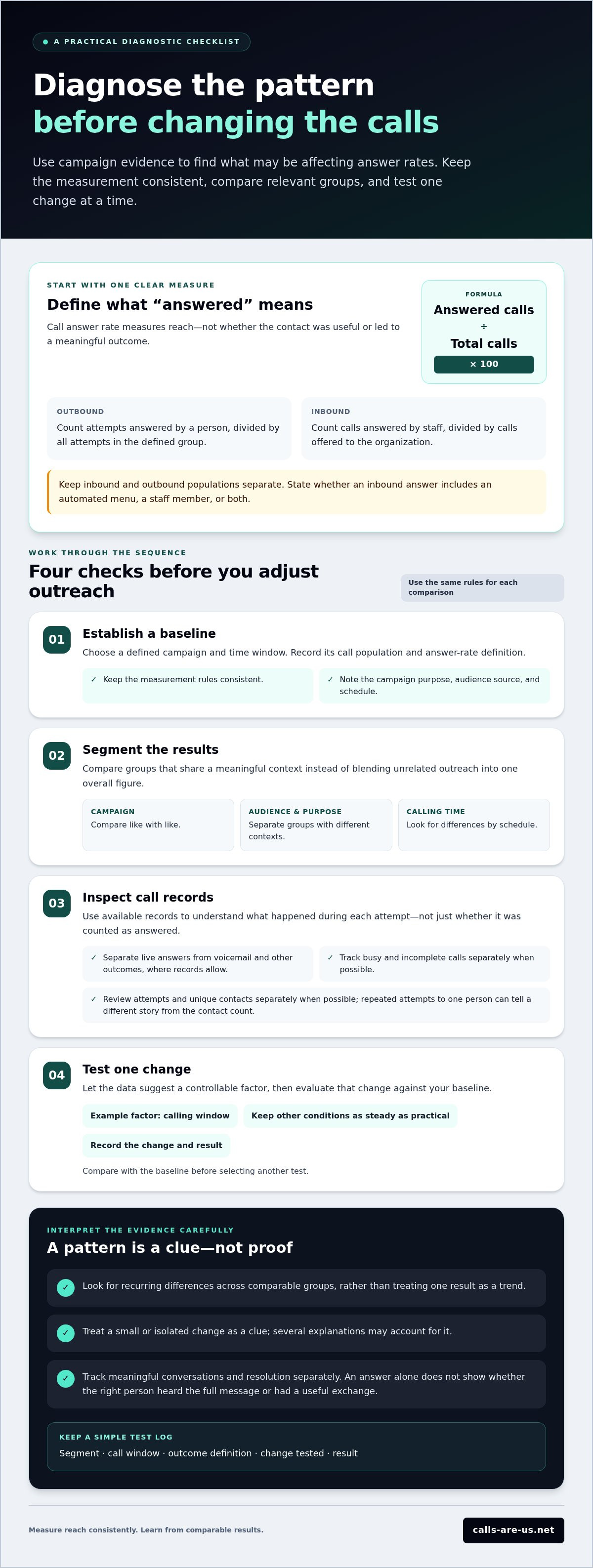
Call answer rate is the share of calls in a defined group that received an answer. It measures reach, not the quality of the outreach. Results can change when the audience, call purpose, list source, or tracking rules change. Define what counts before comparing performance.
Use one consistent formula:
For a campaign, the call population might include all outbound attempts made during a set period. Decide whether “answered” means a live person picked up. Where your records allow, classify voicemail, busy signals, and other outcomes separately. A voicemail greeting does not necessarily mean you spoke with the intended recipient.
Outbound answer rate versus inbound call answer rate
With outbound calls, your organization initiates contact. Count attempts answered by a person in the numerator, and all attempts in the campaign or other defined group in the denominator. With inbound calls, the caller initiates contact. The numerator is calls answered by staff, and the denominator is calls offered to the organization.
Keep the two populations separate. An inbound system may count a call as answered when an automated menu picks up, even if no staff member speaks with the caller. State whether your measure includes an IVR response, a staff answer, or both. Don’t compare inbound service calls directly with outbound outreach attempts because callers have different expectations and reasons for calling.
Why a single benchmark can mislead
Context shapes what an answer rate can tell you. Someone calling for help may be ready to speak, while an outbound recipient may not recognize the number or expect the call. Existing contacts differ from a newly assembled audience, and a time-sensitive update has a different purpose from an invitation to respond.
Compare like-for-like campaigns. Keep the call population, audience type, purpose, answer definition, and measurement window consistent, then compare results with your own baseline. If several factors change at once, it’s hard to tell what influenced the outcome. This gives you a more useful starting point for deciding how to improve call answer rates than a universal target that may not fit your work.
An answer also doesn’t prove that the recipient heard the full message, reached the right person, or had a useful exchange. Track meaningful conversations and resolution separately. For customer service, First Call Resolution describes a related outcome: resolving an issue in the first interaction. It complements answer rate, but measures something different. Read the metrics together to understand whether contact happened and what followed.
How to Diagnose Call Answer Rates Before Changing Your Outreach
Start with evidence, not a new dialing tactic. A lower result could reflect a change in the audience, call schedule, campaign purpose, or outcome tracking. A repeatable diagnostic process helps narrow down possible causes before you adjust your outreach, and gives you a clear way to evaluate the change.
Use this sequence to make the analysis repeatable:
Establish a baseline. Choose a defined campaign and time window. Record the answer-rate definition and total call population, then use the same rules for future comparisons so a measurement change isn’t mistaken for a performance change.
Segment the results. Compare groups that share a meaningful context, such as campaign, audience segment, call purpose, or calling time. Don’t blend unrelated outreach into one overall figure, since a combined rate can hide differences between groups.
Inspect call records. Where records support it, separate live answers from voicemail and other outcomes, such as busy or incomplete calls. Review attempts and unique contacts separately when possible. Repeated attempts to the same person can make those totals tell different stories.
Test one change. Choose a controllable factor suggested by the data, such as the calling window. Keep other conditions as steady as practical, record what changed, and compare the result with your baseline before choosing another test.
Build a useful baseline from call records
A baseline is useful only when its rules are clear. Record the call population, period covered, answer definition, and available outcome categories. Add context such as campaign purpose, audience source, and schedule. If you later compare a different audience or change how voicemail is classified, document that too. Otherwise, the comparison may not be like-for-like.
Find patterns without overreading small differences
Look for recurring differences across comparable groups instead of treating one result as a trend. For example, if the same audience and purpose show a similar pattern across several campaign periods, that may help you choose a focused test. A small or isolated change can have several explanations, so treat it as a clue, not proof. Findings can guide the next experiment, but they can’t guarantee its outcome.
This evidence-first approach is the foundation for deciding how to improve call answer rates. Keep a simple log of the segment, call window, outcome definition, change tested, and result. Your team can learn from that record without confusing greater reach with better conversations. If the diagnosis suggests that scale or conversation needs should shape your next step, review call outreach options as you plan the test.
Which Call Answer Rate Tactics Build Recognition and Trust?
Recognition starts before the phone rings. Recipients are more likely to understand an outreach call when its identity, purpose, and relevance make sense in the context of their relationship with your organization. These are factors to assess and test, not guaranteed ways to raise answer rates. The goal isn’t simply to prompt an answer. It’s to make a respectful, useful conversation possible.
Improve the reasons recipients recognize and trust a call
Use your organization’s real identity and explain why you’re calling in plain language. Clear caller identification and a concise opening can help recipients connect an unfamiliar number with an expected campaign or relationship. Don’t imply that a call is local, personal, or associated with an organization if that isn’t true. Misleading identity may draw attention, but it undermines trust and can make people less willing to engage.
Relevance matters too. Before calling, check whether the list fits the purpose. A reminder, event update, and request for a conversation call for different audiences and wording. Keep contact records accurate, and consider what recipients are likely to recognize about your organization. If the purpose would surprise someone on the list, reconsider the audience or explain the context through an appropriate outreach channel before calling.
Choose timing and call style around the outreach goal
There is no universal best time for every audience. Use your call records to identify patterns, then test a suitable window while keeping other factors consistent. Consider recipient expectations and the nature of the message, too. A call can arrive at a reasonable time and still feel intrusive if it lacks a clear reason or repeats contact without value.
Prioritize dialogue: Use live calling when the purpose requires questions, listening, clarification, or a responsive human conversation. The caller can adapt to what the recipient says instead of delivering only a fixed message.
Prioritize consistent delivery: Automated voice outreach can distribute the same message across a broader audience. It supports reach and message consistency, but doesn’t replace a person when the interaction calls for judgment or back-and-forth discussion.
Match the channel to the need: Consider whether a call is the clearest way to reach people. A message that needs a personal response calls for a different approach from a straightforward update.
These choices help you work out how to improve call answer rates without treating a higher number as the only goal. A reach-focused tactic can support scale, while human-led contact makes space for conversation. Neither fits every purpose. Make one change at a time, review the response alongside interaction quality, and keep your approach transparent. Clarity and relevance are a stronger starting point for meaningful outreach than confusion.
How to Turn Answered Calls into Useful, Respectful Outreach
An answered call is an opening, not a conversion. The next steps should fit the recipient and the reason for reaching out: explain the message, offer a clear response path, connect people with someone when needed, and follow up in a way that respects their time. Planning this flow before a campaign helps prevent a successful connection from ending in confusion.
Make the response path clear and relevant
Tell recipients why you called and what they can do next. If the purpose is to share an update, say where they can get more information. If you’re inviting a response, explain how to respond and what will happen afterward. Keep the requested action connected to the stated purpose instead of treating every answer as a lead or an immediate commitment.
Some questions need context, empathy, or discussion. A live agent can listen, clarify the issue, and guide the recipient to an appropriate next step. For a concise voice message, Voice Broadcast can include Press-1 routing so a recipient can indicate that they want a response. Make the prompt clear and ensure the route leads to relevant follow-up, not a dead end.
Coordinate voice and text without blurring their roles
Voice and text can support the same outreach plan, but each channel has a distinct role. Mass Texting supports broad distribution of a consistent message, while Peer-to-Peer texting supports more conversational exchanges. Choose based on the interaction you want, and make the connection between a call and any follow-up message clear. An unexpected text after a call can feel disconnected if it doesn’t explain why it arrived.
For SMS, account for 10DLC compliance in the messaging workflow. Keep the message relevant to the campaign and provide a clear, appropriate response path. Don’t use a text as a substitute for a human conversation when the recipient’s question needs a thoughtful reply. A coordinated plan should specify which channel starts contact, how a response is handled, and when follow-up is appropriate.
Before launch, map the journey from answer to resolution: the opening message, available response options, the person or process that handles replies, and the follow-up. Then review whether recipients reached the intended next step, not just whether they answered. For help planning channel roles across a broader outreach effort, use this mass communication strategy guide. The political voice broadcasting guide offers additional planning context for a voice-message campaign.
Calls-Are-Us brings voice, text, and email together in a desktop-based calling workflow. Explore Calls-Are-Us outreach options to plan a channel mix around the response your campaign needs.
How Calls-Are-Us Supports Scalable Call Outreach
Choose a calling method based on the conversation you need, not just the number of calls you plan to place. Live calling and Voice Broadcast serve different purposes: live calling supports responsive human dialogue, while Voice Broadcast delivers a consistent voice message to a large audience. Neither guarantees that recipients will answer. The right fit depends on whether your outreach requires discussion, standardized information, or a path between the two.
When live calling or Voice Broadcast fits the job
Use live calling when callers may need to listen, answer questions, or respond to different situations. It makes room for a human exchange that a recorded message can’t provide. Voice Broadcast is suited to consistent message delivery at scale. Campaigns can use text-to-speech or uploaded audio, with Press-1 routing as a response option and voicemail skipping to manage message delivery.
Keep reporting clear: voicemail skipping doesn’t mean a recipient answered. It affects whether a message is left when a call reaches voicemail, not whether a person picked up or engaged. Measure call outcomes according to the campaign’s defined purpose, and don’t treat message delivery as proof of a conversation. For more on organizing campaign calling operations, explore this political campaign call center guide.
Choose live calling when the purpose depends on listening, clarification, or a personal response.
Choose Voice Broadcast when many recipients need the same voice message and consistent wording matters.
Plan a connected approach when a broad message may lead some recipients to request further contact. Set up the response path before outreach begins.
Bring the outreach workflow together
Calls-Are-Us Call Center software combines voice, text, and email in a desktop-based workflow. This helps teams coordinate channels around a campaign objective while keeping each channel’s role distinct. Voice Broadcast messages can also be scheduled months ahead, helping teams plan message timing as part of a broader outreach calendar.
Before choosing an approach, define what success means beyond delivery: a live conversation, a requested follow-up, or consistent distribution of information. That distinction matters when deciding how to improve call answer rates. The right operational fit supports the intended interaction without overstating what a call outcome proves.
Explore Calls-Are-Us calling solutions to match live calling, Voice Broadcast, and complementary channels to your outreach objective.
Make Your Next Campaign a Learning Opportunity
Turn your findings into a focused campaign plan. Choose an outcome that matters beyond whether someone picks up, such as a useful conversation or a clear response to your message. Give your team a simple way to review what recipients did, then refine the next outreach based on what you learn. This keeps improvement grounded in audience needs rather than activity alone.
Trust grows through consistency. Make each contact relevant, explain its purpose, and give people a clear way to respond. These choices can help your organization take a more thoughtful approach to how to improve call answer rates while keeping meaningful engagement at the center.
Calls-Are-Us has supported campaigns and public officials across more than 40 states. Explore Calls-Are-Us outreach solutions to shape an approach around your audience and goals.
Start with one well-defined objective, learn from the response, and build stronger connections with each campaign.
Frequently Asked Questions
Is there a universal benchmark for a good outbound call answer rate?
No single benchmark fits every outbound campaign. A rate depends partly on who you’re calling, why you’re calling, and how your system defines an answer. To assess how to improve call answer rates, compare campaigns with similar audiences and purposes using the same measurement rules. Treat the result as a reference for your own planning, not a pass-or-fail grade for every type of outreach.
Why can call answer rates vary between campaigns using the same calling approach?
The same calling method can reach people with different expectations and relationships to your organization. A list of people who recently engaged with a campaign may produce different results from a list of contacts with little prior interaction. Message relevance, contact-record freshness, and how often recipients have heard from you can also vary. Review those campaign details before concluding that the calling approach itself caused a change.
Can improving call answer rates guarantee more conversations or conversions?
No. An answer records that a call was picked up under your measurement rules. It doesn’t confirm that the intended person heard the message, chose to respond, or took another action. Someone might answer a brief informational call but have no reason to continue the conversation. Track outcomes such as completed discussions or requested follow-ups separately, and assess them alongside answer rate.
How can a team tell whether an answer-rate change is meaningful?
Check that both results use the same call population, answer definition, and measurement window. Then consider the number and mix of calls behind each rate: a small campaign can shift noticeably after only a few different outcomes. Review comparable campaign periods and look for a pattern before acting. Record changes in audience, schedule, or message so the comparison has useful context.
Does voicemail skipping mean someone answered a Voice Broadcast call?
No. Voicemail skipping is a Voice Broadcast message-delivery feature, not proof that a person answered. Keep those outcomes separate in reporting. A call record must show an answer according to your defined measurement rules before you count it as answered. Don’t treat a voicemail-related outcome as a live conversation simply because the message wasn’t left on voicemail.
When is a live call preferable to an automated voice message?
A live call is preferable when the recipient may need to explain a situation, ask follow-up questions, or receive a response shaped around their circumstances. An automated voice message is a better fit when the priority is delivering consistent information, such as a straightforward campaign update. If the message may prompt complex questions, plan a clear way for the recipient to reach a person rather than relying on the recording alone.



Comments