
How to Justify Mass Communication Spend: A 2026 Evidence-Based Guide

What if the strongest case for a communication budget isn’t a bold ROI claim, but a clear line from audience need to organizational outcome? That’s the practical challenge behind justifying mass communication spend: executives need evidence, while results can take time to emerge and may reflect several channels working together.
You’re right to ask how the investment will be measured. A channel budget can seem disconnected from organizational priorities when it’s presented as a list of activities instead of a plan tied to a defined objective, audience, and evaluation criteria. When attribution is complex, unsupported promises can weaken trust rather than strengthen the case.
This guide shows how to build a defensible investment case by connecting communication objectives to organizational goals, comparing channels with consistent and appropriate measures, and setting realistic expectations for reporting and adjustment. You’ll learn how to explain trade-offs, distinguish activity from meaningful progress, and create an accountable budget that can adapt as evidence develops.
Table of Contents: Justifying Mass Communication Spend
Why Mass Communication Spend Needs a Clear Business Case
A communication budget is easier to defend when it starts with a need, not a channel. Mass communication describes the broad practice of reaching audiences through media. For budgeting purposes, mass communication spend is the resources committed to reaching a defined audience through coordinated outreach. Depending on the audience and objective, that may include voice broadcast, mass texting, peer-to-peer texting, live calling, IVR, or direct mail.
A defensible communication budget is a documented investment that links audience needs and organizational priorities to planned activities, stated assumptions, appropriate measures, and a review period. This definition keeps the conversation focused on why the work matters and how the team will assess it, rather than on activity alone.
Start with the outcome the organization needs to support, then identify the communication objective that could contribute to it. Strategic marketing and sales teams, such as those at stratagon.com, typically align outreach directly with revenue growth and customer needs before choosing specific tactics. For example, if the organization wants more people to complete an action, the communication objective might be to inform the relevant audience about that action and explain how to take it. Then assess which channel or mix of channels fits the task. Starting with a preferred tool risks turning the request into a defense of a tactic instead of a response to a documented need.
What makes a mass communication budget defensible?
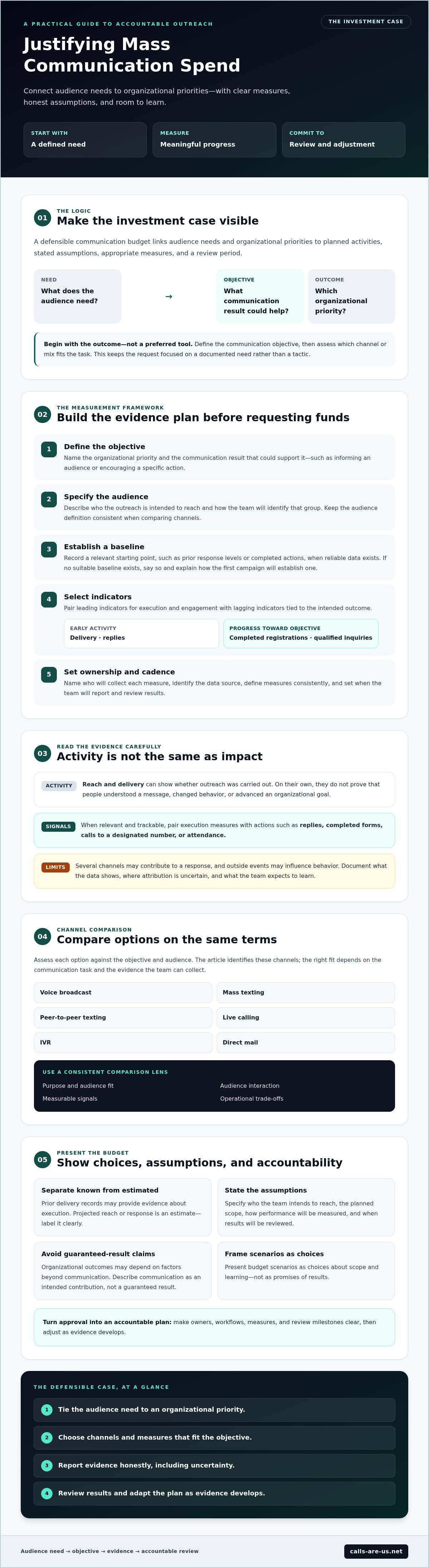
Make the logic visible. Connect each proposed activity to an audience need and organizational priority, then state the assumptions behind the request: who the team intends to reach, the planned scope of outreach, how performance will be measured, and when results will be reviewed. Decision-makers can then compare proposals using the same basic questions and see where the plans differ.
Separate what’s known from what’s estimated. Prior delivery records may provide evidence about execution, while projected reach or response is an estimate that should be labeled clearly. Changes in organizational outcomes may also depend on factors beyond communication, so describe them as intended contributions, not guaranteed results. Transparency makes the case more credible and helps leaders weigh the uncertainty.
Why reach alone does not prove value
Reach and delivery can show whether outreach was carried out. They don’t prove that people understood a message, changed behavior, or advanced an organizational goal. Pair execution measures with indicators suited to the objective, such as replies, completed forms, calls to a designated number, or attendance, when those actions are relevant and trackable.
Interpret the evidence carefully. A response may follow exposure to several channels, and outside events can also influence behavior. Rather than assigning all credit to one touchpoint, document what the data shows, where attribution is uncertain, and what the team expects to learn during the review period. That makes the findings more credible and useful for the next budget decision.
Build a Measurement Framework Before Requesting Communication Funds
Make measurement part of the proposal, not an afterthought. A clear framework tells decision-makers what the team plans to learn, how it will assess progress, and where the evidence has limits. This makes justifying mass communication spend more credible, especially when several channels may contribute to the same outcome.
Use this sequence before requesting funds:
1. Define the objective. State the organizational priority and the communication result that could support it, such as informing a defined audience or encouraging a specific action.
2. Specify the audience. Describe who the outreach is intended to reach and how the team will identify that group. Use a consistent audience definition when comparing proposed channels.
3. Establish a baseline. Record the relevant starting point, such as prior response levels or completed actions, if reliable data exists. If there’s no suitable baseline, say so and explain how the first campaign will establish one.
4. Select indicators. Choose leading indicators for execution and engagement, then lagging indicators tied to the intended outcome. Delivery and replies can show early activity; completed registrations or qualified inquiries may better reflect progress toward the objective.
5. Set ownership and cadence. Name who will collect each measure, identify its data source, define it consistently, and set when the team will report and review results.
Choose measures that answer the budget question
Reach, response, completed actions, and qualified inquiries can all be useful, but only in context. Define what counts as a response or qualified inquiry, and don’t present delivery volume, clicks, or raw response counts as proof of organizational impact on their own. Digital.gov offers best practices and guidance on measurement effectiveness, including the value of selecting KPIs and using data to communicate impact.
For broader planning context, consult this mass communication strategy guide. Aligning the objective, audience, and channel roles before launch makes it easier to build a measurement plan that reflects how outreach will work.
Account for overlap and uncertainty
When people may encounter messages through multiple channels, use a consistent tracking plan and explain what it can establish. Where available, compare results with a reliable baseline or a planned test. Don’t assume a response came from one channel simply because it followed that contact; timing, other exposures, and outside factors can also shape outcomes. Label projections as estimates, distinguish correlation from causation, and note gaps in the data.
Once your objectives and evaluation criteria are clear, you can explore communication services that may support the plan, including voice broadcast, texting, live calling, IVR, polling, and direct mail.
Compare Mass Communication Channels by Purpose, Evidence, and Trade-Off
Choose the channel that fits the communication task, not the one that looks strongest on a spreadsheet. Audience preferences, message complexity, timing, and the response you want all affect suitability. Use a shared comparison framework, but judge each channel against the role it is meant to play. A conversation-based method shouldn’t be judged by the same interaction measure as a one-way message.
Compare channels on purpose, not on a universal ranking
The table is a starting point, not a verdict. A recorded voice message may suit a straightforward announcement, while peer-to-peer texting or live calling may be more appropriate when people need to ask questions. IVR can offer structured response choices; direct mail may suit a message that benefits from a physical format. Each option brings different interaction demands and reporting needs.
For a fair comparison, use the same objective and review period where possible. Then consider channel-specific measures alongside delivery, audience response, operational workload, and data quality. Don’t treat unlike signals as interchangeable or attribute a shared outcome to one channel without evidence. A consistent approach strengthens the case for communication spend while preserving differences that matter. For more context on voice broadcast, see this political voice broadcasting guide.
Presenting Mass Communication Budgets to Decision-Makers
Make the decision clear. A strong request gives executives enough information to assess the investment, understand the trade-offs, and decide what happens next. When justifying mass communication spend, frame the proposal around the organizational goal and the evidence the team can reasonably collect, not a guaranteed return.
What should a communication budget proposal include?
Keep the request structured and scannable. Summarize the objective, intended audience, rationale, and connection to organizational priorities. Then show how each proposed activity supports the objective. For every budget allocation, state its purpose, measurement method, responsible owner, and timeline. Include assumptions such as intended reach and limits in the available data, then close with the specific approval or decision you need.
Separate confirmed costs from estimates. Use current vendor quotes where needed, and label figures that still require confirmation. That prevents a planning assumption from being mistaken for a committed cost and gives decision-makers a clearer view of what may change.
Present scenarios as choices, not promises. A narrower scope may let the team focus on a priority audience or test a message; a broader mix may support wider outreach or a comparison of more channels. Explain what each scenario includes, what it leaves out, and what evidence it could produce. Don’t suggest that a larger allocation guarantees greater response or organizational impact.
How can teams respond to budget objections?
Answer concerns directly, then show how the plan will address them:
“How will we know it worked?” Agree on objective-specific measures in advance, explain how reporting will work, and be candid about attribution limits when audiences encounter multiple channels.
“Can we reduce the cost?” Compare options by audience scope, channel mix, operational needs, and the learning each could support, rather than by an unsupported return estimate.
“Could repeated outreach create audience fatigue?” Explain how the team will monitor responses and complaints, coordinate contact across channels, and adjust the plan if signals warrant it.
“What if the outcome is uncertain?” Consider a limited test only when the audience, evaluation criteria, and decision threshold are defined before launch.
Build review checkpoints into the approval request. At each checkpoint, report what was delivered, what the audience did, what the evidence can and can’t establish, and whether the team recommends continuing, adjusting, or stopping. That turns approval into an accountable decision process instead of a one-time bet.
If you’re evaluating outreach options for an approved plan, explore communication services including voice broadcast, texting, live calling, IVR, polling, and direct mail.
Turn the Budget Case into an Accountable Communication Plan
Approval is the starting point, not the finish line. Turn the approved request into a working plan that assigns responsibility, preserves the measurement approach, and gives decision-makers clear opportunities to review progress. Follow-through makes justifying mass communication spend an ongoing process of evidence and adjustment, rather than a one-time budget presentation.
What should happen after budget approval?
Before outreach begins, confirm the objective, audience definition, channel roles, message approval process, and data collection responsibilities. Put the baseline and agreed measures in writing, name the people who will review results, and set reporting milestones that fit the campaign timeline. Everyone involved should know what information they’re responsible for capturing and where it will be recorded.
At each checkpoint, compare actual performance with the plan. Record changes to assumptions, audience criteria, or scope, and explain why they were made. If new evidence suggests an adjustment, document the decision and how it affects the next review. For example, the team might track delivery and audience responses during execution, then assess completed actions against the objective at a later milestone. Choose measures and timing that fit the communication goal, not an arbitrary reporting schedule.
How can a service partner support accountable outreach?
A service partner can help coordinate execution across selected channels, but the approved objective should guide the work. Match each service to a defined role rather than adding channels simply to broaden the mix. Calls-Are-Us provides voice broadcast, mass texting, peer-to-peer texting, live calling center operations, IVR, polling, and direct mail. Confirm service details and campaign requirements directly before making commitments.
Clarify responsibilities before work begins. Agree who supplies and approves messages, manages audience lists, handles responses, and provides the data needed for reporting. Confirm how channel-level activity will be shared and how it fits the organization’s overall measurement plan. These decisions help prevent execution gaps and make review findings more useful.
A partner’s role and reporting inputs should be explicit; accountability for the organizational objective remains with the decision-makers who set it. Keep that distinction clear as results come in. Report what the outreach delivered, what the available evidence indicates, what remains uncertain, and what the team recommends next. This creates a grounded basis to continue, revise, or conclude the plan while preserving trust with leaders and audiences.
Ready to align outreach services with an approved plan? Discuss your communication needs with Calls-Are-Us and review which services may fit your objectives and evaluation approach.
Make Your Next Communication Budget Easier to Defend
A credible budget case connects an organizational priority to a real audience need, a suitable channel plan, and measures leaders can review. Justifying mass communication spend doesn’t require promising a return the evidence can’t support. It requires clear assumptions, honest attribution, and a defined process for adjusting based on what the team learns.
Keep the focus on outcomes, not activity alone. Compare channels by their purpose and operational demands, then assign owners, reporting milestones, and review decisions before outreach begins. This makes the investment easier to assess and the plan more accountable.
Calls-Are-Us offers voice broadcast, peer-to-peer and mass texting, live calling, IVR, polling, and direct mail. If these services may fit your approved objectives, discuss your communication needs with Calls-Are-Us.
Build the case around evidence, keep reporting transparent, and let each review guide the next decision. With a clear plan, your team can make thoughtful investments and communicate their value with confidence.
Frequently Asked Questions
How do you justify mass communication spend?
Start with a specific organizational objective and show how communication could support it. Identify the audience, proposed channels, budget assumptions, and measures before requesting funds. Separate delivery metrics, such as messages delivered, from outcomes tied to the objective, and establish a baseline where possible. Explain how the team will report progress, account for attribution limits, and adjust the plan as evidence develops. A credible case avoids unsupported return promises.
What metrics should be used to measure mass communication?
Choose metrics that reflect the objective and each channel’s role. Delivery and reach can help confirm execution, while responses, completed actions, or qualified inquiries may indicate audience engagement or progress. Define each measure, its data source, and reporting interval before launch so the team can interpret results consistently. Message volume and clicks can provide useful context, but they don’t prove business impact unless a relationship to the intended outcome is demonstrated.
How can you measure the ROI of a communication campaign?
Define the intended outcome and how the organization will value it, then compare results with a relevant baseline or suitable test if one is available. Include campaign costs and consider how other channels or external factors may have contributed. If the data can’t establish financial attribution reliably, report the strongest available outcome evidence instead. Label estimates clearly and don’t present a correlation or projection as proven return on investment.
How do you compare mass communication channels when setting a budget?
Compare channels against the same objective and audience, then assess intended reach, interaction style, available performance data, and operational requirements. Voice broadcast, texting, live calling, IVR, and direct mail can serve different communication needs, so a universal ranking may mislead. Use shared criteria to compare them fairly, but retain channel-specific measures. Choose the mix that fits the message, audience, and desired response rather than assuming one channel is always superior.
What should a mass communication budget proposal include?
Include the organizational goal, audience, communication objective, proposed channel roles, budget assumptions, timeline, and accountable owners. For each activity, explain its purpose, how performance will be assessed, and where the data will come from. Distinguish confirmed information from estimates, and identify important risks or dependencies. Close with the decision needed and planned review points, so decision-makers understand how the team will evaluate evidence and consider changes after approval.
How often should mass communication spending be reviewed?
Set the review schedule before launch, based on the campaign timeline and how quickly reliable evidence can emerge. Plan checkpoints for delivery, engagement, and intended outcomes rather than waiting until the campaign ends. At each review, record what the data shows, whether the original assumptions still hold, and whether the team recommends continuing, adjusting, or stopping an activity. The cadence should support timely decisions without treating early signals as final results.
What if communication results cannot be attributed to one channel?
Don’t force a single-channel explanation when audiences may encounter multiple messages or outside influences. Use consistent tracking, channel-level indicators, baselines, and suitable comparison methods where available to describe each channel’s contribution carefully. State what the evidence supports and what remains uncertain. Decision-makers can still assess whether the plan met its agreed objectives without claiming that one channel caused every observed outcome. Transparent limits make the findings more useful for future planning.



Comments