_edited.png)
How to Run a GOTV Campaign: The 2026 Strategic Blueprint for Voter Mobilization

In 2026, a perfectly curated supporter list is essentially worthless if your outreach never reaches a single screen. With major carriers now blocking 100% of unregistered 10DLC traffic, the old "spray and pray" tactics don't just fail; they get your campaign blacklisted. Learning how to run a GOTV campaign in this high-stakes landscape requires more than just enthusiasm. It demands a sophisticated technical backbone, a deep respect for regulatory boundaries, and a commitment to meaningful human connection.
You've likely felt the frustration of empty phone banks or the anxiety of seeing SMS engagement rates plummet due to aggressive carrier filtering. It's exhausting to build momentum only to have it throttled by compliance hurdles or real-time tracking gaps. We understand that your mission is too important to be silenced by a technicality. This strategic blueprint empowers you to master modern mobilization, ensuring your outreach remains high-impact, regulatory-safe, and technically sound.
We'll provide a high-impact 72-hour plan to turn identified supporters into actual ballots cast. You'll learn to navigate 10DLC registration, leverage peer-to-peer texting for deeper engagement, and utilize live calling centers to provide the human touch automated systems lack. Let's transform your data into a decisive movement at the polls.
Table of Contents
The Anatomy of a Winning 2026 GOTV Campaign
Winning an election isn't about winning an argument; it's about winning a calendar. Successful strategists understand that Get Out the Vote (GOTV) is the bridge between intention and action. It's the terminal phase of your operation where the mission shifts from changing minds to changing behaviors. To master how to run a GOTV campaign, you must respect the 72-hour window, the period where timing becomes your most precious asset and your most volatile risk.
Impact requires a sophisticated blend of grassroots passion and professional infrastructure. You aren't just talking to the general public; you're focusing on the "GOTV Universe." This is the specific subset of voters who already support your vision but might lack the urgency or logistical plan to cast their ballot. Mobilization is about logistics, precision, and momentum. It's the difference between a list of names and a stack of ballots.
To better understand these mechanics, watch this deep dive on voter victory:
Persuasion vs. Mobilization: Knowing the Difference
Stop convincing and start mobilizing. Understanding how to run a GOTV campaign effectively means recognizing that your resources must shift toward "high-propensity supporters" who are "low-propensity voters." These individuals like your candidate, but they don't always prioritize the act of voting. The psychological shift is total. You're no longer explaining why you're the best choice; you're explaining where their polling place is, what ID they need, and how they'll get there. This is the moment to stop debating policy and start facilitating participation.
The 2026 Voter Landscape: Challenges and Opportunities
Digital fatigue is the new voter suppression. The 2026 cycle presents a high-density digital environment where voter exhaustion is a constant threat. Early voting and mail-in ballots have stretched the traditional timeline, meaning your GOTV effort starts weeks before the actual Tuesday. Professional outreach is the only way to cut through the noise of a crowded inbox. While organic social media often fails to reach the right people at the right time, direct tools like voice broadcasting and peer-to-peer texting ensure your message lands directly in the voter's hand. Reliability, speed, and volume are the metrics that define success in this modern arena.
Targeting the GOTV Universe: Data-Driven Mobilization
Data is the heartbeat of every modern campaign. Your voter file isn't just a spreadsheet; it's a living map of your path to victory. To master how to run a GOTV campaign, you must move beyond broad demographics and embrace granular precision. This means focusing your limited resources on the "GOTV Universe." These are the specific voters who are already in your corner but require a final, tactical nudge to actually cast their ballot. Without this focus, you're wasting time on voters who have already made up their minds or those who will never show up regardless of your efforts.
We prioritize these voters using a specific mathematical lens. We look for individuals with a high support score but a medium turnout score. These are the "swing" voters of mobilization; they're already convinced of your message, but they aren't guaranteed to show up. By focusing here, you maximize every dollar spent and every minute of volunteer time. Your voter file should be segmented to separate high-propensity voters who always show up from those who need a specific plan-to-vote conversation to ensure they make it to the polls.
Building Your Target Lists
Efficiency dictates your strategy. You must segment your audience by their preferred voting method to ensure your message is relevant and timely. This approach allows you to identify "Base" voters who simply need a reminder of their polling location, create a "Ballot Chase" list for supporters who haven't returned their mail-in ballots, and target Election Day traditionalists with high-urgency reminders. Voter scoring serves as the mathematical foundation of modern outreach, allowing campaigns to predict behavior with surgical precision. Utilizing these Research-Backed Ways to Get Out the Vote ensures you aren't guessing where your impact lies.
Refining Data with IVR Polling
Real-time intelligence is a game changer. Automated Interactive Voice Response (IVR) systems allow you to clean your lists and confirm "Plan to Vote" status in a matter of hours. This automated polling identifies which supporters are ready and which need more attention from a live human voice. Once identified, this data flows back into your CRM, allowing your team to follow up with high-priority targets. It's an efficient way to verify that your data is still accurate and that your supporters haven't already cast their ballots. This level of precision is a core component of a sophisticated voter outreach strategy. Partnering with a technical expert for integrated IVR and data management ensures your campaign stays agile and informed until the final polls close.
The Triad of Outreach: Voice, Text, and Direct Mail
A single touchpoint is no longer a strategy; it's a gamble. To truly master how to run a GOTV campaign, you must deploy a multi-channel triad that ensures your message is heard, read, and felt. Relying on a single medium leaves your mobilization effort vulnerable to carrier filters, busy signals, or overflowing inboxes. By integrating voice, text, and direct mail, you create a persistent presence that surrounds the voter with urgency, clarity, and purpose. This synergy transforms a simple reminder into an unavoidable call to action that sticks with a voter until they reach the ballot box.
Voice Outreach: From Robocalls to Live Agents
Voice remains the most personal way to deliver a candidate's message at a massive scale. Use automated Voice Broadcast for rapid alerts, such as polling place changes or final Election Day reminders. While automation offers unmatched speed, a professional political campaign call center provides the high-empathy engagement needed for high-stakes persuasion. Live agents can navigate hesitation, confirm specific voting plans, and provide the human connection that automated systems sometimes lack. This combination of efficiency and empathy ensures your campaign feels like a partner, not just a broadcast.
Texting Strategy: P2P vs. Mass Broadcast
Texting provides the immediate visibility that other channels struggle to match in a high-density digital environment. Peer-to-peer (P2P) texting has become the gold standard for high-engagement mobilization because it allows for genuine two-way dialogue. It's the ideal tool for "Ballot Chase" operations, where agents can answer specific questions about drop box locations or registration status. Conversely, Mass Texting excels at delivering urgent, one-way alerts when the clock is ticking on Election Day. Understanding the nuances of P2P vs broadcast texting is vital for any leader who wants to maintain a 10DLC-compliant, high-impact presence on every supporter's phone.
The Tangible Touch: Political Direct Mail
Digital outreach is fleeting, but mail is physical. A well-timed mailer provides a "kitchen table" reminder that serves as a constant visual cue in the voter's home, long after a text message is swiped away. To maximize impact, your GOTV mail should land exactly 48 hours before the polls open, reinforcing the digital messages the voter has already received throughout the week. Mailers are also the perfect medium for "Social Pressure" tactics, which use voting history data to motivate participation through community accountability. A sophisticated political direct mail strategy doesn't operate in a vacuum; it anchors your digital efforts in the physical world, ensuring your mission is both seen and remembered.
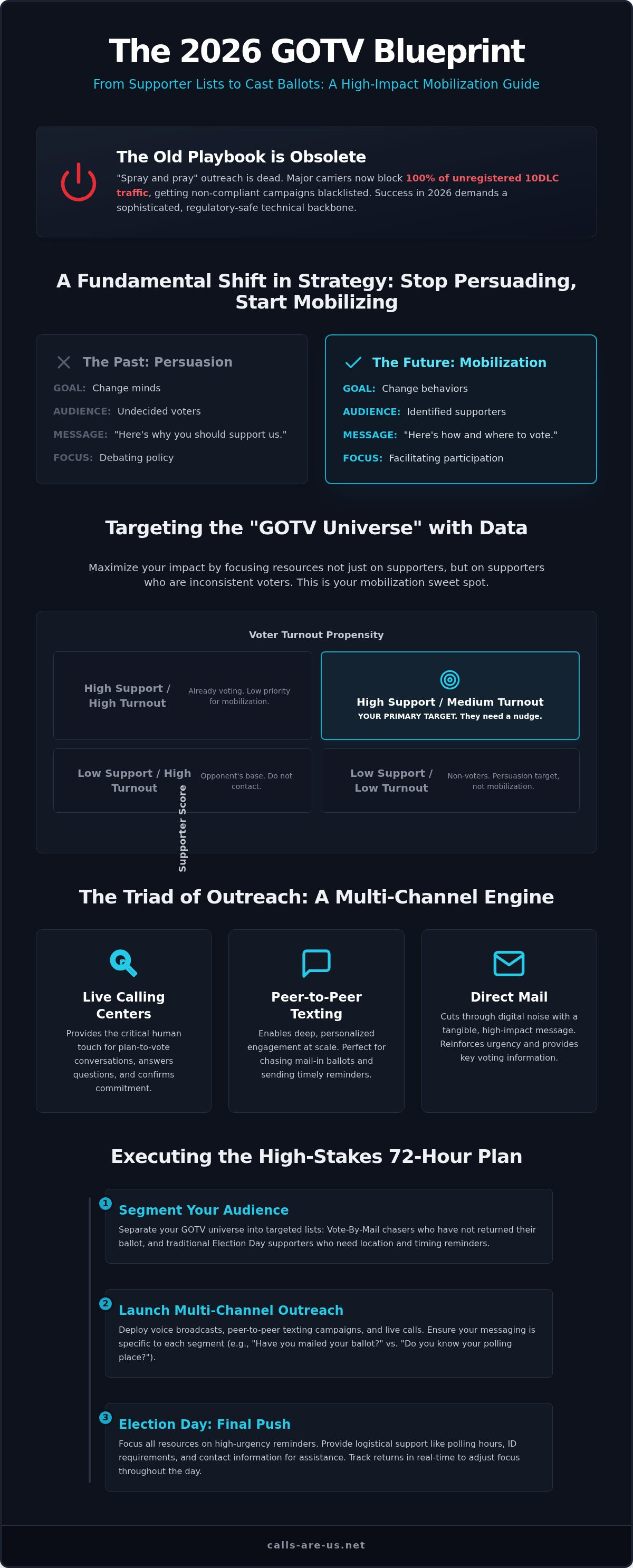
Executing the 72-Hour GOTV Checklist
Precision wins elections. The final 72 hours of a campaign represent a logistical sprint where every second must be accounted for with surgical accuracy. To master how to run a GOTV campaign, you must transition from broad strategy to tactical execution. This is the period where your preparation, infrastructure, and timing converge to drive voters to the polls. It is the moment where your months of data collection finally transform into actual ballots cast.
Your operational timeline begins at T-minus 7 days. During this critical preparation phase, you must finalize your scripts, record high-quality candidate audio, and rigorously test your 10DLC routes to ensure maximum deliverability. When the launch hits at T-minus 72 hours, you deploy the first wave of multi-channel reminders across voice and text platforms. By T-minus 24 hours, the phase known as "The Chase" begins, involving aggressive, high-touch follow-up with supporters who have not yet confirmed their specific plan to vote.
Regulatory Safety: TCPA and 10DLC Compliance
Compliance is not optional in the modern landscape. As of February 2026, major U.S. carriers block 100% of unregistered 10-digit long code (10DLC) political text traffic. You must verify your campaign identity through Campaign Verify and adhere to strict TCPA guidelines to avoid penalties that range from $500 to $1,500 per violation. This includes honoring quiet hours between 9 p.m. and 8 a.m. in the recipient's time zone and avoiding the use of AI-generated voices in robocalls. A2P 10DLC serves as the industry standard for campaign text deliverability. Navigating these complex rules requires a technical partner who understands the nuances of 10DLC-compliant political messaging.
The Election Day 'Strike List' Strategy
Efficiency is your greatest ally when the polls are open. By integrating real-time poll-watching data, you can create a "Strike List" that removes individuals from your outreach queue the moment they cast their ballot. This prevents your team from wasting valuable resources on voters who have already performed their civic duty. Instead, you can focus all remaining energy on the "Late Afternoon Surge," shifting live agents and automated text alerts to the most critical, unvoted precincts in the final hours. This dynamic reallocation of resources ensures that your campaign remains agile, focused, and impactful until the final polling location closes its doors.
Scaling Your Impact with Professional GOTV Services
Passion alone doesn't win elections; infrastructure does. While volunteers are often celebrated as the heart of mobilization, relying solely on them introduces a high "flake rate" that can cripple a campaign in the final 72 hours. To truly master how to run a GOTV campaign at scale, you must transition from managing individuals to directing a professional mobilization machine. Professional scaling offers the reliability, speed, and massive volume required to move thousands of voters simultaneously across multiple jurisdictions without the risk of volunteer burnout.
Calls-Are-Us provides the technical backbone necessary for this high-stakes transition. Our integrated suite brings Voice Broadcast, P2P Texting, and Direct Mail under one roof, allowing you to synchronize your message across every critical channel. This unified approach eliminates the friction of managing disparate vendors during the most stressful week of the cycle. You stop "doing it all" and start directing a system designed for one purpose: turning your supporter lists into actual ballots cast.
Infrastructure for High-Stakes Outreach
Redundant systems are the silent guardians of a successful campaign. When you're deploying millions of messages, you need carrier-grade delivery to ensure your outreach isn't lost in a digital void or throttled by inadequate hardware. Professional live agents offer a high-empathy alternative to traditional robocalls, maintaining a human touch at a national scale that volunteers simply cannot sustain. Utilizing political voice broadcasting as part of this infrastructure ensures your candidate's voice reaches every household with consistent clarity, authority, and impact. It's about building a foundation that is as resilient as it is reach-oriented.
Taking the Next Step
Evaluating a GOTV vendor requires a focus on three pillars: compliance, speed, and integrated reporting. Understanding how to run a GOTV campaign in 2026 means recognizing that a technical failure is a political failure. You need a partner who understands the high-stakes environment of modern elections, from 10DLC registration timelines to TCPA-safe workflows. We offer a consultative partnership that begins with a custom mobilization plan tailored to your specific universe. This expert guidance ensures your campaign remains agile, compliant, and focused on the finish line. Empower your campaign with Calls-Are-Us mobilization tools to ensure your vision is realized on Election Day.
Securing Your Path to Victory
Victory is a matter of precision logistics. You've seen that mastering how to run a GOTV campaign in 2026 requires more than just passion; it demands a sophisticated technical foundation and a commitment to regulatory excellence. By focusing on your highest-impact voter segments and deploying a multi-channel outreach triad, you ensure your message cuts through the digital noise. Timing remains your greatest asset during the final 72 hours, and a professional infrastructure is your best defense against carrier filtering and volunteer flake rates.
Our TCPA and 10DLC compliant infrastructure provides the nationwide service coverage you need to scale with total confidence. We deliver an expert-led multi-channel strategy that transforms your supporter data into a decisive movement at the polls. It's time to transition from managing spreadsheets to directing a high-capacity mobilization engine. Scale your voter mobilization with Calls-Are-Us professional outreach and turn your supporters' intentions into actual ballots cast. Your mission is too important to leave to chance; let's secure the win together.
Frequently Asked Questions
What is the most effective GOTV tactic in 2026?
The most effective tactic is an integrated multi-channel approach that combines digital speed with human empathy. High-volume voice broadcasting and P2P texting are essential for reach, but they must be anchored by the personal touch of a live calling center. Research suggests that emphasizing social pressure and providing a specific plan-to-vote significantly increases turnout. Success requires surrounding the voter with consistent, urgent reminders across every device and their mailbox.
How do I ensure my campaign text messages aren't blocked by carriers?
You ensure deliverability by completing full A2P 10DLC registration and obtaining verification through Campaign Verify. As of February 2026, major carriers block 100% of unregistered political traffic to prevent spam. Beyond registration, maintaining clean lists and providing clear opt-out instructions are vital for maintaining carrier trust. Working with a specialized provider ensures your routes are tested and your templates meet the latest regulatory standards for high-impact deliverability.
When should a GOTV campaign officially begin?
Your operation should officially begin at least 30 days before Election Day to account for early voting and mail-in ballot timelines. This period allows you to clean your voter file and finalize your 10DLC registration. While the intense 72-hour sprint is the climax of the effort, the groundwork for how to run a GOTV campaign effectively is laid weeks in advance. Early engagement ensures you capture mail-in voters before they lose their ballots.
Is voice broadcasting still legal for political campaigns?
Voice broadcasting remains legal for political campaigns, provided you adhere to TCPA regulations and state-specific laws. You must respect federal quiet hours between 9 p.m. and 8 a.m. and provide clear disclaimers identifying the caller. Automated calls to mobile phones generally require prior express consent, whereas calls to residential landlines are more flexible but limited in frequency. Using a professional partner helps you navigate these evolving compliance hurdles safely and efficiently.
How much of my budget should I allocate to GOTV?
Most successful campaigns allocate between 15% and 25% of their total budget specifically to mobilization operations. This investment covers the technical infrastructure for voice broadcasting, P2P texting, and direct mail during the final weeks. While persuasion is expensive, mobilization is where elections are won or lost. Prioritizing these funds ensures you have the necessary volume and speed to turn your hard-earned supporter lists into actual ballots cast on Election Day.
What is a 'strike list' and how do I use it on Election Day?
A strike list is a real-time record of supporters who have already cast their ballots, allowing you to remove them from your outreach queue. By integrating poll-watching data into your CRM, you stop wasting resources on people who have already voted. This allows your live agents and automated systems to focus exclusively on those who still need a nudge. It's a critical tool for maximizing efficiency and reducing voter fatigue during the final hours.
Can I use automated calls to remind people of their polling location?
You can use automated calls to deliver logistical information like polling locations and opening hours. These reminders are highly effective because they provide immediate utility rather than just a persuasion pitch. When combined with IVR systems, you can even allow voters to press a key to receive a text with their specific polling address. This proactive approach simplifies the voting process and removes the friction that often prevents supporters from showing up.



Comments