_edited.png)
Mastering Live Voter Identification Calls: The 2026 Strategy Guide

Updated: Jun 18
What if the most powerful data in your 2026 campaign isn't found in an algorithm, but in a three-minute conversation? While digital platforms struggle with plummeting contact rates and passive engagement, professional live voter identification calls remain the gold standard for high-fidelity intelligence. This human-centric approach cuts through the noise of a crowded election cycle, providing a level of nuance that automated tools simply cannot capture.
You've likely felt the frustration of sinking resources into inaccurate voter files or seeing your digital outreach ignored by the very people you need to reach. It's a common struggle to balance the perceived cost of live agents against the need for clean, actionable data. We'll show you how to deploy live agent calls to identify your true supporters, uncover the local influencers who can flip their networks, and build a high-fidelity database. This article explores the strategic shift toward human-centric outreach, the impact of new regulatory standards like the 2026 TCPA updates, and the exact workflow for maximizing your campaign's impact.
Key Takeaways
Discover why authentic human interactions break through digital fatigue to provide the real-time messaging feedback that algorithms often miss.
Learn how to leverage live voter identification calls to pinpoint "Undecided Influencers" who have the unique power to mobilize their own social networks.
Understand the strategic criteria for choosing between live agents and IVR to ensure your budget is always allocated to the highest-leverage activities.
Master a proven execution framework that prioritizes the "Ask" early in your scripts to build a high-fidelity database of confirmed supporters.
Explore how integrating live calling centers with P2P texting and IVR creates a multi-layered outreach strategy for maximum voter impact.
Table of Contents
The Human Connection: Why Live Voter Identification Remains Peerless
Connection is the currency of modern campaigns. While digital ads are easy to ignore, a phone call from a real person demands attention. Live voter identification calls provide the essential human touch that transforms a cold data point into a meaningful interaction. They foster trust, elicit nuance, and build lasting loyalty. This isn't just about checking a box; it's about understanding the heart of the electorate. Professional agents listen to the hesitation in a voter's voice, identify the specific issues that matter to them, and provide immediate clarity that an algorithm would miss.
The legal and social landscape of voting continues to shift. Understanding the current status of Voter identification laws is critical for any campaign seeking to mobilize supporters effectively. When a live agent speaks with a voter, they aren't just verifying a name. They are navigating a complex environment where personal identification and political participation intersect. This high-stakes dialogue requires a level of empathy and professional poise that automated systems simply cannot provide. It establishes a human-centric baseline that digital tools cannot replicate.
To better understand the evolving dialogue surrounding voter identification, watch this helpful video:
Overcoming the Digital Noise in 2026
Voters are exhausted. By mid-2026, the surge of AI-generated content has led many to tune out digital messaging entirely. They filter out automated texts and scroll past social ads without a second thought. A professional live voice breaks through this digital noise with immediate authority. It validates the voter's opinion and signals that the campaign values their individual perspective. This human-to-human interaction creates a psychological bond that digital platforms can't replicate. It transforms a generic outreach attempt into a personal invitation to participate in the democratic process.
The Strategic Value of High-Fidelity Voter Data
Data is only as good as its depth. Binary "Yes" or "No" answers tell you very little about a voter's underlying motivations. Live voter identification calls capture the "why" behind the sentiment, uncovering specific concerns or localized issues that drive decision-making. This high-fidelity intelligence is the foundation of a sophisticated mass communication strategy. When you know exactly why a voter is hesitant, you can refine your direct mail and digital ad targeting with surgical precision. This real-time feedback allows your campaign to pivot messaging instantly, ensuring your resources are always focused on the most persuasive arguments.
Defining the Influencer: Beyond Simple Supporter Identification
Identify the force multipliers. An influencer is more than just a single vote; they are a catalyst for change within their social circle. While traditional outreach focuses on individual support, sophisticated live voter identification calls aim to uncover those who actively shape the political opinions of their neighbors, colleagues, and families. These individuals act as trusted messengers. They build community consensus, drive grassroots turnout, and provide the social proof necessary for undecided voters to commit.
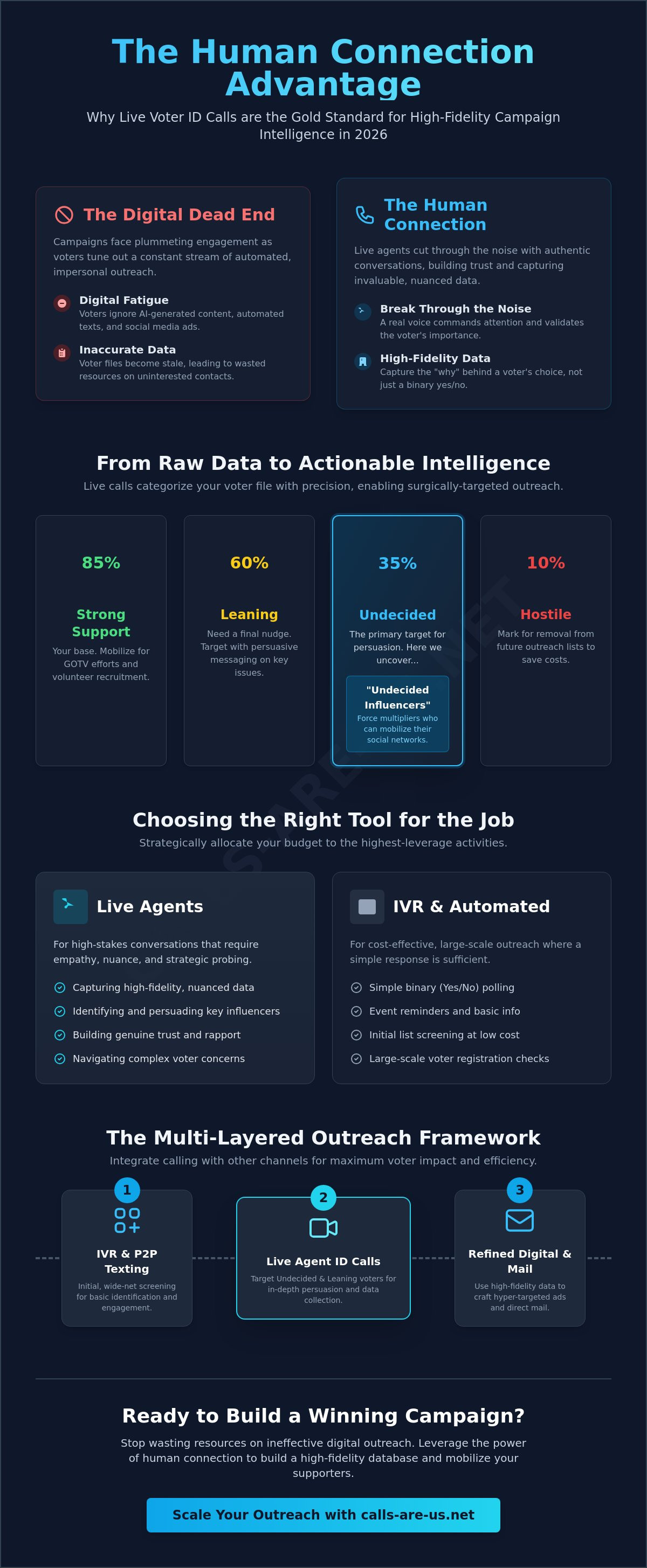
Effective campaigns categorize voters on a nuanced scale to prioritize resources. We typically use a four point system to organize the data collected during these interactions. "Strong Support" voters are your base. "Leaning" voters require a final nudge. "Undecided" voters are the primary target for persuasion. Finally, "Hostile" voters are marked for removal from future outreach to save costs. When conducting these high-stakes outreach efforts, staying compliant with FCC rules for political calls is non-negotiable for protecting your campaign’s reputation and ensuring your message is heard legally.
The Influencer ID Model
Target the undecided influencer first. This specific profile is the highest-leverage asset in any field operation. Unlike a firm supporter, an undecided influencer is still weighing their options but possesses the social reach to take five or ten people with them once they decide. We identify them by asking about the frequency of their political discussions and their willingness to share their views. Once an influencer is identified as a supporter, we immediately solidify their commitment. A "Yard Sign Ask" is a powerful tool here. It transforms a private opinion into a public declaration, making it much harder for that voter to flip later in the cycle.
Data Categories That Drive Strategy
Capture more than just a name. High-fidelity live voter identification calls focus on gathering "Hard ID" data that fuels your entire multi-channel strategy. This includes verified phone numbers, active email addresses, and the voter’s preferred communication channel. Beyond contact info, agents track specific issues of concern like the economy, healthcare, or local infrastructure. This granular detail allows for surgical precision in your messaging. If you’re ready to scale these interactions, a professional live calling center can help you identify these key players at scale. All results must then be integrated directly into your central voter database, such as VAN or L2, to ensure your ground game and digital ads are perfectly synchronized.
Live Agent vs. IVR: Choosing the Right Tool for Your Data
Strategy dictates the tool. You wouldn't use a scalpel for a sledgehammer's job, and political outreach is no different. Choosing between live agents and automated systems depends entirely on your campaign phase, your target universe, and your specific data goals. While live voter identification calls offer unmatched depth and rapport, automated systems provide the sheer scale needed for broad sentiment snapshots. Successful campaigns don't just pick one; they deploy each strategically to maximize every dollar in the budget.
Data integrity serves a dual purpose. Beyond helping you win, maintaining high-fidelity lists is a foundational step in preventing voter fraud by ensuring that communication only reaches verified, active participants in the democratic process. When your database is clean, your outreach is more effective, and your campaign's credibility remains beyond reproach.
When to Deploy Live Calling Center Services
Use live agents when the goal is transformation. In high-stakes persuasion phases, the human voice is your most powerful asset. If a voter presents a complex objection regarding a policy or a candidate's history, a pre-recorded script will fail. Professional agents can pivot the conversation, address specific concerns, and build the trust necessary to secure a "Yard Sign" commitment or recruit a volunteer. They allow you to verify data, address objections, and secure commitments in a single interaction. This human-centric approach is peerless when you need to move a voter from "Leaning" to "Strong Support."
The Role of Automated Systems
Efficiency drives the automated approach. For campaigns needing a quick pulse on a massive district, IVR data collection offers a cost-effective solution for high-volume sentiment tracking. It's the ideal choice for simple "Yes/No" identification where volume is the priority over nuance. Additionally, political voice broadcasting can prime a list before your agents pick up the phone. By sending a broad message first, you can filter out disconnected numbers and disinterested parties, ensuring your live voter identification calls are focused exclusively on the most receptive targets.
Consider the hybrid model for the highest ROI. You can use an automated sweep to categorize your initial list, then deploy live agents for follow-up with the high-value "Undecided Influencers" we discussed earlier. While the per-call cost of a live agent is higher, the quality of the intelligence they return is far superior. This tiered strategy ensures your budget is spent on meaningful conversations that actually move the needle on election day.
How to Execute a High-Impact Live Voter ID Campaign
Execution is where strategy meets reality. Launching live voter identification calls requires a disciplined, multi-step workflow to ensure every dial contributes to a winning margin. You don't just "make calls"; you engineer a data acquisition engine that identifies, persuades, and mobilizes. Precision in the early stages prevents wasted resources in the final weeks of the campaign. By following a structured operational plan, you can transform a raw list into a high-fidelity map of your electorate.
Define and segment: Use historical turnout and demographic data to build your target universe before the first dial is made.
Engineer the script: Place your primary identification question within the first thirty seconds to capture data even if the voter hangs up early.
Train for precision: Agents must be experts in tone, rebuttal management, and accurate data entry to prevent "dirty" voter files.
Execute multiple passes: Reach voters when they are home by varying call times across a three to five day window to maximize contact rates.
Report and iterate: Review daily metrics to identify messaging friction and optimize your script based on real-time feedback.
Scripting for Success
The "Hook-and-Elaborate" method is your best defense against early hang-ups. Start with a punchy, assertive introduction that highlights the importance of the voter's opinion, then immediately pivot to the identification question. Every script should follow a logical flow: Introduction, ID Question, Persuasion/Ask, and a professional Closing. A rebuttal is a respectful tool used to acknowledge a voter's hesitation while providing the specific information needed to deepen the conversation. By mastering these transitions, agents can keep voters engaged longer and extract higher-quality intelligence.
Operational Excellence in Call Centers
High-stakes outreach demands high-stakes compliance. All live voter identification calls must adhere to TCPA regulations to avoid costly penalties and protect the campaign's integrity. This includes maintaining rigorous list hygiene to ensure that "Do Not Call" requests are processed immediately. Bilingual outreach is no longer optional; it is a requirement for national coverage in a diverse electorate. If you are ready to deploy a professional outreach team that understands these complexities, our Live Calling Center provides the scale and expertise needed for high-impact results.
Iterative optimization is the final piece of the puzzle. Don't let your script go stale. If agents report a specific policy question is trending, update the rebuttal guide by the next shift. This agility ensures your campaign stays relevant and responsive to the shifting concerns of the voters you are working to identify.
Scaling Your Outreach with Calls-Are-Us
Trust is the most valuable asset in any election. Calls-Are-Us provides professional live calling center operations designed specifically for the rigors of modern influence. We don't just provide staff; we provide a strategic partnership that ensures your live voter identification calls are executed with precision. Our agents are trained to handle the nuances of the 2026 landscape. They navigate new state-level requirements and maintain strict compliance with the latest TCPA standards. In an era where Americans lost over $1.1 billion to phone scams in 2025, the value of a professional, ethical voice cannot be overstated. We help you earn that trust one conversation at a time.
Synergy drives results. Our platform allows for a seamless flow between live agents, IVR systems, and P2P texting. You can use an IVR sweep to identify general sentiment. You follow up with live agents for persuasion. You reinforce the message through mass texting. This tripartite approach ensures no voter is left behind. Every interaction is captured in your central database, providing a clear picture of your path to victory. We turn complex conversations into actionable campaign strategy. We provide daily, data-driven reporting that highlights emerging trends and messaging opportunities, allowing you to pivot before the competition even realizes the ground has shifted.
The Calls-Are-Us Advantage
Impactful communication must be inclusive and ethical. Our solutions are built to scale. Your outreach grows naturally from the primary phases to the final general election push. This multi-channel approach extends beyond the phone. It integrates with a robust political direct mail strategy. Your message reaches voters in their mailboxes and on their devices simultaneously. We combine national reach with localized nuance. Your campaign sounds like a neighbor, not a machine. We focus on fostering genuine connections that lead to long-term voter loyalty and grassroots advocacy.
Ready to Identify Your Base?
Don't wait for the opposition to define the narrative. Starting your live voter identification calls early in the 2026 cycle is the only way to build a high-fidelity database before the airwaves become saturated. We help you develop a custom voter identification plan. We target the right universes with the right message. Our methodical approach breaks down complex workflows into manageable steps, ensuring your team stays focused on the highest-leverage activities. When you're ready to move beyond generic outreach and start building real human connections, Partner with Calls-Are-Us for Your Live Outreach. Our team is ready to help you master the 2026 strategy and secure your winning margin.
Securing Your Victory Through Human Connection
The 2026 election cycle demands more than a passive digital presence. It requires a proactive, human-centric approach to data acquisition. You've seen how identifying undecided influencers and prioritizing high-fidelity live voter identification calls can transform a struggling campaign into a precision engine. This strategy isn't just about collecting names; it's about building a foundation of trust that carries you through election day. By integrating real-time feedback with a disciplined outreach workflow, you ensure your message resonates exactly where it matters most.
Expertise matters in a high-stakes environment. We've proven our worth across more than 40 states, navigating the complexities of TCPA and 10DLC compliance with absolute precision. Our multi-channel integration brings together Voice, Text, and Direct Mail to create a unified, impactful narrative for your voters. You don't have to navigate this landscape alone. Launch Your Live Voter ID Campaign with Calls-Are-Us to secure the intelligence you need to win. Let's build a more connected and engaged electorate together.
Frequently Asked Questions
What counts as a "completed call" for live voter identification?
A completed call is defined as any interaction where the agent successfully reaches the targeted voter and obtains a clear response to the primary identification question. It's the critical moment where a name on a list becomes a verified, actionable data point for your campaign. While agents aim for a full conversation, capturing the voter's stance on your candidate is the baseline requirement for a successful "Hard ID."
What is the typical completion rate for live voter ID calls in 2026?
Identification rates for live voter identification calls vary significantly based on the age of your voter file and the timing of your outreach. Most professional campaigns find that their contact rates improve when they spread dials across different times of day and vary the days of the week. This persistence is necessary to overcome the noise of modern life and ensure your message reaches the intended audience effectively.
How are live call center agents trained to handle voter objections?
Training focuses on active listening and the disciplined use of rebuttal guides to handle voter hesitation. Agents learn to acknowledge a voter's specific concerns with empathy before providing the factual information needed to pivot back to the campaign's core message. This human-to-human interaction allows for a nuanced dialogue that builds trust and identifies the underlying motivations behind a voter's political sentiment.
How many passes should we make through a voter list before it is exhausted?
Most sophisticated operations plan for three to five passes through their voter list to ensure they reach every possible supporter. Reaching a voter on the first attempt is rare in the 2026 landscape. Spreading these attempts over several days and varied time slots ensures you catch people during different parts of their weekly routine, maximizing the return on your data investment.
Are live voter ID calls compliant with TCPA regulations?
Live agent calls are compliant with TCPA regulations when they follow established FCC guidelines for political speech. The FCC permits campaigns to call voters on the Do Not Call Registry, though professional centers must still honor specific opt-out requests within 10 business days as per the April 2025 rules. Our live voter identification calls are designed to meet these rigorous standards while maintaining a respectful, human-centric approach.
Can live ID calls be used to request yard signs or volunteer commitments?
Absolutely, and this is one of the highest-leverage uses of a live interaction. Once a voter is identified as a "Strong Support," agents can immediately pivot to a secondary ask like a yard sign or a volunteer shift. This turns a private opinion into a public declaration, making it much more likely the voter will follow through on election day and influence their neighbors.
How do live ID calls integrate with my existing campaign CRM?
Integration is seamless through API connections or structured batch uploads into major voter databases like VAN or L2. Professional calling centers prioritize data integrity, ensuring that every tag, Issue of Concern, and Influencer status is mapped correctly to your central CRM. This allows your entire campaign team to act on fresh intelligence for targeted mail and peer-to-peer texting campaigns within hours of the conversation.
What is the difference between a Live ID call and a GOTV call?
Timing and intent represent the primary differences between these two outreach methods. Identification calls happen early in the cycle to map the electorate and identify your base of supporters. GOTV calls happen in the final push to ensure those identified voters actually cast their ballots. You can't run an effective GOTV operation without the high-fidelity lists generated during the identification phase.



Comments