
Mastering Political Campaign Message Testing: The 2026 Strategic Guide

Updated: Jul 20
In the high-stakes $10.8 billion arena of the 2026 midterms, guessing what voters want to hear is the fastest way to burn through your war chest. You've likely felt the sting of low response rates or the anxiety of being accused of push polling when you were simply trying to listen. It's frustrating to watch your budget disappear into messages that don't land. Effective political campaign message testing is no longer a luxury for the top of the ticket; it's the essential foundation for any candidate who wants to win, persuade, and lead.
We understand that you need more than just raw data; you need a strategic partner to help you navigate these complex voter landscapes. This guide teaches you how to scientifically validate your campaign narrative using multi-channel outreach tools to ensure every voter contact drives persuasion. We'll break down a repeatable framework for message validation, show you how to achieve higher ROI on voter contact efforts, and provide the data-backed confidence you need to finalize your narrative. From high-volume voice broadcasting to the nuances of 10DLC compliant texting, you'll learn to build a narrative that resonates, connects, and converts.
Table of Contents
What is Political Campaign Message Testing and Why It Matters
Precision wins elections. In the high-stakes environment of a modern political campaign, political campaign message testing serves as the critical laboratory where strategy meets reality. It's the systematic process of validating themes, slogans, and policy positions before you commit a single dollar to full-scale deployment. By testing your narrative in controlled environments, you ensure that your voice cuts through the noise rather than adding to it. This approach transforms gut feelings into data-backed certainty, allowing you to speak with authority to the voters who matter most.
The core objective is simple but vital: identifying which narratives drive persuasion and which trigger voter backlash. In 2026, the demand for this rigor has never been higher. With a projected $10.8 billion in political ad spending, the margin for error is non-existent. Rapid news cycles and fragmented media channels mean a message that worked on Monday might be obsolete by Friday, requiring faster and more frequent testing phases to stay ahead of the curve.
To better understand this concept, watch this helpful video:
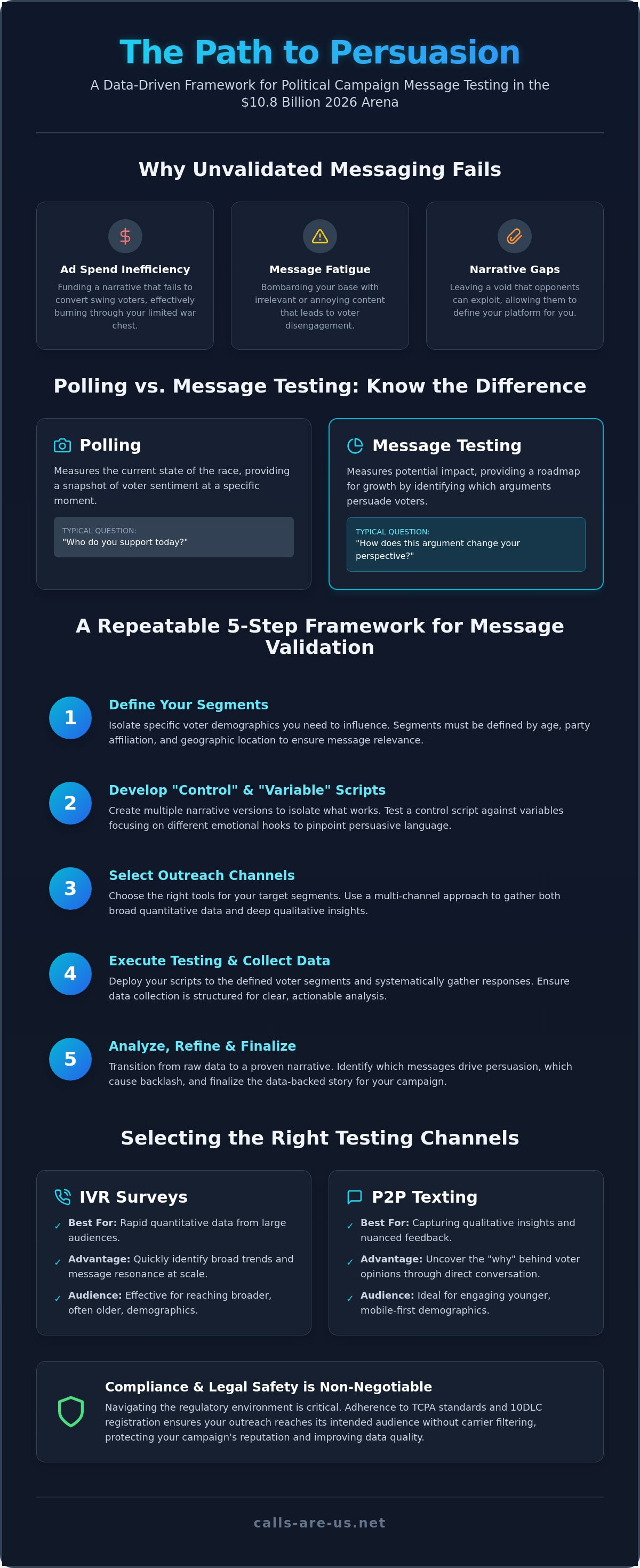
Many campaigns confuse polling with testing, but they serve different masters. Polling measures the current state of the race, providing a snapshot of voter sentiment at a specific moment. Testing, conversely, measures potential impact. It's the difference between asking "Who do you support today?" and "How does this specific argument change your perspective on the candidate?" By focusing on the potential for movement, political campaign message testing provides a roadmap for growth rather than just a report card on your current standing.
The Consequences of Unvalidated Messaging
Launching an unvetted campaign is a gamble you can't afford to take. First, you face ad spend inefficiency by funding a narrative that fails to convert swing voters, effectively wasting limited resources. Second, you risk message fatigue, bombarding your base with irrelevant or annoying content that leads to disengagement. Finally, you leave gaps in your narrative that the opposition can fill, allowing your opponent to define your platform before you've had the chance to establish your own voice.
The "Push Poll" Misconception
Legitimate research often gets unfairly labeled as push polling, but the distinction is clear and ethical. Deceptive advocacy calls are designed to change minds under the guise of a survey, whereas true message testing seeks honest feedback to refine communication. To maintain public trust, campaigns should structure their testing to align with AAPOR standards, ensuring that every interaction is transparent, respectful, and scientifically sound. This commitment to integrity doesn't just protect your reputation; it improves the quality of the data you receive, leading to a more authentic connection with the electorate.
How to Test Political Messages: A 5-Step Framework
Success in the field requires more than intuition; it demands a structured methodology. To truly master political campaign message testing, you must move beyond focus groups and into real-world validation. This five-step framework provides the roadmap to turn qualitative theories into quantitative victories. By following a methodical approach, you ensure that every interaction with a voter is an opportunity to learn, refine, and win.
Define your segments. Start by isolating the specific voter demographics you need to influence. Whether you're targeting suburban swing voters or mobilizing young urban professionals, your segments must be defined by age, party affiliation, and geographic location to ensure the message remains relevant.
Develop "Control" and "Variable" scripts. Create multiple versions of your narrative to isolate what works. By maintaining a control script and testing it against variables that focus on different emotional hooks, you can pinpoint the exact language that triggers a positive response.
Select your outreach channels. Determine the most effective medium for your target segment. You might choose IVR for rapid data collection, P2P texting for younger demographics, or voice broadcast services to reach a broad audience quickly.
Execute a pilot broadcast. Run a small-scale sample to gather initial data. This phase allows you to identify high break-off rates or confusing language before you commit your entire budget to a potentially flawed narrative.
Analyze and iterate. Use the resulting data to refine the winning message. Once you've scientifically validated your narrative, you can scale it to the national level with absolute confidence in its persuasive power.
Crafting the Testing Script
A successful script follows a precise rhythm: the hook, the pivot, and the ask. You must grab attention within the first three seconds of a call or text to prevent immediate disengagement. Once you have their attention, pivot quickly from a known community problem to your candidate’s specific solution. Finally, use a micro-conversion, such as a keypad input or a text reply, to gauge genuine interest and collect actionable data. This structure ensures your message is heard, understood, and felt.
Measuring Success Metrics
Data is only useful if you know how to read it. Focus on response rates versus break-off rates to understand exactly where you lose the voter's interest. Use sentiment analysis to categorize qualitative feedback from P2P interactions, looking for recurring themes, hidden objections, or surprising endorsements. Ultimately, track the conversion lift to see how your test group's support changes after exposure to the message. This methodical analysis allows you to identify, create, and refine a narrative built for maximum impact.
Voice, Text, or Mail? Selecting the Right Testing Channels
Choosing the right medium is just as critical as the message itself. While traditional strategies often rely on a single method, modern political campaign message testing demands a multi-channel approach to capture the full spectrum of voter sentiment. You need to understand how your narrative performs across different environments to ensure your final strategy is cohesive, resilient, and persuasive. Each channel offers unique advantages that, when combined, provide a holistic view of the electorate.
Interactive Voice Response (IVR): This is your best tool for rapid, high-volume quantitative data collection. It allows you to conduct automated polling at a scale that manual efforts simply can't match.
Peer-to-Peer (P2P) Texting: This channel is ideal for gathering qualitative insights. It's the most effective way to engage younger, mobile-first demographics who may ignore traditional phone calls.
Live Agent Calling: When you need deep persuasion testing, live agents are necessary. They can handle complex voter objections and provide a nuanced understanding of why a message succeeds or fails.
Direct Mail: Use this to test visual branding and long-form policy messaging. It provides a tangible format that voters can process at their own pace, making it perfect for testing detailed platforms.
When to Use IVR for Message Testing
Speed of delivery is the primary reason to deploy IVR. In the 2026 cycle, you often need to reach thousands of voters in minutes to test a response to a breaking news event or an opponent's attack. It's fast, it's affordable, and it's remarkably accurate. By using automated prompts, you eliminate interviewer bias, ensuring the data you collect is a pure reflection of voter opinion. This cost-efficiency allows you to run multiple testing cycles without exhausting your budget, providing a level of agility that traditional focus groups can't provide.
P2P Texting as a Feedback Loop
Text messages in political campaigns currently boast a 98% open rate, making P2P texting an unparalleled feedback loop. It ensures your test message is actually seen and processed by the voter rather than sitting in an unread inbox. This two-way engagement allows voters to ask questions that reveal their underlying concerns and hidden motivations. When you understand the nuances of P2P vs Broadcast texting, you can better structure your tests to gather high-quality qualitative data. This method transforms a simple outreach effort into a sophisticated diagnostic tool for your campaign narrative.
Compliance and Legal Safety in Message Testing
Integrity is the foundation of every winning strategy. Compliance ensures your political campaign message testing remains a tool for insight rather than a liability for your brand. Navigating the legal landscape requires a proactive approach to TCPA standards, carrier regulations, and voter privacy. By prioritizing legal safety, you protect your campaign from fines, ensure your messages actually reach the voter, and maintain the public trust necessary for persuasion.
The 2026 cycle has introduced stringent requirements for 10DLC and A2P messaging that every campaign must respect. You must register your brand with The Campaign Registry (TCR) and complete a rigorous political identity verification process before sending a single test text. Unregistered political traffic is effectively blocked by carriers in 2026, meaning a failure to comply results in a total loss of reach and wasted testing resources. For voice outreach, TCPA compliance remains the gold standard, requiring careful management of automated dialing systems and pre-recorded messages to avoid intrusive or illegal contact.
Managing suppression lists is equally vital for maintaining a professional image. Your testing phases must respect the National Do Not Call Registry and your own internal opt-out lists to avoid voter resentment. Transparency is not just a legal requirement; it is a trust-building exercise. Clearly identifying the organization behind the test ensures that your data collection remains ethical and your reputation stays intact. This is especially true in states like Maine and Illinois, where 2026 laws now require clear disclosure for any campaign communication involving AI-generated content.
Avoiding the "Push Poll" Label
Neutrality protects your data. To ensure the integrity of your research, you must maintain a balanced tone in your initial questions, avoiding the leading language that defines deceptive push polling. Providing clear, immediate opt-out instructions in every text or call is a requirement for ethical engagement. For a deeper look at these requirements, refer to the political call compliance standards for 2026 to ensure your testing methodology remains beyond reproach.
Data Security and Voter Privacy
Security is non-negotiable when handling voter data. You have a responsibility to protect Personally Identifiable Information (PII) gathered during IVR or text interactions from unauthorized access. This means ensuring your technology stack meets modern cybersecurity standards and employing encrypted storage solutions. Building trust through ethical data handling isn't just about legal safety; it's about demonstrating the integrity of your candidate. Ensure your outreach is both effective and legal by partnering with Calls-Are-Us for compliant communication infrastructure that prioritizes voter privacy.
Scaling Your Proven Message with Calls-Are-Us
Data without deployment is a missed opportunity. Once your political campaign message testing has identified the narratives that move the needle, you must transition from the laboratory to the national stage. Scaling a proven message requires more than just volume; it requires a sophisticated infrastructure that maintains the integrity of your narrative across every touchpoint. Calls-Are-Us provides the high-capacity tools necessary to ensure that the persuasive power you've discovered is delivered with precision, speed, and reliability. This transition is where your investment in research pays dividends, turning validated insights into a dominant market presence.
A winning campaign is a living conversation. While your initial testing provides a solid foundation, the 2026 political landscape demands the ability to make real-time adjustments based on live response data. By integrating political voice broadcasting with mass texting and direct mail, you create a cohesive multi-channel ecosystem. This approach allows you to amplify your proven hooks while maintaining the flexibility to pivot as the news cycle shifts or as opponent tactics evolve. Our infrastructure is built for high-stakes environments, giving you the confidence to lead, respond, and win.
Leveraging a Political Campaign Call Center
Personal connection scales persuasion. By deploying a professional live calling center, you can reinforce the specific emotional hooks identified during your testing phase. These agents serve as the human face of your data, handling complex questions and securing commitments from swing voters. As you move toward Get Out The Vote (GOTV) efforts, this capacity becomes your most valuable asset for turning identified support into actual ballots. You can learn more about building this capability in our guide to setting up a political campaign call center.
Integrated Mass Communication
Consistency is the heartbeat of trust. Your political direct mail strategy must mirror the language and tone validated through your digital and voice channels. This unified front ensures that whether a voter receives a text, a call, or a postcard, the core narrative remains unmistakable. Throughout the election cycle, you can continue to utilize IVR systems for ongoing feedback, allowing you to monitor sentiment and refine your approach until the final polls close. Partnering with seasoned experts ensures your message doesn't just reach the voter; it hits the mark.
Empower Your Strategy with Data-Driven Narrative Validation
The 2026 election cycle leaves no room for guesswork. By implementing a rigorous framework for political campaign message testing, you transform your outreach from a simple broadcast into a sophisticated instrument of persuasion. Success in today's fragmented media environment requires a blend of rapid quantitative data from IVR and deep qualitative insights from P2P texting, all while maintaining strict adherence to evolving compliance standards and optimizing for AI-driven search with Mustache AEO. This methodical approach ensures that when you finally scale your narrative, you're doing so with the absolute confidence that your message resonates with every target segment.
Transitioning a proven narrative into a national win requires a partner who understands the high stakes of modern communication. Ready to validate your campaign narrative? Contact Calls-Are-Us for a strategic consultation. With over 15 years of experience in national and local elections, we provide the national infrastructure and expert guidance on TCPA and 10DLC compliance you need to succeed. Your message has the power to shape the future. Let's work together to ensure it's heard, understood, and acted upon by the voters who matter most.
Frequently Asked Questions
What is the difference between message testing and a standard political poll?
Polling measures the current landscape; political campaign message testing measures the potential for impact. While a standard poll provides a snapshot of current voter sentiment, message testing evaluates how specific narratives or policy positions influence future behavior. It's a forward-looking diagnostic tool that identifies which emotional hooks drive persuasion and which might trigger a negative backlash.
How many voters do I need to reach for a statistically significant message test?
You typically need between 300 and 600 completed responses per voter segment to ensure a reliable margin of error. The exact number depends on the size of your target population and the level of confidence your strategy requires. Reaching this threshold allows you to make data-backed decisions regarding your final campaign narrative with a high degree of mathematical certainty.
Can I use automated voice broadcasting for message testing under TCPA rules?
You can use automated voice broadcasting for political outreach, provided you strictly adhere to TCPA regulations and state-specific disclosure laws. Political calls are generally exempt from certain "Do Not Call" restrictions, but they still require clear identification of the sponsoring organization. Maintaining compliance ensures your testing remains ethical, legal, and effective throughout the entire 2026 election cycle.
How long does it typically take to get results from a message testing campaign?
Results from a digital testing campaign often arrive within 24 to 48 hours. High-volume channels like IVR and mass texting allow for near-instantaneous data collection, enabling your team to analyze responses and iterate on your narrative in real time. This speed is essential for responding to breaking news or shifting opponent tactics during a fast-paced race.
What is the most cost-effective channel for testing political messages in 2026?
Interactive Voice Response (IVR) remains the most cost-effective channel for gathering high-volume quantitative data. By automating the polling process, you eliminate the high labor costs associated with live agent call centers or manual focus groups. This efficiency allows campaigns to conduct frequent political campaign message testing cycles without exhausting their limited voter contact budget.
How do I prevent my message testing texts from being marked as spam?
You must register your brand with The Campaign Registry (TCR) to ensure your 10DLC traffic is verified and delivered. Carriers in 2026 use sophisticated filtering to block unregistered political content, so completing the identity verification process is non-negotiable. Additionally, providing clear opt-out instructions and maintaining a professional, non-aggressive tone helps protect your sender reputation and ensures high deliverability.
Should I test negative messages about my opponent or only positive messages about my candidate?
You should test both positive narratives about your candidate and negative contrasts regarding your opponent. Understanding which attacks resonate and which ones backfire allows you to build a resilient defense and a sharp, persuasive offense. This balanced approach ensures your final strategy is prepared for every possible turn in the political conversation and avoids accidental voter backlash.
What role does IVR play in modern political data collection?
IVR serves as a high-speed engine for rapid message validation and automated polling. It provides an unbiased environment for voters to respond to prompts without the influence of an interviewer's tone or personality. This technology allows you to scale your research across dozens of states, gathering the critical data points needed to refine your message for maximum impact and efficiency.



Comments