_edited.png)
P2P vs Broadcast Texting: The 2026 Strategic Comparison for High-Impact Outreach

In 2026, the era of guessing your way through a text campaign is officially over. You likely feel the weight of every message sent, knowing that carrier filtering and shadow-banning can silence your voice in an instant. Navigating the complex landscape of 10DLC registration and A2P requirements is no longer optional; it's the foundation of high-impact outreach. Understanding the nuances of P2P vs broadcast texting is the difference between a campaign that resonates and one that disappears into a digital void. We recognize that the January 27, 2026, FCC one-to-one consent rule has fundamentally reshaped how organizations connect with their audiences.
You deserve a strategy that scales without sacrificing the human touch or risking heavy compliance penalties. This article will help you master the critical differences between these two methods so you can select an effective, compliant, and scalable strategy for your unique mission. We'll provide a clear decision-making framework, analyze the latest carrier throughput tiers, and show you how to maximize deliverability. From managing volunteer workflows to integrating seamless CRM sequences, you'll gain the clarity needed to drive meaningful action, foster trust, and achieve your goals.
Table of Contents
P2P vs Broadcast Texting: Defining the 2026 Digital Outreach Landscape
Peer-to-Peer (P2P) Texting: The Power of Human-Centric Conversation
Broadcast Texting: Achieving Unrivaled Scale and Instant Visibility
Strategic Comparison: Choosing the Right Tool for Your Campaign Goals
Beyond the Text: Integrating Messaging into a Multi-Channel Strategy
P2P vs Broadcast Texting: Defining the 2026 Digital Outreach Landscape
Outreach strategies have reached a critical inflection point. As of 2026, the technical and regulatory walls between different messaging styles have grown taller, making the choice of P2P vs broadcast texting a high-stakes decision for any organization. While both methods utilize mobile networks to reach audiences, they operate on fundamentally different mechanical and legal foundations. Understanding these differences isn't just about technical preference; it's about safeguarding your deliverability, managing your budget, and ensuring every message actually reaches its intended recipient.
The landscape has been significantly shaped by legal precedents and shifting carrier policies. For those involved in advocacy, the history of Political Text Messaging in the U.S. highlights how Supreme Court decisions and FCC rulings have forced a move toward transparency. In 2026, this transparency is codified through mandatory 10DLC registration. Whether you're sending a single personalized reply or a million-person alert, carriers now require verified brand identity and campaign intent to prevent the shadow-banning that plagued unregistered traffic after February 1, 2025.
To better understand the technical differences in how these messages are routed and delivered, watch this helpful video:
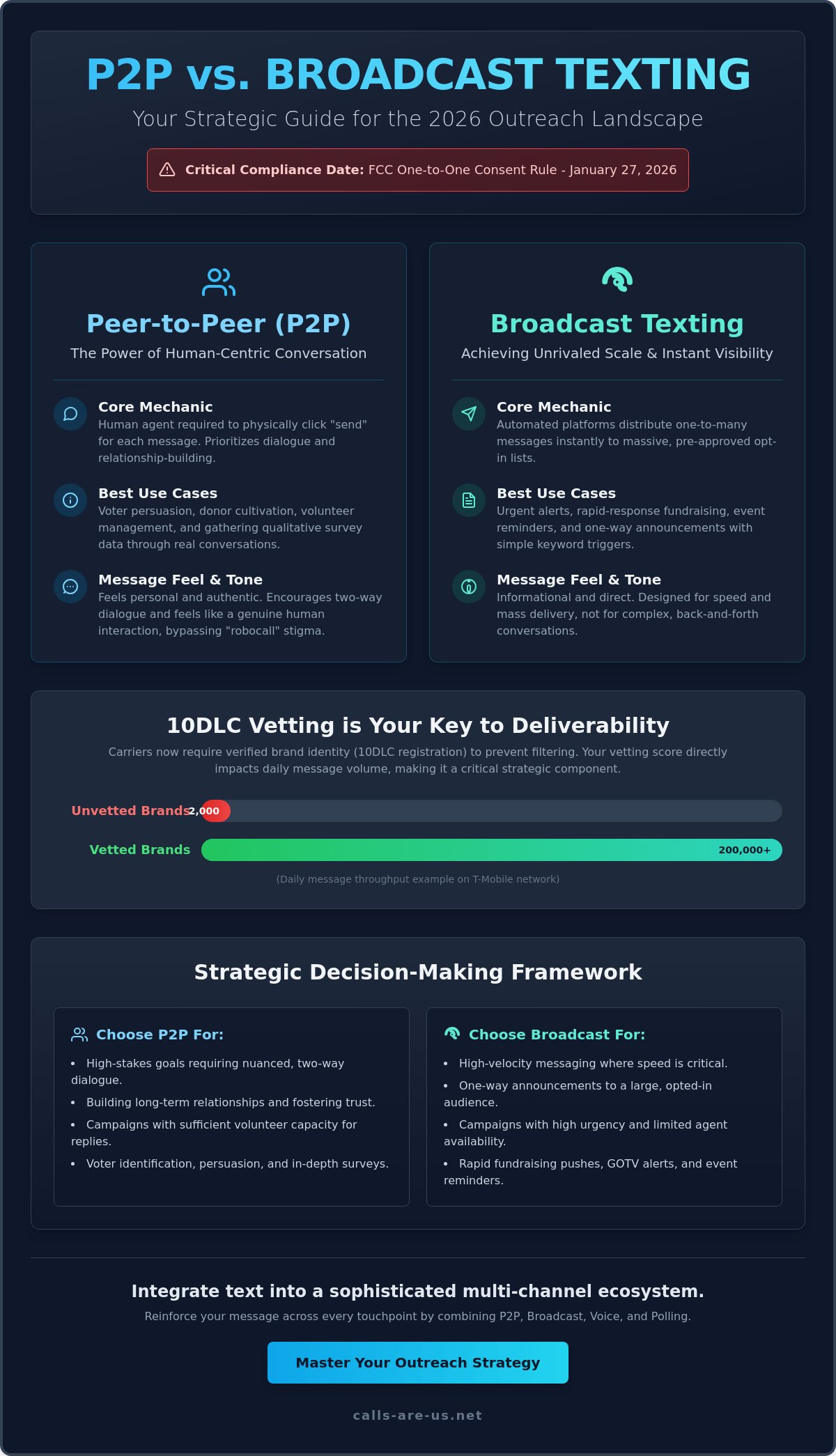
The convergence of these technologies into the 10DLC framework is absolute. Your staffing requirements and conversion metrics are now tied directly to your vetting score and registration status. A high vetting score can grant you throughput of up to 200,000 messages per day on T-Mobile, while unvetted brands are capped at just 2,000. This makes the strategic choice between P2P vs broadcast texting a matter of balancing your "people power" against your need for sheer volume and speed.
The Core Mechanics of Peer-to-Peer Messaging
P2P texting thrives on human interaction. It requires a human agent to physically click "send" for every individual message, a mechanic that traditionally kept it outside the strictest definitions of automated dialing systems. This method prioritizes quality, depth, and relationship-building. By utilizing standard 10-digit long codes, P2P feels personal and encourages a two-way dialogue. It's the ideal tool for voter persuasion, donor cultivation, and gathering qualitative data through real conversations.
The Architecture of Broadcast Texting
Broadcast texting represents the heavy artillery of your communication stack. It uses automated platforms to distribute one-to-many messages instantly to massive, opted-in lists. While it excels at speed and scale, it demands rigorous compliance. Under the FCC One-to-One Consent Rule that took effect on January 27, 2026, you must have explicit, separate consent for each entity contacting a consumer. This architecture is built for urgent alerts, rapid-response fundraising, and one-way announcements with simple keyword triggers.
Peer-to-Peer (P2P) Texting: The Power of Human-Centric Conversation
Connection is the currency of influence. In the ongoing debate of P2P vs broadcast texting, P2P stands out as the choice for organizations that value deep, meaningful engagement over sheer transmission volume. It thrives in high-stakes environments where nuance, empathy, and relationship-building are paramount to success. Unlike automated systems, P2P bypasses the "robocall" stigma through authentic human interaction, ensuring that every outreach attempt feels like a personal conversation rather than a digital intrusion.
Scalability doesn't have to sacrifice sincerity. Modern platforms empower a single volunteer to send thousands of "individual" texts per hour with just a few clicks, maintaining the legal and ethical requirement for human-initiated delivery. This efficiency is why response rates for political SMS typically range from 4% to 25%, significantly outperforming traditional cold outreach. If your goal is to identify voters, drive Get Out The Vote (GOTV) efforts, or manage complex advocacy campaigns, P2P provides the agility you need to adapt to shifting narratives in real-time.
When to Deploy P2P for Maximum Impact
P2P is most effective when the desired outcome involves persuasion or high-value commitments. Organizations should deploy it for specific, high-impact scenarios:
Voter persuasion: Navigating objections in real-time requires a human touch that can adapt scripts to specific concerns and provide immediate, relevant answers.
Event recruitment: A personal invitation significantly increases attendance rates by making the recipient feel exclusively valued and personally invited.
High-dollar fundraising: Cultivating donor relationships requires a level of detail and follow-up that automated broadcasts simply cannot replicate.
Technical Integration: The P2P API Workflow
To achieve true scale, your messaging cannot exist in a silo. Advanced organizations utilize a sophisticated API workflow to bridge the gap between their CRM and their outreach efforts. By implementing peer to peer texting best practices, you can ensure real-time data syncing that updates your records the moment a message is sent or a reply is received. This tripartite model, syncing data, automating volunteer assignments, and maintaining human-initiated delivery, allows for a seamless flow of information. You can effectively manage thousands of conversations without losing the context of previous interactions. If you're looking to modernize your outreach, you can explore how to scale your peer-to-peer texting through our integrated platform.
Broadcast Texting: Achieving Unrivaled Scale and Instant Visibility
Speed is the ultimate advantage. While P2P focuses on building individual relationships, broadcast texting acts as the heavy artillery of digital outreach, delivering critical information to thousands of people simultaneously. It's the essential tool for rapid response, urgent alerts, and hitting those high-pressure fundraising deadlines where timing is everything. This method ensures your message isn't just sent but seen, achieving instant visibility when every second counts. High-volume voice broadcasting and mass texting often work in tandem to saturate an audience, creating a multi-sensory outreach strategy that reinforces your message across different channels.
In 2026, the 10DLC ecosystem for broadcast messaging is a standardized, carrier-sanctioned pathway that mandates brand verification and campaign vetting to ensure high-volume messages are delivered reliably. This framework eliminates the ambiguity of the P2P vs broadcast texting choice by providing a secure, high-throughput channel for organizations that have secured explicit consent from their audience. It's a transparent environment where your traffic is recognized as legitimate, allowing you to bypass the filters that catch unregistered or suspicious activity.
Broadcast Use Cases: Speed and Volume
Success with broadcast messaging depends on utilizing its strengths for specific, high-velocity goals. You should leverage this tool when your objective requires mass mobilization or immediate awareness:
Emergency notifications: You can deliver life-saving or time-critical data to your entire database in mere seconds.
Mass fundraising: Capitalize on major news events or debate moments by driving traffic to donation pages while interest is at its peak.
Compliance and Opt-ins: Adhering to the FCC One-to-One Consent Rule, effective January 27, 2026, is mandatory. You must ensure every recipient has provided separate, explicit permission for your specific organization to avoid costly legal pitfalls.
Navigating 2026 Compliance Standards
The vetting process is now the primary gateway to successful delivery. Achieving a top-tier vetting score of 75-100 with The Campaign Registry allows for up to 200,000 messages per day on major carriers like T-Mobile, providing the scale necessary for national campaigns. This high-stakes vetting ensures you protect your reputation, minimize costs, and maximize impact. Without it, unregistered traffic can incur surcharges ranging from $0.006 to $0.017 per segment, which can quickly drain a budget. To maintain your standing, you must implement automated systems for managing opt-out (STOP) requests immediately. Mastering mass texting compliance is the only way to protect your sender reputation and ensure your long-term ability to reach your supporters effectively.
Strategic Comparison: Choosing the Right Tool for Your Campaign Goals
Efficiency is the byproduct of strategic alignment. Selecting between P2P vs broadcast texting requires a cold-eyed assessment of your organizational assets and your ultimate objectives. It's not just a technical choice; it's a resource allocation decision that impacts your 2026 budget and your team's capacity. You must decide whether your message requires the depth of a human conversation or the sheer velocity of an automated alert. While P2P often carries higher per-message fees, it offers a superior engagement ROI for persuasion-heavy tasks where a human reply is the primary goal. Broadcast texting, by contrast, delivers the lowest cost-per-contact for massive announcements, making it the fiscally responsible choice for scale.
Deliverability metrics also shift based on your choice. Carrier filtering affects P2P long-codes and Broadcast short-codes differently. P2P traffic is scrutinized for its human-initiated nature, while Broadcast traffic relies on the strength of your 10DLC vetting and opt-in records. If your organization lacks the volunteer "people power" to maintain the manual click-rate required for P2P, the automated efficiency of a broadcast campaign is your only viable path to reaching a massive audience before a critical deadline.
P2P vs. Broadcast: Feature Comparison
Your choice hinges on three critical variables that dictate the rhythm of your outreach:
Engagement: P2P provides high, two-way interaction for persuasion; Broadcast offers moderate, one-way visibility for announcements.
Speed: P2P delivery is dependent on human input and manual clicks; Broadcast is instant and fully automated.
Setup: P2P allows for fast deployment via standard long-codes; Broadcast setup varies and often requires more rigorous vetting for high-volume 10DLC paths.
Selecting the Right Software for Your Stack
Modern outreach demands a unified approach. Your political campaign texting software must support hybrid workflows that allow your team to pivot between P2P and broadcast as the campaign cycle evolves. Security is another non-negotiable pillar; you need robust data encryption and granular user access controls to protect sensitive donor data. Finally, your reporting must be comprehensive. You can't manage what you can't measure, so ensure you track delivery, open rates, and response sentiment across both channels to refine your strategy in real-time. If you're ready to deploy a winning strategy, start building your high-impact outreach campaign with our expert-led tools today.
Beyond the Text: Integrating Messaging into a Multi-Channel Strategy
Outreach is never a solo act. In the high-stakes environment of 2026, messaging doesn't exist in a vacuum; it functions as a critical component of a sophisticated tripartite outreach model. While the technical debate of P2P vs broadcast texting focuses on how you send the message, the strategic debate focuses on how that message fits into a recipient's entire journey. Success requires a symphony of touchpoints that create a tangible and digital presence simultaneously, ensuring your organization remains top-of-mind across multiple platforms.
Choosing between P2P vs broadcast texting is just the first step in building a resilient communication stack. Integrating your text strategy with political voice broadcasting allows you to reinforce audio and visual messaging in a way that single-channel campaigns cannot match. You can use the "Text-to-Call" bridge to schedule live agent interactions for deep persuasion, turning a simple SMS reply into a meaningful human conversation. By layering direct mail with digital messaging, you provide a physical anchor to your digital outreach, increasing the likelihood of long-term recall and action.
The Synergy of Voice and Text
Efficiency increases when you use different tools for their specific strengths. You can deploy voice broadcasts for broad awareness or teaser content, followed immediately by a targeted text that provides a direct link for action. This sequence respects the recipient's time while providing a clear path to conversion. Interactive Voice Response (IVR) systems can collect initial data or preferences via voice, which then triggers a targeted P2P text tailored to that specific input. For complex inquiries that exceed the limits of a text thread, a live calling center integration allows for a seamless hand-off. A human agent can step in to resolve objections or provide detailed information, ensuring no potential supporter is left behind.
Executing a National-Scale Outreach Plan
Managing a national campaign requires a master-level command of data flow. You must carefully coordinate your direct mail, voice, and text schedules to prevent audience fatigue and maintain high engagement rates. Over-saturation leads to increased opt-outs and damages your sender reputation, making precise timing essential. Multi-channel attribution is the final piece of the puzzle. It allows you to understand which specific touchpoint drove the final conversion, whether it was the initial mailer, the follow-up voice broadcast, or the final P2P text. Partnering with an authoritative guide helps you navigate these complexities, ensuring your communication remains ethical, compliant, and impactful. By orchestrating these channels together, you transform individual messages into a powerful movement.
Mastering the Future of Digital Connection
Impact is the result of precision. Successfully navigating the choice of P2P vs broadcast texting requires a deep understanding of your audience's needs and the rigorous 2026 regulatory environment. We've explored how to balance human-centric P2P conversations, technical scale, and multi-channel integration. You now have the framework to select the right tools, protect your sender reputation, and orchestrate a strategy that resonates. Digital outreach isn't just about sending messages; it's about fostering trust through compliant and meaningful interactions.
Success in national outreach requires a partner with proven experience in high-pressure environments. Calls-Are-Us has operated in over 40 states supporting national elections, providing a comprehensive suite that includes voice, text, live agents, and direct mail. Our team delivers sophisticated 10DLC and TCPA compliance management to ensure your deliverability remains uncompromised. Ready to scale your outreach? Consult with the experts at Calls-Are-Us today. Your mission deserves a strategy that's as bold as your vision. Let's work together to drive the change you want to see.
Frequently Asked Questions
Is P2P texting legal without an opt-in?
Consent is mandatory for all organizational messaging in 2026. While P2P once occupied a legal gray area, the FCC One-to-One Consent Rule effective January 27, 2026, requires explicit permission for each specific entity contacting a consumer. Sending messages without prior consent risks statutory damages under the TCPA and immediate carrier blocking, as shared consent lists are no longer compliant.
How does 10DLC affect P2P vs broadcast texting in 2026?
10DLC acts as the universal gateway for all business messaging. In 2026, the distinction between P2P vs broadcast texting is codified through specific campaign use cases within The Campaign Registry (TCR). Your registration status determines your daily throughput limits; for instance, top-tier vetted brands can send up to 200,000 messages per day on major networks like T-Mobile.
Which has better deliverability: P2P or broadcast?
Deliverability depends entirely on your vetting score and registration accuracy. Registered broadcast campaigns achieve high success rates because they follow carrier-sanctioned routes designed for volume. P2P offers excellent deliverability for nuanced conversations, provided you use verified 10-digit long codes and avoid keywords that trigger automated spam filters during real-time AI audits.
Can I switch from broadcast to P2P mid-campaign?
Pivoting between methods is possible, but it requires updating your campaign registration. Carriers treat these as distinct use cases with different routing requirements. Transitioning mid-campaign involves re-assigning your numbers to a P2P-specific workflow within your platform to ensure you remain compliant with the human-initiated delivery standards required for that specific route.
What is the average response rate for P2P texting?
Response rates for P2P typically range from 4% to 25%, depending on your call to action and audience relevance. This high engagement stems from the conversational nature of the medium. Recipients are significantly more likely to interact when they know a human agent is on the other end to answer questions, handle objections, or provide additional context.
How much does peer-to-peer texting cost compared to mass SMS?
P2P involves a distinct cost structure that includes both carrier fees and human labor. While mass SMS offers lower per-contact costs for sheer volume, P2P provides a higher return on engagement for complex persuasion tasks. You must balance the per-message carrier fees, which are often higher for A2P routes, against the operational cost of your volunteer or staff time.
Do I need a short code for broadcast texting in 2026?
Short codes are no longer a strict requirement for high-volume outreach. While they remain useful for high-visibility marketing keywords, the 10DLC framework allows organizations to send massive broadcast campaigns using verified 10-digit long codes. This provides a more local and approachable appearance while maintaining the scale necessary for national mobilization and rapid response alerts.
What happens if my campaign messages get filtered by carriers?
Filtering results in immediate delivery failure and potential shadow-banning of your brand. Carriers use AI to audit content in real-time, blocking messages that lack proper 10DLC registration or valid consent. If filtering occurs, you must review your vetting score and ensure your message templates align with current carrier content guidelines to restore your deliverability.



Comments