
Personal Connection at Scale: 2026 Practical Guide

What if the key to making a personal connection at scale isn’t sending a more personalized message to everyone, but choosing the right interaction for each audience? Broad outreach can feel generic or intrusive, while coordinating one-to-one conversations across a large contact list takes time. You don’t have to choose between reach and relevance.
Start by matching the communication task to the interaction people need. A clear, consistent message may suit a voice broadcast or mass text. Peer-to-peer texting or a live call can make room for a more personal exchange, while IVR, polling, and direct mail provide other ways to share information and hear from an audience.
This guide offers a practical way to choose outreach channels, make messages more relevant without adding unnecessary complexity, and coordinate communication so responses can shape what happens next. Whether you’re planning a campaign or managing organizational outreach, the goal is to reach more people while keeping the human connection at the center.
Table of Contents
What Does Making a Personal Connection at Scale Actually Mean?
Audiences want communication that speaks to their concerns. Organizations need to reach many people efficiently, often across different needs and levels of interest. The challenge isn’t choosing between personal attention and broad reach. It’s avoiding messages that treat every recipient as interchangeable.
Making a personal connection at scale means delivering relevant, audience-aware communication through a channel suited to the interaction. Adding someone’s name doesn’t automatically make a message personal. The message needs a clear purpose, information that matters to its intended audience, and a next step people can understand. The broader idea of social connection helps explain why communication involves more than delivery: people also need to feel acknowledged and able to engage.
For another perspective on building relationships, watch this TEDx Talk:
Why Does High-Volume Outreach Often Feel Impersonal?
A one-size-fits-all message can miss the mark because recipients may have different interests, questions, or readiness to act. A reminder may help someone who already understands an issue but leave someone encountering it for the first time without enough context. Adding a first name won’t fix that mismatch.
Frequency and purpose matter, too. Repeated messages without a clear reason can compete for attention and weaken trust. Automation itself isn’t the problem; it can help organizations communicate consistently. The problem is choosing a message or channel that doesn’t fit the audience or the moment.
What Makes an Interaction Feel Personal?
Relevance is a good starting point, alongside clear purpose, appropriate timing, and a useful way to respond. A concise update can share essential information, for example, while a poll can invite people to express a view. Make clear why recipients are hearing from you and what they can do next.
A tailored message can address needs shared by an audience group. A conversation is different: it may involve listening, answering an unexpected question, or using judgment that a preset message can’t provide. Respectful outreach makes room for both, with meaningful ways for people to respond, participate, or decline further engagement.
Build Personal Connection at Scale with Audience Insight and Relevant Messages
Relevant outreach starts before you write the message. Begin with the communication goal, then ask what the audience needs to know, decide, or do. This keeps the message grounded in a real purpose instead of relying on surface-level personalization.
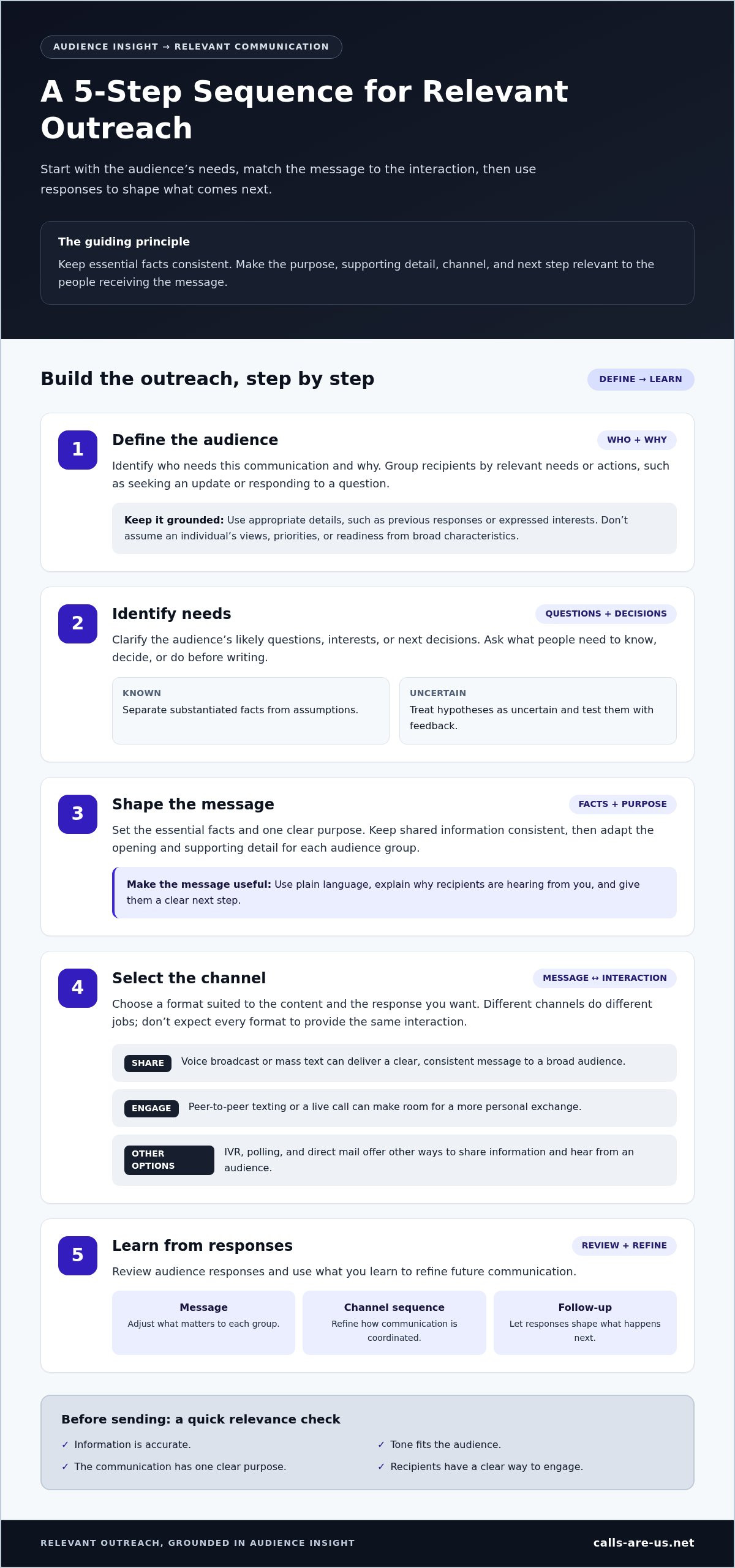
Audience insight turns shared needs into messages people can recognize as relevant. To make a personal connection at scale, use a repeatable sequence:
Define the audience: Identify who needs this communication and why.
Identify needs: Clarify likely questions, interests, or next decisions.
Shape the message: Set the essential facts and one clear purpose.
Select the channel: Choose a format suited to the content and the response you want.
Learn: Review responses and use them to refine future communication.
How Do You Understand Audience Needs Before Sending?
Start with information you can substantiate. Use appropriate details, such as previous responses or expressed interests, to understand what people have asked about or acted on. Group recipients by relevant needs or actions, such as seeking an update or responding to a question. Don’t assume an individual’s views, priorities, or readiness based on broad characteristics. Separate known facts from hypotheses, then use feedback to test uncertain assumptions.
How Can One Message Stay Consistent and Still Feel Relevant?
Keep essential facts consistent, then adapt the opening, supporting detail, and next step for each audience group. One group may need a concise status update, while another may need context before deciding how to respond. Use plain language and give each communication one purpose. Before sending, check that the information is accurate, the tone fits, and recipients have a clear way to engage.
This approach makes relevance manageable without turning every message into a separate project. A shared foundation supports consistency; thoughtful variations help people see why the information matters to them. Responses then provide useful signals for future planning, not just a record of delivery.
For campaigns and organizations coordinating communication across audiences, coordinated outreach options can bring consistent messaging together with different ways to invite a response.
Does Scale Make Outreach Impersonal? Match Channels to the Interaction
No. Scale doesn’t have to erase personal connection. The key is choosing a channel that suits the message and the response you want. A recorded update can share the same information with a broad audience; a question that calls for conversation needs a more interactive approach. Matching the channel to the interaction lets organizations reach people without expecting every format to do the same job.
Use this comparison to weigh reach, responsiveness, and human involvement before choosing:
Voice broadcast: Delivers a consistent recorded message to a broad audience. It works well for straightforward updates but doesn’t offer the flexibility of a live conversation.
Mass texting: Sends a concise message to many recipients and can make a clear call to action easy to see. A broadcast text, however, isn’t an individual exchange.
Peer-to-peer texting: Supports direct text exchanges and gives people room to respond to questions. It involves more human interaction than a one-way message.
Interactive Voice Response (IVR): Uses prompts to invite structured responses, such as selecting an option. It can collect input consistently but is less suited to questions that need a nuanced answer.
Live calls: Give people a chance to speak with someone, clarify details, and raise questions. They suit more involved conversations and require live staff participation.
Direct mail: Provides a physical message recipients can review on their own time. It suits information that benefits from a tangible format, though it doesn’t invite an immediate back-and-forth exchange.
When Should an Organization Use Broadcast Messaging or IVR?
Choose voice broadcast when you need to deliver a consistent recorded message to a broad audience. Use IVR when you want recipients to respond to clear, structured prompts. For example, an update can share information first, then direct listeners to an option that captures a simple response. For more detail on this channel, explore a guide to political voice broadcasting.
When Do Texting or Live Calls Create More Interaction?
Mass texting suits concise messages sent broadly; peer-to-peer texting makes room for individual exchanges. Live calls add the human judgment needed to address follow-up questions or more nuanced concerns. Choose based on the response you’re inviting. A comparison of P2P and broadcast texting, or a campaign call center guide, can help clarify those differences.
There’s no universally best channel for making a personal connection at scale. Start with the audience’s need, then choose a format that can meet it. A coordinated approach can pair broad, consistent communication with structured feedback or human conversation, rather than asking one channel to carry the entire relationship.
How to Design a Scalable Outreach Journey That Feels Human
A strong outreach journey has direction. Each contact should help people move from receiving information to understanding it, responding, or taking a relevant next step. Calls, texts, and mailings can feel disjointed if every touchpoint repeats the same request without acknowledging what came before.
Plan a human-centered outreach journey by setting a goal, defining the audience, shaping the message, sequencing channels, and reviewing responses. Use these five stages to create a coordinated plan:
Goal: Decide what the communication should help people know, consider, or do.
Audience: Identify who needs the information and which relevant needs or prior actions distinguish groups.
Message: Establish consistent facts and give each communication one clear purpose.
Channel sequence: Choose the channel for each touchpoint and define the next step it offers.
Response review: Examine replies and participation to inform the next communication.
How Do You Coordinate Channels Without Overwhelming People?
Give each touchpoint a distinct role. A voice broadcast might introduce an update, a text could point recipients to a clear next step, and direct mail could provide information they can revisit. Keep the core facts aligned and coordinate timing so messages feel connected, not like unrelated requests. Let relevant responses guide follow-up. If someone has already acted or asked a question, repeating the same appeal may create friction instead of helping.
How Should You Evaluate Whether Outreach Feels Personal?
Look beyond whether a message was sent. Ask whether recipients can understand why it matters, what action is available, and how to respond or ask for more information. Review response patterns and feedback to see whether the message, timing, or channel needs adjustment. A low response alone doesn’t explain the cause, so treat it as a reason to investigate rather than proof of audience disinterest.
Keep the learning loop practical: note what people asked, which response options they used, and where the journey seemed unclear. Use those observations to refine a later touchpoint while keeping information accurate and consistent. This process makes making a personal connection at scale a repeatable capability, not a one-off writing exercise. For broader planning context, connect this journey to your organization’s mass communication strategy.
To coordinate outreach across voice, text, live conversations, and direct mail, explore Calls-Are-Us outreach support.
Turn Personal Connection at Scale into a Repeatable Outreach Capability
Human connection doesn’t require a live conversation at every step. It does require a deliberate handoff between efficient information delivery and meaningful opportunities to respond. A repeatable outreach approach can use automation for consistent reach, then make space for human judgment when audience needs call for it.
For example, a voice broadcast or mass text can share a clear update. Peer-to-peer texting or live calling can support a more individual exchange, while IVR can collect structured feedback through prompts. Polling can help an organization understand audience views, and direct mail can deliver information in a format recipients can revisit. These options work best as parts of a coordinated plan, with each channel serving a distinct purpose.
How Can Automated Outreach and Human Conversations Work Together?
Use automated communication when the information is consistent and a live exchange isn’t essential. When people may need to ask questions or explain a concern, peer-to-peer texting or a live calling center can create a path to human conversation. IVR can collect structured responses, helping teams see what audiences select and where follow-up may be useful. Treat responses as signals for thoughtful next steps, not as a reason to repeat the same message automatically.
This balance makes making a personal connection at scale practical: automation supports consistent delivery, while people handle interactions that benefit from listening, context, and judgment. Calls-Are-Us supports national and local elections, with voice broadcast, texting, live calling, IVR, polling, and direct mail for different outreach needs.
What Should an Organization Do First?
Start with one audience and one communication goal. Define the response or relationship you want to support, then match the channel and message to that purpose. Use this planning check to keep the first outreach focused:
Audience: Who needs this communication, based on relevant needs or actions?
Interaction goal: Should recipients receive information, give structured feedback, or have a conversation?
Channel: Which format best supports that interaction?
Follow-up: What useful next step will follow a reply or other response?
Review what people ask, select, or respond to, then use those signals to refine later outreach. That learning loop helps teams improve relevance without losing consistency. Calls-Are-Us provides voice broadcast, text messaging, IVR, live calling, polling, and direct mail to help organizations put this framework into practice.
Make Your Next Outreach More Human
Personal connection doesn’t depend on making every interaction one-to-one. It grows from understanding what an audience needs, choosing a channel that fits the interaction, and giving each touchpoint a clear purpose. Consistent messages support broad reach, while live conversations and response options make room for questions, feedback, and meaningful next steps.
That’s the practical foundation of making a personal connection at scale: combine relevant communication with an outreach plan that can learn from audience responses. Calls-Are-Us offers voice broadcast, texting, live calling, IVR, polling, and direct mail for outreach to national and local audiences.
Start with one audience, one goal, and a clear follow-up plan. Then build on what you learn. Build a more personal outreach strategy with Calls-Are-Us using the channels that fit your audience and communication goals.
Frequently Asked Questions
How can you make communication feel personal when reaching a large audience?
Making a personal connection at scale starts with communicating about what matters to the audience, not simply inserting names into a standard message. Define the goal, group people by relevant needs or actions, and make each message clear about its purpose and next step. Keep essential facts consistent while adjusting context or response options where useful. Review replies and participation to learn what to improve in future outreach.
Can automated calls and texts still create a personal connection?
Yes. Automated calls and texts can feel relevant when they deliver useful information to the right audience in a clear, respectful way. Voice broadcasts can share a consistent update, while mass texts can make a concise message easy to receive. Automation is less suited to resolving complex or unexpected questions. When recipients may need more support, offer a meaningful response path, such as an interactive prompt or a route to a live conversation.
What is the difference between mass texting and peer-to-peer texting?
Mass texting distributes a message broadly, while peer-to-peer texting supports more direct exchanges between a recipient and a person or team. Use mass texting to share a concise update or clear request with an audience. Choose peer-to-peer texting when replies, follow-up questions, or a more individual exchange would serve the goal. The distinction is the level of interaction, not simply whether the message is written for a specific audience.
How do you choose the right channel for large-scale outreach?
Start with the interaction you want to create. A voice broadcast can deliver a consistent recorded message, IVR can collect structured responses, and direct mail can provide information recipients can revisit. Texting can share updates or support exchanges, while live calls allow conversation. Consider the message’s complexity, the response path, and the level of human involvement needed. No single channel suits every audience or goal.
Does personalizing outreach mean writing a different message for every person?
No. Personalizing outreach doesn’t require a separate message for each recipient. Build a shared foundation with accurate core information, then adapt relevant details, examples, or calls to action for audience groups with different needs or actions. This preserves consistency while making communication more useful. Avoid tailoring messages around assumptions about individuals. Use information people have provided or actions they’ve taken, and refine your approach as you learn from responses.
How can an organization tell whether its outreach feels personal?
Assess whether recipients can understand why the message matters, what it asks of them, and how they can respond. Review replies, participation, questions, and feedback for signs that the content or channel needs adjustment. A response pattern may point to confusion or an unhelpful next step, but it doesn’t explain the cause on its own. Treat what you observe as a reason to review and improve, rather than make assumptions about the audience.
When should a campaign use live callers instead of automated outreach?
Use live callers when an interaction calls for listening, follow-up questions, or human judgment. Automated outreach can efficiently deliver consistent information, but it may not address nuanced concerns or unexpected responses. A live calling center can support conversations where people need clarification or a more personal exchange. Campaigns can combine both approaches: use automated communication for straightforward updates, then offer live calls when conversation better serves the audience and campaign goal.



Comments