_edited.png)
Political Direct Mail Strategy: The 2026 Guide to High-Impact Voter Contact

Updated: Oct 1
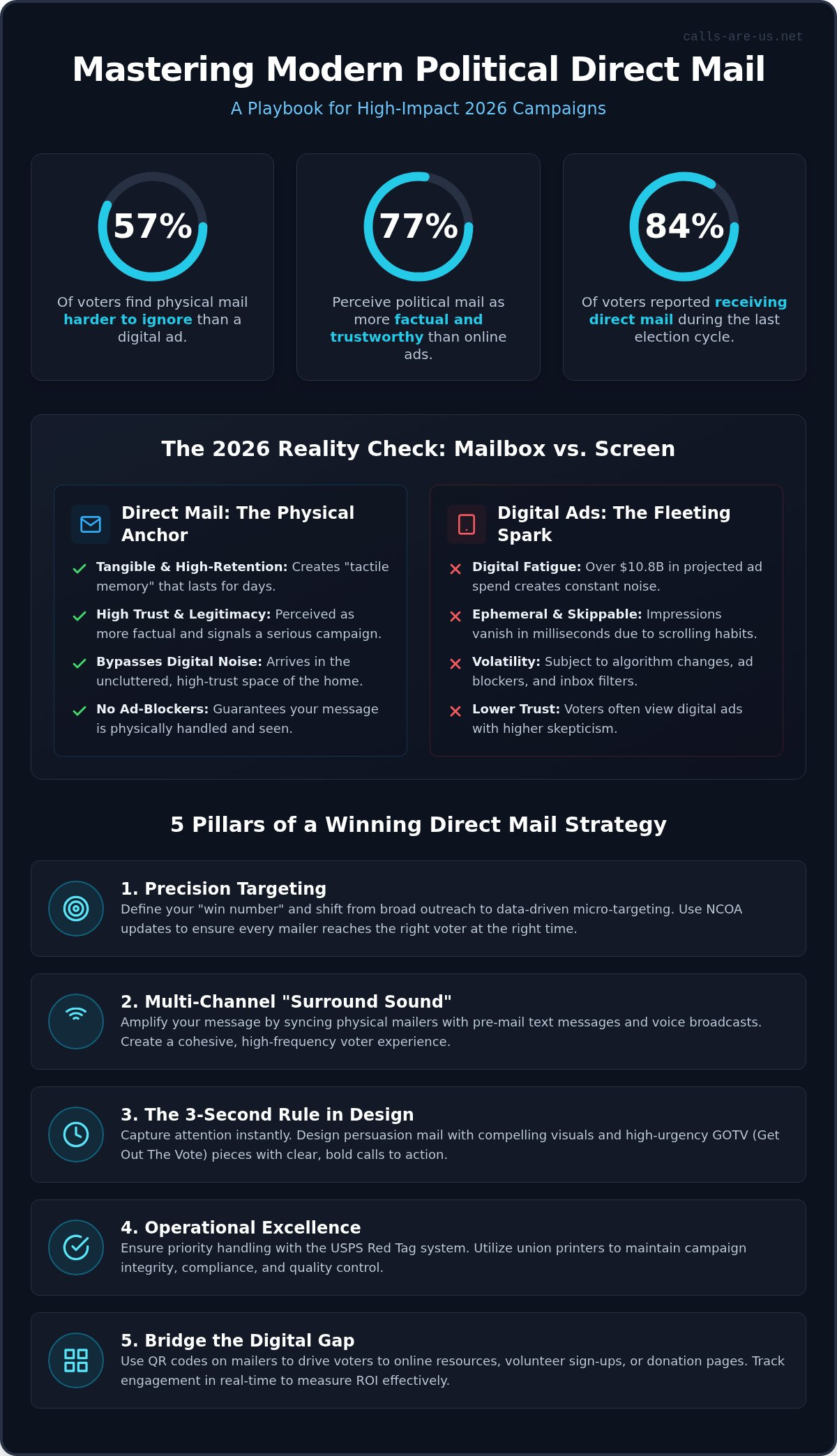
57% of voters report that a physical mailer is harder to ignore than a digital ad, even in our hyper-connected 2026 environment. While your inbox overflows with automated noise, the mailbox remains a space of high-trust, high-impact, and high-retention. You likely feel the pressure of rising postage rates and the struggle to measure ROI in a fractured media market. Developing a modern political direct mail strategy isn't just about sending paper; it's about anchoring your campaign in a tangible reality that digital screens can't replicate.
This guide helps you master the art of physical voter engagement by integrating direct mail with modern digital and telephonic outreach for a winning 2026 campaign. We'll explore the latest USPS Red Tag standards, the implications of the June 2026 Supreme Court ruling on coordinated expenditures, and the specific workflows that drive higher turnout. You'll learn how to increase name recognition, persuade the undecided, and mobilize your base through a sophisticated, multi-channel approach.
Table of Contents
The Enduring Power of Political Direct Mail in 2026
Physical mail is the only medium that requires a voter to physically engage with your message. In an era where digital noise is constant, a well-executed political direct mail strategy serves as the physical anchor of a modern campaign. It isn't just paper; it's a tangible extension of your candidate’s brand that arrives in the least cluttered environment remaining: the home mailbox. This channel allows you to bypass the noise of social media feeds, the volatility of algorithm changes, and the annoyance of pop-up blockers. It provides a direct line to the people who decide elections. By landing on the kitchen table, your message enters a private, trusted space where voters are prepared to process information.
To better understand the impact of physical outreach on modern elections, watch this helpful video:
The weight of a physical piece of mail translates directly into perceived legitimacy. According to recent data, 77% of voters perceive political mail as more factual and trustworthy than digital advertisements. This trust factor is vital for establishing candidate authority, especially when 84% of voters reported receiving direct mail during the last cycle. Unlike ephemeral digital ads that disappear into a feed, mail carries a sense of permanence and social responsibility. It signals that a campaign is organized, well-funded, and deeply invested in the local community. It bridges the gap between a digital "like" and a physical vote.
Why Voters Still Reach for the Mailbox
The tactile nature of mail creates a unique cognitive connection. Research into The Enduring Power of Political Direct Mail suggests that physical materials generate higher brand recall than digital-only campaigns. Voters don't just see the mail; they touch it, move it, and often keep it on their kitchen counters for days. This "tactile memory" is critical for high-propensity older voters who view the arrival of the daily mail as a ritual rather than a chore. There are no ad-blockers in the physical world. This ensures your message is seen at least once before a decision is made, making it indispensable for stable households and rural demographics.
Direct Mail vs. Digital: A 2026 Reality Check
Digital fatigue has reached a breaking point as projected political ad spend for 2026 exceeds $10.8 billion. While a digital impression is a fleeting spark that vanishes in milliseconds, a high-quality mailer is a persistent physical artifact that remains in the voter's household for several days. This physical presence bypasses the scrolling habit that renders most social media ads invisible to the average user. In 2026, the most effective campaigns use mail to validate the claims made in their digital ads. While a text message provides speed and a voice broadcast offers personal connection, direct mail provides the "proof of life" that establishes a candidate as a serious, legitimate contender.
Precision Targeting: Building Your Voter Mail Universe
Efficiency wins elections. Every dollar spent on a voter who cannot or will not vote for you is a dollar wasted. A sophisticated political direct mail strategy begins with defining your "win number," which is the exact number of votes required to secure victory based on projected turnout. Once this number is established, you build your Voter Universe by identifying the specific individuals who will get you across that finish line. This process shifts the focus from broad awareness to surgical persuasion, ensuring your resources are concentrated where they have the highest potential for impact.
Precision depends on the quality of your list. Data hygiene is the foundation of a high-impact campaign. You must utilize National Change of Address (NCOA) updates to ensure your budget isn't swallowed by undeliverable mail. Adhering to USPS Political Mail guidelines ensures that your data formatting meets the requirements for discounted rates and efficient processing. A clean list is the engine of a successful political direct mail strategy, allowing you to plan, execute, and measure with confidence. Accurate data ensures that your message actually reaches the intended recipient rather than an empty house.
Micro-Targeting and Demographic Segmentation
Broad geographic mailings are a relic of the past. Today, we segment voters by three primary pillars: party affiliation, voting history, and lifestyle data. You shouldn't send the same mailer to a "Base" voter that you send to a "Persuadable" swing voter. Your base needs a Get Out The Vote (GOTV) message focused on urgency and duty. Conversely, your persuadable universe requires narrative-driven content that addresses their specific anxieties or values. By using lifestyle data, you can speak to a suburban parent about education or a rural homeowner about property rights within the same mailing wave. This level of personalization is vital, as 90% of gubernatorial voters report they want political mail to speak to them personally.
Data Modeling and Predictive Analytics
Propensity scores are the modern strategist’s best friend. These scores predict how likely a voter is to support your candidate or show up on election day. By integrating internal polling data into your selection process, you can rank your universe from most to least likely to move. Data modeling reduces waste in campaign budgets by ensuring that high-cost physical touchpoints are reserved for the voters most likely to be influenced by them. This allows you to deploy smaller, highly targeted waves that hit harder than any blanket mailing ever could. It is a streamlined approach that respects your budget while maximizing your reach.
Creative Strategy: Designing for Persuasion and Action
Design is the silent ambassador of your campaign. In a high-stakes election, your political direct mail strategy succeeds or fails in the three seconds it takes a voter to walk from the mailbox to the recycling bin. This "3-second rule" dictates that your headline, primary image, and core message must be absorbed instantly. If the recipient cannot identify who is sending the mail and what they want within that window, the piece has failed its mission. Effective design isn't about winning art awards; it's about guiding the eye, reducing cognitive load, and triggering a specific emotional response.
Authenticity drives connection in 2026. Voters are increasingly skeptical of "over-produced" studio photography that feels clinical or detached. Instead, prioritize high-quality, candid imagery that shows the candidate in action: listening to constituents, walking through local neighborhoods, or working in the community. Use bold typography to anchor your call to action and leverage white space to ensure your message doesn't feel cluttered. A clean layout signals transparency and competence, while a cramped design can project chaos or desperation. By focusing on clarity, impact, and authenticity—principles embraced by design and print providers like ideasfactory—you transform a simple postcard into a powerful tool for engagement.
The Psychology of Persuasion Mail
Persuasion mail is designed to change minds or solidify support through narrative and comparison. The "contrast piece" remains one of the most effective tools in this category. Rather than relying on purely negative attacks, a sophisticated contrast piece highlights differences in policy, community impact, and future vision. This approach allows you to frame the choice for the voter without appearing overly aggressive. Incorporate social proof by featuring endorsements from trusted local figures, such as teachers, veterans, or small business owners. These testimonials build a bridge of trust, using community belonging and shared values as emotional triggers to move the needle with undecided voters.
GOTV Mail: Driving Voters to the Polls
Get Out The Vote (GOTV) mail requires a fundamental shift in tone and structure. While persuasion mail is conversational, GOTV mail is transactional and urgent. It must provide clear, unmistakable instructions on how to cast a ballot. Include specific polling locations, early voting dates, and registration deadlines to remove any friction from the process. One of the most potent tactics in this space is "social pressure," which involves ethically reminding voters that their participation is a matter of public record. Additionally, you must bridge the gap between the physical and digital worlds. A QR code, sized at least 1" x 1", allows voters to scan the mailer and instantly access digital registration forms or look up their specific polling place, turning a static piece of paper into a dynamic gateway to action.
The Multi-Channel Ripple: Syncing Mail with Voice and Text
Modern campaigns don't rely on single-channel silos. Syncing your political direct mail strategy with digital and telephonic tools creates a surround-sound effect that validates your message across every voter touchpoint. You should view the mailbox as the physical anchor and your phone-based outreach as the high-speed reinforcement. Send a pre-mail text 24 hours before delivery to prime the mailbox, then follow up with political voice broadcasting to reinforce the core argument once the piece has landed. This multi-channel ripple ensures your candidate remains top-of-mind while driving high-intent traffic to your political campaign call center for deep data collection and voter ID.
Mail and Texting: The High-Engagement Duo
Integration is the force multiplier of 2026. Coordinating P2P vs broadcast texting with specific mail delivery dates allows you to hit voters exactly when they are most engaged with your physical content. Use the mail piece to tease a text-based poll, asking voters to weigh in on a specific local issue via an interactive SMS keyword. This strategy creates a measurable cross-channel lift, as voters who receive a physical mailer are significantly more likely to respond to subsequent mobile outreach. You aren't just sending messages; you're building a persistent dialogue that spans multiple devices and environments.
Voice and Mail: Reinforcing the Message
Voice touchpoints add a human dimension to the physical mailbox. A day-of arrival call that mentions the mailer creates a narrative thread that voters find hard to ignore. Interactive Voice Response (IVR) systems can be programmed to let voters request additional mail-in ballot information or volunteer kits simply by pressing a key during the call. Industry data indicates that pairing physical mail with a voice touchpoint can lead to a 15-20% increase in message recall compared to standalone mailings. This combination of the tangible and the audible provides a sense of urgency that a single postcard cannot achieve alone. To maximize your impact, consider how a unified multi-channel campaign can streamline your voter contact and drive higher turnout on election day.
Navigating Logistics and Compliance for National Campaigns
Logistics can make or break your 2026 campaign. Even the most brilliant creative fails if it arrives after the polls close or gets sidelined by a compliance error. A successful political direct mail strategy requires a deep understanding of the USPS "Red Tag" system. Formally known as Tag 57, this red label identifies political campaign mail for priority handling. It ensures your pieces are processed and delivered promptly during the peak election season. This isn't just a suggestion; it's a vital operational standard that ensures your message reaches the mailbox while the voter is still making their decision.
Compliance is equally critical for maintaining candidate legitimacy. All public communications must include a clear and conspicuous disclaimer identifying who paid for the piece. For printed mail, 12-point type serves as a safe harbor for FEC requirements. You should also stay informed about the June 30, 2026, Supreme Court ruling that struck down limits on political party coordinated expenditures. While the FEC hasn't updated its official guidance as of August 2026, this ruling creates new strategic opportunities for parties to coordinate directly on high-impact mail campaigns. Working with a union printer for direct mail adds an additional layer of credibility, as the "Union Bug" signals a commitment to fair labor practices that resonates with key voting blocs.
Managing the Election Cycle Calendar
Precision timing is the hallmark of a seasoned strategist. You must work backward from Election Day to build a comprehensive 12-week mail plan. This timeline allows you to transition smoothly from early name recognition pieces to complex persuasion narratives. Don't forget to account for the massive rise in mail-in ballot requests. Your strategy must prioritize landing mailers at least 48 to 72 hours before early voting windows open in each specific precinct. Your "Closing Argument" piece should be the final physical touchpoint, landing just as the undecided voter is preparing to head to the polls or sign their ballot.
Choosing a Political Mail House Partner
Capacity and speed-to-market are the two most important criteria when selecting a partner. You need a full-service provider that can handle national-scale distribution without compromising data security. The best partners are integrated providers who can manage your entire voter outreach strategy across physical and digital channels. This ensures that your brand remains consistent whether the voter is reading a postcard or receiving a follow-up text. By choosing a partner that understands the nuances of authoritative communication, you ensure that every piece of mail reinforces your candidate's vision and integrity.
Mastering the Mailbox for a Winning 2026 Campaign
Success in 2026 demands more than just sending postcards. It requires a sophisticated political direct mail strategy that anchors your campaign in tangible trust while utilizing digital speed for reinforcement. You've learned how to define your voter universe, apply the three-second rule to design, and synchronize delivery with voice and text touchpoints. These elements don't just reach voters; they build the legitimacy and urgency needed to secure a victory on election day.
Navigating this complex landscape is easier with a seasoned expert by your side. Calls-Are-Us brings expertise from over 40 states, offering integrated voice, text, and mail solutions that respect both your budget and your timeline. With union-friendly production capabilities and high-capacity technical scale, we empower you to focus on the message while we handle the mechanics of voter impact. We're committed to fostering the meaningful interactions that drive social progress and community trust.
Ready to lead your campaign to the finish line? Build an integrated 2026 voter contact plan with Calls-Are-Us and ensure your message is heard, felt, and acted upon. The future of your community starts with the connections you make right now.
Frequently Asked Questions
What is the most effective size for a political direct mail piece?
Large-format postcards, specifically the 6" x 11" size, are the most effective for grabbing attention in a crowded mailbox. This size allows for high-impact photography and bold typography without getting lost among smaller utility bills or standard envelopes. It provides the physical presence necessary to pass the three-second rule while remaining cost-effective under standard USPS automation guidelines. Larger pieces signal authority and ensure your candidate's message is the first thing a voter sees.
How many times should a voter receive mail from a campaign?
Most successful campaigns aim for a frequency of 5 to 7 mail pieces per targeted household. This repetition is a core component of a political direct mail strategy, as it moves the voter through the stages of awareness, persuasion, and eventually mobilization. Spacing these touches over several weeks ensures your candidate remains top-of-mind without causing the fatigue often associated with digital ad bombardment. Consistency builds the familiarity and trust required to move the needle.
What is the "Union Bug" and why is it important for political mail?
The "Union Bug" is a small trademark or logo placed on printed materials to indicate they were produced by unionized labor. In the political world, this mark functions as a badge of integrity and social responsibility. It signals to voters and labor organizations that your campaign supports fair wages and worker protections, which can be a deciding factor for key demographic segments. Displaying the bug is a simple way to project candidate values and build community trust.
How do I track the effectiveness of my direct mail campaign?
Effectiveness is best tracked using a combination of digital bridges and traditional metrics. Incorporating QR codes that lead to specific landing pages allows you to monitor scan rates and user engagement in real time. Additionally, tracking surges in volunteer sign-ups or polling shifts following a specific mailing wave provides a clear picture of how your physical outreach influences voter behavior. This data-driven approach allows you to refine your targeting for future waves.
What is Red Tag mail and how does it speed up delivery?
Red Tag mail utilizes the USPS Tag 57 to grant political campaign materials priority handling within the postal system. This red label alerts postal workers that the shipment contains time-sensitive election materials that must be processed with urgency. It is an essential logistical tool for ensuring that your GOTV mailers and persuasion pieces arrive exactly when your multi-channel timing dictates. Without it, your mail risk being delayed during the high-volume weeks leading up to an election.
Can direct mail be used for political fundraising effectively?
Direct mail continues to be a powerhouse for political fundraising because it offers a secure and official feel that digital platforms often lack. A physical appeal with a pre-addressed return envelope lowers the barrier for donors who are skeptical of online payment portals. This channel is particularly vital for building a sustainable base of small-dollar donors who appreciate a tangible connection to the campaign and a clear, personal request for support. If your organization also handles recurring pledge receipts or business-critical donor mailings, check out Integrity Statements for professional statement and invoice mailing solutions.
How does direct mail compare to digital advertising ROI for 2026?
In 2026, a political direct mail strategy competes with digital ROI by offering significantly higher retention and trust levels. While digital ads are cheaper to deploy, they are also easier to ignore or block. Because 57% of voters find physical mail harder to ignore than online ads, the cost-per-conversion for mail often proves superior when targeting the high-propensity voters who actually show up at the polls. It is the anchor of a high-impact campaign.
What are the essential legal disclaimers for political mailers?
Legal disclaimers must state who paid for the mailer and whether it was authorized by a candidate or their authorized committee. These statements must be clear and conspicuous, meaning they cannot be hidden in tiny text or obscure colors. Using a 12-point font is the standard safe harbor for meeting FEC requirements, ensuring your campaign remains compliant while projecting transparency and professional authority. Always verify specific state-level requirements as they can vary significantly by jurisdiction.



Comments