
Political Text Message Opt-Out Requirements: A 2026 Campaign Guide

What happens after a voter replies “STOP” to a campaign text? The request needs to trigger more than a polite confirmation. Political text message opt-out requirements involve recognizing the request, suppressing the number, and ensuring staff and vendors don’t accidentally add it back to another texting list. With federal rules changing and carrier and platform procedures adding operational complexity, a gap in the process can undermine trust and create compliance risk.
It can be unclear which replies count and what a campaign must do next. This guide explains opt-out principles for political texts, including the role of “STOP” and the FCC’s recently adopted changes to permitted revocation methods. It also covers how to document requests, coordinate suppression across messaging tools and vendors, and build a repeatable workflow for peer-to-peer and mass texting. The goal is a practical process that respects each person’s choice and supports responsible campaign outreach.
Table of Contents
Political text message opt-out requirements: what campaigns need to know
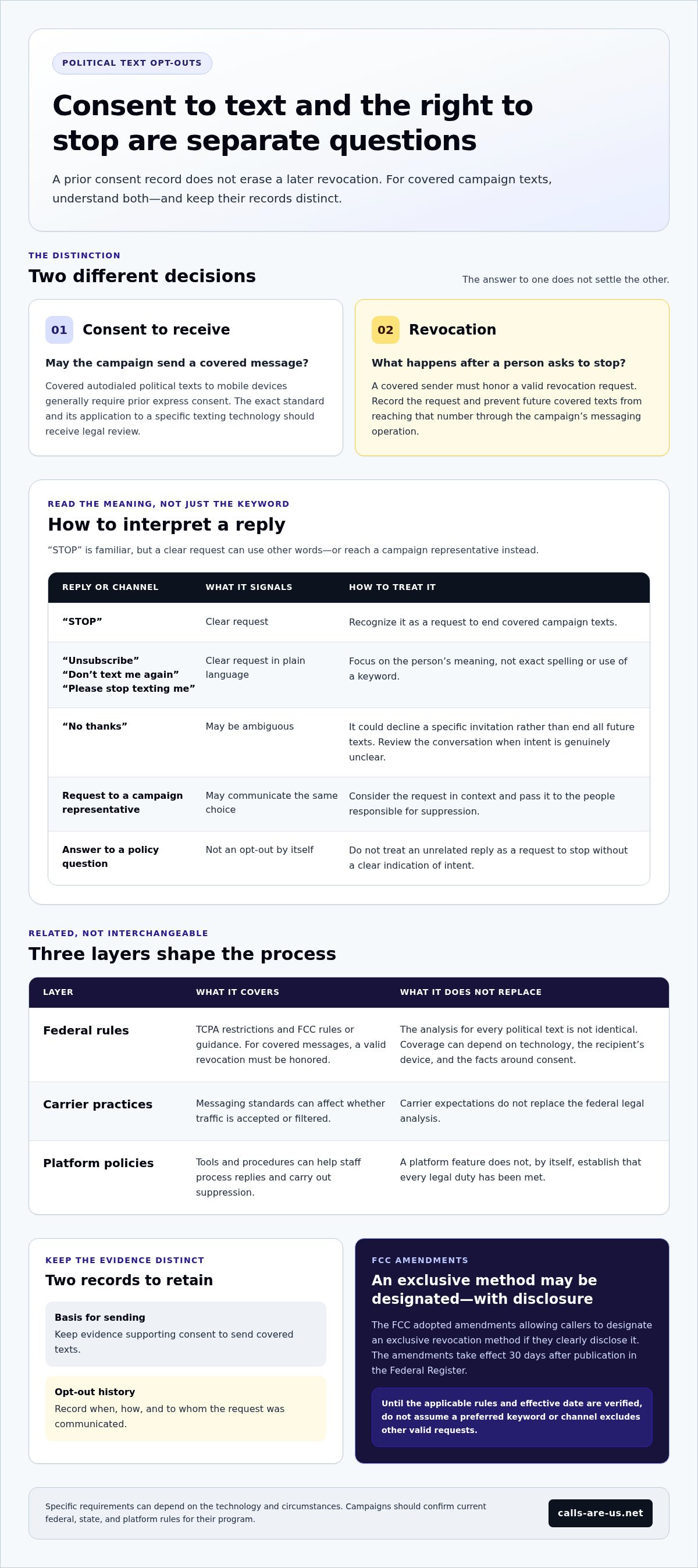
An opt-out is a person’s clear request to stop receiving covered campaign text messages. The operational goal is to record the request and prevent future covered texts from reaching that number through the campaign’s messaging operation. “STOP” is the familiar keyword, but campaigns shouldn’t assume everyone knows or uses that exact word. A plain-language request can communicate the same choice.
Consider the wording and context. Someone who replies “Please stop texting me” has clearly asked for messages to end. A reply such as “No thanks” could decline a specific invitation rather than end all future texts. When the intent is clear, treat the message as a request to stop. When it’s genuinely ambiguous, review the conversation instead of relying only on a keyword filter.
What counts as a political text opt-out request?
Focus on meaning, not spelling. “STOP,” “unsubscribe,” and “don’t text me again” are straightforward examples. A person might also make the request to a campaign representative instead of replying to a text. Consider that request in context and pass it to the people responsible for suppression. Don’t treat an unrelated reply, such as an answer to a policy question, as an opt-out without a clear indication of intent.
Why political texts still require careful compliance
Political purpose doesn’t erase every rule about text messaging. The National Do Not Call Registry exemption is limited: political texts are exempt from that registry, but the exemption doesn’t settle whether a campaign had the required consent to send a particular covered text or whether it must honor a later revocation. The overview of political text messaging in the United States provides broader context on the medium and its legal landscape. For operational decisions, campaigns should rely on current regulator guidance.
Technology also matters. The Telephone Consumer Protection Act (TCPA) and Federal Communications Commission (FCC) rules may apply differently depending on how a text is sent, so “political” alone isn’t enough to determine the requirements. For covered messages, consent to receive texts and the later right to revoke that consent are separate questions. A campaign may have permission to send a message and still need to honor a subsequent opt-out.
In 2026, campaigns should also account for a change in progress. On September 30, the FCC adopted amendments that allow callers to designate an exclusive revocation method if they clearly disclose it. The amendments take effect 30 days after publication in the Federal Register. Until the applicable rules and effective date are verified, don’t assume a campaign’s preferred keyword or channel excludes other valid requests. These political text message opt-out requirements raise compliance questions, and this guide is not legal advice. Campaigns should confirm current federal, state, and platform rules for their specific program.
What FCC and TCPA rules say about political text opt-outs
Separate the legal obligation from the system used to carry it out. The Telephone Consumer Protection Act (TCPA) sets federal restrictions on certain calls and texts, while the Federal Communications Commission (FCC) issues rules and guidance interpreting and implementing those restrictions. The FCC’s Rules for Political Campaign Calls and Texts explain that covered autodialed political texts to mobile devices generally require prior express consent and that recipients can revoke consent. The core federal principle is that a covered sender must honor a valid revocation request.
That principle doesn’t make every political text legally identical. Whether a particular message is covered can depend on the technology used, the recipient’s device, and the facts around consent. Campaigns should have counsel review technology-specific questions rather than assuming that a label such as “peer-to-peer” or “political” determines the legal result.
How consent and revocation fit together
Consent and revocation answer different questions. Consent concerns whether a campaign may send a covered message in the first place. Revocation concerns what the campaign must do after the recipient asks for those messages to stop. For example, a campaign may have a consent record from an earlier interaction, but a later request to end covered texts changes the campaign’s instructions for that number.
Keep evidence of these decisions separate. Retain the basis for sending covered texts, then record when, how, and to whom an opt-out request was communicated. That distinction makes the history easier to review and helps prevent a prior consent record from being mistaken for permission to ignore a later revocation. The exact consent standard and its application to a specific texting technology should receive legal review.
Federal rules, carrier practices, and platform policies
These are related layers, not interchangeable rules. Federal TCPA and FCC requirements establish legal obligations. Wireless carriers may set messaging standards that affect whether traffic is accepted or filtered, while a texting platform may provide tools and procedures for processing replies. A platform feature can help staff carry out suppression, but it doesn’t by itself establish that the campaign has met every legal duty. Carrier expectations don’t replace the federal analysis either.
“STOP” remains a useful operational signal. It gives recipients a familiar way to ask for messages to end and can help campaigns meet carrier or platform handling expectations. But keyword detection should not become a reason to disregard an otherwise clear request received another way. Configure tools to capture relevant replies, and assign responsibility for requests that arrive through staff or another channel.
The FCC adopted amendments on September 30, 2026, allowing callers to designate an exclusive revocation method if they clearly disclose it. The amendments take effect 30 days after publication in the Federal Register, so campaigns should verify publication and the effective date before changing procedures. Review applicable state laws and current platform terms as well, since they may add operational considerations. These political text message opt-out requirements involve fact-specific legal questions, so treat this guide as general information, not legal advice.
Clear handoffs turn the rules into consistent practice. Campaigns coordinating political campaign texting can make opt-out handling part of the same operational plan as consent records, staff responsibilities, and message-platform procedures.
STOP keyword, plain-language reply, or another method: what changes?
The channel and wording can differ, but the campaign’s response should be consistent. A STOP keyword may trigger automatic suppression, while a plain-language text or request to a campaign representative may need a staff member to recognize and route it. A reliable process covers all three, so a person’s choice isn’t lost because they used the “wrong” channel or phrase.
The P2P vs broadcast texting comparison explains how delivery workflows differ. Those operational differences matter when assigning responsibility for receiving and recording opt-outs, but they don’t by themselves determine the legal standard.
Does a person have to text STOP?
Not necessarily. “STOP” is a recognizable keyword, but a campaign shouldn’t dismiss clear language such as “do not text me” just because it doesn’t match a standard command. A reply like “I’m not interested” may need context: it could reject a specific request, or it could mean the person wants no further texts. Assess the message’s meaning, and route uncertainty for review rather than letting an automated keyword filter make the only decision.
The FCC has described text replies and verbal requests as potential ways to revoke consent. Its September 2026 amendments allow an exclusive revocation method when the sender clearly discloses it, once those amendments take effect. Campaigns should verify the effective date and applicable guidance before treating a designated method as exclusive. The AAPC Political Messaging Guidelines also offer industry context for transparent, responsible messaging.
What confirmation and follow-up should a campaign consider?
A brief confirmation can reassure the recipient that the request was received. For example, a campaign might send a neutral message stating that the number has been opted out. Keep it administrative: don’t add a fundraising appeal, persuasion, or another invitation to engage. Verify current FCC rules, carrier standards, and platform procedures before deciding whether and how to send a confirmation.
A confirmation isn’t permission to resume outreach. Apply suppression first, preserve a record of the request and action, and ensure that a confirmation message doesn’t restart a promotional sequence. These controls help campaigns apply political text message opt-out requirements consistently across staff, vendors, and messaging systems.
How to build a political text opt-out workflow
A request only protects the recipient if it reaches every part of the campaign’s texting operation. Build one documented process covering incoming replies, staff handoffs, vendor tools, and future message lists. Political text message opt-out requirements are easier to manage when each person knows what to do and the campaign can verify that suppression works across its communications workflows.
Receive. Identify every route where a request can arrive, including text replies, campaign staff, and vendor or platform inboxes. Assign a role to monitor each route and a backup to handle handoffs.
Interpret. Review what the person is asking, not only whether a reply matches a keyword. If the request clearly asks for texts to stop, send it to the suppression process. Set an escalation path for genuinely unclear messages.
Suppress. Add the number to a shared suppression source and apply the appropriate setting in each relevant texting system. Make sure later list imports and scheduled sends use that source rather than overwriting it.
Acknowledge when appropriate. If the campaign sends a confirmation, keep it brief and administrative. Verify current requirements and platform procedures, and don’t include promotional content or restart an outreach sequence.
Document. Record the number, request channel and wording, received time, responsible staff member or vendor, suppression action, and completion time. Limit access to people who need the information to operate the process.
Capture and suppress requests consistently
Use a shared suppression record that campaign staff and authorized vendors can consult when building or importing lists. A note in one employee’s inbox isn’t enough if another team can later send to that number. Define processing timelines that reflect current applicable requirements, then document and verify that the assigned team meets them. Don’t assume that saving a request automatically updates every campaign account or texting tool.
Coordinate campaign staff and messaging vendors
Write down who checks each inbox, who updates suppression, and how a request moves between the campaign and its vendor. The mass texting compliance guidance provides context on how different delivery workflows can affect campaign operations. In every workflow, the suppression process needs clear ownership.
Test the process before a send and after meaningful system or list changes. Use a controlled test number to check whether suppression carries through:
New list imports and list merges
Scheduled messages and recurring outreach
Each campaign account, texting platform, and vendor workflow in scope
Keep an audit trail of test dates, results, and fixes. If a suppression gap appears, pause the affected workflow while the responsible team resolves it. To coordinate campaign messaging and suppression across channels, build your campaign texting plan around clear ownership and consistent records.
Make opt-out handling part of responsible political texting
Trust depends on consistent choices: manage consent carefully, make opt-out instructions visible, and ensure a person’s request reaches the people and systems responsible for honoring it. A campaign’s process should work beyond a single inbox or texting tool. Staff, vendors, and messaging platforms need to know who receives requests, who acts on them, and how the campaign checks that suppression remains in place.
That operational discipline also helps keep outreach coordinated. A campaign may use more than one messaging workflow or channel, so teams should understand how opt-out records apply to their work and how changes are communicated. Keep ownership clear, make reply monitoring part of routine operations, and review handoffs when teams, vendors, or systems change. These practices support the political text message opt-out requirements discussed in this guide while helping campaigns communicate with greater respect and accountability.
What to look for in a campaign texting operation
Look for visible opt-out instructions, monitored message replies, and a consistent suppression process that campaign staff and vendors understand. Document who owns each step and how a request moves to the responsible person if it arrives through an unexpected channel. For broader channel planning, the mass communication strategy guide can help campaigns consider how outreach methods fit together.
Review more than the written procedure. A process is useful only if it works in practice. Check whether responsibility is clear, whether relevant staff know where to route a request, and whether suppression remains visible as lists and messaging plans change. Revisit those questions when adding a vendor, changing platforms, or expanding outreach across channels. That keeps opt-out handling part of campaign operations rather than a one-time setup task.
Coordinate outreach with Calls-Are-Us
Mass texting and peer-to-peer texting offer distinct ways to communicate with voters, and each should have an opt-out process that reflects its workflow. Campaigns coordinating broader outreach may also use voice broadcast, live calling, Interactive Voice Response (IVR), or direct mail as part of a connected communications plan. Calls-Are-Us provides these communication services for political campaigns and business organizations.
Clear practices help teams protect trust while carrying out meaningful outreach. Calls-Are-Us supports campaign communications through voice broadcast, mass texting, peer-to-peer messaging, live calling, IVR, and direct mail. Explore campaign messaging solutions with Calls-Are-Us to plan outreach with clear opt-out handling at its core.
Put your opt-out process to the test
Before the next campaign send, run a simple rehearsal. Have the people who monitor replies, update suppression records, and manage vendor handoffs walk through a sample request from arrival to confirmation. The exercise can reveal unclear ownership or a gap between written procedures and the tools teams actually use.
Make the rehearsal part of campaign readiness. Revisit the process when staff roles, platforms, or outreach plans change, and check current guidance before adjusting procedures. A practical routine helps turn political text message opt-out requirements into consistent decisions that respect recipients and support responsible outreach.
Calls-Are-Us provides mass texting, peer-to-peer messaging, and coordinated campaign outreach. Explore campaign messaging solutions with Calls-Are-Us and plan communications that put clarity and trust at the center.
Frequently Asked Questions
Does replying STOP unsubscribe me from every political campaign?
No. Replying STOP generally applies to the sender or campaign responsible for that message, not every unrelated campaign that may contact you. Different organizations can maintain separate texting programs and recipient records, so don’t assume one reply updates them all. Follow the instructions in the message, and keep a copy if you need to identify who sent it. If another campaign texts you, use that message’s opt-out method.
Do political campaigns have to honor a text that says “do not contact me”?
A clear request such as “do not text me again” may count as revoking consent even without the word STOP. The campaign should consider the full message and conversation, then route a clear request for appropriate action rather than relying only on automated keyword detection. FCC rules and interpretations can change, so campaigns should verify current guidance before setting policy, especially where a reply could reasonably be read in more than one way.
Will the National Do Not Call Registry stop political campaign texts?
Generally, no. FCC guidance treats political campaign texts as exempt from National Do Not Call Registry requirements. That exemption is limited: it doesn’t remove other consent or revocation rules that may apply to a message. The registry also differs from an opt-out sent directly to a campaign. If you want a particular campaign to stop texting, use the opt-out instructions in its message and retain a copy for reference.
Can a campaign send one final text after someone opts out?
A confirmation, if appropriate under current rules and platform procedures, should only acknowledge the request. It shouldn’t use the opportunity to persuade, solicit a donation, promote a candidate, or invite further campaign engagement. Keep any confirmation brief and administrative rather than adding a campaign message. The rules can depend on the circumstances, so campaigns should verify current FCC guidance and applicable platform requirements before deciding whether to send one.
How quickly must a political campaign process an opt-out request?
Campaigns should act promptly and avoid sending further covered messages after a valid revocation. Don’t rely on an assumed grace period or wait for a scheduled list update before passing the request to the people responsible for suppression. The exact timing standard can depend on current FCC rules, effective dates, and relevant orders or court decisions. Campaigns should verify those authorities as of publication in 2026 before setting internal deadlines.
What should I do if political texts continue after I opted out?
Save the messages or screenshots, note the sender and dates, and use the campaign’s stated contact method to report that texts continued after your request. Keep any confirmation or prior opt-out message with those records. You can also review the FCC’s current complaint options for unwanted calls and texts. Continued messages don’t automatically establish a legal violation, and filing a complaint doesn’t guarantee a particular outcome.



Comments