_edited.png)
Polling Made Affordable: Cost-Effective Data Strategies

High-quality public opinion data doesn't have to carry a premium price tag. For too long, organizations have been forced to choose between the exorbitant costs of traditional live-agent call centers and the questionable reliability of cut-rate automated tools. You've likely felt the pressure of shrinking budgets while facing an increasing need for precise, actionable sentiment analysis. It's a frustrating trade-off that often leaves campaigns guessing instead of knowing. We believe that access to the truth should be accessible to every mission-driven organization.
Securing high-accuracy results is entirely possible when you understand that polling made affordable is about strategy, not just sacrifice. By blending sophisticated automated technology with professional outreach, you can capture the nuance of public opinion without exceeding your financial limits. This article provides a clear roadmap for cost-effective data collection. We'll examine how to integrate Interactive Voice Response (IVR), peer-to-peer texting, and expert compliance management to deliver high-integrity data that drives winning decisions. You'll learn to automate the volume, humanize the nuance, and protect your reputation through rigorous TCPA and 10DLC standards.
Table of Contents
The Evolution of Modern Polling: Why Affordability Matters in 2026
The truth shouldn't be a luxury reserved for a select few. In the current political and social climate, polling made affordable is defined as the strategic application of automated tools to gather quantitative data at scale. It represents a fundamental shift from the legacy models of the past. National organizations no longer rely solely on massive banks of live callers to gauge public sentiment. Instead, they embrace a hybrid approach that integrates Voice Broadcast, IVR, and targeted outreach to capture a representative sample of the population. This evolution allows for data-driven decisions that are rooted in reality rather than intuition. However, speed and cost savings mean nothing without precision. Data integrity remains the non-negotiable floor for any viable polling solution.
The High Cost of Traditional Public Opinion Research
Relying entirely on live agents is an expensive, labor-intensive endeavor. Traditional call centers must constantly recruit, train, and manage a rotating workforce, which drives up overhead costs significantly. These expenses are inevitably passed on to the client. For many smaller campaigns or local organizations, these price tags make high-quality research feel out of reach. When the cost of a single survey consumes a significant portion of the outreach budget, the "truth" becomes a commodity that many simply cannot afford to buy. This creates a dangerous information gap where only the most well-funded voices have access to clear insights.
The 2026 Landscape: Speed, Scale, and Sentiment
Voters and consumers expect immediate, meaningful interactions. In a world where news cycles move in minutes, waiting weeks for a traditional poll to be processed is no longer a viable option. Modern organizations require instant feedback to inform pivot-ready strategies. A shift in public sentiment on a Tuesday must be identified by Wednesday to be countered or leveraged by Thursday. Using polling made affordable provides the infrastructure for this agility. By utilizing high-volume technology and automated systems, campaigns can achieve the scale necessary to see the full picture in real-time. This speed ensures that strategy evolves as quickly as the conversation, turning raw data into a powerful competitive advantage.
Decoding the Cost of Data: What Makes Polling Expensive?
Understanding the financial architecture of a poll is the first step toward optimization. Polling costs aren't arbitrary. They are the sum of three distinct pillars: labor, technology, and compliance. While many organizations focus solely on the initial quote, the true cost often hides in the shadows of poor data quality or regulatory penalties. Achieving polling made affordable requires a fundamental shift in perspective. You must move away from a "lowest price" mentality and toward a focus on Return on Investment (ROI). A larger sample size might increase the upfront spend, but it also reduces the margin of error, providing the high-integrity data needed for high-stakes decision-making.
Labor vs. Automation: Finding the Equilibrium
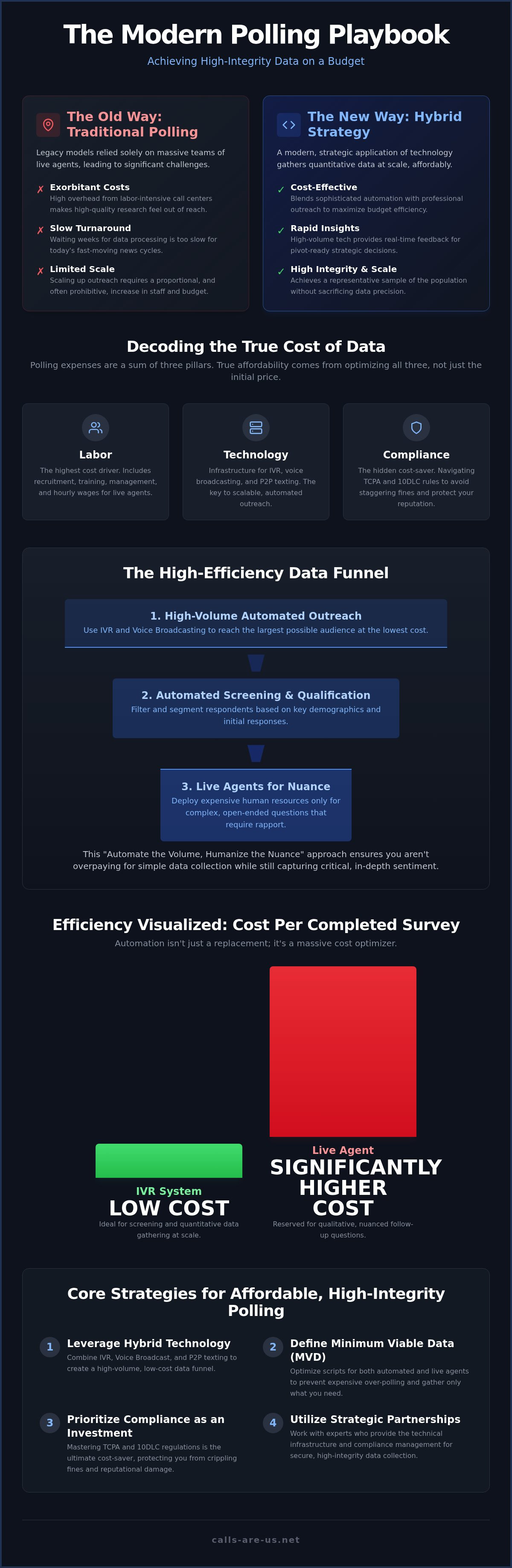
Efficiency is the cornerstone of modern research. The cost per completed survey for a live agent is significantly higher than that of an Interactive Voice Response (IVR) system. This disparity exists because live callers require constant management, training, and hourly wages. However, automation isn't a total replacement for the human touch. It's an optimizer. We recommend using IVR to handle the heavy lifting of initial screening and demographic qualification. This allows you to save your budget for live agents when you need to explore complex, open-ended questions that require human rapport and nuance. This equilibrium ensures you aren't overpaying for simple data collection while still capturing the depth you need.
The Compliance Tax: TCPA and Regulatory Hurdles
Compliance is an investment in your organization's longevity. Mastering the complexities of political call compliance is often viewed as a burden, but it's actually the ultimate cost-saver. The financial risks of non-compliant outreach are staggering. Between TCPA lawsuits and 10DLC carrier fines, a single mistake can evaporate an entire campaign budget. Working with a partner who understands national regulations isn't just about playing by the rules. It's about protecting your capital, your reputation, and your mission. In the long run, clean and compliant outreach is the only way to ensure polling made affordable remains a sustainable strategy for your team.
If you're ready to audit your current outreach expenses, we can help you evaluate your data strategy to find these efficiencies.
Strategy Over Spend: How to Make Polling Affordable
Strategy dictates the budget. A Multi-Channel Polling Framework isn't just a collection of tools; it's a synchronized engine designed to maximize reach while minimizing waste. This approach uses political voice broadcasting as a wide-net funnel to contact thousands of individuals simultaneously. By casting this broad net, you can filter the general public into a qualified pool of respondents ready for deeper engagement. This is the core of polling made affordable: using high-volume technology to do the heavy lifting so your human capital is deployed only where it matters most. When you harmonize Voice Broadcast, IVR, and Texting, you create a comprehensive data collection system that respects both your timeline and your treasury.
The Hybrid Model: IVR + Live Agent Follow-Up
Efficiency starts with qualification. Use Interactive Voice Response (IVR) to identify likely voters or engaged customers before a live agent ever picks up the phone. This ensures your most expensive resources, human callers, spend their time on high-value, deep-persuasion conversations rather than basic screening. IVR data collection is a method to capture keypad inputs for rapid sentiment analysis, providing a clear snapshot of public opinion at a fraction of the cost of manual entry. It's fast, structured, and incredibly scalable. By automating the initial touchpoint, you ensure that every dollar spent on live agents is an investment in nuance rather than just volume.
Leveraging Texting for Higher Response Rates
Reach people where they are. In 2026, the synergy between P2P vs broadcast texting has redefined how we engage diverse demographics. Mobile-first polling is no longer optional; it's essential for capturing the voices of younger populations who rarely answer unknown calls. Peer-to-peer (P2P) texting allows you to distribute digital survey links directly to smartphones, creating a personal touchpoint that feels less intrusive than a cold call. SMS also serves as a powerful nudge, reminding participants to finish longer phone surveys and significantly increasing overall completion rates. By meeting respondents on their preferred devices, you improve data quality, participation levels, and overall project ROI. This multi-layered approach ensures polling made affordable doesn't mean sacrificing the representation of your sample.
Implementation: Launching Your Budget-Friendly Polling Campaign
Execution is where strategy meets reality. To ensure polling made affordable remains a reality rather than a goal, you must follow a disciplined implementation process. It starts with defining your Minimum Viable Data (MVD). Organizations often fall into the trap of over-polling, asking dozens of questions when five key metrics would provide the necessary clarity. By narrowing your focus, you reduce respondent fatigue and lower your cost per completion. Once your objectives are set, you can move through a structured deployment: design your scripts, clean your lists, and run a pilot. A small-scale pilot acts as a litmus test for your script and list quality, allowing you to adjust before committing the full budget. Finally, you must analyze real-time data to pivot mid-campaign if a particular message isn't resonating.
Scripting for Success: Keeping Respondents Engaged
Engagement starts in the first three seconds. Your script must provide a clear "Why" immediately to establish credibility and purpose. We utilize a hook-and-elaborate structure to maintain interest throughout the interaction. Start with a punchy, relevant statement that highlights the importance of the respondent's opinion. Follow this with concise, unbiased questions that avoid leading the participant toward a specific answer. By keeping the survey brief and the language neutral, you capture authentic sentiment while increasing the likelihood of completion. A well-crafted script is the difference between a high-quality data set and a list of hang-ups.
List Hygiene and Deliverability Optimization
Data quality begins with your contact list. A clean, segmented list is the bedrock of a successful voter outreach strategy. Reaching out to disconnected numbers or incorrect contacts is a drain on your budget and your time. Before launching, you should remove inactive entries and verify your data points. Handling the 10DLC registration process correctly is also essential for ensuring your text-based surveys actually reach their intended recipients. Proper registration improves deliverability and protects your campaign from being flagged as spam. Investing in list hygiene upfront ensures that your outreach is targeted, compliant, and cost-effective. You don't want to pay for attempts that never had a chance of succeeding.
Ready to deploy your next survey with precision? You can launch your compliant polling campaign with our expert guidance today.
The Calls-Are-Us Advantage: Accurate Data Meets Strategic Efficiency
Calls-Are-Us stands as the authoritative visionary in national outreach. We don't just provide tools; we offer a sophisticated partnership rooted in high-stakes experience and a deep commitment to inclusive dialogue. Our approach to polling made affordable isn't about cutting corners or sacrificing accuracy. It's about maximizing the strategic impact of every interaction through technological efficiency. By integrating Voice Broadcast, IVR, and our political campaign call center services, we provide a seamless data collection engine that scales with your needs. This infrastructure is built on a human-centric core that ensures every participant is treated with respect and dignity. We believe that ethical communication is the only way to build lasting trust, gather high-integrity data, and foster social progress.
Sophisticated Tech, Simple Integration
Complexity shouldn't hinder your mission. Our team manages the technical heavy lifting so you can focus on the broader strategy of your campaign. We handle the intricate details of carrier registration, system integration, and regulatory compliance without burdening your internal staff with technical debt. You receive "No-Nonsense" data reports that translate raw numbers into actionable, high-level intelligence. Our history of operating in over 40 states serves as a mark of proven reliability and expertise in diverse regulatory environments. We've mastered the operational workflows required to keep your campaign moving at the speed of the 2026 news cycle, ensuring that your data is as fresh as it is accurate.
Multi-Channel Synergy: More Than Just Phone Calls
True reach requires a multi-dimensional strategy that meets people where they live. While digital tools are essential for speed, a political direct mail strategy provides a tangible touchpoint that reinforces your polling message and builds credibility. We advocate for a tripartite outreach approach that utilizes calls, texts, and mail to create a unified presence. This combination ensures your message is heard, read, and remembered across all demographics. This synergy creates a well-rounded narrative arc that captures sentiment more effectively than any single channel could ever achieve.
Calls provide the human depth and rapport needed for complex sentiment analysis.
Texts offer the convenience and speed required for rapid, high-volume data collection.
Mail establishes the permanence and authority that digital channels sometimes lack.
Affordability is ultimately about the power of the connection, not just the price of the call. When you partner with us, you aren't just buying a service; you're securing a principled guide to help you navigate the complexities of modern communication. We're dedicated to helping you achieve your goals while championing a philosophy of open and inclusive dialogue. Let's work together to make polling made affordable the foundation of your next winning decision.
Mastering the Future of Public Sentiment
Data is the lifeblood of strategy. However, high-integrity insights shouldn't drain your budget. You've seen how a hybrid framework turns high-volume automation into a precise data funnel. By prioritizing 10DLC compliance and rigorous list hygiene, you protect your capital while ensuring your message reaches its destination. Polling made affordable isn't a compromise on quality; it's a commitment to strategic efficiency that respects your resources and your mission.
Our team has proven this approach in over 40 states, providing expert 10DLC and TCPA compliance management that shields your organization from risk. We offer full-service multi-channel outreach that integrates Voice Broadcast, IVR, and live agent support to provide a comprehensive view of the landscape. Empower your next campaign with affordable, accurate polling from Calls-Are-Us. Your mission deserves to be guided by the truth. Let's build a more connected and informed future together.
Frequently Asked Questions
Is automated polling as accurate as live-agent polling?
Automated polling is highly accurate when integrated into a strategic hybrid model. It effectively eliminates interviewer bias, ensuring that respondents aren't influenced by the tone or personality of a live agent. By utilizing technology to reach a broader audience, you can capture a more representative sample at a lower cost. This balanced approach ensures that polling made affordable doesn't compromise the integrity of your data or the reliability of your results.
How much does a typical affordable polling campaign cost?
Project costs are determined by the specific scope of your outreach, including the desired sample size and the combination of channels used. Automated methods like IVR generally offer a lower cost per completion than live-agent calling alone. We focus on optimizing your budget by deploying high-volume technology for initial screening and reserving human interaction for nuanced follow-ups. This ensures you achieve maximum ROI without overspending on basic data collection.
What is the difference between IVR and Voice Broadcasting for polls?
Voice broadcasting is the delivery mechanism used to send a pre-recorded message to a large audience simultaneously. Interactive Voice Response (IVR) adds a layer of engagement by allowing respondents to provide feedback through their telephone keypad. While broadcasting is ideal for simple announcements, IVR is the essential tool for data collection. It turns a one-way message into a dynamic survey that captures real-time sentiment analysis and demographic information.
How do you ensure TCPA compliance when conducting automated polls?
Compliance is maintained through a rigorous combination of list scrubbing, opt-out management, and adherence to federal regulations. We utilize sophisticated software to identify and remove numbers on Do Not Call registries while ensuring all outreach follows specific time-of-day restrictions. Our team manages the technical requirements of 10DLC registration and TCPA standards. This proactive approach protects your organization from financial penalties and maintains the reputation of your campaign.
Can I use peer-to-peer texting to conduct a poll?
Peer-to-peer (P2P) texting is an exceptionally effective tool for distributing digital survey links to mobile-first demographics. Unlike broadcast texting, P2P involves a human-initiated interaction that often results in higher engagement and completion rates. It allows you to reach younger voters and busy professionals who may not answer a phone call. Integrating P2P into your strategy is a cornerstone of making polling made affordable while maintaining a diverse and representative sample.
What is the ideal length for a phone-based survey?
The ideal length for a phone-based survey typically ranges between three and five minutes. Keeping your script concise respects the respondent's time and significantly reduces abandonment rates. If a survey exceeds this window, you risk losing the participant before capturing critical data points. We recommend focusing on your Minimum Viable Data to ensure every question serves a direct strategic purpose. This brevity ensures higher data quality and a more positive respondent experience.
How many people do I need to poll for a statistically significant result?
Statistical significance depends on your total population size and the desired margin of error. For most national or statewide campaigns, a sample size between 400 and 1,000 respondents provides a reliable snapshot of public opinion. Increasing the sample size further can reduce the margin of error but also increases the project's total cost. We help you find the right balance to ensure your data is robust enough for high-stakes decision-making without exceeding your budget.
What kind of reporting will I receive after my polling campaign?
You will receive comprehensive data reports that include raw data sets, cross-tabulations, and executive summaries. These reports break down sentiment by key demographics such as age, location, and party affiliation. We provide these insights in a structured, easy-to-digest format that allows your team to pivot strategy immediately. Our goal is to transform raw keypad inputs and text responses into clear, actionable intelligence that drives your mission forward.



Comments