
Reducing Voter Apathy: Practical Guide for 2026 Campaigns

More campaign messages don’t necessarily create more civic connection. Reducing voter apathy starts with understanding why people disengage, not simply contacting them more often. Voters may feel unheard, be unsure how an issue affects them, or not know how to participate. When outreach feels repetitive or intrusive, it can deepen the distance campaigns hope to close.
A stronger approach begins with listening. This guide explains how to identify different reasons for disengagement, build a respectful and accessible voter engagement plan, and assess whether your outreach is useful. You’ll learn how to reduce information gaps and choose communication methods that fit the message and give people a clear way to respond, from live calls and texts to IVR, polling, and direct mail. Outreach can create relevant, considerate opportunities to take part, but it can’t cure civic distrust or guarantee turnout. Use what you learn from each contact to improve the next one.
Table of Contents
What Does Reducing Voter Apathy Actually Mean?
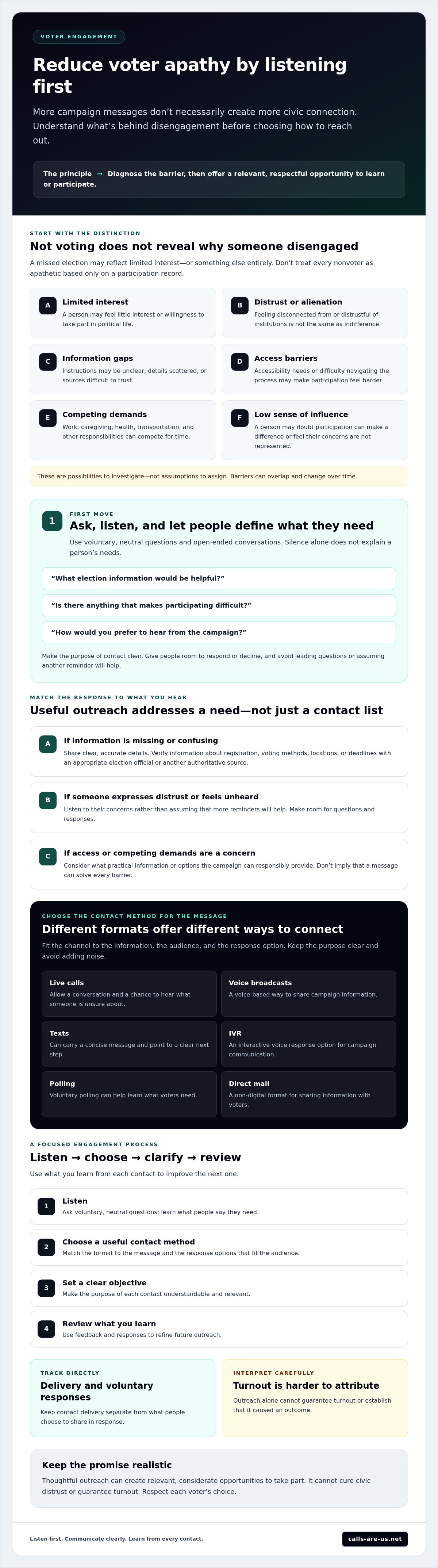
Start with a distinction: not everyone who doesn’t vote is apathetic. A missed election may reflect low interest, but it may also result from distrust, limited information, difficulty accessing the process, or competing demands on someone’s time. Treating every nonvoter the same can lead campaigns to choose the wrong response.
Voter apathy is disengagement from political life, often expressed as limited interest or willingness to participate. This definition leaves room for other explanations for low participation. Political apathy is also distinct from political alienation: feeling disconnected from or distrustful of institutions doesn’t necessarily mean a person feels indifferent. For campaigns, reducing voter apathy means learning what’s behind disengagement and offering relevant, respectful opportunities to learn or participate, not simply increasing message volume.
How Is Voter Apathy Different From Not Voting?
Voting behavior alone doesn’t reveal a person’s motivation, values, or beliefs. Someone may want to participate but lack clear information about how or when to do so. Another person may feel their concerns aren’t represented, distrust political institutions, or be balancing work, caregiving, health, and other responsibilities. These circumstances can overlap and change over time.
That’s why campaigns shouldn’t label nonvoters as uninterested based only on a participation record. A person’s stated lack of interest is one possible signal; a practical or informational obstacle calls for a different response. Ask, listen, and let people describe their own needs before deciding what may be causing disengagement.
Why Does Voter Engagement Matter Beyond Election Day?
Engagement is about more than casting a ballot. People need opportunities to understand choices, raise concerns, and feel that their perspectives can be heard. Thoughtful contact can help by sharing useful information, inviting questions, or offering a clear way to respond. A live conversation, for example, can make room to hear what someone is unsure about, while a concise message can point them toward a next step.
Respect matters. Make the purpose of each contact clear, give people space to respond or decline, and avoid implying that outreach alone can repair distrust or guarantee turnout. The aim is to make participation more understandable and approachable while recognizing that the decision belongs to each voter.
Let the diagnosis guide the response. If people need information, clarify it. If they express distrust, listen rather than assume another reminder will help. If access or competing demands stand in the way, consider what practical information or options your campaign can responsibly provide. This groundwork makes later outreach more relevant and respectful.
What Causes Voter Apathy, and How Can Campaigns Diagnose It?
Disengagement has more than one possible cause. A voter may doubt that participation can make a difference, feel that campaign messages don’t address their concerns, distrust political institutions, or struggle to find clear and accessible election information. Work, caregiving, health, transportation, and other responsibilities can also compete for time. These are possibilities to investigate, not assumptions to assign to a person or group.
Diagnose the barrier before choosing the channel: the right outreach depends on what voters say they need, not what a campaign guesses they need. Reducing voter apathy starts with finding out whether people want clearer information, a chance to ask questions, a more relevant conversation, or something communication alone can’t resolve.
Which Barriers Can Make Participation Feel Difficult?
Election information can be hard to use when instructions are unclear, details are scattered, or a voter isn’t sure which source to trust. Accessibility needs and competing responsibilities may create other challenges. Campaigns can make their own information easier to understand, but shouldn’t imply that a message will solve every practical barrier or replace official election guidance.
Before sharing details about registration, voting methods, locations, or deadlines, verify them with the appropriate election official or another authoritative source. For guidance on making voter materials clearer and more useful, consult the Center for Civic Design’s voter information best practices. Clear, accurate information can help address confusion, but it won’t automatically resolve distrust or lack of time.
How Can Organizers Listen Before They Message?
Ask neutral, voluntary questions that leave room for honest answers: “What election information would be helpful?” “Is there anything that makes participating difficult?” “How would you prefer to hear from the campaign?” Avoid leading questions that assume someone is frustrated, uninformed, or unwilling to vote. Open-ended answers can reveal needs that a fixed-choice survey may miss.
Polling, IVR feedback, and structured live conversations can help organizers collect and compare responses. Treat each as one input, not a complete account of voter sentiment. Responses may reflect who chose to participate and how a question was framed, so combine feedback with careful human judgment. For practical guidance on structured voter conversations, see political campaign call center guidance.
Group findings by what people actually say they need or prefer, such as election details, opportunities to ask questions, or less frequent contact. Don’t infer preferences from age, location, or other broad categories without evidence. Campaigns considering polling, live calling, or messaging can explore voter communication services as tools for gathering feedback and sharing information, while keeping listening and judgment at the center of the plan.
Which Voter Outreach Approaches Build Engagement Without Adding Noise?
More contact doesn’t automatically mean more trust or interest. A channel works best when it fits the voter’s needs: how much detail they want, whether they want to respond, and what format works for them. To reduce voter apathy, choose the purpose first, then the communication method.
Each option can play a different role:
Live calls: Create space for questions, nuanced responses, and listening. Use them when a conversation matters more than simply delivering a reminder.
Voice broadcasts: Share consistent recorded information with an audience for whom listening to a message is a suitable format.
Peer-to-peer texts: Support direct exchanges when recipients may want to reply or ask a question.
Mass texts: Deliver concise, timely updates to a broader audience. Keep each message focused and verify permissions and applicable requirements before sending.
Direct mail: Give voters a physical piece they can review at their own pace. This can suit information that needs more context than a short message can provide.
Campaigns planning recorded calls can review political voice broadcasting guidance. For a broader view of coordinating campaign communications, see this mass communication strategy guide.
When Should a Campaign Use Live Calls, Voice Broadcasts, or Texts?
Use a live call when a voter’s answer could shape what happens next. Choose a voice broadcast for a straightforward update that doesn’t require a personal exchange. Texts can work for brief information or replies, provided the audience welcomes that format and the campaign checks permissions and applicable requirements. No channel is best in every situation. Match the method to the purpose of the contact and the audience’s stated preferences.
How Can Campaigns Make Outreach Feel Relevant and Respectful?
Be clear about who’s contacting the voter and why. Offer a useful next step, such as where to confirm election details or how to share a question, instead of repeating a generic appeal. Respect stated contact preferences, avoid unnecessary repetition, and make each message earn its place. A coordinated mix of calls, texts, broadcasts, and mail can offer options without sending every person the same message through every channel.
Before choosing a format, define what the contact should accomplish and how a voter can respond, if a response is appropriate. Campaigns assessing options such as live calling, texting, voice broadcasts, and direct mail can explore voter communication services as possible tools, not substitutes for relevance, trust, or careful listening.
How to Build a Practical Plan for Reducing Voter Apathy
A useful outreach plan gives every contact a reason to exist. Instead of measuring success by how many messages a campaign sends, define the need, choose a suitable response, and learn from what happens. This keeps reducing voter apathy grounded in voter needs, not assumptions about what a campaign should say.
Define the audience need. Use what voters have shared to identify a specific gap, such as uncertainty about an election detail or a desire to ask a question. Don’t treat broad demographic categories as proof of what people need.
Listen before planning. Invite voluntary feedback through polling, open-ended conversations, or another appropriate method. Explain the purpose and consider whose perspectives may be missing from the responses.
Choose a channel. Match the format to the task: a live call for a conversation, a concise text for a brief update, or direct mail when people may benefit from more space to review information. Consider accessibility and stated contact preferences.
Make the contact useful. Identify the campaign, explain why it’s reaching out, and provide accurate, understandable information. Include an appropriate way to ask a question or respond, and verify election details with an official source before sharing them.
Review and adjust. Examine questions, replies, opt-outs, and signs of confusion. Use those observations to improve the next contact, and record what changed and why.
For a broader framework that connects research, channel choices, and campaign goals, explore this guide to voter outreach strategy planning.
How Should a Campaign Set an Outreach Objective?
Choose an outcome the contact can reasonably support and the team can observe. That might mean answering a common question, inviting an informed reply, or sharing details about an event. Separate communication outputs from voter behavior outcomes: sending a message or answering a question doesn’t prove that outreach changed turnout. Don’t promise a specific turnout increase without reliable evidence.
How Can Teams Test and Improve Their Outreach?
Before broader delivery, review a draft with a small, appropriate audience to check whether the purpose and next step are clear. After contact, look for unanswered questions, opt-outs, and feedback that suggests confusion or fatigue. Document what the team learned and changed, so each follow-up reflects new information rather than repeating the same appeal.
Campaigns looking to coordinate voter contact across live calling, texting, voice broadcasts, IVR, polling, or direct mail can explore communication options for campaigns. Choose tools to support a thoughtful plan, not as a substitute for listening or a guarantee of participation.
How Can Campaigns Sustain Engagement and Know What Is Working?
Measure what outreach can show, and be careful about what it can’t. Delivery and response data can help a campaign understand whether communication reached people and prompted useful interaction. Turnout is a more complex outcome, influenced by factors beyond any single contact. Contact metrics alone can’t prove that outreach caused a change in voting behavior.
To sustain engagement, review results against the purpose of each contact and the preferences voters have expressed. Assess a message intended to answer a question differently from one inviting a reply. Use what people tell you to refine future communication, not as a reason to contact them more often by default.
What Should Campaigns Measure After Outreach?
Define each measure in advance so the team interprets results consistently. Depending on the channel and objective, useful signals may include:
Delivery: whether the message was delivered or the call connected, where that information is available.
Responses: voluntary replies, completed feedback, or questions received.
Opt-outs: requests to stop receiving contact, which can signal that preferences need closer attention.
Recurring questions: topics that suggest information is unclear or missing.
Compare those signals with the stated objective and audience preferences. If the goal was to clarify an election detail, for example, assess whether people asked fewer follow-up questions or reported that the information answered their concern. Treat this as evidence about communication, not proof of a turnout effect. Keep definitions and review periods consistent so comparisons remain useful.
Where Can Communication Services Support the Plan?
Different channels can help deliver information or invite responses as part of a coordinated plan. Voice broadcasts can share recorded updates, texts can carry concise messages or support replies, and live calling can make room for conversation. IVR can offer a structured way to collect responses, while direct mail gives voters a physical format to review. Choose according to the communication need and the audience’s stated preferences, then review the feedback.
Calls-Are-Us provides communication services that can support voter contact. These tools can help campaigns deliver information and gather responses, but they don’t resolve structural barriers or guarantee participation. Keep human judgment central: review what voters share, make appropriate adjustments, and avoid treating volume as a measure of trust.
If your campaign is assessing options for coordinated voter communication, explore Calls-Are-Us communication services as a possible part of its outreach plan.
Make Your Next Voter Contact More Meaningful
Reducing voter apathy begins with understanding what may be behind disengagement. Low interest, distrust, unclear information, and practical barriers call for different responses, so listen before deciding what to send. Then choose a channel and a clear purpose that respect voters’ needs and preferences.
Keep learning after each contact. Review delivery and responses, notice recurring questions or opt-outs, and refine your approach without treating message volume as success or assuming outreach alone will increase turnout.
Calls-Are-Us offers voice broadcast, peer-to-peer and mass texting, live calling, IVR, polling, and direct mail to support coordinated voter communication. These services can help campaigns share information and invite responses, while trust-building and human judgment remain central to the work.
Explore communication services that can support your voter outreach plan. With thoughtful listening and respectful follow-through, your campaign can create more meaningful opportunities for people to engage.
Frequently Asked Questions
Can voter apathy be reduced?
Yes, campaigns can address some forms of disengagement, but outreach can’t guarantee participation or resolve every underlying cause. Start by finding out whether people need clearer information, a chance to ask questions, or a more relevant conversation. If practical barriers or distrust are involved, acknowledge them rather than assuming another reminder will help. Reducing voter apathy is an ongoing effort to make civic information and opportunities to engage more useful and respectful.
What causes voter apathy?
Voter apathy can reflect low interest, but disengagement may also stem from distrust, a sense that participation won’t make a difference, limited information, or competing responsibilities. Unclear election details or accessibility needs can make taking part more difficult without indicating indifference. These factors may overlap and differ from person to person. Campaigns should ask neutral questions and listen to voluntary feedback instead of assigning reasons based on someone’s age, location, or other assumptions.
How can campaigns engage apathetic voters?
Begin with respectful listening, then offer information or a next step that responds to what voters say they need. A live call may help when someone wants a conversation; a concise text may suit a brief update, while direct mail can provide space to review details. Make the sender and purpose clear, respect contact preferences, and avoid repetitive generic appeals. Engagement should invite participation without pressuring people or promising a particular result.
Does more voter outreach increase turnout?
Not necessarily. More messages can increase exposure, but message volume alone doesn’t establish trust, answer a voter’s question, or prove that outreach changed turnout. Define a useful objective for each contact, such as sharing verified election information or inviting voluntary feedback. Then assess delivery and responses against that objective. Treat turnout as a broader outcome that can be influenced by factors beyond a single campaign contact, not as a guaranteed result of more outreach.
Which communication channel works best for voter outreach?
There isn’t one best channel for every audience or purpose. Live calling can support conversation, voice broadcasts can share recorded information, and peer-to-peer or mass texting can deliver concise updates or invite replies. Direct mail offers a physical format, while IVR can collect structured responses. Choose based on what voters say they prefer, the detail they need, and whether they should be able to respond. A coordinated mix can provide options without contacting everyone through every channel.
How do you measure voter engagement?
Track measures that fit the outreach objective, such as delivery, voluntary replies, questions received, opt-outs, or whether recurring questions suggest confusion. Define each measure consistently and compare results with audience preferences. These indicators help assess communication and reveal what voters may need next. They don’t, by themselves, show that outreach caused a change in turnout. Keep contact metrics separate from voter behavior outcomes and use the findings to refine future messages.
Is voter apathy the same as voter suppression?
No. Voter apathy describes disengagement or limited interest in political participation. Voter suppression refers more broadly to actions or barriers that hinder people from participating; it isn’t simply a lack of motivation. The concepts can intersect if a person’s experience with barriers contributes to disengagement, but they aren’t interchangeable. Campaigns should avoid labeling someone apathetic based only on nonparticipation and should direct questions about election access to appropriate official sources.



Comments