
Risks of Using Volunteer Phone Banks for Voter Outreach

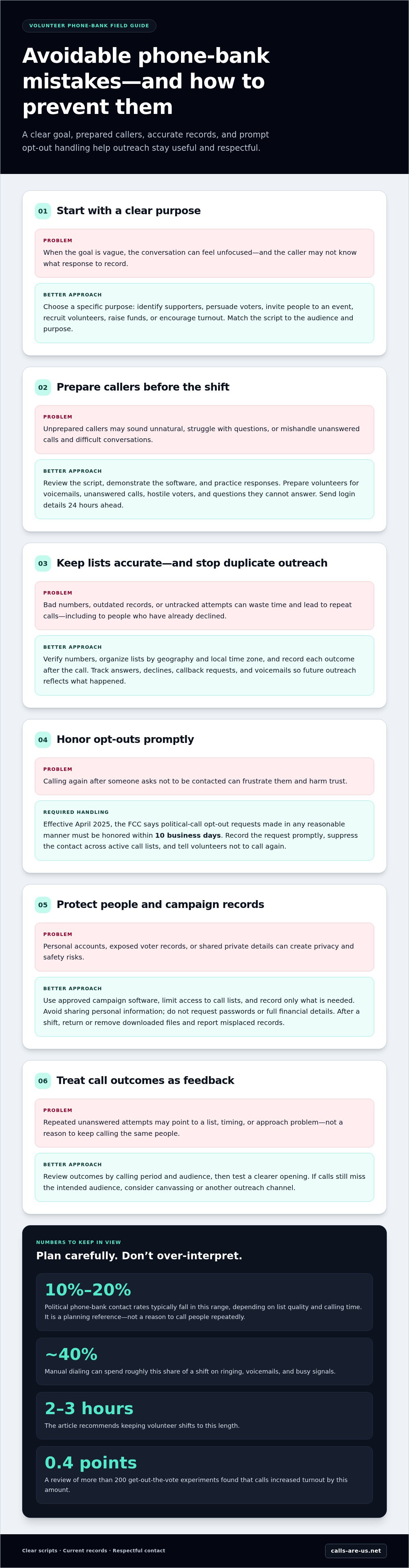
Volunteer phone banks can still support voter outreach: a review of more than 200 get-out-the-vote experiments found that calls increased turnout by 0.4 points. The risks of using volunteer phone banks include inaccurate call lists, inconsistent conversations, and repeated calls to people who have already been contacted or opted out. Effective April 2025, campaigns must honor political-call opt-out requests made in any reasonable manner within 10 business days, according to the Federal Communications Commission.
Volunteer callers can identify supporters, persuade voters, invite people to events, recruit volunteers, and raise funds. But results depend on more than enthusiasm: callers need training, clear scripts, accurate records, and carefully managed lists.
This article explains how phone banks support outreach and where they can go wrong. You’ll learn how to prevent avoidable mistakes, honor opt-out requests, and manage repeat contacts so conversations build trust rather than undermine it.
Table of Contents
1. Phone banking for voter outreach, fundraising, and persuasion
Volunteer phone banking turns campaign supporters into direct voter outreach teams. Campaigns use calls to identify supporters, persuade undecided voters, invite people to events, recruit volunteers, raise funds, and encourage turnout. A caller may ask about a voter’s priorities, share an approved message, then record the response.
Phone banking works best when the goal is clear and the call list is accurate. Organizers can sort lists by geography and local time zone, then match each script to its audience. A supporter-identification script, for example, might ask whether someone plans to vote; a fundraising script should make a clear donation request.
Training shapes the conversation. Set aside time to review the script, demonstrate the software, and practice responses. Prepare callers for voicemails, hostile voters, unanswered calls, and questions they cannot answer. A virtual phone bank can let volunteers enter responses directly into the campaign’s voter records.
Volunteer and paid phone banks differ in direct labor costs, consistency, and results. Volunteers can reduce payroll needs, while paid callers may offer more consistent staffing; neither approach guarantees reliable data or voter response. A review of more than 200 GOTV experiments found phone calls increased turnout by 0.4 points.
For personal safety, use the campaign’s calling platform and avoid sharing private information. Planned Parenthood Advocates of Iowa uses technology that allows volunteers to call without displaying their personal number. Don’t disclose a home address or personal account details, and never request sensitive information such as passwords or full financial details.
Set up the phone bank before the shift begins. Verify numbers, distinguish mobile phones from landlines for TCPA compliance, and send login details 24 hours ahead. Use a dialer or campaign software to route calls and capture outcomes. After every conversation, record the result so future outreach reflects what the voter said.
Volunteer calling might not work well when lists contain bad numbers, scripts feel unnatural, or callers lack preparation. Manual dialing can spend roughly 40% of a shift on ringing, voicemails, and busy signals. Keep shifts to two or three hours, and use another outreach method when phone contact repeatedly misses the intended voters.
2. Calling opted-out or previously called contacts
Respecting a voter’s request is essential to responsible phone banking. Effective April 2025, campaigns must honor political-call opt-out requests made in any reasonable manner within 10 business days, according to the Federal Communications Commission. Record the request promptly, suppress that contact across active call lists, and tell volunteers not to call again.
The Telephone Consumer Protection Act (TCPA) restricts calls to cell phones using an Automatic Telephone Dialing System (ATDS) or prerecorded messages without prior express consent. State rules may also apply, so campaigns should consider the jurisdictions they call and the technology they use. Before an election outreach shift, review the calling method, list, and script against those requirements.
Repeated calls can frustrate supporters and harm a candidate’s reputation, especially when someone has declined or asked not to be contacted. Give callers a simple way to handle complaints: listen, remain friendly, end the conversation politely, and record the outcome. Don’t pressure anyone who declines to engage.
Privacy risks arise when volunteers expose voter records or store campaign data in personal accounts. Limit access to call lists, use approved software, and record only what is needed for voter contact. After each shift, return or remove downloaded files and report misplaced records to the campaign lead.
Track every attempt. Record whether someone answered, declined, requested a callback, or went to voicemail; these outcomes help prevent duplicate calls and refine targeting. Political phone-bank contact rates typically range from 10% to 20% of dials, depending on list quality and calling time. Treat that range as a planning reference, not a reason to call the same people repeatedly.
Caller ID can affect whether voters answer. A local area code may sometimes help calls get answered, while repeated unanswered attempts may indicate a problem with the list, timing, or approach. Review outcomes by calling period and audience, then test a clearer opening. If phone outreach still isn’t reaching the intended audience, consider canvassing or another channel.
To reduce legal, privacy, and operational risks, organizers can suppress opt-outs before each shift, provide approved scripts, restrict list access, and review call records afterward. For campaigns that need structured support with calling, explore campaign calling support.
Calls-Are-Us: Voice Broadcast
Calls-Are-Us provides Voice Broadcast for campaigns that need to deliver a consistent recorded message. It can complement volunteer conversations when a campaign needs to share a clear update, while volunteers focus on individual voter questions and feedback.
Choose a channel that fits the task: Peer-to-peer texting supports personal exchanges, Mass Texting distributes messages, and a Live Calling Center provides live calling support. Whichever method you use, keep contact lists current and honor opt-out requests.
Visit Calls-Are-Us to learn more about Voice Broadcast.
Build a More Deliberate Outreach Plan
Plan the next campaign’s outreach around the experience you want voters to have, not just the number of calls volunteers can place. Decide which messages need a live conversation, which can be delivered consistently, and how responses from each channel will shape the next step. This structure helps keep outreach relevant and accountable.
The risks of using volunteer phone banks are easier to manage when campaigns treat every contact as part of an ongoing relationship. Calls-Are-Us offers Voice Broadcast, Peer-to-peer texting, and Mass Texting for different communication needs. Choose the approach that fits the message and audience, while keeping contact preferences central to the plan.
If you’re shaping a campaign outreach strategy, contact Calls-Are-Us to discuss your calling needs. A thoughtful plan can help your team communicate with clarity and earn trust at every touchpoint.
Frequently Asked Questions
Does phone banking still work?
Yes, phone banking can still help campaigns reach voters and learn what matters to them. Its value depends on matching each call to a useful purpose, such as hearing a voter’s concern or explaining where to find election information. Measure success by whether conversations produce actionable insights or a meaningful next step, not just completed dials. The risks of using volunteer phone banks are manageable when outreach respects recipients and has a clear goal.



Comments