
TCPA Compliant Calling Solutions: A 2026 Buyer’s Guide

The most feature-packed dialer may be the wrong choice for a campaign. TCPA compliant calling solutions need to support more than efficient outreach: they should fit the campaign’s audience, communication style, consent practices, and day-to-day workflows.
A long feature list does not show how a team will manage consent records, opt-out requests, content approvals, or campaign activity. Nor can a tool take the place of an organization’s compliance responsibilities. To choose well, compare how each solution supports the campaign’s actual workflow, not just what appears in a product description.
This guide provides a practical framework for comparing workflows, oversight, and campaign support. It explains how voice broadcasting, live calling, and interactive voice response can serve different outreach needs, and how Calls-Are-Us supports campaign calling operations. Use it to assess options against your goals, scale, and resources, then involve qualified counsel in reviewing the approach.
Table of Contents
What TCPA compliant calling solutions do, and what they cannot promise
A calling tool can support a responsible process, but it cannot make campaign decisions for you. TCPA compliant calling solutions are best understood as calling workflows and supporting tools that help an organization manage obligations that may apply to its outreach. The phrase describes a goal for how a campaign is planned and run, not a guarantee that every call is lawful.
Technology handles only part of the work. Your organization still needs to make informed decisions about its campaign, audience, message, and oversight, with qualified legal guidance where needed. The Telephone Consumer Protection Act (TCPA) Wikipedia overview provides background on the law and its history. Current obligations depend on campaign details and should be reviewed with qualified counsel.
For another perspective on automated calling, watch this video:
Which calling approaches can a solution support?
Choose a format for the interaction you want, not only for the number of people you hope to reach. Each approach creates a different experience:
Prerecorded voice broadcasts deliver a consistent message to an audience at scale. They can suit campaign updates when the message needs to remain uniform across recipients.
Live-agent calls put a person at the center of the conversation. They suit outreach that may involve questions, discussion, or polling, where callers can respond to what they hear.
Interactive voice response (IVR) guides recipients through a structured interaction, allowing them to respond using keypad or other caller input configured for the campaign.
These formats can serve different needs within one campaign. A broadcast can share information, while live calls or IVR can provide ways for people to respond. Compare the audience, purpose, message, and intended interaction before choosing a format or combining approaches.
Why no single feature guarantees compliance
A feature may help a team follow a process, but it cannot decide whether that process is appropriate. Campaign purpose, audience data, consent decisions, message content, and execution all shape the risk picture. For example, an organization needs to consider whether its audience information is suitable for the campaign and whether the planned communication aligns with its reviewed approach.
Make ownership explicit. Decide who approves campaign content, makes audience and consent decisions, oversees calling activity, and keeps relevant records. A tool may support parts of that work, but people remain accountable for how it is used and for applying legal guidance relevant to their circumstances.
In short: calling solutions can support risk management, but they cannot promise a lawful outcome. Treat vendor capabilities as one part of a broader operating approach, not as a substitute for legal review or organizational oversight. Since requirements can depend on campaign details and change over time, have qualified counsel review the current rules before launch.
How TCPA-related safeguards fit into a calling workflow
Safeguards work best as part of a coordinated process, not as isolated software features. Before launch, connect the campaign’s purpose, audience, message, calling method, and oversight plan. This makes decisions that need review easier to identify and clarifies who is responsible for each step.
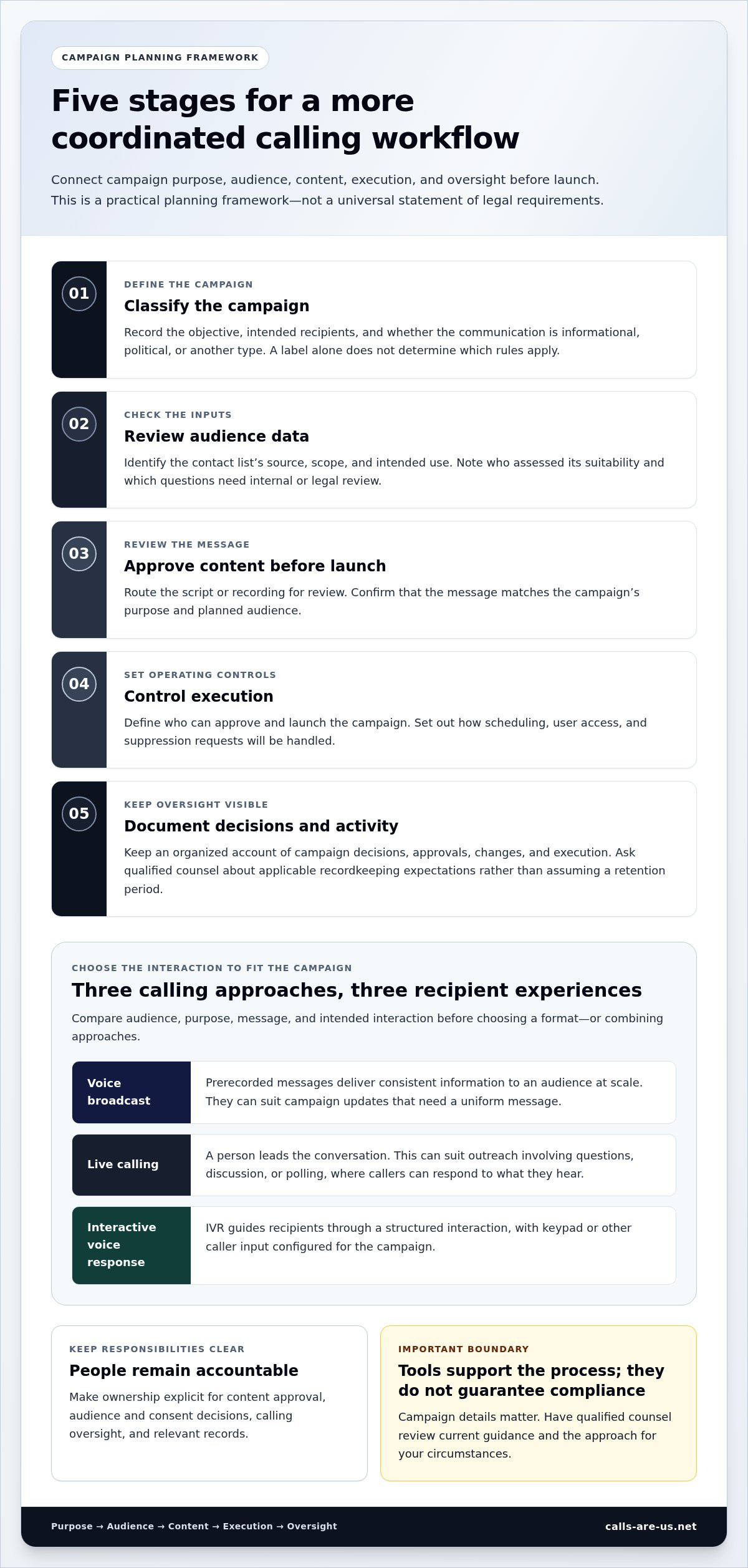
Use this five-stage workflow to organize the work. It is a practical planning framework, not a universal statement of legal requirements. Applicable rules can depend on the campaign and audience, so have qualified counsel review current guidance, including the FCC TCPA Regulations.
Classify the campaign. Record its objective, intended recipients, and whether the communication is informational, political, or another type. A label alone does not determine which rules apply.
Review audience data. Identify the contact list’s source, scope, and intended use. Record who assessed its suitability and which questions need internal or legal review.
Approve content. Route the script or recording for review before launch. Confirm that the message matches the campaign’s purpose and planned audience.
Control execution. Define who can approve and launch the campaign. Set out how scheduling, user access, and suppression requests will be handled.
Document oversight. Keep an organized account of campaign decisions, approvals, changes, and execution. Ask counsel about applicable recordkeeping expectations rather than assuming a retention period.
Prepare the audience, message, and calling purpose
Start with a campaign brief that names the goal, recipients, call type, data source, and intended response. For example, a campaign using a recorded voice broadcast should document why it selected that format and audience. A live-calling effort may need a distinct plan for conversation and polling. Teams planning recorded outreach can also use this political voice broadcasting guide to consider channel-specific planning. Have qualified counsel review the message and any audience restrictions relevant to the campaign.
Make the basis for key decisions visible. Record who supplied or reviewed the audience data, who approved the message, and which questions were escalated. These notes help staff follow a consistent process, especially when plans or materials change before launch.
Manage execution, suppression, and records
Assign a clear owner for permission decisions, suppression requests, and internal do-not-call instructions. Define how requests reach the team managing the campaign, who updates the working audience, and how completion is recorded. Set the process according to current legal guidance and organizational policy.
Then assess whether the calling workflow supports controlled scheduling, appropriate user permissions, and clear campaign records. Those capabilities can help teams execute approved plans and trace decisions, but they do not make decisions on the organization’s behalf. Calls-Are-Us supports campaign outreach through voice broadcasting, live calling, and IVR. Explore campaign calling support as you align a channel with your objectives.
How to compare TCPA compliant calling solutions beyond feature lists
Compare the work a solution helps your team do, not the length of its feature list. Start with the campaign’s actual needs: how audience data is handled, who controls campaign activity, what records are available, and where human support fits. TCPA compliant calling solutions can support different workflows, so ask for clear explanations of responsibilities and limitations rather than relying on a compliance label or broad marketing promise.
Use this framework to structure internal reviews and vendor discussions. It separates process support from campaign delivery, reporting, and people, making gaps easier to identify before launch.
Evaluation area
What to assess
Compliance-support workflows
How audience lists are handled, how suppression requests move through the process, and how campaign permissions are assigned. Clarify which actions the tool supports and which remain your organization’s responsibility.
Campaign operations
How users review message versions, schedule activity, control access, and track campaign changes. Consider whether the workflow fits your team’s approval steps and intended calling volume.
Reporting and records
Review which campaign activity and outcomes can be documented, how reports are accessed, and whether records help your team understand what happened. Align recordkeeping expectations with internal policy and legal guidance.
Human support and implementation
Understand how assistance fits into setup and campaign operations, who handles each task, and what your team needs to prepare. Define ownership rather than making assumptions about support models or controls.
Scale and data handling
Assess whether the process can accommodate your audience and campaign cadence while keeping access, list handling, and oversight manageable as needs change.
Which capabilities should buyers evaluate?
Look for documented workflows, not just feature names. Map the path from audience-list preparation through approvals, execution, and reporting. Identify who can access campaign materials, how staff distinguish approved message versions, and how changes are recorded. Then compare that process with your organization’s policies and clarify which controls staff handle and which the solution supports.
Match the solution to the outreach model
The right format depends on the interaction your campaign needs. Voice broadcasting can deliver a consistent message to a broad audience. Live calling supports human conversations, polling, and nuanced responses. IVR gives callers a structured way to provide input. These approaches are not interchangeable. Compare them by message, audience, desired response, and the operational capacity available to manage each campaign.
Calls-Are-Us offers voice broadcasting, live calling, and IVR as outreach options for distinct communication needs. Explore campaign calling support to consider how a format aligns with your audience, message, and interaction goals. Keep ownership and documented workflows central to the decision.
A practical checklist for selecting and launching a calling solution
A disciplined launch starts before the first call. Use this checklist to turn campaign goals into clear decisions, compare available support, and prepare a review process your team can follow. The aim is not to find a tool that makes decisions for you. It is to select TCPA compliant calling solutions that fit your campaign workflow and make responsibilities easier to manage.
Questions to resolve before choosing a provider
Bring campaign owners and operational stakeholders into the evaluation early. Agree on the audience, message format, desired interaction, timeline, and person authorized to approve key decisions. Then document what the team needs from the calling workflow, including who manages approvals, suppression requests, access, reporting, and post-campaign review.
Use these prompts in vendor conversations and internal reviews:
Campaign fit: Does the proposed format match the audience, message, and response the campaign wants to invite?
Workflow ownership: Who approves content, controls user access, and handles suppression requests or internal do-not-call instructions?
Operational visibility: Can the team review campaign setup, scheduling, activity, and available reports in a way that supports its review process?
Support needs: What help does the team need during implementation and campaign operations, and how does the proposed support fit those needs?
Evaluation criteria: How will the team judge usability, operational fit, visibility, and readiness to manage its planned campaign?
For campaigns involving human callers, plan for practical agent-led outreach needs, such as briefing callers, coordinating campaign timing, and handling responses. The political campaign call center guide offers additional context for planning live-agent operations.
Plan a controlled launch and ongoing review
Start with an appropriately scoped pilot or staged rollout. Define what the initial deployment is meant to test, such as whether staff can follow the approved setup process, access the right campaign information, and interpret available reports. Set internal approval steps before launch, and make sure those responsible for oversight know how to raise concerns.
During the rollout, assign owners to monitor execution, handle responses, and escalate operational issues through the organization’s chosen channels. After each stage, compare what happened with the campaign’s objectives. Look for setup confusion, workflow gaps, incomplete records, or response patterns that may need closer review. Document observations and decisions without assuming a particular outcome or legal conclusion.
Keep the review active beyond launch. Schedule check-ins with qualified legal and operational stakeholders, especially when the campaign’s purpose, audience, messaging, or process changes. Calls-Are-Us supports campaign outreach through voice broadcasting, live calling, and IVR. Explore campaign calling options to align a format with your outreach goals and operational plan.
How Calls-Are-Us supports campaign calling and next steps
Campaign outreach works best when the format serves the message and the people receiving it. Calls-Are-Us provides campaign calling through voice broadcasting, live calling, and interactive voice response (IVR). These services help campaign teams plan how to deliver information and invite a response, while the organization retains responsibility for legal review, audience decisions, and campaign oversight.
That distinction matters when evaluating TCPA compliant calling solutions. Calls-Are-Us supports campaign calling operations, while each organization remains responsible for reviewing the decisions that shape its outreach. Calling services can support a campaign workflow, but they do not replace legal advice or organizational oversight.
Choose the right calling format for the campaign
Begin with the campaign’s communication goal. The format influences whether the outreach is primarily one-way, conversational, or structured around recipient input:
Voice broadcasting delivers a consistent recorded message to an intended audience. It can suit campaign updates when the message needs to be shared uniformly. For planning considerations specific to this channel, explore the political voice broadcasting guide.
Live calling brings a human voice into the interaction. It can support conversations, polling, and personalized voter contact when a campaign wants to hear and respond to what people say.
IVR offers a structured way for recipients to provide input. It can fit information gathering or campaign feedback when callers respond through a defined sequence.
These formats can also complement one another when a campaign has different communication and response needs. For example, a recorded message can share consistent information, while live callers or an IVR interaction can support a separate response objective. Choose based on the audience, message, intended interaction, and the team’s capacity to manage the outreach.
Turn the evaluation into a campaign plan
Bring the practical details into the planning conversation: campaign objective, intended audience, assumptions behind the audience data, proposed message, and timing. Identify who within your organization owns legal review, audience decisions, message approval, and ongoing oversight. Clear responsibilities connect the outreach service to the campaign’s review process.
A useful discussion should clarify the calling format, what the campaign expects to communicate or learn, and how the organization plans to review activity. Calls-Are-Us supports campaign calling through voice broadcasting, live-agent operations, and IVR, with the approach aligned to your outreach goals. Share your campaign needs through a campaign outreach discussion.
Make your next campaign plan actionable
Turn your outreach goals into a focused plan: decide what the audience needs to hear, what kind of response you want to invite, and who will oversee each decision. Bring those priorities into campaign planning alongside the legal review and internal approvals your organization needs. This gives your team a stronger basis for selecting and using TCPA compliant calling solutions responsibly.
Calls-Are-Us helps campaign teams shape calling outreach around their objectives, whether they are considering voice broadcasting, live calling, or IVR. A clear discussion of your campaign’s audience, message, and interaction goals can help identify an approach that fits the work ahead.
Plan your campaign calling approach with Calls-Are-Us and take the next step toward thoughtful, effective outreach.
Frequently Asked Questions
Is any calling solution automatically TCPA compliant?
No. A tool may support campaign processes, but its features and settings cannot determine whether a specific call is appropriate in context. The same calling system might be used for campaigns with different purposes, audiences, or message formats, each requiring its own review. Treat “TCPA compliant” as a description to examine, not a status automatically conferred on the software. Have qualified counsel assess your campaign’s circumstances.
Can a provider guarantee that a campaign will avoid TCPA claims?
No provider can promise that a campaign will avoid claims or guarantee a legal outcome. A provider can deliver calling services or tools, but campaign decisions, audience information, message approvals, and oversight involve the organization running the outreach. Before launch, document who owns those decisions and how concerns will be escalated. Ask qualified counsel to review the campaign’s approach. A vendor’s assurances are not a substitute for that review.
How should an organization evaluate consent records for calling?
Review whether records let your team understand how permission was obtained and what it covered. Depending on your process, useful context may include the source, date, wording presented, phone number, and relevant campaign or sender information. A bare “yes” entry, for example, may be harder to interpret later than a record linked to the form and language the person saw. Ask counsel what evidence is appropriate for your campaign and applicable rules.
Do political calls have the same TCPA requirements as business calls?
Not necessarily, and neither label settles the analysis. The communication’s purpose, technology, recipient, and other circumstances may affect which rules apply. Political outreach may also raise state or other requirements. A campaign should not assume that a political message is automatically exempt or that rules for a commercial call apply unchanged. Have qualified legal counsel review the specific call plan and current federal and state guidance before outreach begins.
What should a calling solution report after a campaign?
Useful reporting should help your team reconstruct activity and improve planning, not just present a headline total. Depending on the system and campaign, review scheduled and completed activity, delivery or connection outcomes, responses, and operational exceptions. Keep context such as the campaign identifier and approved message version alongside the report where available. Decide in advance who reviews the data, what issues require escalation, and how findings will inform the next campaign.
Should I choose voice broadcasting, live agents, or IVR?
Choose based on the interaction you want to create. Voice broadcasting fits a consistent recorded message. Live agents can support conversation, polling, or questions requiring a human response. IVR can collect structured input through caller selections. A campaign might use one format for a specific objective or combine approaches for distinct audience needs. Compare the message, expected response, and team capacity, then have counsel review the planned method in context.



Comments