
The Authoritative Guide to Multi-Channel Campaign Strategy in 2026

Updated: Jul 21
Digital-only outreach is no longer a strategy for growth; it's a recipe for invisibility in an oversaturated market. You've likely felt the sting of declining engagement as your audience retreats from the endless noise of their digital feeds. Between fragmented data silos and the mounting pressure of 2026 regulatory hurdles, like the FCC's strict one-to-one consent rule and 10DLC requirements, reaching your supporters has never been more complex.
Mastering a modern multi-channel campaign strategy requires more than just adding another platform to your stack. It's about building a synchronized engine that layers the personal rapport of a live calling center, the immediate urgency of mass texting, and the tangible anchor of direct mail. This guide provides the blueprint to unify your audience view, ensure your workflows remain compliance-proof, and achieve the high-impact response rates that only true channel synergy can deliver.
Table of Contents
What is a Multi-Channel Campaign Strategy in 2026?
A multi-channel campaign strategy is a synchronized outreach framework that orchestrates voice, text, and mail to establish a persistent presence in the lives of your audience. To understand what is multi-channel marketing in its most potent form, we must look beyond simple message distribution. It's about strategic synchronization. This approach ensures your message isn't just heard once but felt across multiple dimensions of a person's daily life.
Digital-only strategies are a trap. Between aggressive ad-blockers and crushing inbox fatigue, relying solely on screens is a recipe for missed connections. When you limit your outreach to the digital sphere, you compete with an infinite stream of distractions. By integrating offline channels, you break through the noise and claim a space that digital ads simply cannot reach.
To better understand this concept, watch this helpful video:
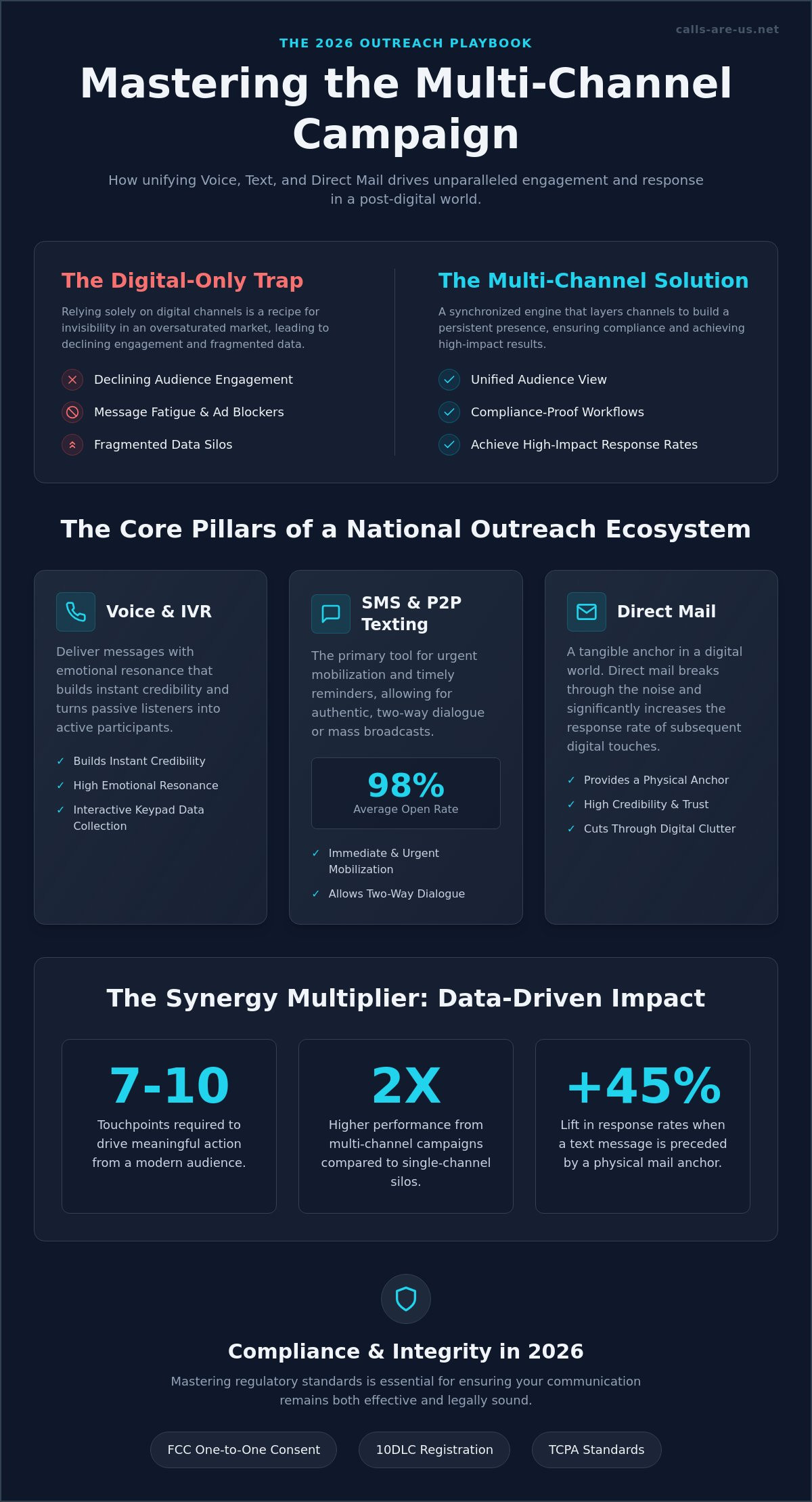
Modern audiences now require 7 to 10 touchpoints before they take significant action. This isn't just about repetition; it's about layering. When you combine the tactile nature of direct mail with the personal rapport of a live calling center, you create a synergy effect. Research shows that multi-channel outreach yields double the performance of single-channel silos. It meets people where they are, rather than where you hope they'll be.
Multi-Channel vs. Omni-Channel: The Strategic Distinction
Many professionals confuse multi-channel with omni-channel, but the distinction is vital for high-stakes advocacy. While omni-channel focuses on a seamless, customer-centric journey, a multi-channel campaign strategy prioritizes rapid mobilization and consistent messaging across diverse platforms. It's about being omnipresent, reliable, and authoritative. This approach allows organizations to build trust with national audiences by delivering a unified message through voice broadcast, peer-to-peer texting, and physical mailers simultaneously.
The ROI of Connectivity
Integrated outreach drives efficiency. By using multiple channels, you lower your cost-per-acquisition because every touchpoint warms up the lead for the next interaction. This creates a "halo effect" where a direct mail piece acts as a tangible anchor that significantly increases the response rate of a subsequent text message. The "synergy multiplier" represents the compounding impact of this layered outreach, where organizations in 2026 see a 45% lift in response rates when a text message is preceded by a physical mail anchor.
The Core Pillars of a National Outreach Ecosystem
Outreach is not a single event. It is a layered ecosystem. To succeed in 2026, you must bridge the gap between digital noise and physical reality. While competitors often focus on ephemeral push notifications, a robust multi-channel campaign strategy utilizes the phone and the mailbox to ground your message. This approach creates a sense of permanence, reliability, and trust by meeting people in the spaces they actually inhabit.
Voice and IVR: The Sound of Authority
Voice carries a weight that text alone cannot replicate. By utilizing political voice broadcasting, you deliver messages with emotional resonance that builds instant credibility. Interactive Voice Response (IVR) systems take this further by turning passive listeners into active participants through keypad data collection. For the best results, keep your messages concise, use a professional yet warm tone, and ensure your call-to-action is unmistakable within the first thirty seconds. This combination of scale and interaction ensures your message is both heard and remembered.
SMS and P2P: The Pulse of Engagement
Texting provides the immediate pulse of your campaign. With open rates consistently hitting 98%, SMS is the primary tool for urgent mobilization and timely reminders. When deciding between P2P vs broadcast texting, consider your goals for engagement versus speed. Peer-to-peer texting allows for authentic, two-way dialogue, while mass texting ensures your message reaches thousands in seconds. Regardless of the method, maintaining 10DLC compliance is non-negotiable to ensure your messages actually land in the recipient's hand without being blocked by carriers.
Persuasion requires a human touch. Live Calling Centers remain the gold standard for building rapport because they allow for real-time objection handling and personal connection. This human element works in tandem with direct mail, which serves as the tactile anchor of your outreach. A physical mailer stays in the home, sits on the counter, and reinforces the digital and telephonic touches. This integrated approach is the foundation of a sophisticated omnichannel marketing strategy that respects the reader's time while maximizing impact. If you are ready to synchronize these channels, you can explore how integrated outreach tools streamline your national coordination.
Orchestrating the Sequence: 5 Steps to Multi-Channel Success
Strategy without sequence is just noise. To execute a high-impact multi-channel campaign strategy, you must move beyond scattershot tactics and embrace a deliberate, phased approach. This ensures your message builds momentum rather than causing fatigue. By coordinating your tools, you transform individual messages into a unified narrative engine that captures attention across every touchpoint.
Step 1: Audience Segmentation. Analyze your national dataset to identify channel preferences. Some demographics respond to voice; others prioritize text.
Step 2: The Tangible Anchor. Launch with direct mail. This physical presence establishes credibility before you ever ring a phone or send a notification.
Step 3: The Digital Echo. Follow up with mass texting. Use the 98% open rate to drive immediate traffic or signatures while the mailer is still on the recipient's counter.
Step 4: The Personal Touch. Deploy live agents for high-value persuasion. This is where rapport is built, objections are handled, and voter IDs are secured.
Step 5: The Feedback Loop. Use IVR and polling to measure sentiment. This real-time data allows you to pivot the narrative and adjust your resources instantly.
Timing and Cadence: The 'Pulse' Strategy
Timing is the heartbeat of effective outreach. Spacing touchpoints across a 14-day cycle prevents over-saturation and respects the recipient's boundaries. A proven tactic is timing a voice broadcast to land exactly 48 hours after a mailer arrives. This "hook-and-elaborate" style ensures the message remains consistent while the medium changes, moving the recipient toward a customer-centric omnichannel marketing experience. When you respect the rhythm of your audience, your outreach feels like a helpful reminder rather than an intrusion.
Tactile Priming: Why Mail Still Matters
Physical mail remains a cornerstone of high-stakes influence. Integrating a political direct mail strategy allows you to reach households that have opted out of digital tracking or use aggressive ad-blockers. There is a profound psychological impact in holding a campaign message; it feels more permanent and trustworthy than a flickering screen. Using union printers further signals your core values, building deep trust with specific demographics who value labor integrity and social responsibility. This tactile anchor provides the weight necessary to make your digital and voice efforts truly stick.
Compliance and Integrity in 2026 Communications
Compliance is the bedrock of any sustainable multi-channel campaign strategy. In an era of heightened regulatory scrutiny, ignoring legal standards is a risk no organization can afford to take. With TCPA violations carrying fines between $500 and $1,500 per individual contact, a single non-compliant campaign can result in liabilities reaching millions of dollars. Protecting your mission requires a rigorous commitment to legal integrity, operational transparency, and data privacy.
The regulatory landscape shifted significantly at the start of the year. The FCC's "One-to-One Consent" rule, which went into effect in January 2026, closed the lead-generator loophole by requiring specific consent for every individual brand. Marketers must also navigate a patchwork of new state-level privacy laws in Indiana, Kentucky, and Rhode Island. As of 2026, twelve states also require businesses to honor Global Privacy Control (GPC) browser signals as valid opt-outs. By adopting a "Safe Harbor" approach and partnering with specialized providers, you reduce legal risk while maintaining the momentum of your outreach.
The 10DLC Compliance Roadmap
Registration is mandatory for all campaign text messaging. To ensure your messages reach the handset, you must navigate the 10DLC and A2P registration process with absolute precision. This involves verifying your brand identity, stating your specific use case, and maintaining high-quality message content that avoids carrier filtering. Vetted providers play a critical role in this process. They provide the technical infrastructure and regulatory expertise needed to manage these complex workflows, ensuring your communication remains uninterrupted, professional, and effective.
Ethical Outreach: Beyond the Regulations
Integrity goes beyond mere legal compliance. Building a voter outreach strategy that respects the human-centric core of communication is essential for long-term trust. This means implementing "stop" and "opt-out" mechanisms that work within the mandated 10 business days, as required by the FCC rule that became effective in April 2025. You should maintain a professional and polished register in every voice broadcast to avoid being perceived as spam. When you prioritize ethical engagement, you foster deeper connections and protect your reputation. To safeguard your next initiative, you can consult with our compliance team to ensure your outreach remains fully protected.
Scaling Your Impact with Calls-Are-Us
Scaling a movement requires more than just high-volume tools. It demands a partner that understands the intricate dance between voice, text, and mail. By consolidating your outreach through a single visionary partner, you eliminate the friction of fragmented data silos and ensure your message remains consistent across every medium. This integration is the core of a successful multi-channel campaign strategy, allowing you to move from simple broadcasting to genuine mobilization.
Our commitment goes beyond technology. We believe in fostering meaningful interactions and championing a philosophy of open, inclusive dialogue. Whether you are leveraging our political campaign call center for professional live interaction or deploying a high-volume mass communication strategy, our team ensures your mission carries the weight of authority and the warmth of human connection.
National Scale, Personal Impact
Precision at scale is our standard. We have operated in over 40 states, delivering consistent quality and compliance-proof workflows regardless of the campaign's geographic reach. Our technology stack is built for speed, allowing for rapid deployment in emergency scenarios or high-stakes election cycles where every hour counts. To further enhance this scale with a personal touch, Kym Ali Consulting offers AI-powered solutions that provide human-like interactions for stakeholders. A partnership with Calls-Are-Us transforms fragmented outreach into a single, unstoppable engine of influence.
Expert Support for High-Stakes Missions
Master the Future of National Outreach
Success in 2026 requires a departure from fragmented, digital-only tactics. By unifying the personal touch of live calling with the tactile impact of direct mail and the urgency of mass texting, you create a campaign engine that cannot be ignored. This synchronized multi-channel campaign strategy ensures your message cuts through the noise while remaining firmly grounded in 2026 regulatory standards. You don't have to choose between scale and sincerity; you can achieve both through deliberate orchestration.
Navigating the complexities of TCPA and 10DLC compliance shouldn't slow your momentum. Partnering with a specialist allows you to focus on your mission while we handle the technical orchestration. Voted #1 for National Outreach Reliability, Calls-Are-Us provides the expertise and infrastructure, including union-printed direct mail services, to scale your impact across the country. We are ready to help you turn passive lists into active, engaged communities through ethical and effective communication.
Launch Your High-Impact Multi-Channel Strategy with Calls-Are-Us Today
Your audience is waiting for a connection that feels authentic, reliable, and meaningful. Let's build it together.
Frequently Asked Questions
What is the most effective channel for a multi-channel campaign in 2026?
The most effective channel is never a single silo, but rather the strategic integration of live calling for rapport and direct mail for permanence. While digital channels offer reach, the human-centric nature of a live calling center provides the highest conversion for complex persuasion. Combining these tools creates a persistent presence that respects the recipient's time while maximizing impact across your entire audience.
How many channels should a national advocacy campaign use simultaneously?
A successful national advocacy campaign should utilize at least three to four primary channels simultaneously. This typically includes a mix of voice broadcast, peer-to-peer texting, and direct mail to achieve the necessary 7 to 10 touchpoints required for action in 2026. Spreading your message across multiple platforms ensures you reach supporters regardless of their digital habits or specific channel preferences.
Is direct mail still effective when combined with digital outreach?
Direct mail remains incredibly effective because it serves as a tangible anchor in an increasingly ephemeral digital world. When a physical mailer lands in a home, it creates a sense of credibility and trust that reinforces your digital ads and text messages. This tactile connection often drives a significant lift in response rates for subsequent digital outreach by providing a physical reminder of your message.
What are the current 10DLC requirements for political text messaging?
Political text messaging in 2026 requires strict 10DLC registration, which includes brand verification, campaign vetting, and specific use-case registration. You must register your organization with mobile carriers to ensure high deliverability and avoid aggressive spam filtering. Working with a specialized provider streamlines this mandatory process and protects your ability to reach voters reliably on their mobile devices without interruption.
How do I measure the ROI of a multi-channel campaign strategy?
You measure the ROI of a multi-channel campaign strategy by analyzing the combined cost-per-acquisition and the "halo effect" across all touchpoints. Rather than looking at channels in isolation, you should focus on how the presence of one channel, like direct mail, improves the conversion rate of another, like mass texting. This holistic view reveals the true efficiency and synergy of your integrated outreach ecosystem.
Can I use voice broadcasting for emergency notifications as well as marketing?
Voice broadcast is an ideal tool for emergency notifications due to its speed, reliability, and immediate reach across national datasets. It allows you to deliver critical, time-sensitive information to thousands of people in seconds, making it a staple for public safety. This same technology supports your marketing efforts by providing a scalable way to deliver consistent, authoritative messaging that demands immediate attention.
What is the difference between P2P and mass texting for engagement?
Peer-to-peer (P2P) texting is designed for authentic, two-way engagement, while mass texting is optimized for high-volume information delivery and rapid mobilization. P2P allows your team to answer specific questions and build personal rapport with individuals on a one-to-one basis. Conversely, mass texting provides the speed and scale necessary for urgent calls to action or widespread campaign updates sent to your entire list.
How do I ensure my campaign calls are TCPA compliant?
Ensuring TCPA compliance requires obtaining specific one-to-one consent and maintaining a robust opt-out management system that honors requests within 10 business days. As of 2026, the FCC requires businesses to obtain consent for each specific brand, closing previous lead-generation loopholes. Utilizing scrubbed lists and working with a provider that specializes in these regulatory standards protects your organization from the risk of non-compliant communication.


Comments