
The Hidden Costs of Political Robocalls: What Campaigns Should Budget For

A low per-call rate can make a political robocall campaign look cheaper than it really is. A quote may cover message delivery, but not the work around it: preparing contact data, coordinating outreach, monitoring responses, and planning for compliance and voter trust. Those are the hidden costs of political robocalls that can reshape a campaign budget.
Starting with cost per call makes sense. It’s easy to compare, and automated voice outreach can help campaigns reach people at scale. But a fair comparison looks at what each dollar supports and whether the contact advances the campaign’s goal.
This article will help you build a fuller budget before choosing an approach. You’ll see how operational demands, compliance planning, and the voter experience affect the value of voice broadcasting, then compare it with live calling, texting, IVR, and direct mail. Use consistent objectives and measurement criteria to build an outreach plan that balances reach, relevance, and responsible communication.
Table of Contents
What the Hidden Costs of Political Robocalls Really Include
A quoted service rate is useful, but it doesn’t show every resource needed to plan, prepare, and evaluate outreach. The hidden costs of political robocalls include indirect expenses, staff time, risks, and trade-offs that may sit outside a headline rate. They don’t automatically mean a quote is incomplete. They point to the wider work campaigns should account for.
A robocall’s total campaign cost includes more than message delivery. A quote may cover a defined service, while campaign staff handle tasks such as setting the outreach objective, preparing audience data, reviewing the message, coordinating timing, and assessing results. The exact work depends on the campaign’s scope, audience, and purpose.
For context on the broader subject of robocalling, watch this video:
Direct expenses versus indirect campaign costs
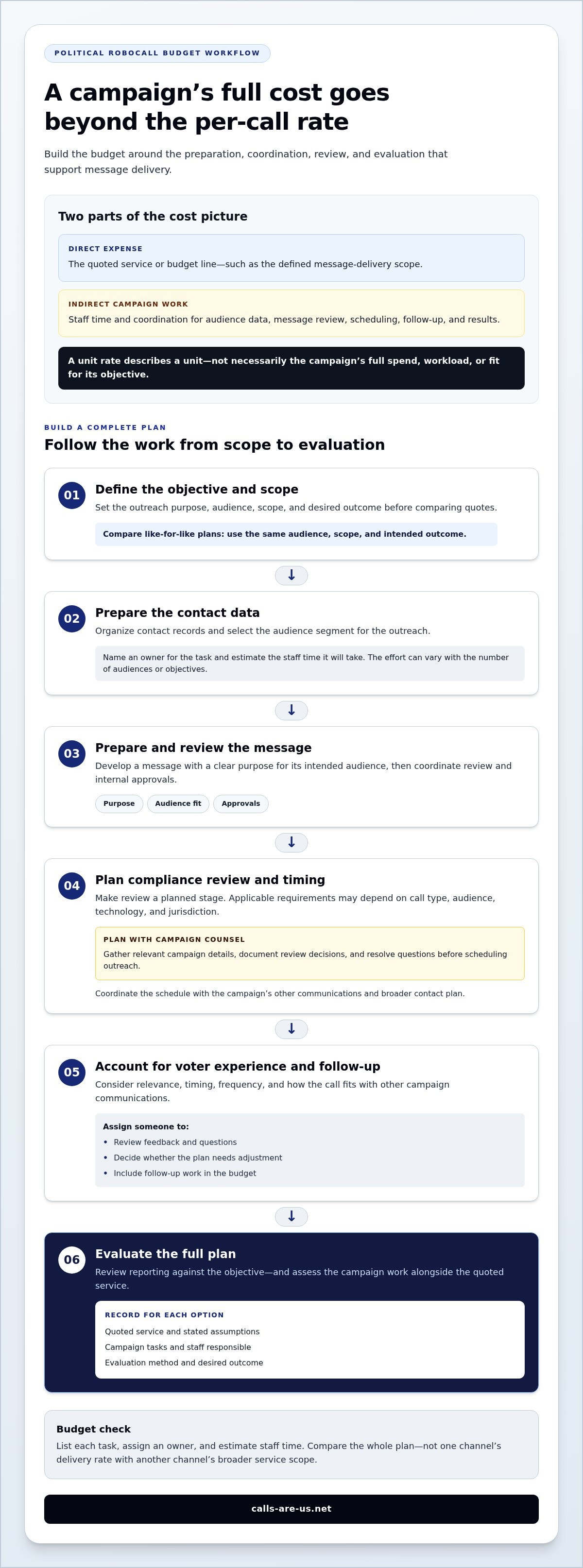
Direct expenses are items shown in a quote or budget line. Indirect costs often sit within the campaign’s workflow, spread across staff time and coordination instead of appearing as a separate charge. Tracking both helps teams distinguish what the service covers from what they need to organize internally.
For example, staff may need to organize contact records, select an audience segment, prepare and approve the message, coordinate the schedule, and review reporting afterward. The effort varies. A focused outreach wave may require less coordination than a campaign with multiple audiences or objectives. List each task, assign an owner, and estimate the staff time it will take.
Why a low per-call rate may not settle the decision
A per-call rate describes a unit, not necessarily the full campaign spend or workload. Total cost depends on the agreed scope and the preparation and evaluation the campaign plans to undertake. A low unit rate may matter, but it can’t tell you on its own whether the approach fits the audience or supports the objective.
Make comparisons consistent. Evaluate options against the same audience, outreach scope, and desired outcome, then include the campaign-side work each requires. Compare like-for-like plans rather than weighing one channel’s delivery rate against another channel’s broader service scope. Read the quote to identify its stated inclusions and assumptions, rather than presuming what the rate leaves out.
A planning worksheet makes the full picture easier to see. For each option, record the quoted service, campaign tasks, staff responsible, and evaluation method. This gives the team a more useful basis for budgeting than a unit rate alone, while keeping operational demands and voter experience in view.
The Operational, Compliance, and Trust Costs Campaigns Should Consider
A campaign plan needs to account for more than getting a message ready to send. Coordination, compliance review, and voter experience all affect the effort required to use political robocalls responsibly. These considerations don’t guarantee a particular result, but they influence how much preparation a team needs and what it chooses to measure.
The hidden costs of political robocalls can include work shared across several roles. A data lead, communications staff, campaign counsel, and decision-makers may each need to review a different part of the plan. Assign owners early to identify dependencies, avoid last-minute rework, and build a realistic schedule.
Compliance preparation belongs in the campaign plan
Make compliance review a planned stage, not an afterthought. Applicable requirements may depend on factors such as call type, audience, technology, and jurisdiction, so campaigns should review their specific plans with qualified campaign counsel. This section isn’t a legal determination; detailed questions belong in a focused review of the campaign’s circumstances.
Build time into the workflow to gather relevant campaign details, document review decisions, and resolve questions before scheduling outreach. The political call compliance checklist offers a practical starting point for organizing that preparation. Counsel can assess how applicable requirements relate to the campaign’s actual plan.
Voter experience can carry a strategic cost
Reach alone doesn’t define a successful contact. Message relevance, timing, frequency, and audience fit influence how outreach may be received. A message that feels poorly timed or unrelated to recipients’ concerns can undermine the respectful communication a campaign wants to establish. Treat these as planning choices, not guaranteed predictors of voter behavior.
Before scheduling a call, check that the message has a clear purpose for its audience and that the timing fits the broader contact plan. Decide who will handle feedback or questions, since negative reactions may require staff follow-up. Include that work in the budget, even if the volume or nature of responses is unknown.
Audience fit: Connect the message to a defined outreach objective and recipient group.
Coordination: Consider how the timing and frequency fit with other campaign communications.
Follow-up: Assign someone to review feedback and decide whether the plan needs adjustment.
These steps make trust part of operational planning rather than an assumption about any one channel. Campaigns using voice broadcast alongside live calling, texting, IVR, polling, or direct mail can set a shared objective and communication calendar to clarify each channel’s role. A coordinated voter outreach plan can help align those choices with audience needs and internal capacity.
Political Robocalls Versus Other Voter-Contact Channels
No single channel serves every campaign objective. A recorded voice message delivers consistent wording, while live calls allow conversation and written messages give recipients something they can revisit. The right mix depends on the campaign’s goal, the quality of its data, and audience preferences. Compare channels by the work they support, not by a universal ranking.
Use the table as a planning framework. Audience fit and measurement options depend on campaign design and the information available.
When automated voice messages may fit a campaign objective
Voice broadcast may fit a broad announcement or reminder when a campaign wants to deliver consistent recorded wording to a defined audience. Consistency can support a clear, focused message, but doesn’t guarantee that people receive, listen to, or act on it. Consider audience fit and message relevance, and decide in advance how the team will assess the effort.
For more detail on the format and workflow, the political voice broadcasting guide can help teams consider how this channel fits their plan.
When human interaction or another channel may be preferable
Choose the channel based on the interaction the objective requires. Live callers can support conversations that call for listening or follow-up. Texting offers a written format, while direct mail provides a physical piece recipients can review later. Each option brings different preparation and evaluation needs, so compare them against the same audience and goal.
This comparison also clarifies the hidden costs of political robocalls: a channel’s practical value depends on the campaign work around it, not just its format. Define the desired outcome, check the audience data, and decide what evidence will inform the next outreach decision.
How to Audit the Full Cost of a Political Robocall Campaign
A useful campaign audit turns a headline quote into a complete plan. It shows what the provider handles, what campaign staff must do, and how the team will judge whether the outreach served its purpose. The hidden costs of political robocalls are easier to manage when you document assumptions before comparing options, rather than reconstructing the workload afterward.
Compare outreach options using the same audience, objective, scope, and measurement window. That like-for-like view helps decision-makers see meaningful differences without treating one channel’s unit rate as a complete budget.
Use a step-by-step campaign audit
Define the goal. State what the outreach should accomplish, such as delivering an announcement or inviting a response. A specific objective gives the team a basis for selecting the audience and evaluating the effort.
Map what the quote includes. Record the service scope and operational support described in the proposal. Note assumptions about audience size, message handling, delivery plan, and reporting so decision-makers can distinguish included work from campaign responsibilities.
Identify campaign-side tasks. Assign ownership for data preparation, message development and review, scheduling, approvals, and follow-up. Track staff time for each task alongside provider charges. Internal work still takes resources, even when it doesn’t appear on an invoice.
Set evaluation criteria. Choose measures that reflect the objective and can be assessed consistently. Decide what information the team will review, who will review it, and when the evaluation period ends.
Separate setup from each outreach wave
Not every task repeats at the same pace. A campaign may complete some preparation once, while other work changes with each audience segment or outreach wave. Separate the two in your worksheet: group initial planning and setup, then list repeatable tasks such as adapting a message, preparing a segment, scheduling activity, and reviewing results for each wave. This makes workload visible instead of hiding it in a combined estimate.
For each option, capture the audience size, message scope, delivery plan, and operational support. Then list the people responsible for each campaign task. Flag assumptions that need resolution, such as which audience records will be used or what reporting will inform the evaluation. Align the scope before comparing proposals, so a difference in assumptions doesn’t look like a difference in value.
Measure value with context
One metric rarely tells the whole story. Depending on the goal, a campaign might track completed contacts or captured responses alongside staff time and follow-up activity. These measures describe parts of the outreach process, but they don’t prove that a specific channel caused a broader political outcome. Keep attribution limits clear.
Review results using the same measurement window and criteria for each outreach option. Note what the team learned about audience fit, message relevance, and operational effort, then use those findings to shape future decisions. Calls-Are-Us supports campaigns coordinating voice broadcast with other voter-contact methods. Plan your campaign outreach with objectives, channel roles, and evaluation in view.
Plan Political Robocalls as Part of a Coordinated Outreach Strategy
A sound outreach plan gives every channel a clear job. Define the campaign objective, identify the audience, choose a suitable communication method, assign operational responsibilities, and decide how to evaluate the effort. This turns cost awareness into practical decisions while keeping message relevance and voter experience in view.
Coordination doesn’t mean using every available method. It means choosing channels for specific purposes, avoiding unnecessary overlap, and making sure the team can manage the work attached to each choice. A recorded announcement, a conversation, and a written message each create a different kind of contact.
Match each communication method to a clear job
Start with the kind of communication the objective calls for. Voice broadcast can deliver a consistent recorded announcement when that format fits the audience and purpose. Live calling supports human conversations, while Interactive Voice Response (IVR) can collect structured responses. Texting and direct mail offer written formats with distinct planning needs. These methods can complement calls, but combining them doesn’t guarantee additional impact.
Voice broadcast: Consider it for a recorded announcement or reminder intended for a defined audience.
Live calling: Use it when the campaign objective calls for a person-to-person conversation or follow-up.
IVR: Consider it when the plan needs a structured way to collect responses.
Peer-to-peer or mass texting: Match the written-message approach to the audience, purpose, and planned interaction.
Polling: Use it to gather information that can inform campaign planning and communication priorities.
Direct mail: Consider a physical written format when the message suits a piece recipients can review on their own schedule.
The right mix depends on the goal, available data, and audience preferences. A reminder and a request for feedback may call for different methods, even when aimed at the same group. Treat channel selection as a strategic choice, not a race to maximize the number of contacts.
Turn cost awareness into a practical campaign plan
Before launch, put the plan in writing. Document what the outreach should accomplish, who the audience is, what each channel will do, who owns preparation and approvals, which assumptions need review, and how results will be assessed. This gives staff and decision-makers a shared reference point and makes responsibilities easier to track.
Calls-Are-Us supports outreach through voice broadcast, live calling center operations, peer-to-peer and mass texting, IVR, polling, and direct mail. Calls-Are-Us serves clients nationally across the United States and can support campaign teams as they consider how these capabilities fit their voter-contact plan. Explore Calls-Are-Us campaign communication services to align outreach needs with campaign objectives.
The hidden costs of political robocalls are easier to account for when voice outreach sits within a broader plan. Clear roles, realistic preparation, and consistent measurement help campaigns make deliberate choices that balance scale with relevant, responsible communication.
Make Your Next Outreach Decision With Confidence
A campaign budget can do more than control spending. Use it to clarify what the team wants voters to hear, how it hopes to connect, and what it will learn from each outreach effort. That turns the hidden costs of political robocalls into practical planning considerations, not last-minute surprises.
Before committing to a plan, bring the people responsible for communications, operations, and evaluation together around the same objectives. Agree on the audience, each channel’s role, staff responsibilities, and how the team will review results. Use what you learn to refine future outreach rather than assuming one approach will fit every campaign or audience.
Calls-Are-Us can help campaigns plan voice broadcast, IVR, live calling, texting, polling, and direct mail as parts of a coordinated communication strategy. Explore campaign communication services from Calls-Are-Us to plan outreach around your campaign’s objectives and voter-contact needs.
Frequently Asked Questions
What are the hidden costs of political robocalls?
The hidden costs of political robocalls are campaign resources and trade-offs that may not appear in a delivery quote. For example, changing a message after approval can require renewed review and coordination, while dividing an audience into groups may mean organizing each segment separately. Include these tasks in planning, along with time for handling voter feedback, so your estimate reflects the work surrounding the calls.
Are political robocalls cheaper than live calls?
Not necessarily when you compare the full effort rather than the delivery method alone. An automated message and a live conversation do different jobs, so a fair comparison depends on the audience, purpose, scope, and staff work involved. If a campaign needs callers to listen and respond to individual concerns, a recorded message may not meet that objective, even if its delivery quote appears lower.
Do political robocalls have to comply with the TCPA?
Political purpose shouldn’t be treated as a blanket exemption from the TCPA. How the law applies can depend on the call, technology, audience, and circumstances, so campaigns should have qualified counsel review their specific plan before outreach. Don’t rely on a general summary as legal advice. Counsel can help identify which requirements are relevant to the proposed campaign and how to document the review.
Can political robocalls hurt a campaign’s reputation?
They can, particularly if recipients find the message irrelevant, poorly timed, or difficult to understand. That risk isn’t unique to recorded calls, and negative reactions aren’t inevitable. Before outreach, ask someone unfamiliar with the script to listen for clarity, confirm the message has a clear purpose for its intended audience, and decide who will review feedback. These steps help the campaign respond thoughtfully if concerns arise.
How should a campaign compare robocall quotes?
Ask each proposal to describe its work and deliverables in practical terms. Review how the quote treats revised recordings, separate audience groups, additional outreach waves, reporting, and coordination with campaign staff. Then compare those details with your internal task estimates. This helps surface differences in assumptions or scope before approval, without presuming that a low or high rate includes particular work.
What is a cost-effective alternative to political robocalls?
There’s no single alternative that’s cost-effective for every campaign; the best fit depends on the task and audience. Live calling may suit a goal that requires conversation, while texting can carry a concise written message and direct mail can provide a physical piece. If the campaign needs structured responses, IVR or polling may fit the objective. Compare total effort and usefulness, not price alone.



Comments